The Avengers: Under Siege reading order is eight issues of Avengers (volume 1), #270 to 277, published from August 1986 to March 1987 by Marvel: Roger Stern writing, John Buscema drawing, Tom Palmer inking the opening issue, and Baron Helmut Zemo leading a new team of Masters of Evil. Start with the handful of issues before it (#263-269) to meet the lineup, then read the eight issues in one sitting, then finish Roger Stern's run with #278-279.
The event isn't a crossover: it unfolds almost entirely inside a single series, with no central miniseries and no dozens of tie-ins. That makes it a pleasure to shelve and simple to read in order. This guide covers what comes before, what makes up the arc, and what follows it.
As always on this site, we only state verified facts (creators, issue numbers, dates); the analysis is our own, with no reproduction of protected pages or dialogue.
What to read first
No prior miniseries is required to jump into issues 270 to 277: the arc opens in the regular series, and writer Roger Stern, who wrote Avengers #227 to 279 and then #281 to 287, continues work he began long before. Three reads still put you in a good position.
The first is the period of the series immediately before it, starting with issue 263. Those issues set up the lineup that will come under attack, built around Captain America, Hercules and the Black Knight, and it's better to have met them a few issues before the siege. A reader who enters at #270 will follow the story, but will feel less of what the mansion means to the team.
The second is Baron Zemo's own file. The future leader of the Masters makes his debut in December 1973, in Captain America #168, where Roy Thomas, Jenny Blake Isabella and Sal Buscema bring him on stage under the Phoenix mask; his father, Heinrich, already carried the title of baron. Our Baron Zemo selection gives you the useful landmarks to understand the grudge behind his plan.
The third is background reading. If you're new to the series, the Avengers reading guide places the Stern era in the bigger picture, and the Captain America reading guide shows why the team's leader is the baron's primary target.
Spoiler warning: the arc attacks the team head-on, and some characters come out of it diminished. The sections below avoid the details, but the reading order itself hints that the mansion doesn't come out unscathed.
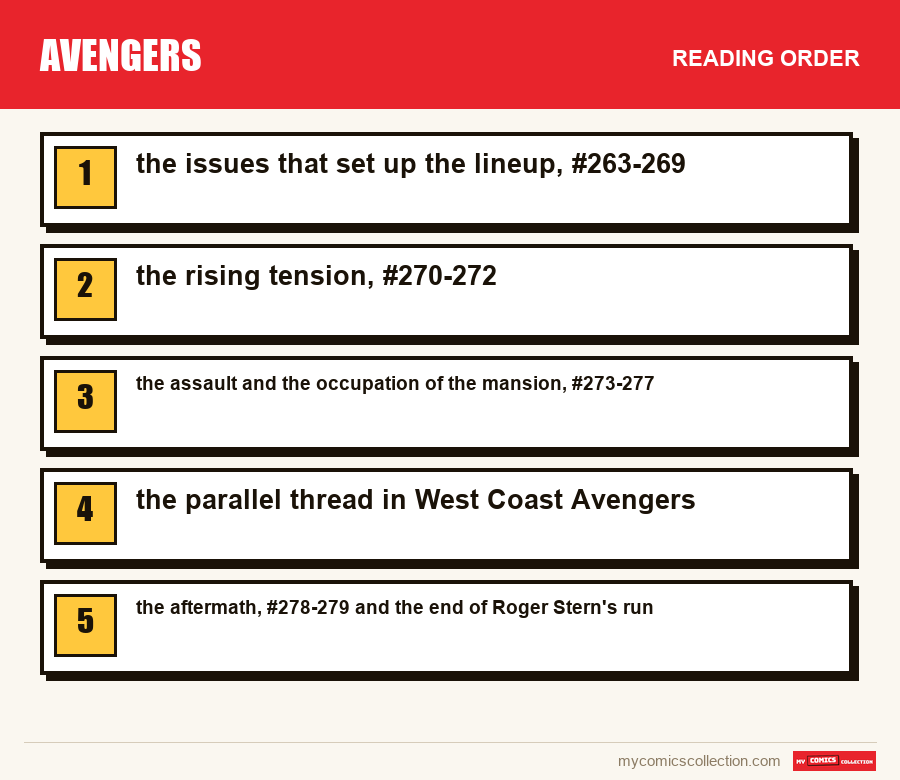
Phase 1: the issues that set up the lineup, #263-269
This phase is optional if you only want the arc, but recommended if you want to feel the group's dynamic. John Buscema has drawn the series since issue 255, and his style is already settled by the time the #263 lineup takes shape. Here you meet the team that will be attacked, with its frictions and its habits.
Read these seven issues as a warm-up: the goal isn't to remember everything, but to notice who lives at the mansion, who leaves and who comes back. One structuring detail: the characters you follow in these issues are the ones you'll find again during the assault. That continuity serves the story, because what a member endures is measured against what they had brought to the group for months.
If you have a collected edition, check where it starts: some add part of these preparatory issues before the arc, while others open directly on #270.
Phase 2: the rising tension, #270-272
Issues 270 to 272, published from August to October 1986, open the Roger Stern story that readers know as Under Siege. For our purposes, they set up the threat: Baron Helmut Zemo builds a team of Masters of Evil to strike Captain America through the Avengers and to overwhelm the team with numbers and brute force.
The makeup of this team is what you need to remember. Zemo's Masters bring together Absorbing Man, Blackout, Black Mamba, Fixer, Goliath, Grey Gargoyle, Mister Hyde, Moonstone, Screaming Mimi, Tiger Shark, Titania, Whirlwind and Yellowjacket, joined by the four members of the Wrecking Crew: Bulldozer, Piledriver, Thunderball and Wrecker. The list is long, and it's a detective's pleasure to spot, issue after issue, who joins the gang and in what order.
Read these three issues slowly. The writer works like a countdown: each setup panel finds its echo later, and the assault of the following issues wouldn't have the same force without this slow buildup. John Buscema, who draws the series from #255 to #279, then from #281 to #300, gives this buildup remarkable clarity for such a large cast.
Phase 3: the assault and the occupation of the mansion, #273-277
From issue 273 (November 1986) to issue 277 (March 1987), the Masters of Evil storm the Avengers mansion and occupy it. This is the heart of the event, and the reason it's called a siege: the place that serves as the team's headquarters becomes the battleground.
Spoiler warning: Hercules is beaten into a coma, the butler Edwin Jarvis is gravely wounded, and Zemo captures Captain America and the Black Knight. The baron then faces Captain America and falls from the mansion's roof. We won't detail more of what each character goes through, because the tension of these five issues depends on the unexpected.
A tip for this phase: read straight through, without interruption, in one or two sittings. The story was published month by month, but it's written to be followed in a single breath, and the five issues flow without a narrative pause. If you prefer to read them in small batches, break between #274 and #275 rather than in the middle of an issue: that way you keep one movement before and one after.
Phase 4: the parallel thread in West Coast Avengers
West Coast Avengers #16, cover-dated January 1987, is among the appearances of Baron Zemo's fourth Masters of Evil lineup, alongside Avengers issues 270 to 277. This issue therefore belongs to the same thread as the main arc, and it's read as a complement, not a prerequisite: Roger Stern's story is self-contained, but anyone hunting for every appearance of this team will want to take a look.
A collector's note for this phase: don't go looking for a second central series. There's no parallel miniseries here in the manner of a big crossover, and the list of companion reads comes down to a single title: that's one of the strengths of this siege for anyone who wants to read it without chasing scattered single issues.
Do you collect this series?
Track what you own, what you are missing and what your collection is worth. 7-day trial.
Start my trial →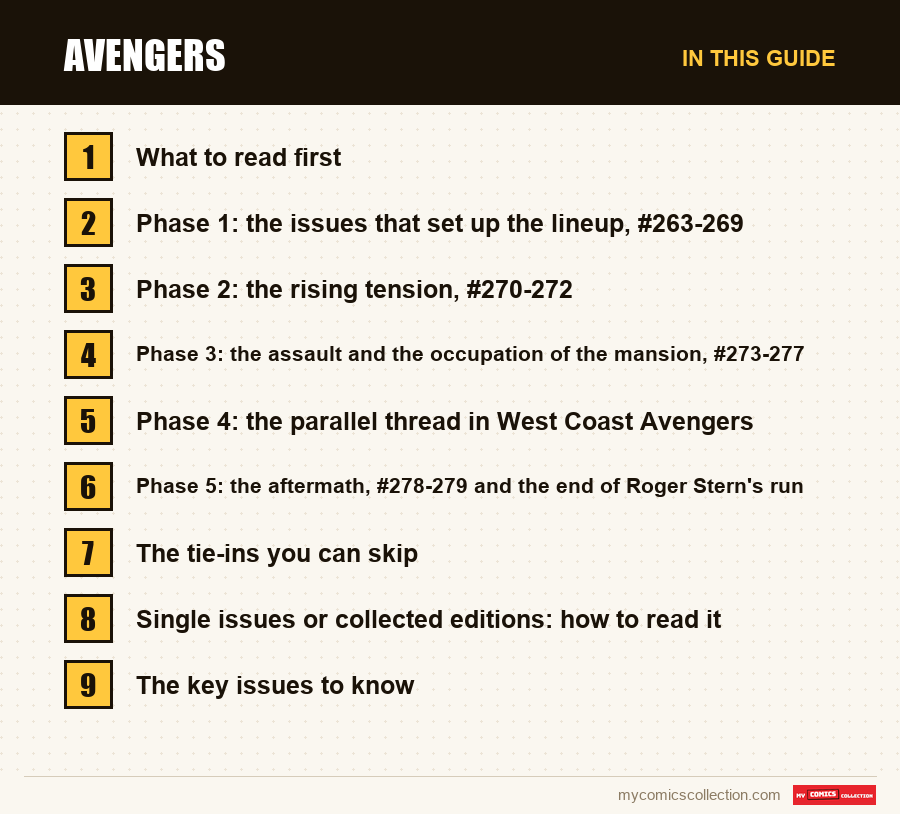
Phase 5: the aftermath, #278-279 and the end of Roger Stern's run
After issue 277, Roger Stern still writes issues 278 and 279, then, after a gap, issues 281 to 287 as well as Annuals #13 and 14. His run ends following a dispute with editor Mark Gruenwald over upcoming stories. John Buscema stays on art through #279, then returns for #281 to #300.
For reading purposes, the consequence is simple: continue with #278 and #279 as long as you want to stay in the same frame of mind, since they're by the same creative team. If you'd rather stop at the end of the arc, #277 is the natural stopping point.
The historical overview of the Avengers will help you place this period in the long run, and the article on the major artists of the series shows what John Buscema means in the lineage of the team's artists.
The tie-ins you can skip
The tie-in question settles quickly: there's almost no companion issue you need to buy to read Under Siege. The only title we associate with this period is West Coast Avengers #16, mentioned above. It's optional, not because it's weak, but because the main arc tells you everything you need to follow the plot.
Issues #263 to #269 are also optional, strictly speaking: you can read the arc without them. We recommend them to anyone who wants the background, not to anyone who only wants the event. As for the period that follows, #278 and beyond, it's more a run read than a tie-in, and it's read in the continuity of the series.
If a collected edition of Under Siege promises other issues as extras, always compare its contents to the issues listed here before adding them to your order.
Single issues or collected editions: how to read it
You have two routes. The original single issues, Avengers #270 to 277, make a compact stack of eight issues, easy to spot in a sale box or on a shelf. It's the choice of the collector who likes to hold the 1986-1987 releases as they came out.
Collected editions, for their part, have the advantage of gathering the eight issues in one volume. Their scope varies from one edition to another: some stick to issues 270 to 277, while others reach further back into the Roger Stern and John Buscema period to give the team's context. Choose depending on whether you want the context or just the event.
A simple method for any collected edition: note the series issue numbers shown on the back or in the contents, compare them to the list in the recap below, then write down what's missing. This habit keeps you from buying the same material twice and from discovering, too late, that an issue sits outside the book.
A word on reading separate issues: the condition of a copy matters less than the completeness of the sequence. Build the full run from #270 to #277 first, then upgrade copies one by one if you wish. Our Avengers collecting guide details this kind of approach.
The key issues to know
The notion of a key issue should be handled carefully with this event: the arc builds on existing characters, and collector value is judged by content rather than by a first appearance. Here are the useful landmarks all the same.
- Avengers #270: the opening issue of the arc, the one you look for first when assembling a complete sequence.
- Avengers #273 to #277: the issues where the mansion is overrun, and so the ones that concentrate the narrative interest; #277 closes the arc and is sought after for that reason.
- Captain America #168 (December 1973): the appearance of Helmut Zemo as Phoenix, a reference for understanding the character who leads the assault.
- West Coast Avengers #16: the complement mentioned above, for anyone who wants to gather every appearance of this Masters of Evil lineup.
Our evaluation method doesn't change: we compare the actual condition of the copy to completed sales, we check whether the spine and corners are clean, and we don't buy an issue solely because it belongs to a well-known event. To see which ones find buyers, our pages on Avengers annuals and special issues give an idea of how demand builds.
Recap: the complete reading order
- Avengers #263-269: the lineup in place (background reading, optional).
- Avengers #270-272: the threat takes shape, August to October 1986.
- Avengers #273-277: the assault and occupation of the mansion, November 1986 to March 1987.
- West Coast Avengers #16: the complement tied to Zemo's Masters (optional).
- Avengers #278-279: the immediate follow-up under the same team, Roger Stern and John Buscema.
Frequently asked questions
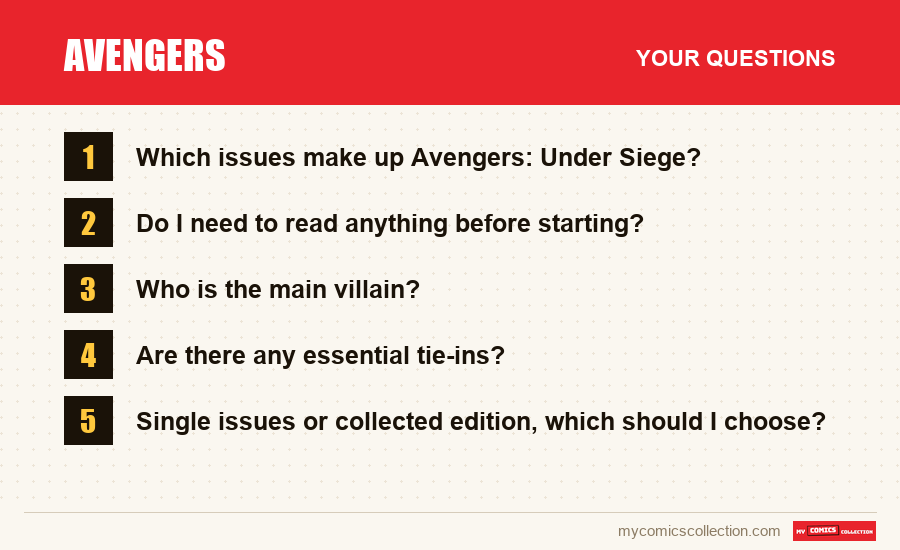
The arc is issues 270 to 277 of the Avengers series, published from August 1986 to March 1987. Roger Stern writes, John Buscema draws. Tom Palmer inks the opening issue, and the story reads straight through in eight issues.
Nothing is required. If you want to know the team being attacked, read issues 263 to 269, where you already follow Captain America, Hercules and the Black Knight before the assault. That background reading gives the assault more weight, but the arc can be followed without it.
Baron Helmut Zemo, who forms a fourth team of Masters of Evil to strike Captain America through the Avengers. His first appearance goes back to Captain America #168, dated late 1973, where he wears a different costume. Our selection on the character helps you trace his path.
No. The only title we tie to this thread is West Coast Avengers #16, linked to Zemo's Masters, and it remains optional. The Roger Stern and John Buscema story stands on its own, with no central miniseries and no long companion list to track down.
Single issues appeal to anyone who likes the original 1986-1987 releases; a collected edition gathers the eight issues with no hunting. Check its contents: pick an edition limited to issues 270 to 277 for the arc alone, or a wider one if you also want the issues leading up to it.
Do you own Avengers #270 to 277 or West Coast Avengers #16? Get the condition and value of your copies appraised before completing the sequence.
Estimate my comic