Avengers: Secret Wars is expected on December 17, 2027, one year to the day after Avengers: Doomsday (December 18, 2026). As of October 1st, 2026, fifteen months therefore remain. At this distance, three things are solid: the announced date, the directors, and the fact that the title refers to two very different paper series, the one of 1984-1985 (12 issues, Jim Shooter) and the one of 2015 (9 issues, Jonathan Hickman). Everything else is hypothesis. Since nobody knows which of the two sources the film will follow, it is impossible to name today the issues that will matter. What is defensible at fifteen months is to read, to map and to prepare. What is not, is to buy now issues chosen on a script guess.
Fifteen months is an unusual length of time in collecting. Buying decisions are generally made a few weeks before an event, sometimes a few days when a trailer drops. Here, the horizon is so distant that the usual landmarks no longer work: there is no trailer, no synopsis, not even the certainty that the film will tell what its title suggests.
This article therefore tells neither the story of Battleworld, nor that of the 1984 tournament, nor that of Emperor Doom. Other guides on the site cover that, and better. It deals with a different problem, rarely posed frankly: what can you rationally do fifteen months before a release, and where exactly does the bet begin? The answer is not "nothing", but it is not "buy early" either.
The case is all the more interesting because it is uncomfortable. We have a title, a date, directors, and a stated source ambiguity. It is precisely the kind of configuration where anticipation turns, without our noticing, into speculation disguised as method.
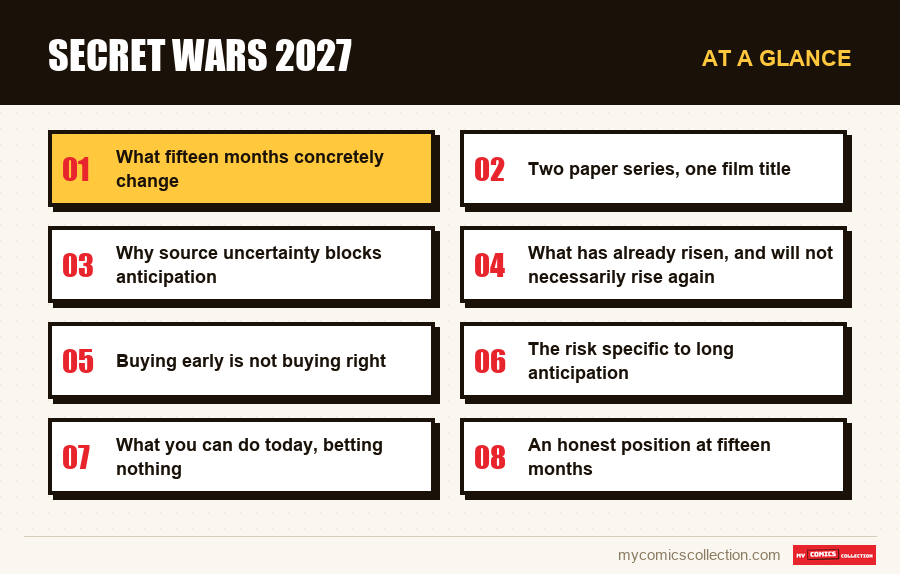
What fifteen months concretely change
Short anticipation and long anticipation do not play on the same ground. Three weeks before a release, information is almost complete: the film's content is known in broad strokes, the characters are identified, and the collector's work is to arbitrate between a price that has already risen and a scarcity that has already been measured. The risk is financial, not informational.
At fifteen months, it is the opposite. Prices have not yet factored in the film, and that is seductive. But information is lacking to such a degree that any targeted decision rests on conjecture. In other words: the price advantage is real, the information advantage is nil, and the second often cancels the first.
There is a third difference, less obvious and more important. At three weeks, the film exists: it is shot, edited, dated, and its content will no longer move. At fifteen months, the film is still an object under construction, whose title, cast, date and even subject can evolve. We will see below that this is not a theoretical worry.
Here, then, is the question to ask before any spending: does my purchase depend on what the film will tell? If yes, you have to wait. If no, it can be made today, and it will often be better today than in November 2027.
Two paper series, one film title
The central difficulty of this file fits in one sentence: the title Secret Wars designates two distinct stories, separated by thirty years, which have in common only their name and a world made of pieces. Confusing them is the starting error; believing you can guess which will be adapted is the next one.
Marvel Super-Heroes Secret Wars (1984-1985)
Script by Jim Shooter, art by Mike Zeck and Bob Layton, inks by John Beatty. The setup is simple and spectacular: an outside entity, the Beyonder, gathers heroes and villains on a composite world and pits them against each other. The series was born from a partnership with a toy manufacturer, and its title itself owes much to a reception study among children, who reacted well to the words "secret" and "wars". It sold massively.
Secret Wars (2015)
Script by Jonathan Hickman, art by Esad Ribić, colors by Ive Svorcina. Nothing of a tournament: it is the destruction of the multiverse by collisions between universes, then its recomposition into a stitched-together world over which Doctor Doom rules as god-emperor, after capturing a power that did not belong to him. The Molecule Man holds a keystone function there. The series extends several years of the same writer's work on the Avengers titles, including the arc titled Time Runs Out.
The two stories do not pose the same dramatic question. One asks "who wins?", the other "who has the right to decide what exists?". The first is a confrontation, the second a theology. A film can borrow from one, from the other, or compose: keep the iconography of the 1984 fragmented world and the power logic of 2015, for example. Nothing in what has been made public allows a decision.
Why source uncertainty blocks anticipation
You might think this ambiguity is a scholarly detail. It has on the contrary very practical consequences, because the two sources do not designate the same collectibles at all.
If the film relies on the 1984 series, attention will go to a tournament, to a broad cast of classic heroes, to the organizing entity, and to the documented fallout of the series in the titles of the time. The issues concerned are old, often already expensive, and their scarcity has been known for a long time.
If the film relies on the 2015 series, the center of gravity shifts toward comics of the previous decade: the building of the stitched-together world, the figures who live only in this frame, and a whole set of spin-off series published on the margins. These are recent objects, printed in quantity, whose price guide depends more on demand than on scarcity.
These two scenarios therefore lead to opposite strategies: in one case, buy expensive and rare; in the other, buy abundant and cheap. There is no middle position that is good in both cases. Buying "a bit of both" simply amounts to paying twice to be right once.
There is a second, more perverse effect. As soon as a source hypothesis circulates, it begins to look like information. You read that a film "will draw on" a story, and this sentence, repeated, ends up being treated as fact. It is exactly the mechanism that, in previous cycles, led people to buy issues chosen because of characters who ultimately did not appear on screen. The only protection is to distinguish, in writing, what is announced by the studio from what is deduced by readers.
Operational consequence: at fifteen months, source uncertainty forbids any purchase targeted at the film's content. It does, however, forbid no purchase justified by something else, and that is the whole difference.
What has already risen, and will not necessarily rise again
A point that long anticipation often forgets: part of the market movement has already taken place. The Doom cycle did not begin in 2026. It began when the studio announced, at the July 2024 Comic-Con, that the December 2026 film would be called Avengers: Doomsday and that Robert Downey Jr. would play the character in it. Then it resumed on March 26, 2025, the day a very broad cast was announced.
In other words, two waves of attention have already occurred on the file's most obvious issues, in particular those tied to the character's first appearance. For anyone discovering the subject today, this means something simple: you are not arriving early, you are arriving after two major announcements. The idea of being "very early" is an optical illusion created by the date of the second film.
This observation leads to another. The issues already reassessed by the Doomsday cycle will not mechanically benefit from a second movement in 2027. A rise occurs when demand meets constrained supply; it does not repeat simply because another film comes out. An issue already sought-after, already expensive, already out of the reserves of those who held it, mathematically has less fuel available for a second climb. What rises twice, in general, are pieces whose scarcity was not dented by the first wave.
A rule for reading the market can be drawn from this, valid beyond this case: an announcement raises what is identifiable, not what is important. Easy-to-name issues rise quickly and early. Those that require knowing the story rise later, less strongly, and sometimes never. For anyone anticipating at fifteen months, the interesting ground is therefore that of pieces nobody has yet had reason to name, which brings us back, inevitably, to the fact that we do not know which source will be adapted.
Buying early is not buying right
The confusion between the two is the heart of the problem. Buying early is a calendar advantage: you pay before demand increases. Buying right is a judgment advantage: you buy the object that will matter. The first without the second produces a collection of cheap issues nobody will ever want.
Put differently: priority does not correct a targeting error. An issue bought two years before a film, but with no relation to what the film shows, is not a good deal, it is a useless expense made in advance. And the reverse is true: a truly central issue remains defensible even bought late, because its value does not depend on the film but on its role in publishing history.
Write the reason for buying before buying
One line is enough. If this line contains the word "if" followed by a script hypothesis, the purchase is not ripe. If it stands without mentioning the film, it is solid. This test eliminates most bad decisions in fifteen seconds, and it works because it forces you to formulate what you prefer to keep blurry.
Read both series before buying anything
It is the only investment whose return is certain, and it is accessible in collected editions or digital without touching the secondary market. Whoever has read both stories stops confusing the two files, immediately recognizes an unfounded hypothesis, and will know in 2027 whether the film borrows from one, the other or both. This skill does not depreciate.
Complete what you already collect
If one of these two series is already started in your collection, finishing it is a purchase that depends on no hypothesis: you wanted it before the film's announcement, you will want it after. It is the only category of spending that stays good whatever the film's content, and it is also the one that becomes harder as attention rises.
Prepare a watch list, not a shopping list
The two look like a list of issues, but they do not have the same function. A watch list records an observed reference price and an observation date, so you can judge later whether a movement took place. A shopping list commits money on a hunch. At fifteen months, only the first makes sense.
Date everything you observe
A price without a date is unusable. A dated price, even approximate, becomes a comparison point that will tell you in 2027 whether you are witnessing a real rise or a return of copies to circulation. It is the difference between having an opinion about the market and having a measurement.
Decide now what would make you change your mind
Fix in advance the events that will make a targeted purchase legitimate: an official source confirmation, the appearance of an identifiable character, a first trailer. Deciding the conditions coolly avoids reinventing them in the excitement of the moment, which is the only known way not to lie to yourself.
The risk specific to long anticipation
One risk remains that is most underestimated: at fifteen months, the film is not a fixed data point. Its content can change, its date can move, and an announced character can disappear. These are not pessimistic hypotheses, they are documented facts about this very cycle.
The title and antagonist of the previous film changed along the way. In July 2022, the studio announced two closing films, one of which was called Avengers: The Kang Dynasty, entrusted to Destin Daniel Cretton with Jeff Loveness on script, and built around Kang. In late 2023, the director left the project and Michael Waldron took over the writing. In July 2024, the film was renamed Avengers: Doomsday, the Russo brothers took over directing, and the central antagonist became Doom. A collector who bought in 2022 on the strength of the announced title would have aimed at a character who is no longer at the center of the film.
The dates have moved twice. The two closing films were announced for 2025 in July 2022. In June 2023, Secret Wars was pushed to May 7, 2027, then, in May 2025, to December 17, 2027. The December 2026 film, for its part, was moved from May 1st, 2026 to December 18, 2026. A date shift is not neutral for anyone buying with an eye to resale: it lengthens the holding period and moves the window of attention.
A change of director can reorient an entire film. Doctor Strange in the Multiverse of Madness was announced at the July 2019 Comic-Con for May 7, 2021, with Scott Derrickson directing. He left the project in January 2020 over creative differences, Sam Raimi succeeded him, Michael Waldron rewrote the script, and the film came out on May 6, 2022. Same title, same lead character, substantially different project.
An announced film may not come out at all. The Blade project was removed from its 2025 slot by the studio, after several years of development. Everything bought in anticipation of this film stayed on its buyers' shelves.
These four cases do not say you must abstain. They say that at fifteen months, a film's announced content must be treated as an intention, not a commitment. And that an anticipation method that does not survive a change of antagonist is not a method.
What you can do today, betting nothing
Plenty remains. Long anticipation is useful provided it concerns what does not depend on the film.
First, map. The two series represent twenty-one main issues, plus a number 0 for the second, plus a significant number of spin-off series for the 2015 one. Knowing exactly what you own, in what condition, and what is missing, is work entirely independent of the film's script. It is also work that becomes painful to do in a rush, that is, exactly when you will need it.
Next, measure. A dated survey of the market state on the issues that interest you, done now, is worth more than any estimate made in 2027 with no comparison point. In the app, that is precisely the value: record a price paid or a price observed with its date, to have a real basis later rather than a recollection. An estimate taken today on your own copies plays the same role of zero point.
Finally, learn about the stories rather than the price guides. The site's guides devoted to the stitched-together world, to the notable issues of the 2015 series, to the comparison of the two sagas and to the relationship between the announced film and its paper sources cover the substance of the file. Reading them costs time and nothing else, and it is the only capital that cannot depreciate by December 2027.
One last practical point, on preservation. If you already hold old issues concerned, the period is favorable for putting them in proper condition: protection, shelving, spotting defects. Having a comic graded is another matter, and the decision is better made on the object itself, not on a studio's calendar. A grading service charges the same fee fifteen months before a film and fifteen days after; what changes is the turnaround time, which lengthens when everyone has the same idea at the same time.
An honest position at fifteen months
Here is what seems defensible to me, stated without caution.
Defensible: read both series; finish a series already started; inventory and date what you own; record reference prices with their date; buy an issue you wanted anyway, at a price you would have accepted without the film; define in advance the conditions that would justify a targeted purchase.
Not defensible: buying issues chosen from a hypothesis about the adapted source; paying a premium on the grounds that the film is still far off; having comics graded in bulk in hope of a 2027 spike; treating the issues already carried by the Doomsday cycle as if they were due to rise a second time; and, more generally, confusing acting early with acting well.
There is a gray zone, and it would be dishonest to pass over it in silence. Some old issues are both central in publishing history and tied to the two possible sources. For those, the argument "I buy it for what it is" really holds, and long anticipation then becomes a simple price advantage on a purchase you would have made anyway. The border is thin, but it is testable: if you would still be happy to own the issue in the event the film were canceled tomorrow, the purchase is good.
Fifteen months, at bottom, is not a market opportunity. It is time to find out what you are talking about. It is less exciting than a list of issues to buy, and it is the only thing you can be sure will still be worth something on December 17, 2027.