
In short
Hunt for The Amazing Spider-Man #20, whose cover reads January 1965. The story inside, "The Coming of the Scorpion!", has Lee on script and Ditko on every page. J. Jonah Jameson sends the private detective Mac Gargan to the chemist Farley Stillwell, who gives him a scorpion-based treatment and a mechanical tail. Gargan himself debuts one issue earlier, in #19 of December 1964, as a detective.
Two numbers hold the Mac Gargan file, and collectors often ask for one when they mean the other. Issue #19 introduces the man, issue #20 introduces the costume, the tail and the name, and the title of this page follows the second because that is where the Scorpion exists.
Every date, title and credit in this guide to #20 was matched against published reference listings for #19, #20 and the follow-up issues. The reading of the Jameson and Stillwell plot, and the advice on examining a copy, are our own, and neither artwork nor dialogue is reproduced.
What #20 is on paper: date, title and credits
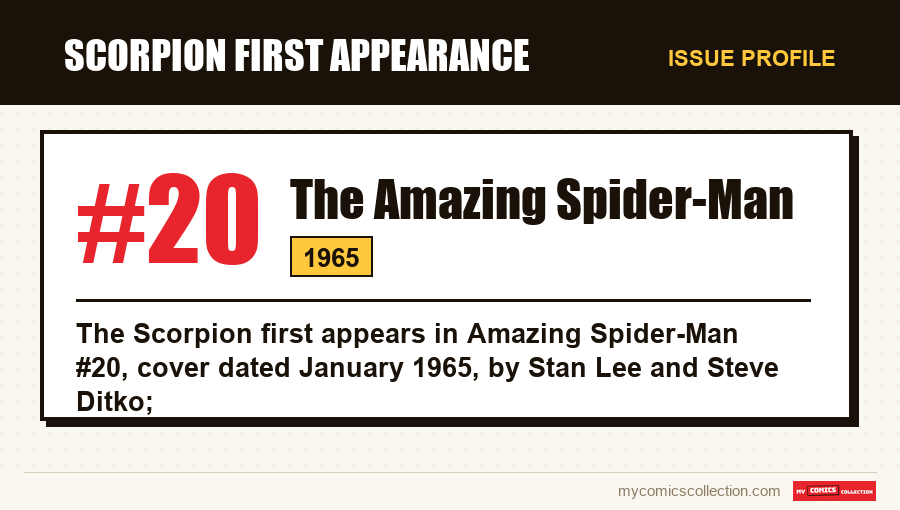
The Amazing Spider-Man #20 carries a January 1965 cover date. Its lead story is "The Coming of the Scorpion!". Stan Lee is credited as writer and editor. Steve Ditko is credited with the pencils, the inks and the cover, which means the whole visual identity of the issue, from the costume to the cover composition, comes from one hand.
That last point is useful when you compare copies. A Ditko cover over Ditko interiors has no handoff between artists, so there is no inker to name and no credit dispute to chase. We do not list a letterer or colorist here, because the listings we read differ on those credits and none is printed here.
The cover date also anchors the issue in the title's early rhythm. Reference material notes that the series began as a bimonthly and became monthly after four issues, and that Ditko drew every number from #1 to #38. Issue #20 therefore sits in the middle of the Ditko run. If a listing shows a different month, check the cover itself, not the description.
Mac Gargan before the tail: what #19 sets up
Gargan debuts in #19, cover dated December 1964, also by Lee and Ditko. He is a private investigator hired by J. Jonah Jameson, publisher of the Daily Bugle, to find out how Peter Parker manages to get his photographs of Spider-Man. The job fails on the street: Peter's spider-sense lets him notice and avoid the man who is following him.
This matters for the logic of the next issue. Jameson, who has already lost patience with every plan to expose or stop the hero, turns from surveillance to a stronger idea. In #19 the Scorpion does not exist, but the person who will wear the costume, and the employer who will pay for it, are both already on the page.
Because of that setup, a collector who wants the complete debut should treat #19 and #20 as a pair. The pair also reads well in sequence: the detective who cannot catch a teenager is followed, one month later, by the same detective given a body built to hunt spiders.
How the Scorpion is introduced in #20
In #20, Jameson takes Gargan to Dr. Farley Stillwell, a chemist known for creating animals with altered abilities. Stillwell performs a barely tested procedure that is meant to give a person the useful traits of one animal. The animal chosen is the scorpion, picked because scorpions prey on spiders. Stillwell also fits Gargan with a club-like mechanical tail, and Gargan puts on a green costume to go with it.
The tail is a weakness as well as a weapon. Stillwell warns that the controls are imperfect and that Gargan needs practice, but the new Scorpion is eager to fight. In their first battle he beats Spider-Man badly, cutting free of the webbing and leaving the hero in poor shape. Jameson watches with satisfaction and concludes that the problem is solved.
The aftermath is where the issue becomes a debut worth keeping. Stillwell realizes what he has made and tries to reach the Scorpion with an antidote. The Scorpion refuses to change back, and Stillwell falls to his death when he follows him up a building. The Scorpion turns to crime and then turns on Jameson, the man who paid for his transformation. Spider-Man recovers and returns, tears off the tail and finishes the fight, and Jameson goes on opposing Spider-Man.
Stillwell debuts in the same issue, so #20 carries two first appearances and the death of one of them. Readers who collect scientists and supporting casts, beyond costumed villains, have a reason to want the number as well.
Like most issues of the period, #20 is more than a single-villain pamphlet. The Daily Bugle cast keeps moving around the fight, and Peter's uneasy situation with Betty Brant runs alongside it, a reminder that Jameson is also the employer who signs Peter's checks while he pays for a monster.
At home, Peter has to hide the cost of the first defeat from Aunt May, and the secret identity weighs on him as much as the bruises do. Those scenes are not why a collector chases the issue, but they explain why the book holds up as a complete Lee and Ditko installment and not just as a villain debut.
Who created the Scorpion, and in what editorial context
Reference material credits Mac Gargan and Farley Stillwell to Stan Lee and Steve Ditko. The credit line on the issue is simple, but the working method behind it was not always simple. Ditko described plotting stories as well as drawing them, and published accounts of the period state that Lee agreed to give Ditko a plot credit starting with issue #25 of June 1965. For #19 and #20 the credit box reads as Lee writing and Ditko drawing, and a listing that gives "plot by Ditko" for #20 is reading a later practice backward.
The context also helps explain the villain design. The animal behind the costume is a scorpion, chosen in the story because scorpions prey on spiders. That choice gives Jameson a motive that fits his character: he does not want justice, he wants a counter built for the job. If you want to place the number among the other villain debuts of the same stretch, the guide to villain first appearances covers the wider field.
Do you collect this series?
Track what you own, what you are missing and what your collection is worth. 7-day trial.
Start my trial →
Why #20 is a key issue
The debut of the Scorpion matters for three reasons that are independent of any market. First, it introduces a villain whose story stretches across decades and into other titles. Second, it sits inside the Ditko years, which many collectors treat as the core of the series. Third, Gargan later becomes more than the Scorpion: he becomes a host of the Venom symbiote, so a collector of the symbiote line has a reason to own the man's origin.
Those later uses are what keep the number in conversation. Marvel Knights: Spider-Man #9 and #10 of 2005 are where the symbiote approaches Gargan and he appears as a Venom host, and the symbiote side of the story is covered in our guide to the best Venom runs. For the Scorpion's own debut, however, #20 is the target, and the best Scorpion comics page ranks the reads that follow if you want a reading order instead of a single purchase.
The appearances that matter after #20
Treat the list below as a reading and collecting map. Every entry was checked against reference material for the issue number and date.
- The Amazing Spider-Man #29, October 1965: the Scorpion returns to pursue his vendetta against Spider-Man and Jameson.
- Ms. Marvel #1 and #2, January and February 1977: he fights Ms. Marvel after a botched attempt at revenge on Jameson.
- The Spectacular Spider-Man #215 and #216, August and September 1994: Gargan pleads that he is a changed man, and Spider-Man beats him savagely anyway.
- Marvel Knights: Spider-Man #9 and #10, 2005: the symbiote approaches Gargan, and #10 carries his debut as a Venom host.
- Dark Avengers #1, 2009: Gargan debuts as the third Spider-Man of Norman Osborn's team.
Between those poles, the character appears as a Thunderbolts member in 2006 and 2007, with Civil War #4 of October 2006, where as Venom he joins the team, and Thunderbolts #112 of May 2007, where he fears the symbiote's control yet grows addicted to its power. Those are supporting pieces. They are worth reading if you want the arc, but they are not substitutes for #20 as the debut.
Reprints, collected editions and numbers people confuse
Collected editions of the Ditko years exist, which means the tale of Gargan, Stillwell and the tail can be read without touching a 1965 newsstand copy. Keep that reading choice apart from the shelf choice: a reprint carries its own cover and its own indicia, so it is a different object.
The common confusion is between #19 and #20. A seller may describe a copy of #19 as the Scorpion debut, or a copy of #20 as the first Mac Gargan, and both descriptions are half true in different ways. Gargan the person debuts in #19; the Scorpion, the tail and Stillwell debut in #20. Match the listing to the number on the cover, and decide which of the two you actually want before you buy.
A second confusion involves #29. That issue is the Scorpion's return, not his debut, and it is often mislabeled in casual searches. A third involves the Venom host: Gargan is the host of the symbiote in 2005, but the symbiote itself belongs to a different history, and a page that says "Venom first appearance" is about a different character.
Inspecting a copy of #20 before you commit
The steps below are a method for a 1965 newsstand book, with no price attached.
- Read the cover itself for the number 20 and the January 1965 date, whatever the listing text says.
- Request sharp images of the front, back, spine and staples. Rust around a staple or a spine that looks re-stapled deserves a question to the seller.
- Check the corners, the cover edges and the paper tone for color touch, glue or fill, which are the usual signs of restoration. If the seller says a copy is restored, ask what was done and request the written note that accompanies it.
- With an encapsulated book, study the label's grade, page quality line and any defect or restoration remark, and check its serial number on the grader's website.
- On an unslabbed copy, request interior pages as well, since a bright cover can sit on top of tape, cuts or a detached cover.
- Decide whether you want #19, #20 or the pair, and keep each condition note separate.
One habit pays off more than any other here: line up the photographs of several #20 copies and study them together. Raking light across a Ditko cover reveals creases and wear that a flat scan hides.
For a collector building the Ditko years, #20 follows the villain debuts of the first nineteen numbers and comes before the larger cast of the mid-1960s. Our guide to starting with Steve Ditko shows how the artist's other work connects, and the guide to the Sinister Six is useful if your interest is the group of villains that grows from this era.
For a collector who prefers characters to runs, the number belongs to a Scorpion and Venom sub-collection that can start with #19 and #20, continue with #29, and then skip to the 2005 Marvel Knights issues. Four or five books make a complete Gargan shelf, which is short enough to track in a simple list. Once you know exactly which issue sits in your hands, the free valuation page linked at the end gives a way to put a figure on it.
Frequently asked questions
The Scorpion debuts in The Amazing Spider-Man #20, cover dated January 1965, in "The Coming of the Scorpion!" by Stan Lee and Steve Ditko. Mac Gargan, the man who becomes the Scorpion, appears one issue earlier, in #19 of December 1964, as a private detective hired by Jameson.
Reference material credits Stan Lee and Steve Ditko. On #20, Lee holds the writer and editor credit, and Ditko the pencils, inks and cover. Ditko received a separate plot credit later, starting with issue #25 of June 1965, so #20 is credited as Lee writing and Ditko drawing.
It depends on the question. #19 introduces Mac Gargan as a detective, and #20 introduces the Scorpion, the mechanical tail and Dr. Farley Stillwell. A collector of the villain usually wants #20, and a collector of the complete debut wants both. Match every listing to the number printed on the cover.
In Marvel Knights: Spider-Man #9 and #10 of 2005, the symbiote approaches Gargan, and #10 is cited as his debut as a Venom host. He later appears with the Thunderbolts and in Dark Avengers #1 of 2009 as the third Spider-Man of Norman Osborn's team.
Read the number 20 and the January 1965 date off the cover first. Next, collect photographs of the spine, staples, corners and pages inside, keeping an eye out for restoration. A slabbed book should have its label cross-checked with the grader's own records.
Holding a copy of #19 or #20 and wondering what to check next? Run it through the free valuation tool.
Estimate my comic