
For the best Scorpion comics, start with Mac Gargan's debut in The Amazing Spider-Man #19 and #20 (December 1964 and January 1965), by Stan Lee and Steve Ditko. For the best reads, begin with Marvel Knights: Spider-Man #10 (2005) by Mark Millar, where he inherits the symbiote, then Dark Avengers (2009 and 2010) by Brian Michael Bendis and Mike Deodato, where he poses as Spider-Man.
Mac Gargan has two lives as a collectible. On one side, the private detective turned scorpion-man in the 1960s, an adversary with a stubborn grudge; on the other, the 2000s host of Venom, who takes Spider-Man's place on Norman Osborn's team. This guide ranks six reads to understand that double path and tells you where to jump in.
As always in this guide, we only state verified information (creators, issue numbers, dates); the analysis is our own, with no reproduction of protected art or dialogue.
His first appearance
Amazing Spider-Man #19, from December 1964, marks Mac Gargan's debut: Stan Lee writes, Steve Ditko draws. He is introduced there as a private detective hired by J. Jonah Jameson. It is #20, from January 1965, that shows him transformed into the Scorpion: he beats Spider-Man twice before losing the third round. Issue #19 introduces the man, #20 introduces the costume, and the two issues are best hunted down together.
Jameson is tied to the character from the start: the boss of the Daily Bugle is Gargan's employer before becoming, along with Spider-Man, one of his targets in #29. These two issues belong to the series' initial period, which the Silver Age guide details issue by issue. On an older #19 or #20, the sensitive point is restoration: ask for photos of the spine, corners and staples, and compare the copy to sales with legible photos.
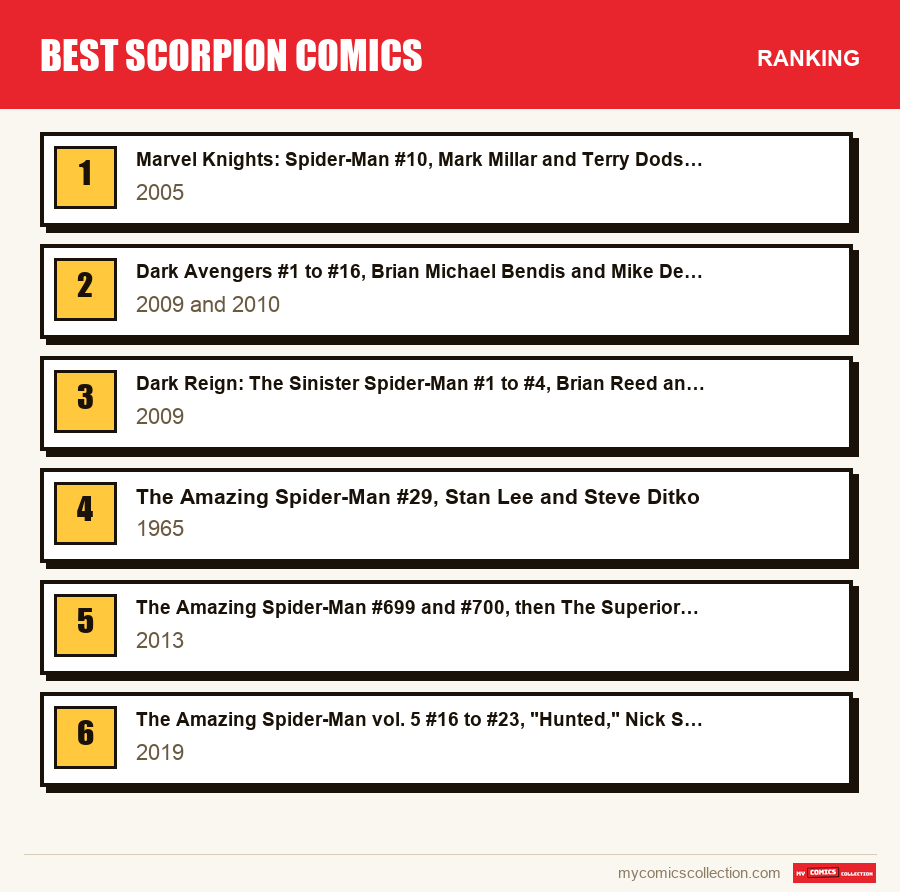
1: Marvel Knights: Spider-Man #10, Mark Millar and Terry Dodson (2005)
The Marvel Knights: Spider-Man series is written in twelve issues by Mark Millar, with Terry Dodson on art for most of it. It is in #10, dated March 2005 and titled "The Last Stand," that Mac Gargan bonds with the symbiote and becomes Venom. One useful marker: some sources also point to the previous issue for the meeting between the man and the symbiote, which is why #10 is the issue to use as your buying benchmark.
What this issue brings to the character is considerable: the Scorpion stops being a somewhat dated adversary and becomes a host of Venom, with new strength and cruelty. He then joins the Thunderbolts in 2006, and Osborn's team in 2009. The read is for every Venom collector, since it is a key appearance of a new host of the symbiote, but it also appeals to Spider-Man readers who want to see a former enemy cross a threshold. Read #10 with the issues around it to understand the context, or go through the trade paperback of Mark Millar's series. To place this symbiote over the long run, our history of Venom is a good complement.
2: Dark Avengers #1 to #16, Brian Michael Bendis and Mike Deodato (2009 and 2010)
As part of Dark Reign, Norman Osborn leads a version of the team where criminals take the place of heroes. Brian Michael Bendis writes the series, Mike Deodato draws it, and Mac Gargan, in Spider-Man's guise, is part of the original lineup. The series runs sixteen issues; Gargan is part of the original lineup.
What it brings to the character: a borrowed identity that lets him hold the place of the hero he hates. Issues #2 and #3 (April and May 2009) bring in Morgana le Fay, who turns Venom into a monster; #10 (December 2009) shows the effect of Norman Osborn's treatment, which weakens his will to fight. In #16, Gargan is captured and, once the suit is taken back, he becomes the Scorpion again. The story is for the reader who likes teams of villains disguised as heroes. For the writer's other work, see his author page.
3: Dark Reign: The Sinister Spider-Man #1 to #4, Brian Reed and Chris Bachalo (2009)
This four-issue miniseries, written by Brian Reed and drawn by Chris Bachalo, carries Gargan's life as a fake Spider-Man into a story of its own. Issue #1 came out in June 2009; #3, from October 2009, is the one where a treatment resets the suit. It is a shorter read, more centered on the character than Dark Avengers.
For a collector, it is worth it for Chris Bachalo's signature, whose nervy linework gives the series a strong visual identity. For a reader, it serves as a quick introduction to Gargan's mental state at the time: a man playing a role who is being eaten away by the symbiote. It reads in one go, in an afternoon, and without the Dark Avengers issues if you only want the portrait. Its four single issues have been collected in a trade paperback.
4: The Amazing Spider-Man #29, Stan Lee and Steve Ditko (1965)
Released in October 1965 under the title "Never Step on a Scorpion!", this issue brings together Stan Lee on text and Steve Ditko on pencils. It shows the Scorpion as a professional criminal, with a grudge aimed at Spider-Man and at Jameson. It is the character's second appearance in costume, which makes it a landmark for fans of the era.
This entry is for readers who want to read the Scorpion before his Venom period. Steve Ditko's art, with its angles and sense of unease, gives the costume a disquieting silhouette, faithful to the spirit of the series at that time. To understand the artist, our guide Steve Ditko: where to start gives the keys to his work. In a chronological reading, come to this issue after #19 and #20.
Do you collect this series?
Track what you own, what you are missing and what your collection is worth. 7-day trial.
Start my trial →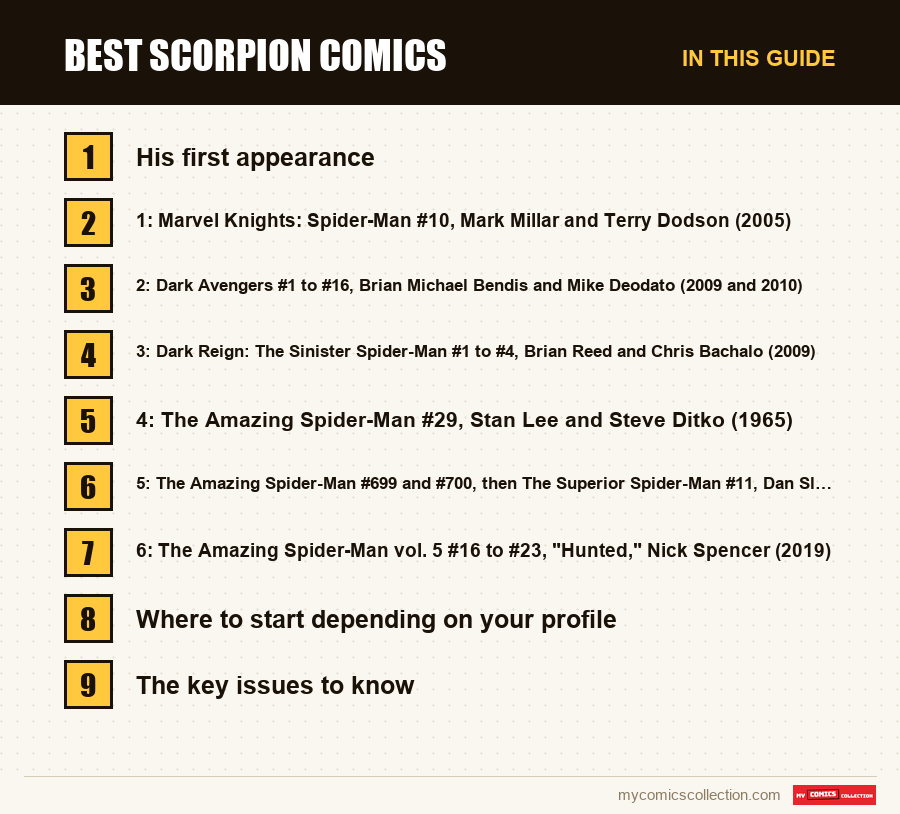
5: The Amazing Spider-Man #699 and #700, then The Superior Spider-Man #11, Dan Slott (2013)
Dan Slott writes Amazing Spider-Man #699 and #700 (February 2013), the "Dying Wish" arc, where Doctor Octopus breaks Gargan's jaw. In The Superior Spider-Man #11 (August 2013), again by Dan Slott, the Scorpion's jaw receives a metal piece.
This passage matters less for Gargan himself than for what it says about him: after the Venom episode, he comes back as the Scorpion, with a damaged body and a cyborg costume in 2011. The entry is for readers of the Slott years, and it shows that the character survived the end of his role as a host. To get into this writer, read Dan Slott: where to start before the 2013 issues.
6: The Amazing Spider-Man vol. 5 #16 to #23, "Hunted," Nick Spencer (2019)
The "Hunted" arc begins with #16 of the fifth volume, dated April 2019 and written by Nick Spencer; the arc runs through #23, with several artists including Humberto Ramos and Ryan Ottley. Kraven captures several Spider-Man adversaries, including Mac Gargan, and gathers them into the Savage Six. The Scorpion is therefore game here, not a hunter.
This read is for those who want a recent story and a dark take on the hunter and his prey. It helps show that Gargan can stay present in Spider-Man's current events well after the Venom years. The arc exists in a trade paperback under the title Hunted, which spares you the hunt for single issues.
One last marker for choosing editions: trade paperbacks generally collect the issues of a single arc, which suits readers, while collectors favor the original single issues, with the cover date as their benchmark. For Marvel Knights: Spider-Man, Dark Avengers and "Hunted," both forms coexist, and the choice depends on your use: reading or preserving.
Where to start depending on your profile
You want the classic character. Read The Amazing Spider-Man #19, #20 and #29 (1964 and 1965): this is the Stan Lee and Steve Ditko version.
You want the most striking story. Take Marvel Knights: Spider-Man #10 (2005) for the Venom turn, then Dark Avengers for its consequences.
You prefer villain teams. Aim for Dark Avengers and The Sinister Spider-Man (2009).
You collect Venom. Start from #10 of Marvel Knights: Spider-Man and continue with the key issues of Venom.
You like recent Marvel. Choose "Hunted" (2019) and then work back toward 2005.
The key issues to know
For a collector, the method comes before the list: first spot the foundational appearances, then the turning points, and compare several completed sales before deciding. Here are Mac Gargan's landmarks.
- The Amazing Spider-Man #19 (December 1964): first appearance of Mac Gargan;
- The Amazing Spider-Man #20 (January 1965): first appearance as the Scorpion;
- The Amazing Spider-Man #29 (October 1965): the grudge against Spider-Man and Jameson;
- Marvel Knights: Spider-Man #10 (2005): Gargan becomes Venom;
- Dark Avengers #1 (2009): Gargan in Spider-Man's guise;
- Dark Reign: The Sinister Spider-Man #1 (June 2009): the miniseries devoted to him;
- The Amazing Spider-Man #699 and #700 (February 2013): the broken jaw;
- The Amazing Spider-Man vol. 5 #16 (April 2019): start of "Hunted."
On value, do not lean on an isolated result: gather several completed sales for the same issue and the same grade, then reason from the whole set. The 1964 and 1965 issues belong to a vintage market where restoration and grading weigh heavily; those from 2005 to 2019 are judged mostly on cover condition and the possible presence of variants.
How to organize a complete read
To cover Gargan's whole trajectory, follow the dates: #19, #20 and #29 of the main series, then Marvel Knights: Spider-Man #10 in 2005, Dark Avengers and The Sinister Spider-Man in 2009, Amazing Spider-Man #650 and #651 (2011), where Alistair Smythe gives him a new Scorpion costume, then 2013 and 2019. This order brings out a common thread: a man who is permanently looking for a strength greater than himself, and who pays for it every time.
On numbering, the title has been relaunched several times: the "vol. 5" of "Hunted" is not to be confused with the 1963 series, even if a cover may show a second number recalling the historical numbering. You can also compare with another adversary from the Ditko era in our guide to the Lizard.
Frequently asked questions
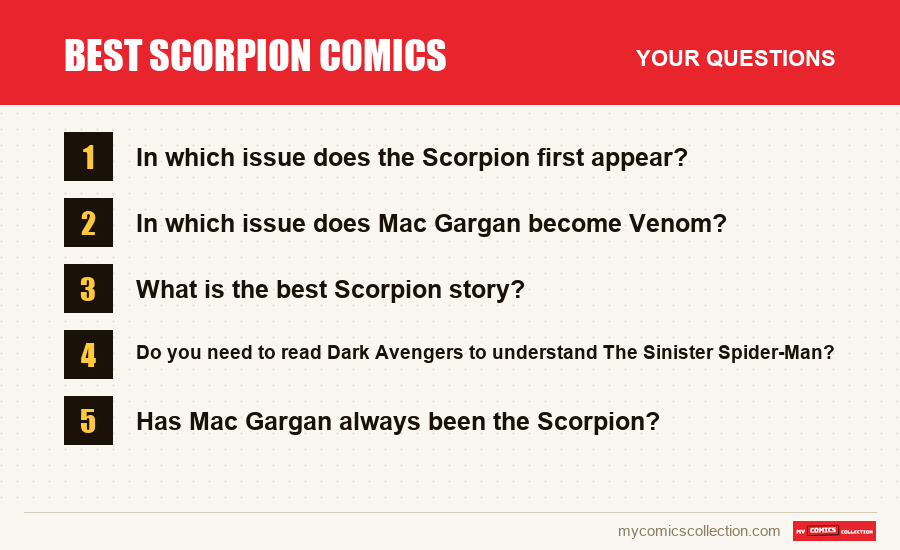
Mac Gargan appears in The Amazing Spider-Man #19 (December 1964) as a private detective, and becomes the Scorpion in #20 (January 1965). Stan Lee writes and Steve Ditko draws these issues. Check the number and date printed on the cover before buying a copy.
He bonds with the symbiote in Marvel Knights: Spider-Man #10, dated March 2005 and written by Mark Millar, with Terry Dodson on art. Some sources also cite the previous issue for the meeting, but #10 remains the usual buying benchmark.
It depends on the period. On the Venom side, start from #10 of Marvel Knights: Spider-Man, then continue with Dark Avengers, by Brian Michael Bendis and Mike Deodato. For the classic version, read Amazing Spider-Man #19, #20 and #29, by Stan Lee and Steve Ditko.
No. Dark Reign: The Sinister Spider-Man, by Brian Reed and Chris Bachalo (2009), forms a complete four-issue set. Dark Avengers gives context to Osborn's team, but the portrait of Gargan stands without it. Read it first if you want a short way in, then add the regular series afterward if you feel like it.
No. After the Venom years, he lost the symbiote during Siege (2010), then came back as the Scorpion. That alternation explains why his collection splits into two periods, the Stan Lee and Steve Ditko one, and the Osborn era.
Did you find a copy of Amazing Spider-Man #19, #20 or #29, or of Marvel Knights: Spider-Man #10? Get it appraised before selling it or having it graded.
Estimate my comic