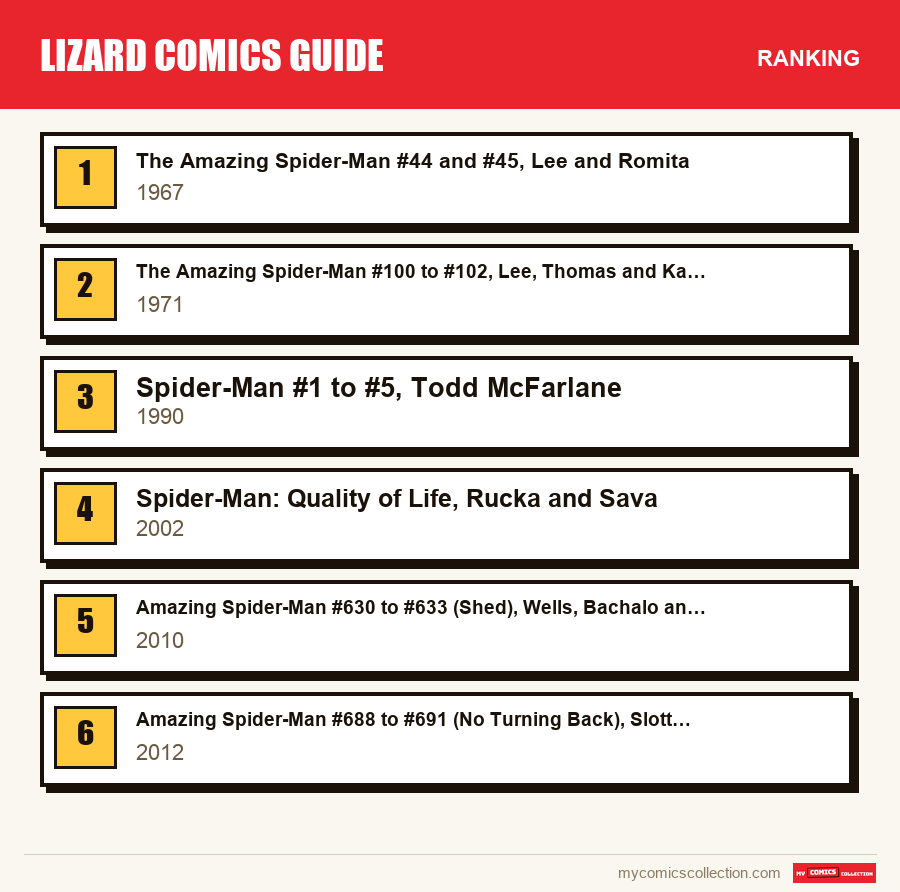
The best Lizard comics start with his debut in Amazing Spider-Man #6 (November 1963), created by Lee and Ditko, then the #44 and #45 two-parter (1967). Where to go next depends on your taste, and the key issues follow: Spider-Man #1 to #5 by Todd McFarlane (1990) for graphic horror, Shed in Amazing Spider-Man #630 to #633 (2010) for the darkest story, or No Turning Back (#688 to #691, 2012) for the end of a cycle.
Dr. Curt Connors is not just another villain in Spider-Man's gallery: he is a friend, a one-armed scientist trying to recover what amputation took from him, and whose transformation turns every fight into a tragedy. The Lizard therefore reads on two levels, the monster and the man who contains it. This guide ranks six stories and helps you pick the entry point that suits you.
As always in this guide, we only state verified facts (creators, issue numbers, dates); the analysis is our own, with no reproduction of artwork or protected dialogue.
His first appearance
November 1963: Amazing Spider-Man #6, scripted by Stan Lee and illustrated by Steve Ditko, introduces the Lizard. Curt Connors is a one-armed biologist there, who tries to regrow lost limbs from the study of reptiles; the formula he develops turns him into a scaly creature. The mainspring rests on an inversion: the scientist wants to repair a lack, and the cure produces a monster.
For a collector, this is a Silver Age first appearance. Before buying a copy, check the printed issue number and date, the condition of the spine, the corners, and any sign of restoration. To compare this #6 with the very first issues of the title, see the entry on issue #1 from 1963.
Keep in mind the gap between the two episodes: between #6 from November 1963 and #44 from January 1967, more than three years go by, and #44 is presented as a return of the Lizard after that long pause. A reader who jumps from #6 to #44 therefore loses nothing essential, and the reading order remains that of the cover dates.
1: The Amazing Spider-Man #44 and #45, Lee and Romita (1967)
After his first appearance in 1963, the Lizard does not return to the series until #44, dated January 1967 and titled "Where Crawls the Lizard!". Stan Lee writes and John Romita draws. This return, followed by #45, sets up the pattern that will become the character's: Connors, pursuing his research, transforms again, and Peter Parker must both save him and stop him. The issue is also tied to a specific moment of the series, the one where the Lee and Romita team sets up the cast that will carry on.
This is the most natural entry point for anyone reading the series in chronological order. John Romita's art gives Spider-Man a face closer to the one the general public knows, which eases entry into the era for a reader used to modern versions. For a purchase, these two issues are often sought together, since the story reads in one go. The file on the Amazing Spider-Man Silver Age guide helps place this period.
2: The Amazing Spider-Man #100 to #102, Lee, Thomas and Kane (1971)
Issue #100 of the series, dated 1971, marks a break: Stan Lee and Gil Kane leave Spider-Man in a situation that becomes the "six-armed Spider-Man saga". Roy Thomas then writes #101, the first issue of the series not scripted by Stan Lee, then #102, still with Gil Kane on art. #101 is the first appearance of Morbius, the Living Vampire, and #102 shows Dr. Connors working on a serum that might finally cure Spider-Man.
This entry point suits the reader who wants to see the Lizard in a story broader than a duel: he is a link there, not the center. It also interests those who collect by supporting character, since Morbius appeared in these pages; our page on the history of Morbius tells what the character became. For reading, count on three issues that run together, and do not read them out of order.
3: Spider-Man #1 to #5, Todd McFarlane (1990)
In 1990, Todd McFarlane launches a new Spider-Man series whose first five issues, titled Torment, pit the hero against the Lizard. McFarlane is both writer and artist. The arc was collected as a trade paperback as early as 1992, then as a hardcover in 2009, and it is also in a McFarlane omnibus that gathers issues #1 to #14 and #16 of the series along with an issue of X-Force. The extra content varies from one edition to another: read the table of contents before buying, because one edition may add a preview issue that another leaves out.
This is the story to read if you prefer atmosphere and line work to continuity: the Lizard is drawn there as a nightmare creature, far from the Silver Age saurian. On the collecting side, two pages of the site detail it: Todd McFarlane's Spider-Man, the key issues and, for the French release, Spider-Man #1 from 1991.
4: Spider-Man: Quality of Life, Rucka and Sava (2002)
Quality of Life is a four-issue miniseries published from July to October 2002. It is written by Greg Rucka, with Scott Sava on art for the first issue. Marvel sums it up this way: Connors becomes the Lizard after a blocked procedure and an unscrupulous company hinder his effort to treat his wife.
This is the entry point for the reader who wants a more intimate story, less centered on combat than on the cause of the drama. It works without knowing the history, which makes it useful for anyone discovering the character through another medium. The miniseries has four issues, published from July to October 2002: you buy a complete set or a trade paperback, not an isolated issue, and you check that the four single issues do carry the same series.
The Lizard of Quality of Life stands apart from the others on this list by its starting point: the cause of the transformation is social, with a sick wife and an institution that slows things down, rather than scientific. This gives Curt Connors a dimension as a victim that action stories sometimes leave aside, and it is the reason the miniseries is recommended to anyone who finds the character too mechanical elsewhere.
Do you collect this series?
Track what you own, what you are missing and what your collection is worth. 7-day trial.
Start my trial →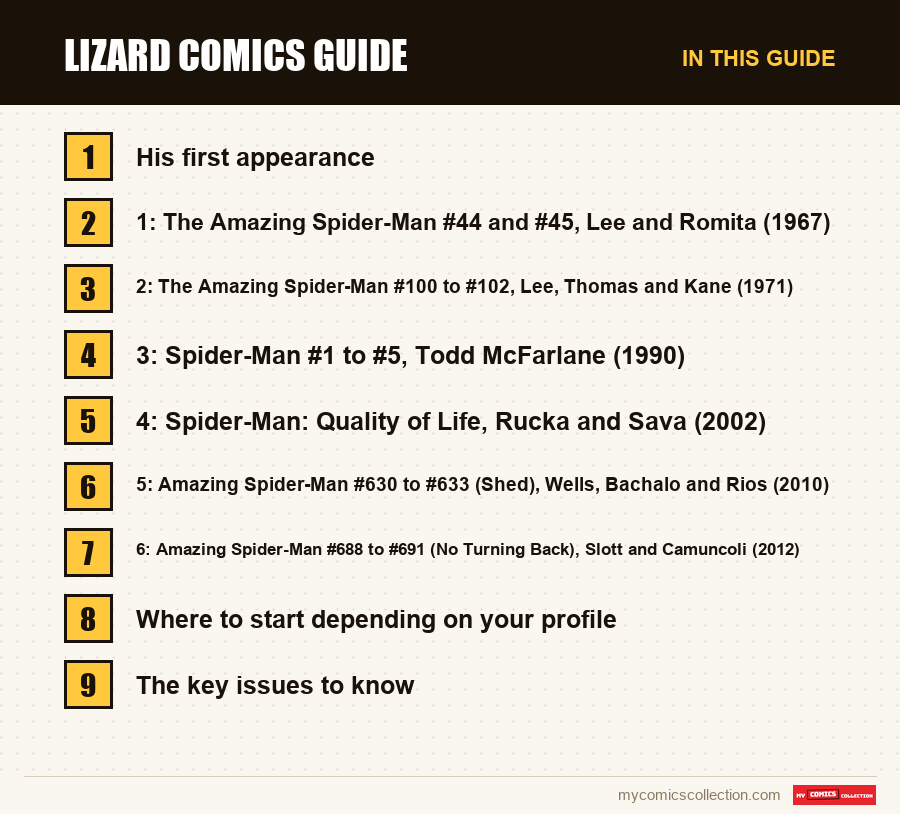
5: Amazing Spider-Man #630 to #633 (Shed), Wells, Bachalo and Rios (2010)
In the storyline The Gauntlet, Shed is the last opponent of the series. Zeb Wells writes, Chris Bachalo and Emma Rios draw. The arc covers #630 to #633 from 2010, and the The Gauntlet vol. 5 trade paperback collects it under the title Lizard. Several critics of the time see it as a horror story, among the darkest of the period.
This is the story to recommend to the adult reader who appreciates stories that unsettle. Chris Bachalo's line work divides opinion: some see a strange, disturbing creature, others find the Spider-Man less faithful. To go deeper into the work of the writer, the Zeb Wells page gathers his articles. For a purchase, look closely at which extra issues the different trade paperbacks add to the arc.
A point of method for the Shed collections: the editions do not agree on the extra issues they add to the arc, some listing a neighboring issue of Amazing Spider-Man or an issue of Web of Spider-Man. If you want the arc alone, check that #630 to #633 are all included.
6: Amazing Spider-Man #688 to #691 (No Turning Back), Slott and Camuncoli (2012)
Dan Slott writes No Turning Back, which spans #688 to #691 of the series, with Giuseppe Camuncoli on art, joined by Mario Del Pennino on the last issue. The arc was collected as a trade paperback in 2012 with an issue of Untold Tales of Spider-Man. Morbius plays a central role in it: a cure for the Lizard might also heal the Living Vampire, and that is what draws the two characters into the story.
The story concludes a long cycle: at the end, the antidote gives Connors back control of his mind, but the Lizard keeps coming back. It is the best read for anyone who has already seen the Lizard in several forms and wants the end point of a quest that has run since 1963. To place the writer more broadly, see Dan Slott: where to start.
Where to start depending on your profile
If you read in chronological order, open The Amazing Spider-Man #6, then #44 and #45: in three issues you have the birth of the character and his archetype. If you prefer a self-contained story that reads without preparation, choose Quality of Life, four issues in one piece.
If you like horror and spectacular line work, read the first five issues of the 1990 Spider-Man, then Shed in 2010 for an even darker version. If you are looking for a conclusion, finish with No Turning Back in 2012. For the collector, the logic is reversed: aim first for the three pillars, #6 from 1963, #44 from 1967 and #101 from 1971, then fill in with the era that draws you. Whatever your profile, read an arc in one block rather than issue by issue as chances come, because the chapters answer one another.
The key issues to know
Few issues truly matter, and that is good news for anyone building a collection. The first is The Amazing Spider-Man #6 (November 1963), first appearance of the Lizard, created by Stan Lee and Steve Ditko. The second is #44 (January 1967), his documented return. In the following period, remember #101 (1971) for the first appearance of Morbius, which belongs to a story where Connors looks for a cure.
On the modern side, remember Spider-Man #1 (1990) as the entry point to McFarlane's arc, and Amazing Spider-Man #630 for the opening of Shed. Issues marked with a grade or a restoration change how a copy reads: read the notation in full, check the cover date printed on the single issue and never rely on the listing alone. The Lizard is only one thread among others: the overview of the key issues of Amazing Spider-Man and the ranking of Spider-Man runs show what surrounds him.
Frequently asked questions
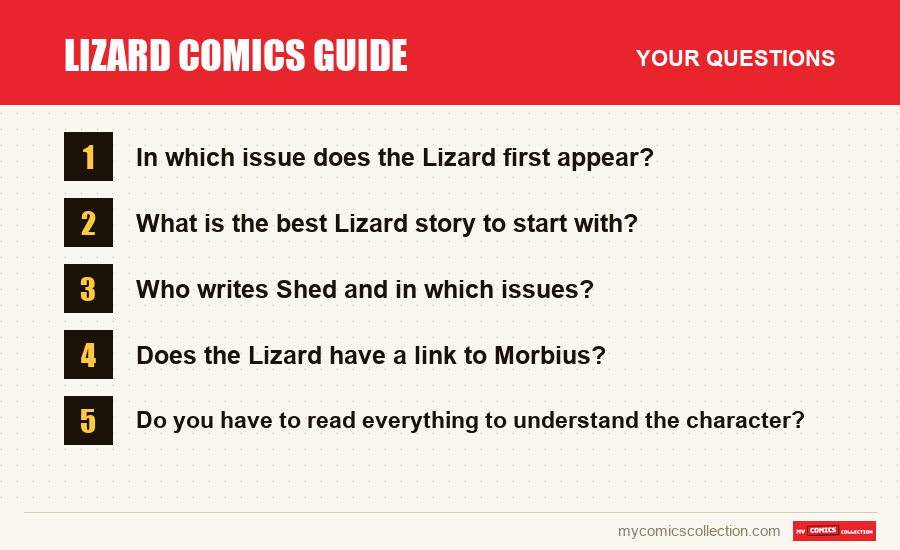
His first appearance is in Amazing Spider-Man #6, from November 1963, by Lee and Ditko. The character there is Dr. Curt Connors, a one-armed biologist, who transforms following an experiment on reptiles.
It depends on your taste. For the source, read Amazing Spider-Man #6 then #44 and #45. For a complete, self-contained story, take the 2002 miniseries Quality of Life. For horror, choose Spider-Man #1 to #5 by Todd McFarlane (1990) or Shed in 2010.
Shed is written by Zeb Wells and covers The Amazing Spider-Man #630 to #633, in 2010. Chris Bachalo and Emma Rios handle the art. The arc is part of the The Gauntlet storyline and was collected in a trade paperback titled Lizard.
Yes, at two moments. In the 1971 saga, Amazing Spider-Man #100 to #102, Morbius appears for the first time in #101, in a story where Connors looks for a serum. In 2012, the No Turning Back arc (#688 to #691, Dan Slott) puts Morbius at the heart of the attempt to cure the Lizard.
No. The character rests on a simple idea: a scientist who tries to repair his body and transforms. Three reads are enough to grasp him: #6 from 1963, Spider-Man #1 to #5 from 1990 and Shed from 2010. The rest serves to fill in according to your interest.
Do you own Amazing Spider-Man #6, #44 and #45 or an issue of the 1990 Spider-Man series? Have its condition appraised before putting it away or selling it.
Estimate my comic