
In short
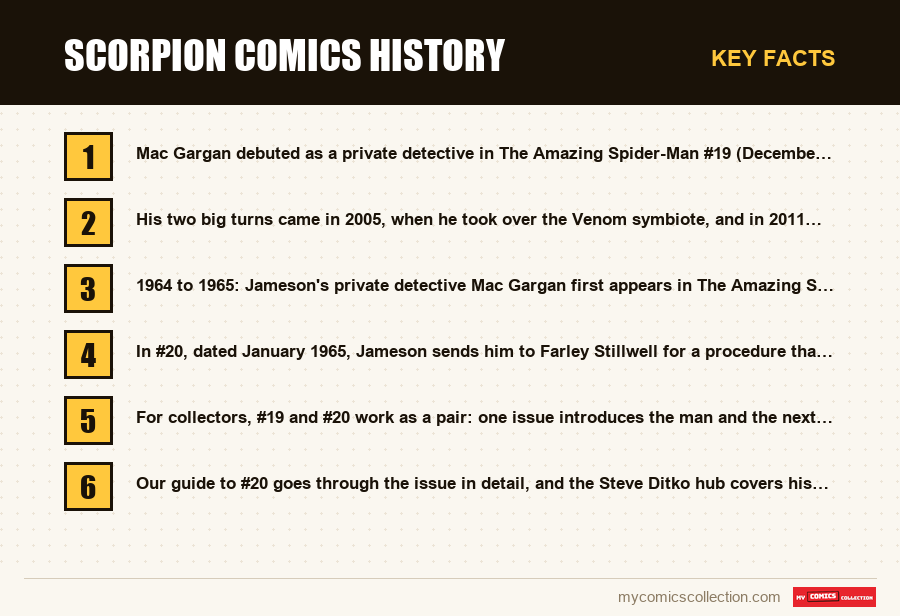
Mac Gargan debuted as a private detective in The Amazing Spider-Man #19 (December 1964) and became the Scorpion in #20 (January 1965), both by Stan Lee and Steve Ditko. For decades he was a bitter, minor foe of Spider-Man and J. Jonah Jameson. His two big turns came in 2005, when he took over the Venom symbiote, and in 2011, when he returned in a cybernetic Scorpion suit after the Dark Avengers fell.
The Scorpion is a villain built on a single grievance: he was promised a gift by Jameson and paid for it with his sanity. For most of his early history he is that man, repeating the same revenge with minor variations. Then Marvel did something unusual with him. It gave him a symbiote, a team and a title, and then took them away, and the second Scorpion that came back was a different character from the first.
We matched the debut dates, the Venom-era issue numbers, the Dark Avengers issues and the Big Time breakout against published listings. When an issue's writer or artist could not be confirmed, we name the issue and leave the credit out. The explanations of why each stretch matters, and the shelving tips, are our own judgment.
1964 to 1965: Jameson's private detective
Mac Gargan first appears in The Amazing Spider-Man #19, dated December 1964, as a private investigator hired by J. Jonah Jameson to find out how Peter Parker gets his photographs of Spider-Man. He is not a villain yet; he is a hired man doing surveillance. In #20, dated January 1965, Jameson sends him to Farley Stillwell for a procedure that grafts scorpion traits onto him, and Gargan becomes the Scorpion. Lee and Ditko created the character.
The setup matters because it makes the Scorpion a product of the Daily Bugle's publisher. Jameson wants Spider-Man stopped, pays for the weapon, and loses control of it. In the course of the story Gargan beats Spider-Man twice, turns on Jameson, and is defeated in a third battle. For collectors, #19 and #20 work as a pair: one issue introduces the man and the next introduces the costume and the name. Our guide to #20 goes through the issue in detail, and the Steve Ditko hub covers his other work on the title.
1965 to 1978: a grudge that keeps returning
The Amazing Spider-Man #29, dated October 1965, brings Gargan back to his vendetta against Spider-Man and Jameson. From then on the Scorpion is the villain who is always angrier than he is capable. He loses, escapes, and returns with the same list of enemies.
Two later appearances show how writers used him. In Ms. Marvel #1 and #2 (January and February 1977), the Scorpion attempts revenge on Jameson, fails, and ends up fighting Ms. Marvel before being dumped in acid. And in Peter Parker, the Spectacular Spider-Man #21 (August 1978), he comes to believe his costume cannot be removed, which Spider-Man shows is only a belief in his mind. Each story takes the same wound and presses it in a new place: the suit was a gift, then a prison, then a delusion.
Seen together, these stories explain why the Scorpion stays below the top rank of the gallery in this period. He has a clear motive, a recognizable look and a direct link to the Bugle, which is exactly what makes him easy to slot into any issue that needs a threat with a personal angle. It also explains why he is a good choice for a collector who likes the middle layer of the Silver Age cast: these issues sit below the headline debuts, yet they show how the series built its supporting rogues.
1994 to 1996: reform, relapse and the Ben Reilly years
The 1990s give the character a short experiment with redemption. In The Spectacular Spider-Man #215-216 (August and September 1994), the Scorpion quits crime and wanders the sewers. He tells Spider-Man he has changed, and Spider-Man rejects the plea and beats him badly. It is a harsh moment, and it shows what the writers wanted: a villain whose attempt to reform is not rewarded, which keeps him dangerous.
In Spider-Man Unlimited #13 (August 1996), the Scorpion is defeated by Spider-Man's clone Ben Reilly. The reform story ended where it began, and the character remained in the second tier.
2005 to 2007: the third Venom
The change comes in Marvel Knights Spider-Man. The symbiote approaches Gargan in #9, and in #10 (2005) he appears as the third Venom, an extra edge as part of Norman Osborn's Sinister Twelve. In the same story he carries out Osborn's orders in kidnapping Aunt May.
The effect is a reversal of the character's meaning. The Scorpion had been a man whose suit he could not remove; now he carries a living costume that bonds to him, and he is more powerful than he had been. In Civil War #4 (October 2006) he joins the Thunderbolts, using electrical implants to keep the symbiote in check, and Civil War: Choosing Sides #1 (December 2006) shows him killing six S.H.I.E.L.D. agents before joining the team. In Thunderbolts #112 (May 2007) he fears the symbiote's control but becomes addicted to its power.
For a history of Venom itself, our Venom history and the Venom first appearance guide cover the other hosts and the original, and the Venom character hub lists the rest.
It is worth pausing on what the symbiote changes for a reader following one character. A host who is a thief or a scientist can be read as a tragic case; a host who is a hired killer is a different kind of protagonist. Gargan is the second kind, and the books around him treat the symbiote as a source of strength that comes with a price he is not willing to pay in full.
2009: Dark Avengers and Sinister Spider-Man
Dark Avengers #1 (2009) has Norman Osborn introduce Gargan as the "Spider-Man" of his new team. It is a bold use of the character: the Scorpion is the villain wearing the hero's identity, and the series makes that irony part of its premise. In #2, Morgana le Fay turns him into a giant, demonic monster that tries to eat Ares; in #3 he coughs Ares back up, but her magic keeps making him lose control.
The same year gave Gargan a solo series. Dark Reign: Sinister Spider-Man (2009), by writer Brian Reed and artist Chris Bachalo, is his first solo series. Its third issue deals with Osborn's "medication," which lets the symbiote take a smaller, human-looking form, and in Dark Avengers #10 (December 2009) the same medication reduces his will to fight. Taken together, the books turn the Scorpion into a patient, which turns a long-running grudge into a question of treatment and control.
The two series also differ in tone. Dark Avengers is a team book with a large cast and a political frame, while Sinister Spider-Man is a short solo story in which Gargan is the lead. A collector who wants the character and not the team can read the solo issues and the Dark Avengers issues that feature him, and skip the rest.
Do you collect this series?
Track what you own, what you are missing and what your collection is worth. 7-day trial.
Start my trial →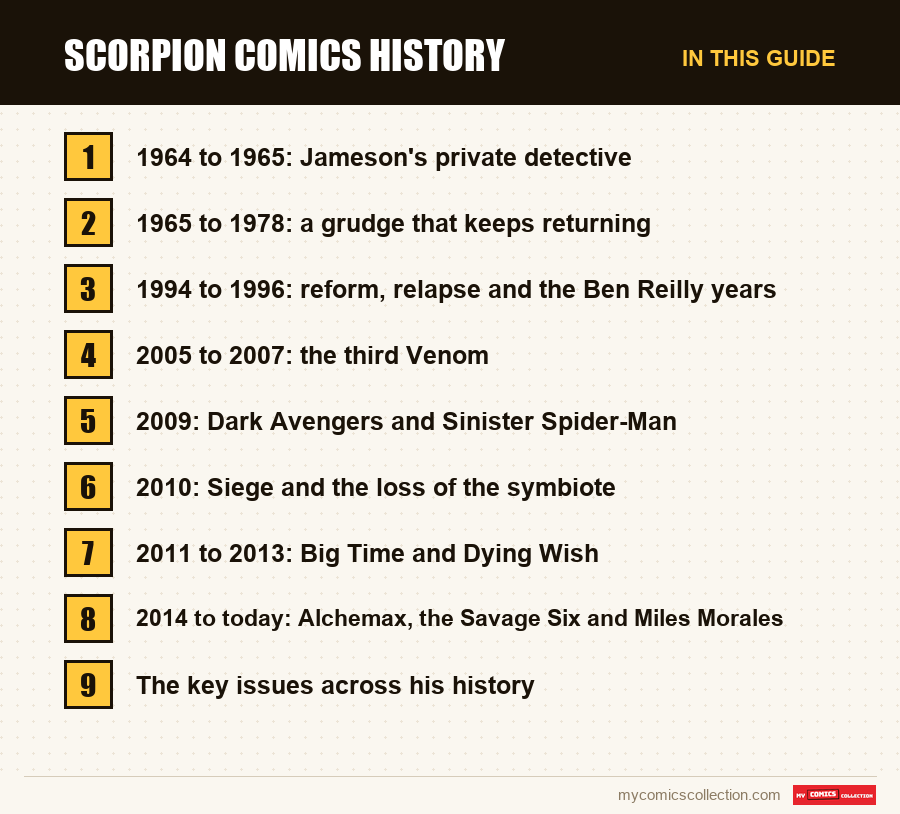
2010: Siege and the loss of the symbiote
Gargan is a regular in Dark Avengers from #1 through #16 (May 2010). In Siege #1 (March 2010) he joins the attack on Asgard, and in Siege: Spider-Man #1 (June 2010) he is forcibly separated from the Venom symbiote while fighting Ms. Marvel and Spider-Man. Without the symbiote, he is left to return as the Scorpion.
That sequence ends the Venom era in a few pages. The man who had been a team member, a headline name and a solo lead is back in a cell, with no symbiote and no team. For a collector, 2010 is the dividing line: the Venom books are one set, and the books after Siege are another.
2011 to 2013: Big Time and Dying Wish
The Big Time era of The Amazing Spider-Man finds Gargan in the Raft prison and brings the Scorpion back. In #650 (February 2011), Alistair Smythe breaks him out of the Raft, and in #651 (March 2011) he is fitted with a new Scorpion suit: bulletproof, with a scorpion-sense, and cybernetically wired into him, which makes him a cyborg. The Dan Slott hub follows the run in more detail.
The Scorpion of this period is a technological threat, not a mutated detective. In the Dying Wish storyline, issues #699 and #700 (February 2013), he answers Peter Parker's call to apprehend Otto Octavius, and Octavius breaks his jaw in #700. A metallic jaw apparatus follows in The Superior Spider-Man #11. For the body swap behind that finale, read the Doctor Octopus history.
The jaw is the detail to watch. It is an injury inflicted in 2013, fitted with a metallic apparatus the same year, and replaced by a new jaw from an employer in 2014, so it works as a marker for where a given issue falls in the character's timeline.
2014 to today: Alchemax, the Savage Six and Miles Morales
In Spider-Man 2099 volume 2 #3 (November 2014), Gargan gets a new jaw after being employed by Alchemax. In 2019, the Hunted storyline in The Amazing Spider-Man volume 5, issue #16 (April 2019), captures him for Kraven's Great Hunt, where he is grouped as part of the Savage Six. Gargan also appears in Absolute Carnage (2019) and in Ravencroft (2020), and in Venom volume 4 #25 (July 2020) he appears as "Virus."
More recently, the Scorpion is a foe for Miles Morales. Miles Morales: Spider-Man #1 (2022) sets up a rematch between them, and in volume 2 #6 (July 2023) he joins Agent Julia Gao's Cape-Killers during Carnage Reigns. In both, he is a mid-level threat with a long memory, closer to the original Scorpion than the Venom years would suggest.
Alternate versions are separate continuities. Exiles #26-27 (2003) has a heroic Gargan in the Heroes for Hire, killed by Magik, Spider-Man: Reign #1-4 makes him a member of the Sinner Six, Spider-Verse Team-Up #2 has him among Verna's Hounds, and Ultimate Comics: Spider-Man volume 2 #6 introduces Maximus Gargan, a Mexican mob boss. Treat them as side branches.
The key issues across his history
- The Amazing Spider-Man #19 (December 1964): Mac Gargan debuts as Jameson's private investigator.
- The Amazing Spider-Man #20 (January 1965): the Scorpion debuts after the Stillwell procedure.
- The Amazing Spider-Man #29 (October 1965): the return of his vendetta against Spider-Man and Jameson.
- Marvel Knights Spider-Man #10 (2005): Gargan appears as the third Venom.
- Dark Avengers #1 (2009): the Scorpion wears the Spider-Man identity on Osborn's team.
- Dark Reign: Sinister Spider-Man #3 (2009): his first solo series, by Brian Reed and Chris Bachalo, and the "medication" that changes the symbiote's form.
- Siege: Spider-Man #1 (June 2010): Gargan is forcibly separated from Venom.
- The Amazing Spider-Man #650-651 (2011): the Raft breakout and the new cyborg suit.
How to follow the Scorpion in a collection
Treat him as two collections. The first is the Silver Age villain: #19, #20 and #29, plus the stray appearances of the 1970s and 1990s. The second is the Venom and Dark Avengers sequence, which begins in Marvel Knights Spider-Man and ends in Siege. Which set matters depends on whether you collect Spider-Man's rogues' gallery or the Venom symbiote's hosts.
Two numbering pitfalls apply. Marvel Knights Spider-Man became The Sensational Spider-Man at #23, so check the title on the cover and not just the number. And Marvel reused the Dark Avengers title after the 2009 run, so check the cover year before filing an issue with Gargan's era. Our best Scorpion comics guide gives a shorter route, and the blog index lists neighboring histories.
Frequently asked questions
Mac Gargan debuts in The Amazing Spider-Man #19 (December 1964) as a private detective, and he becomes the Scorpion in #20 (January 1965). Stan Lee and Steve Ditko created him, and J. Jonah Jameson pays for the scorpion procedure performed by Farley Stillwell.
Gargan appears as the third Venom in Marvel Knights Spider-Man #10 (2005), then serves with the Thunderbolts and the Dark Avengers. The Venom years end around Siege, when Siege: Spider-Man #1 (June 2010) separates him from the symbiote and he becomes the Scorpion again.
Yes. In Dark Avengers #1 (2009), Norman Osborn introduces Gargan as the team's "Spider-Man" while he is Venom. He is a regular from #1 through #16 (May 2010), and Siege: Spider-Man #1 (June 2010) separates him from the symbiote.
In The Amazing Spider-Man #650 (February 2011), Alistair Smythe breaks Gargan out of the Raft, and in #651 (March 2011) he is fitted with a new bulletproof Scorpion suit with a scorpion-sense, cybernetically wired into him. The return is part of the Big Time era.
For the origin, read The Amazing Spider-Man #19 and #20 together. For the Venom years, begin with Marvel Knights Spider-Man #9-12 and continue into Dark Avengers. For the technological return, read The Amazing Spider-Man #650-651 and then the Dying Wish issues #699-700.
If you hold a copy of The Amazing Spider-Man #20 or an early Dark Avengers issue, you can have it valued before you decide how to keep it.
Estimate my comic