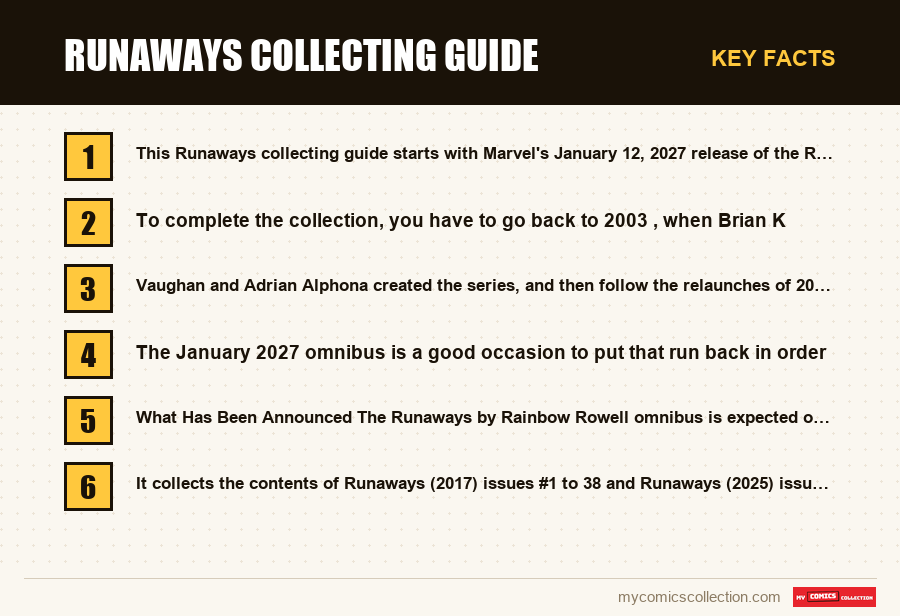
This Runaways collecting guide starts with Marvel's January 12, 2027 release of the Runaways by Rainbow Rowell omnibus, which collects the 2017 series (38 issues, with Kris Anka and then Andrés Genolet on art) and the 2025 miniseries (5 issues, with Elena Casagrande). To complete the collection, you have to go back to 2003, when Brian K. Vaughan and Adrian Alphona created the series, and then follow the relaunches of 2005, 2008 and 2015.
Teenagers who catch their parents in the middle of a criminal ritual: Runaways can be summed up in one scene, yet the series has lasted more than twenty years, across six successive volumes. The January 2027 omnibus is a good occasion to put that run back in order.
For the omnibus, we rely on bookseller listings and the specialized press. The volume history comes from the series' reference page, and the buying advice is our own analysis, with no panels or dialogue reproduced.
What Has Been Announced
The Runaways by Rainbow Rowell omnibus is expected on January 12, 2027, according to listings from booksellers and specialized sites, which have carried it since the spring of 2026. It collects the contents of Runaways (2017) issues #1 to 38 and Runaways (2025) issues #1 to 5, for a total of 43 issues. The standard cover is by Kris Anka, the artist who launched the 2017 series. A variant cover by Adrian Alphona, the series' co-creator, is reserved for comic shops. The publisher's listing gives 1,040 pages.
The contents come down to two Rainbow Rowell series. The first, launched in 2017 with Kris Anka, ran until 2021. Andrés Genolet then took over much of the interior art, with David Lafuente and Natacha Bustos also contributing. The second, Runaways (2025), is a five-issue miniseries drawn by Elena Casagrande, tied to the One World Under Doom event. Those five issues are also announced in another omnibus, the one for the event itself, expected on March 9, 2027.
So this is not a complete collection. The specialized press describes it as the equivalent of a third omnibus volume, in a line whose second volume has not been published. Above all, remember what it does not contain: neither the Vaughan and Alphona years, nor Joss Whedon's final arc, nor the in-between period from 2008 to 2015.
Point 1: 2003, the Series by Brian K. Vaughan and Adrian Alphona
The series was born in 2003 under Marvel's Tsunami banner, aimed at a young audience. Brian K. Vaughan writes, Adrian Alphona draws. In issue #1, six teenagers join the scene: Alex Wilder, Nico Minoru, Karolina Dean, Gertrude Yorkes, Molly Hayes and Chase Stein. Old Lace, Gert's companion, arrives in issue #2. Topher appears in issue #7 and Leapfrog in issue #18, in late 2004.
This first series runs 18 issues and stops in 2004, after which the success of the trade paperbacks in bookstores justified a revival. That detail matters when you buy: the 2003 series is short, so it is easy to inventory, and each of its eighteen issues should be hunted with the same attention to printing and condition.
For the collector, issue #1 is the reference point of the entire series: first appearance of six characters, start of the saga. Check the printing, the cover and the condition of the spine before buying, and reread our guide on telling a first printing from a reprint if the listing says nothing.
A word on reading: the 2003 series reads in one sitting, and the eighteen issues form an almost complete story, from the parents' secret to the team's flight. If you are discovering the series, this first set is an honest entry point. It requires no prior reading, which is not true of the later relaunches, which assume you know the characters' past and their ties to the Marvel universe.
Point 2: 2005 to 2008, the Second Series and the Departures
The revival launched in 2005 and runs 30 issues until 2008. Vaughan and Alphona stay through issue #24, and Joss Whedon then writes an arc that closes the series. Several notable characters arrive in this period: Victor Mancha in issue #6, in 2005, Xavin in issue #17, in 2006, and Klara Prast in issue #30, in 2008.
These first-appearance issues matter for a character-based collection: issue #6 for Victor Mancha, issue #17 for Xavin, issue #30 for Klara. They do not belong on the same rung as the 2003 issue #1, but they complete the picture for anyone following one character in particular.
The Vaughan and Alphona omnibus, published in 2018 (1,072 pages), covers the 2003 series and issues #1 to 24 of the 2005 series, for a total of 42 issues. Joss Whedon's arc, issues #25 to 30, is not in it. Our article on entry points into Brian K. Vaughan's work places Runaways among his major series. The collected edition is the simplest way to read this period in one go, while single issues remain the choice of anyone who wants to keep the period artifact.
Point 3: 2008 to 2015, the In-Between Series
This is the least well-known period, and the one the January 2027 omnibus leaves aside. The third series, launched in 2008, runs 14 issues until 2009. Terry Moore and Humberto Ramos open it, and then Kathryn Immonen and Sara Pichelli take over starting with issue #11. Marvel ended it in 2009.
The fourth series appears in 2015: four issues written by ND Stevenson and drawn by Sanford Greene, as part of Secret Wars. These two short series are shelved as complements to the rest. They run 14 and 4 issues, which makes them quick to inventory, and they sit outside the two omnibuses discussed in this article, as do Whedon's six issues.
It is more useful to identify what is missing than to buy at random. Before any purchase, draw up a list by volume: the 2003 series (18 issues), 2005 (30), 2008 (14), 2015 (4), 2017 (38) and 2025 (5). This inventory makes the gap between the two omnibuses visible, from issues #25 to 30 of 2005 through the 2015 series, and keeps you from paying twice for the same issues.
Do you collect this series?
Track what you own, what you are missing and what your collection is worth. 7-day trial.
Start my trial →
Point 4: 2017 to 2025, the Rainbow Rowell Era
The 2017 series relaunches Runaways with Rainbow Rowell on script and Kris Anka on art, announced in June of that year. It runs 38 issues and ends in 2021, with Adrian Alphona among the artists at the end of the run. Rufus appears in issue #6, in 2018, Gib in issue #18, in 2019, and the Doombot in issue #32, in 2020.
On the screen side, a series broadcast on Hulu from 2017 ran in parallel, and the comparison article linked at the top of the page sets the two versions side by side. For a buyer who discovers the series through the screen, the Rowell era is the most natural entry point, especially since the 2027 omnibus gathers it in one volume.
Rowell returns in 2025 for five issues drawn by Elena Casagrande, the first of which appears in June 2025. The series follows the Runaways in a world where Emperor Doom, that is to say Doctor Doom endowed with the powers of the Sorcerer Supreme, has taken power. A reprogrammed Doombot joins the team. Issue #1 exists in several variant covers: note the artist listed on the credits page to identify a copy. The five issues were already collected in February 2026 in the trade paperback Runaways: Think of the Children.
What This Means for a Collector
Before getting into detail, one observation: an omnibus announcement shifts attention toward the collected edition, but the original 2003 and 2005 issues remain the ones that define the core of the collection. The two approaches are not in opposition.
The January 2027 omnibus reshuffles the choice between single issues and the collected edition. Here are the concrete methods for finding your way.
Choose by period, not by title. The two omnibuses complement each other without overlapping: the 2018 one covers the Vaughan and Alphona years through issue #24 of 2005, and the 2027 one covers the Rowell years. If your interest lies in the start of the saga, the first is enough; if it is the 2017 series, the second. Whedon's arc and the 2008 to 2015 period remain, at this stage, outside both volumes.
Avoid duplicate contents. The five 2025 issues are announced in both the Rowell omnibus and the One World Under Doom event omnibus. If you are following the event, check the table of contents before ordering either one: buying both means paying for those five issues twice.
Compare the collected edition and the single issue. An omnibus does not have the same status as a single issue: it is a hardcover book, easy to read but preserving neither the original cover of each issue nor the period advertising. Our guide on the omnibus and original issues details this trade-off, and our feature on preservation completes the picture for single issues.
Take care when storing big volumes. More than a thousand pages of coated paper is heavy: set the volume on its bottom edge or flat, away from a window, and open it gently so you do not weaken the binding. For a 2003 issue bought from a distance, ask for photos of the corners and the spine before you commit, then slip it into a neutral bag.
Note what you already have. Before the January 2027 omnibus, list the issues of the 2017 series that you own: if you already have the whole series, the collected edition only adds the five 2025 issues, which you should compare with the event omnibus so you pay for those issues only once. If you only own the beginning, note the issue where your collection stops, and the change of artist that follows Kris Anka's departure.
No figure to remember. The market for these issues moves with printings and condition, and this article gives no price guide. Always compare the same issue, the same printing and the same condition before you pay.
What Remains to Be Confirmed
The January 2027 omnibus is announced by booksellers and specialized sites. A book's release date can move, and several points are not settled.
- The presence of bonus pages and variant covers in the volume: the detailed table of contents has not been published yet.
- The existence of a collected edition for the 2008 to 2015 period: no announcement we have read mentions one.
- The precise contents of the One World Under Doom event omnibus: only the publisher's listing will be authoritative.
Frequently Asked Questions
The Runaways by Rainbow Rowell omnibus, expected on January 12, 2027, collects Runaways (2017) issues #1 to 38 and Runaways (2025) issues #1 to 5, for a total of 43 issues. The standard cover is by Kris Anka, the variant by Adrian Alphona. It does not contain the Vaughan and Alphona years, already published in a 2018 omnibus.
With the 2003 issue #1, by Brian K. Vaughan and Adrian Alphona, which introduces the six original characters. For a read in one go, the 2018 omnibus collects the 2003 series and the first 24 issues of the 2005 series. For the recent era, the January 2027 one collects the 2017 series and the 2025 miniseries.
Six volumes according to the reference history: 2003 (18 issues), 2005 (30), 2008 (14), 2015 (4, during Secret Wars), 2017 (38) and 2025 (5). On top of that comes one Infinity Comic arc. Each volume has its own numbering, so always specify the year when you search for an issue.
Yes, according to the listings we have read: Runaways (2025) issues #1 to 5 appear in both the January 2027 Rowell omnibus and the One World Under Doom event omnibus, announced for March 9, 2027. Check the table of contents before ordering to avoid a duplicate.
It depends on how you will use it. The omnibus is easy to read and gathers a complete run in one volume. Single issues keep the original cover and the period paper, but they take up more room and demand more condition checks. Many collectors take both: the collected edition for reading, the key issues for keeping.
Do you own a 2003 or 2005 issue of Runaways? Have it identified before adding it to your collection.
Estimate my comic