In a bound collection which takes place over several years, the first volumes remain available for a long time and the last ones disappear quickly. The August 30, 2026 report on the French market, in euros, only shows eight advertisements for the Urban Comics collection from the Rebirth period: too few to set a price level, enough to observe a difference. Volume 1 of the Batman series is asking for €10.00 and volume 11 of the same series for €49.90, with the “rare” mention written by the seller himself. Practical consequence: on a long collection, you must secure the end before the beginning.
A collector who enters into a bound collection almost always proceeds in the natural order: he buys volume 1, then volume 2, then the next, according to his budget and his finds. The process seems obvious, yet it is the opposite of what the actual availability of volumes recommends. The first volumes of a collection are printed when the publisher bets on it, when the press talks about it, when the public discovers it. The last ones came out years later, to a readership which had shrunk with each volume. The collector discovers the problem when he is on the tenth volume, that is to say at the precise moment when he has invested the most and when it is most difficult for him to give up.
This text is based on a survey carried out on August 30, 2026 on the market français, with amounts expressed in euros: which is not usual for this site, most of whose statements concern American issues denominated in dollars. This difference is not cosmetic: a French bound volume and an American booklet have neither the same distribution method, nor the same lifespan in bookstores, nor the same second-hand market. The figures cited below are amounts claimed by sellers as of this date, no transactions concluded. No one has paid these amounts in front of me, and a requested amount remains a request until a buyer has honored it.
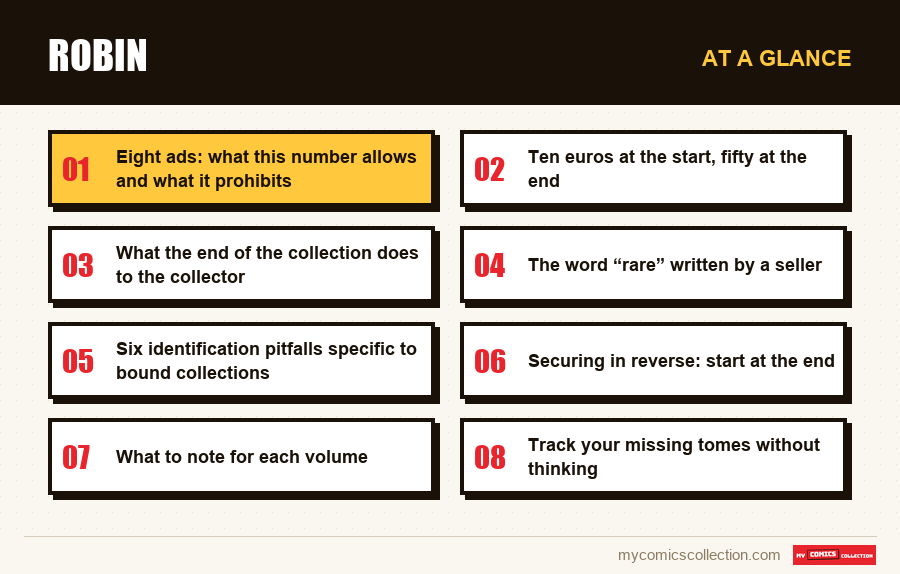
Eight ads: what this number allows and what it prohibits
The query was for the Batman Urban Comics volumes from the DC Rebirth period. She returned eight ads. Eight. For a collection widely distributed in France, in a country of several tens of millions of inhabitants, this is a derisory number. I therefore refuse to draw a price level: on eight lines, the median raised at €42.45 does not describe anything stable, and the maximum at €550.00 reflects the hope of an isolated seller much more than a market price. The minimum, €10.00, is just as unrepresentative taken alone. Furthermore, none of these eight announcements related to a copy that had undergone an independent verification procedure: in this segment, verification by a third party is simply absent, which deprives the reader of the only benchmark that would allow two volumes to be compared in equal condition. The reading having been made on a single date, it does not show by construction any movement: to speak of an increase or a decrease would be to invent a second measurement which does not exist.
Ten euros at the start, fifty at the end
Volume 1 at €10.00
The ad “Batman Rebirth Volume 1: My name is Gotham: DC Comics (Urban)” costs ten euros. This is the lowest amount of the eight lines of the statement, and it relates to the opening volume: the one that every new reader is looking for, therefore the one that the publisher has printed the most and that the greatest number of homes have today.
Volume 11 at €49.90
The ad “Batman Rebirth volume 11 The Fall and the Fallen: Urban Comics DC RARE” is asking €49.90, or almost five times the opening volume. Two ads do not prove a rule and I do not claim otherwise; but the gap is clear and the most ordinary explanation is also the most banal.
Another volume 1, at €15.00
“Nightwing Rebirth, Volume 1 - Stronger Than Batman, DC Urban Comics 2017” costs fifteen euros. This is the opening volume of a autre series from the same collection: again, a first volume, again, a low amount. The pattern repeats from one series to the next.
A volume 6 in the middle of the ford
“JUSTICE LEAGUE VOLUME 6 THE JUSTICE TRIAL: DC REBIRTH URBAN” is asking €12.99. An advanced volume is therefore not mechanically expensive: the position in the series does not explain everything, and I am careful not to make it a law. It would take dozens of announcements per series to decide.
The most probable mechanism behind this discrepancy is not mysterious and does not require any theory: a publisher adjusts its print runs to the demand it observes. A collection loses readers with each volume: some lose the plot, others the budget, still others waiting for an opportunity that doesn't come. The publisher prints accordingly, and the last volume of a cycle comes out in a number of copies out of all proportion to the first. I don't have no draw number for this collection, no editorial document, no printer's declaration: this reasoning describes a general mechanics of the book, it does not measure this specific case. It simply explains why the second-hand rarity of a late volume surprises no one in the profession.
A claimed amount is not a prize. The eight announcements from August 30, 2026 say what sellers hope to obtain that day on the French market; they do not say what a buyer has agreed to pay, nor what the same volume will be worth the following month. A single date produces no trend.
And eight ads, on a collection distributed nationally, is too small a number to establish a price level. Consider the difference between an opening volume and a late volume as an observation to verify, never as a scale to apply to your own purchase.
What the end of the collection does to the collector
The imbalance between the start and end of the collection does not just impact a price: it changes the very nature of research. Finding a volume 1 is a matter of simple attention: it circulates, it hangs around in second-hand bins, it comes out in the weeding lots of personal libraries. Finding a late volume is a matter of foresight: you have to be present the day it appears, decide quickly, and accept an amount that you haven't had time to compare to others. It is not the same activity, and the collector who approaches the end of his collection with the reflexes of the beginning finds himself in difficulty without understanding why.
Then there is an engagement effect that needs to be spoken about frankly. After ten volumes purchased, the idea of giving up is more psychologically expensive than paying for a missing volume above your estimate. The collector knows he is trapped and pays anyway, because a collection that is incomplete except for a single volume seems worse to him than a complete collection paid too much. This reasoning is human, it is also exactly what an informed seller anticipates when setting his amount. The word “rare” written in an advertisement title is addressed to this collector, not to the curious reader.
The third effect is more discreet: it concerns the pace of purchase. Many collectors spread out their acquisitions to smooth out the expense, which is reasonable on the budget side and expensive on the availability side. Each month of waiting on late volume is a month in which residual stock flows without being restocked. The opening volume does not go out of print in the same way: it is reprinted when the publisher wants to recruit new readers, which puts copies back into circulation and, ultimately, second-hand. The two ends of the collection do not follow the same clock.
Finally, the end of the collection is also where identification becomes difficult. The first volumes are documented everywhere, cited in guides, recommended to newcomers. The last ones are much less so, and the collector who seeks to verify what he is missing must reconstruct the list himself. It’s inventory work, not reading work, and this is precisely where written follow-up, whatever its medium, changes everything. If you want to understand how these series relate to each other before getting started, the editorial history of Batman in comics gives the framework in which these French collections are placed.
The word “rare” written by a seller
The announcement for volume 11 contains the word "rare" in capitals. It must be taken for what it is: an assertion by the seller, made by him, in his own title, without any third party attesting to it. No verification body intervened on this copy: the statement confirms it, there was no verified copy among the eight advertisements. The word therefore does not refer to any measurement: neither a known number of copies, nor a sales count, nor a public index.
That doesn't mean he's lying. It most likely describes a reality that the seller observes on his own scale: he sees few volumes 11 passing by, he offers one, he points it out. This is a supply difficulty, and it is plausible in view of all of the above. But a difficulty of supply and a measured scarcity are two different things, and the second alone would justify a lasting price gap. As it stands, the reader should read this word as a sincere sales pitch, not as a given.
The right reaction is therefore neither to believe nor to reject. It's about checking availability yourself: how many copies of this specific volume are offered at the moment, at what amounts, and how long these announcements have been online. A single ad that doesn't move for months tells a different story than one that disappears in two days. This control does not require any expertise, only regularity.
Collecting this series?
Track what you own, what you are missing and what your collection is worth. 7 day trial.
Start my trial →Six identification pitfalls specific to bound collections
The volume number alone does not locate anything
Several different series share the same collection name, and each restarts its numbering at one. “Volume 1” is therefore not an address: there are at least two in the list, one for Batman, the other for Nightwing. Without the series name, the number locates nothing.
The year is not that of the story
One advert is marked 2017, another 2024-2025. These dates refer to the French edition or the period covered, not necessarily the same thing from one announcement to another. Always note the year of the object you are holding, as printed on it.
The proper title is the best key
“My Name is Gotham”, “The Fall and the Fallen”, “The Trial of Justice”, “Stronger Than Batman”: each volume has its own title. It is the most reliable identifier, because it depends neither on the French numbering nor on the original numbering.
Two numberings coexist
A bound volume brings together several episodes which have their own original numbering. The French volume number and the original numbers do not correspond term to term, and confusing the two is the most common source of error when counting what is missing.
The length of the series is a given
Knowing that a volume is the eleventh says nothing as long as we know how many volumes the set contains. Eleventh out of twelve and eleventh out of thirty do not describe the same position, nor the same difficulty to complete. This information is noted in the same way as the price.
Collection name is not a series
Batman, Nightwing, Justice League, Future State Batman: four distinct entries under the same editorial banner in the statement. Treating the collection as a single series leads us to believe that we have a continuous sequence while we pile up fragments of parallel series.
Securing in reverse: start at the end
The practical consequence of all of the above is frankly counter-intuitive, and that's what makes it useful: on a long collection, these are the latest volumes that must be secured first. Not because they are better, but because they are the only ones whose future availability is uncertain. The first ones will still be there in two years, at a probably modest amount, because they were printed in large numbers and there is nothing to make them disappear from the second-hand circuit.
Concretely, this means reversing the purchase order without reversing the reading order. There is no obligation to read a volume as soon as you buy it. A collector who spots a late volume at an acceptable price has an interest in picking it up immediately and putting it on the shelf, even if it means not reading it until two years later, when he has caught up with the middle volumes. The cost of this strategy is tying up cash; its benefit is to never find yourself having to pay for a volume at any amount because it no longer shows up.
This logic is all the more valid as the collection is long and its publication spreads out. On a set of two or three volumes, the question does not arise. On a set that spans several years and more than ten volumes, it becomes the structuring decision of the entire collection. And it supposes, to be applied, to know at all times what we have and what is missing: without an inventory kept up to date, we cannot seize an opportunity, because we do not know if it is one. Those who first seek to limit spending will find additional guidelines in our article on buying Batman at a low price.
What to note for each volume
The name of the series and that of the collection, separately.“Batman” and “Nightwing” are two series; “Urban Comics” and the Rebirth period designate the editorial group that hosts them. Writing both in two separate fields is the only way to avoid confusing volume 1 of Batman, which costs €10.00, with that of Nightwing, which costs €15.00. An inventory that only records “Rebirth volume 1” is already unusable after three series.
The volume number accompanied by its proper title. Note “volume 11. The Fall and the Fallen,” never “volume 11” alone. The proper title survives everything: it remains correct even if you get the series wrong, even if the original numbering escapes you, even if the advert you consult is poorly written. This is the key to recognizing a volume in an announcement written in capitals and abbreviated, which is the case for several lines of the statement.
The place of the volume in a set whose length you know. Note "11 of N", not "11". As long as N remains unknown, you can neither measure your progress nor decide which volumes to secure as a priority. Establishing this length requires a bit of work up front, and that work is exactly the work that will keep you from discovering by the tenth volume that the whole thing is double that length.
The publisher and year carried by the object. The same series can have several successive presentations, and two volumes with the same number are not necessarily the same book. The mentions noted in the announcements (2017 for Nightwing, 2024-2025 for Future State Batman) show that these dates circulate in the titles without being standardized. Copy the one that appears on your copy, not the one from the ad that sold it to you.
The amount actually paid, including shipping. A volume purchased for €49.90 plus ten euros of shipping cost you nearly sixty euros, and it is this figure that must appear in your inventory. Without the port, your future comparisons are distorted by a margin which, on heavy volumes shipped individually, is not anecdotal. Also note the date of purchase: this is what will later give meaning to your amounts, since, as we have seen, a single measurement says nothing.
The usual explanation lies in circulation: a publisher prints according to the demand he observes, and a collection loses readers with each volume. The last volume of a cycle is therefore released to a narrower audience than the first, which leaves fewer copies in circulation a few years later. I have no circulation figures for the observed collection: this mechanism describes the general functioning of the book, it does not measure this specific case.
No, and it must be said clearly. Eight advertisements on an entire national collection constitute far too small a number to establish a price level. Both the median of €42.45 and the maximum of €550.00 are based on too few lines to mean anything. These amounts are also sums claimed by sellers on a given date, not concluded sales, and no copy verified by a third party appeared in the statement.
This word is an assertion by the seller, not attested by a third party. It probably describes a real supply difficulty, observed at the scale of this seller, but it is not based on any public measurement: neither a count of copies, nor a sales record. Treat it as information to verify for yourself, by looking at how many copies of the same volume have been offered and for how long.
By the name of the series, never by the number. The same collection contains several series, each numbered starting from one: the statement contains a volume 1 of Batman and a volume 1 of Nightwing, at different amounts. The proper title of the volume definitely removes the ambiguity, since it is unique within the collection and appears in almost all advertisements.
Against intuition: first secure the late volumes, which there is no guarantee of finding, and leave the opening volumes for later since they remain widely available. The order of purchase does not have to follow the order of reading: a volume can wait months on a shelf before being read. This strategy requires keeping an up-to-date inventory, otherwise you will not be able to recognize an opportunity when it presents itself.
Track your missing tomes without thinking
My Comics Collection records for each volume the series, the collection, the volume number, its proper title, the publisher, the year and the amount paid including shipping. You see at a glance what you're missing at the end of a collection, when it still matters. To go further into the figures of the universe, see also the story of the Joker in comics and our comparison between the Batman movie & Robin from 1997 and the comics.