In short
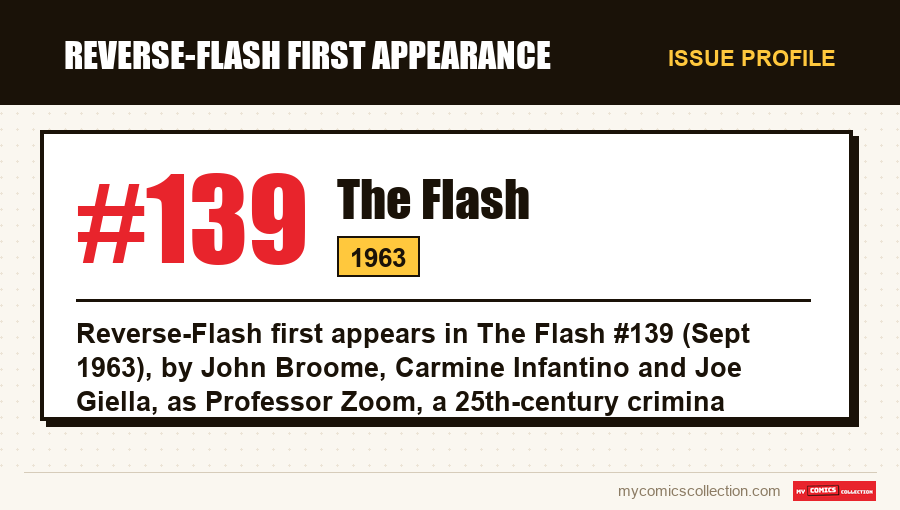
Reverse-Flash, written in the issue as Professor Zoom, makes his debut in The Flash #139, cover dated September 1963. John Broome scripted the story "Menace of the Reverse-Flash," Carmine Infantino penciled it, and Joe Giella inked it. The villain is a lawbreaker from the 25th century who borrows the hero's old uniform as a power source. His real name, Eobard Thawne, arrives later, in issue #153 from 1965.
Most collectors who search for this book already know the face on the page: the yellow suit, the red lightning, the mirror image of Barry Allen. What they want to pin down is the exact issue, the credits behind it and the point where the character stops being a one-story rival and becomes a permanent part of the Flash mythology. The Flash #139 is that point, and it deserves to be read as a specific comic book, not only as a line item on a checklist.
For this guide the cover date, the story title and the credits for issues #139 and #153 were checked against several reference pages, and the later milestones were checked for creators and dates. Everything about buying and grading is method, not market data.
The identity of the issue: date, credits and story title
The Flash #139 carries a September 1963 cover date and sits in the first volume of the title, the run that Barry Allen led after the character was revived at the end of the 1950s. The lead story is "Menace of the Reverse-Flash." The writer is John Broome, the penciler is Carmine Infantino, and the inker is Joe Giella. Broome and Infantino also return for the next appearance that matters, issue #153, which makes the early Reverse-Flash material a coherent body of work from one creative partnership.
A word on the cover. It puts the villain's reversed costume in front of the reader, and it is the design that sells the issue on a rack or a shelf. When you hold a copy, judge the cover by looking at it: the colors, the registration and the remaining gloss tell you more than any listing line, and the interior credits above are the ones to quote.
How the villain is introduced in the story
The setup is a time-travel crime story of the kind The Flash did well in the early 1960s. A criminal from the 25th century finds an old Flash costume, a relic from the hero's era, and uses advanced science to turn it into the source of a speed power. The twist that gives the character his name is cosmetic and conceptual at once: the powers come out mirrored, and the costume reads with the colors flipped, yellow where Barry Allen is red. He calls himself Professor Zoom, and Barry Allen defeats him by the end of the story.
That is the original version, and it is simpler than the character most readers know today. There is no tragic obsession with a hero he idolizes yet, no cosmic curse, no plan to erase Barry's family. The story reads as a clever adventure with a conceptual hook: what if someone had the Flash's speed and none of his scruples? The hook is the reason the idea survived. Later writers could keep the costume, the time travel and the rivalry, and rebuild the psychology around them without breaking what the 1963 issue established.
Broome, Infantino and the editorial climate of 1963
John Broome and Carmine Infantino are credited as the creators of the character, and the pairing is well established in this title: Infantino drew the series from its earliest numbers in the revival, and Broome was one of its main writers. The villain fits the pattern of their collaboration on the Flash, where an idea would be built on a clean visual contrast and then resolved with a scientific or logical twist. Mirror-image costumes are exactly that kind of idea, readable from across a room.
The context matters for understanding why this character stayed. In 1963 the Flash's rogues were already a famous gallery, and each villain tended to have a gimmick, a theme and a weakness. Professor Zoom was different in one structural way: he was built as a reflection of the hero, not as a thematic opposite such as cold against heat. That meant he could be reused in any story about speed, time or identity, and writers kept returning to him. You can see the effect in the appearance list that follows: issue #147 in 1964, issue #153 in 1965 and issue #165 in 1966, the wedding story "One Bridegroom Too Many!", all bring the villain back during the same creative era.
Why #139 is a key issue and what followed
A debut is a key when later stories make it matter, and the Reverse-Flash has been given plenty. A return came in issue #147 from 1964. Further along, in 1965, comes the story that supplies the civilian name Eobard Thawne. In the Bronze Age the character kept appearing in The Flash and in team titles, and the long arc of the early 1980s led to issue #324, dated August 1983 and titled "The Slayer and the Slain," written by Cary Bates and drawn by Infantino, in which Barry Allen kills the villain after the murder of his wife.
Then the story keeps going. A six-part mini-series, The Flash: Rebirth, arrived between 2009 and 2010 with Geoff Johns writing and Ethan Van Sciver drawing, and Thawne sat behind the curtain of Barry's past once more. Flashpoint in 2011, written by Johns with Andy Kubert penciling, used the villain as the pivot of a whole event. And in 2017 The Button crossed Batman and The Flash, with Tom King and Jason Fabok on the Batman issues and Joshua Williamson and Howard Porter on the Flash issues. Each time the character returns, the debut issue gains new readers who want to see where it started.
The collector takeaway is that #139 is a debut with continuous demand behind it, not a one-time bump. The character has been revisited by the main line of DC publishing in every generation since the early 1960s, and the television appearances of the character in recent years have kept that audience wide. That demand lives mostly on one book. For the broader story of how the character evolved, the companion article on Reverse-Flash in comics covers the full timeline; this page stays on the issue itself.
Do you collect this series?
Track what you own, what you are missing and what your collection is worth. 7-day trial.
Start my trial →
Who is who: the names that get confused with this book
The Reverse-Flash name has been used by more than one character, and listings mix them up all the time. Eobard Thawne, the 1963 character, is the original. Hunter Zolomon, called Zoom, is a separate man who became the nemesis of Wally West in the volume-two era. Daniel West, a figure from the 2010s era of The Flash, is another character to carry the Reverse-Flash name. Inertia, whose given name is Thaddeus Thawne, is yet another figure who shares the surname; he was introduced in the Impulse series in 1999. None of these is the subject of the September 1963 book.
The confusion usually comes from the name "Zoom," because Professor Zoom is the 1963 villain's alias, while Zoom without a title usually points to Hunter Zolomon in modern listings. If a seller writes "first Zoom" without a year or a volume, ask which one. A title that says "first Reverse-Flash" without naming a character is just as vague. The copy that satisfies the original debut search is The Flash volume one, issue #139.
Reprints, collected editions and where else the story shows up
Readers who only want to read the story, not own the original, have options. The early Reverse-Flash stories have been collected in trade paperbacks and hardcover volumes devoted to the Silver Age Flash, and the character is also summarized in modern origin stories that retell the 1963 debut in new art. These are separate products, and a reprint of the story is not the same as the first printing of the comic book.
For collectors, the practical difference is simple. A collected edition lets you read "Menace of the Reverse-Flash" in clean modern print, and it does not carry the cultural weight of the original issue. If you plan to own the original eventually, reading the collected version first is a cheap way to confirm that the story is what you want. If you plan to own only the story, you can stop there.
What to check before you buy a copy
The first check is identity. Start by matching the series name, volume, number and cover date printed on the book, then hold the cover layout up against a reliable photo. The second check is condition. Silver Age books of this period are printed on newsprint-style paper, and the typical problems are spine stress, color breaks along the fold, corner wear, small tears at the edges and cover gloss that has dulled. Look at the spine first, because a wide, clean spine with no stress lines is the clearest sign of a well-kept copy.
The third check is restoration. A copy with color touch, tear seals, spine repair or cleaned pages can look attractive in a photograph and sit in a different category from an unrestored copy of the same visual grade. If a seller calls a copy "high grade," ask for photos of the spine, the corners, the staple area and the interior pages, and ask directly whether the book has any restoration. A graded copy in a sealed holder carries a label that states the grade and, for a restored book, a restoration notice, so read the label and not only the grade number.
The fourth check is method for valuation. Because prices for a key like this move with grade and with demand, do not rely on a single sale. Line up a handful of completed sales for that grade and that holder brand, with the date written next to each. For label reading, see the Flash CGC grading guide, which shows how a small grade step changes the picture. A quick way to turn that comparison into a working number is to estimate the book against sold copies before you commit.
The next appearances worth tracking
If you are building a Reverse-Flash set, a short list of issues covers the character's most important moments. After #139, the next steps are issue #153 from 1965 for the name Eobard Thawne, and issue #324 from 1983 for the death story by Cary Bates and Carmine Infantino. On the modern side, Johns and Van Sciver's Rebirth mini-series reopens Barry's history, and Johns with penciler Andy Kubert turns that history into the engine of Flashpoint.
The collected view of those later issues sits in the guide to Flashpoint key issues, and the Zoom confusion is covered in the reading guide to the best Zoom comics. A sensible order for a limited budget is to decide first whether you want the debut, then the name reveal, then the death story. The debut is the anchor of any collection of this character; the other three are the books that explain why.
Frequently asked questions
The debut of Reverse-Flash, presented as Professor Zoom, is in The Flash #139, cover dated September 1963. The story is titled "Menace of the Reverse-Flash." It is the original character, Eobard Thawne, and not Hunter Zolomon, who is known as Zoom and belongs to a much later era of the series.
John Broome and Carmine Infantino are credited as the creators of Eobard Thawne. Broome wrote the story in The Flash #139, Infantino penciled it, and Joe Giella inked it. Broome and Infantino returned for issue #153 in 1965, where the civilian name Eobard Thawne is given to the character.
No. Issue #139 presents the villain as Professor Zoom. The civilian name arrives later, in a 1965 story, issue #153. Owning the debut therefore does not cover the naming story.
Eobard Thawne is the 1963 character. Hunter Zolomon, the man behind the Zoom name today, is tied to Wally West. Daniel West belongs to the 2010s era of the series. Inertia, Thaddeus Thawne, debuted in Impulse in 1999. Check the cover date and volume on every listing before you buy.
Read the label for the grade and for any restoration notice, then compare the slab photos with the cover details: spine stress, color breaks, corners and staples. Compare several sold copies at the same grade from the same grading company, and note the sale dates, before treating any single result as a benchmark.
Holding a Silver Age Flash with a mirrored yellow villain on the cover? Run its details through the estimator before you decide what to do with it.
Estimate my comic