
In short
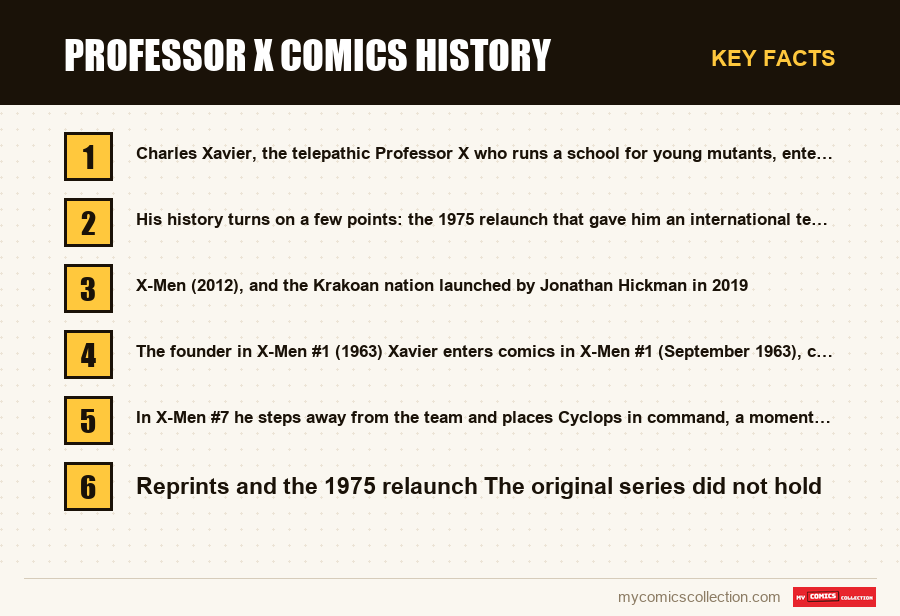
Charles Xavier, the telepathic Professor X who runs a school for young mutants, entered comics in X-Men #1 (September 1963) from Stan Lee and Jack Kirby. His history turns on a few points: the 1975 relaunch that gave him an international team, the Brood saga and Legion, Onslaught in 1996, Grant Morrison's New X-Men from 2001, his death in Avengers vs. X-Men (2012), and the Krakoan nation launched by Jonathan Hickman in 2019.
Charles Xavier has been the moral center of the X-Men for more than sixty years, and also the character the writers most like to complicate. A mentor who can read minds is a gift to a storyteller: every secret he kept, every boundary he crossed and every student he failed becomes material for a later run.
Issue numbers, creator credits and cover years in this timeline were confirmed against the Professor X publication record; what each era meant for the man himself is our reading, with no pages or dialogue reproduced.
The founder in X-Men #1 (1963)
Xavier enters comics in X-Men #1 (September 1963), created by writer Stan Lee and artist Jack Kirby. Kirby is credited as artist and co-plotter, and Lee cited the actor Yul Brynner as the physical inspiration for the character. The premise is plain: a telepathic professor in a wheelchair gathers young mutants at a school in Westchester and trains them to use their powers.
The same issue sets up the structure that the character would carry for decades. A mentor, a group of students and an adversary who shares his goals but not his methods. The adversary is Magneto, who appears in that same debut, and the relationship between the two men became the backbone of the franchise. You can follow it in our Magneto and Xavier key issues guide.
The early series gives Xavier a conventional role: he plans, directs and mentors, while the students carry the action. In X-Men #7 he steps away from the team and places Cyclops in command, a moment that signals how the book intended to treat leadership from the start. The professor is present, but the team is meant to learn to stand without him.
For a collector, this era is defined by the debut. That one issue introduces the team and the figures around it, which makes it a Silver Age landmark. Our first appearances guide breaks down what it introduces.
Reprints and the 1975 relaunch
The original series did not hold. The title fell back on reprints around 1970. New material came back in May 1975 with Giant-Size X-Men #1, and an international team arrived with it, courtesy of Wein and Cockrum. Chris Claremont took over the main title with Uncanny X-Men #94 (August 1975) and stayed for a sixteen-year stint.
For Xavier, the relaunch changes his function. In 1963 he is the trainer of a small group of teenagers. In 1975 he is the recruiter of a team drawn from several countries, and a mentor to adults and teenagers who do not share a background. The professor becomes a figure who stands behind a wider cast, and the books begin to explore what it costs him to ask people to risk their lives for his dream.
Numbering is the first trap for a collector here. The title became The Uncanny X-Men with issue #114 (October 1978). A second series titled X-Men launched in 1991 alongside the ongoing Uncanny series, so the same name belongs to different runs. Record the series and volume whenever you log an issue. The Chris Claremont author page covers the writer who defined this period.
Lilandra, the Brood and a new body
Under Claremont, Xavier's personal story expands. The book records a romance with Lilandra Neramani of the Shi'ar across Uncanny X-Men #105 to #109, along with later stories in the same stretch. The book gives him a private life of his own, away from the school and the students, and it reframes him as a man with desires and a future.
The Brood saga follows, across Uncanny X-Men #154 to #158 and on to #167. The Brood implant Xavier with an egg, and the resolution moves his consciousness into a cloned body. The physical change is significant: the body that had defined the character since 1963 is replaced, and the books treat it as a second start for him.
Then comes Uncanny X-Men #161 (September 1982), in the Claremont era, which shows that Xavier and Magneto knew each other before the X-Men existed. In Haifa, Xavier works with Holocaust victims, Magnus volunteers there, and Xavier meets Gabrielle Haller, the future mother of Legion. The earlier friendship of the two men is dramatized here, as our Magneto and Xavier guide explains. It matters because it turns the professor from a figure with no history into a man who made mistakes before the school existed.
Legion, a son and a death in the past
The Gabrielle Haller thread produces one of the most consequential additions to the character's story. Legion, David Haller, is Xavier's mutant son with Gabrielle Haller, a patient Xavier met at a psychiatric facility in Israel; she did not tell him she was pregnant. Legion appears in a cameo in The New Mutants #25 (March 1985) and in full in #26 (April 1985), written by Chris Claremont and drawn by Bill Sienkiewicz.
The son becomes a source of consequences for the father. In the Legion Quest crossover, which runs through Uncanny X-Men #320 and #321 among other issues, Legion travels twenty years into the past and tries to kill Magneto, and Xavier intervenes and is killed. His death creates the Age of Apocalypse timeline, which the X-Men Omega one-shot (June 1995) closes, with Bishop repairing it. It is one of several deaths in the character's history, and it sets a pattern: Xavier's mistakes, and his sacrifices, produce effects that outlive him.
For a reader, this strand is a useful way into the character because it condenses his flaws. A father who does not know he has a son, a telepath who failed to read the person closest to him, and a mentor whose past comes back through a child he never raised.
Onslaught and the cost of power
In 1996 the books turn the professor's own mind into the threat. A cameo of Onslaught appears in X-Men: Prime #1 (July 1995), and the full first appearance arrives in X-Men volume 2 #53, with Scott Lobdell and Mark Waid writing and Andy Kubert drawing. Onslaught was created from the subconscious of Xavier and Magneto: during a fight with Magneto's Acolytes, Xavier shut down Magneto's mind, and their negative emotions merged into a new entity.
The effect on Xavier is profound. Onslaught possessed him and kidnapped him, and the crossover ran through Avengers, Fantastic Four and The Amazing Spider-Man as well as the mutant books. It ended when several Avengers and Fantastic Four members sacrificed themselves by entering the energy field, which destroyed Onslaught; Heroes Reborn: The Return #4 (December 1997) later showed they had survived in a pocket universe.
What matters for the character is the shift in moral weight. Xavier had long been the voice of restraint against violent mutants. Onslaught makes him the origin of one, and the story forces readers to ask whether a man who uses his mind to shut down another has the right to lead. The telepath's ethics become the subject of the book, not the background.
Do you collect this series?
Track what you own, what you are missing and what your collection is worth. 7-day trial.
Start my trial →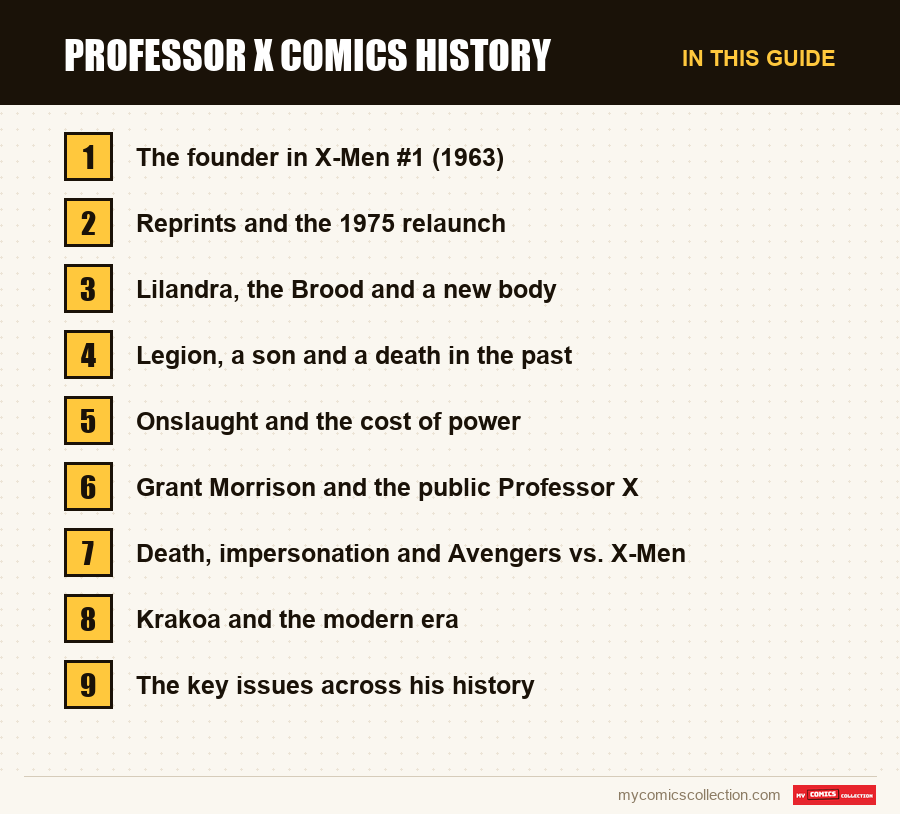
Grant Morrison and the public Professor X
Grant Morrison took over X-Men volume 2, retitled New X-Men from issue #114, and the book became the flagship X-Men title. The opening story, "E Is for Extinction" (2001), introduces Cassandra Nova, and it is Nova who outs Xavier as a mutant.
That public outing is a major shift in the character's position: his mutant status only became public during this 2001 story. For decades he had been a hidden figure who ran a school under cover; in Morrison's run he becomes a known one, and the school becomes a public institution. The change turns the X-Men from a secret team into a visible one, and it recasts Xavier as a public figure with public responsibilities.
Collectors tracking this era should note that the numbering carries on from the preceding volume of X-Men, so the series starts at #114 and not at #1. Our Grant Morrison author page lists the writer's other work, and the run is a natural place to continue after Claremont's period.
Death, impersonation and Avengers vs. X-Men
The late 2000s subject Xavier to repeated reversals. In the Messiah Complex crossover, in X-Men #207, Bishop shoots him in the head during the fight over the mutant child. In the following stretch, Mystique poses as Xavier in Uncanny X-Men #513 to denounce Cyclops while the real Xavier is held on Alcatraz. These stories keep him in play while stripping away his certainty.
The decisive event is Avengers vs. X-Men, the 2012 crossover that also ran through the main X-Men titles. In issue #11, Xavier confronts Cyclops and the others who side with him, and Cyclops kills him.
The killing matters because of who does it. Cyclops, one of his original five students, kills the teacher, and the books spend years working through the consequence. For the history of the character, it ends the model of mentor as unchallenged moral authority. A man who spent decades teaching restraint is killed by the pupil he trained, and the legacy becomes a question about what he really taught.
Krakoa and the modern era
Xavier returns to a changed franchise. House of X #1 (July 2019), written by Jonathan Hickman with art by Pepe Larraz, launches a new sovereign nation of mutants, Krakoa. Hickman scripted House of X and its companion Powers of X, drawn by R. B. Silva, two interlocking miniseries released from July to October 2019. The storyline turns Krakoa into a sovereign nation state for the entire mutant race, with Xavier at its origin.
The central device is the Five, a group of five mutants who can combine their powers to revive dead mutants, which lets Krakoa defeat death; Cerebro, fed by the regular backup copies of mutant minds that Xavier makes, gives each new body its mind back. For a character whose history is full of deaths and returns, the device is almost self-referential: the franchise builds a mechanism that explains why he, and everyone else, keeps coming back. The Krakoan Age runs from July 2019 to June 2024, and X-Men: From the Ashes followed in 2024.
The Jonathan Hickman author page covers the writer who built this period. Read as a whole, the Krakoan years move Xavier from the head of a school to the head of a nation, and the sequence is the clearest statement of what the books now believe he is for.
The key issues across his history
- X-Men #1 (1963): his debut, by Stan Lee and Jack Kirby, alongside Magneto and the original team.
- Giant-Size X-Men #1 (1975): the international team, by Len Wein and Dave Cockrum.
- Uncanny X-Men #154 to #158 (1982): the Brood saga, which implants Xavier with an egg and leads to his cloned body.
- Uncanny X-Men #161 (1982): Xavier's past in Haifa with Magnus and Gabrielle Haller, the future mother of Legion.
- The New Mutants #25 and #26 (1985): Legion, by Chris Claremont and Bill Sienkiewicz.
- X-Men volume 2 #53 (1996): Onslaught on the page in full, with Scott Lobdell, Mark Waid and Andy Kubert.
- New X-Men #114 (2001): the start of Grant Morrison's run and of "E Is for Extinction," the story that makes his mutant status public.
- Avengers vs. X-Men #11 (2012): Xavier is killed by Cyclops.
How to follow Professor X in a collection
The simplest method is to follow eras and not a single title. Anchor the collection with X-Men #1 if the budget allows, or a later reprint if it does not, then add the 1975 relaunch, the Claremont-era issues above and one book from each later period. The list gives a path through his history without needing every X-Men issue, and our X-Men reading guide places the larger runs.
Numbering needs care. The original title was renamed, a second X-Men series began in 1991, and New X-Men continues the numbering of that second series. Always log the series, volume and cover year together, and treat a bare issue number as ambiguous. The same applies to the Giant-Size and annual issues, which sit outside the regular numbering.
Finally, remember that Xavier is a supporting presence in many of the best-known stories and a central figure in only some. Decide whether you are collecting the character or the franchise, then keep a separate shelf for each. The blog index links related guides.
Frequently asked questions
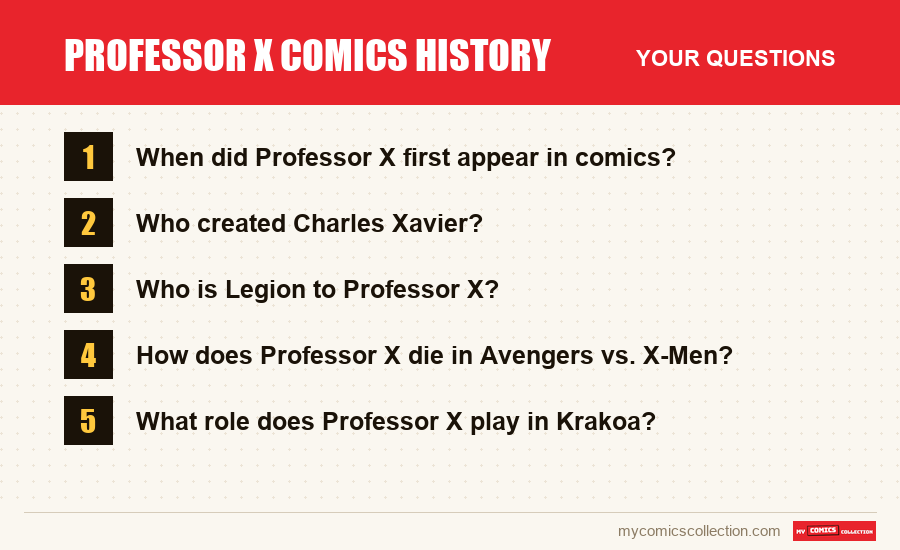
Xavier's debut carries the cover date September 1963: X-Men #1, from writer Lee and artist Kirby. The same issue introduced the original team and Magneto, which is why it is regarded as the foundation of the franchise and of his history as the founder of the school.
Stan Lee and Jack Kirby created him for X-Men #1 in 1963. Lee is credited as writer and Kirby as artist and co-plotter, and Lee named the actor Yul Brynner as the physical inspiration for the character.
Legion, David Haller, is Xavier's mutant son with Gabrielle Haller, whom Xavier met at a psychiatric facility in Israel. He appears in a cameo in The New Mutants #25 (1985) and fully in #26, written by Chris Claremont and drawn by Bill Sienkiewicz.
In issue #11 of the 2012 series, Xavier confronts Cyclops and is killed by him. The death of the founder at the hands of one of his original students is the turning point of that 2012 crossover.
In House of X #1 (2019), by Jonathan Hickman and Pepe Larraz, the story begins turning Krakoa into a sovereign nation state for the entire mutant race. The Krakoan Age ran from July 2019 to June 2024, and when it ends Xavier leaves for space with Lilandra.
If a Xavier landmark such as X-Men #1 or an issue from the Brood saga is in your collection, a free estimate shows where it stands.
Estimate my comic