The X-Men #1 carries a September 1963 cover date. Stan Lee writes the script, Jack Kirby provides the pencils and Paul Reinman the inks. The issue introduces at once Professor Xavier's school and its five students, Cyclops, Marvel Girl, the Beast, Iceman and Angel, and then pits them against Magneto. Collectors seek it because an entire team and its principal adversary are born in the same booklet.
Few 1963 issues concentrate as many first appearances into thirty-two pages. That is what makes buying this one tricky: the demand does not come from a single character, it comes from seven, and it adds up. When a film franchise pushes one of these faces back into the spotlight, the pressure carries over to the same booklet. A collector aiming for this issue is therefore not buying an object whose price depends on a single factor, but a piece pulled in every direction at once, which translates into enormous price gaps depending on condition and on the moment you sign.
As always in this guide, only verified information (creators, issue numbers, dates) is stated as fact. The analysis is ours, with no reproduction of panels or protected dialogue.
The issue: September 1963, Lee, Kirby and seven arrivals
The booklet opens at a school in Westchester, where a man in a wheelchair trains teenagers with innate powers. The main story sets up the educational backdrop, brings in a new student, and then swings into a military attack led by a man capable of manipulating magnetism. All of it is contained in a single episode: no origin spread over six months, no backup prologue. This compactness explains the documentary value of the issue, since no earlier booklet features any of these seven characters.
On the credits, the three names to know are Stan Lee on the script, Jack Kirby on the pencils and Paul Reinman on the inks. This pairing matters to the buyer, because Reinman inked some of the very first issues before other hands took over the series, so the graphic style of the early run is not that of the following year. Sellers who describe the series wholesale often mix up the periods.
The simplest identification detail remains the twelve-cent cover price, the standard for American production in 1963. It guarantees nothing on its own, but it immediately rules out a whole category of reprints, which carry higher prices.
The editorial context: a house under construction
In September 1963, the publisher was not yet publishing a universe; it was assembling one. The Fantastic Four were already two years into their series, Thor and Iron Man had just launched, and the studio was looking for repeatable formulas. The X-Men arrived in this wave, with a difference in construction: instead of a solitary hero with a founding accident, the publisher offered a group whose power was hereditary, under the guidance of a professor. The series told the story of a school before it told stories of fights.
This launch position had a direct effect on print runs. A new 1963 title did not benefit from the distribution of an established title, and the survival rate of a booklet bought by a twelve-year-old reader has nothing in common with that of a deliberate collectible. This is the classic equation of the period's keys: strong current demand, a reduced population of survivors, and within that population an overwhelming majority of read, folded, taped copies.
It should also be remembered that the series was not an immediate success. It lost momentum, moved to reprints at the end of the 1960s, then was revived in the mid-1970s. The rarity of this first issue is therefore not the product of launch hysteria, but of a title that was long considered secondary.
Why this issue became a key
Three mechanisms overlap. The first is the accumulation of first appearances: Professor Xavier, the five founding students and Magneto. No other booklet lets you tick these seven boxes, which makes it a mandatory stop for any thematic mutant collection.
The second mechanism is the trajectory of the characters. Magneto did not remain a situational antagonist; he became one of the most debated figures of the publisher, and Jean Grey went through a narrative transformation that durably broadened the franchise's audience. Each reassessment of one of these roles resonates on the issue where it begins.
The third mechanism is the position of the title in the hierarchy of 1963 keys. Collectors who work the period reason through lists, and this booklet appears on almost all of them. When a buyer completes the list of 1963 launches, this is often the one left, because it is the hardest to find in a presentable condition.
What moves the price: condition, edition, origin
For a booklet of this age, condition dominates everything else. The gaps between a read copy and a near-mint copy are measured in multiples, not percentages, and a single grade step can be enough to change the category of buyers. In practice, the market for this issue divides into three: complete reading copies, average copies that still hold together, and the handful of high grades that almost never circulate.
Three defects are especially costly here. The first is color loss on the solid areas of the cover, very visible across the background of this illustration. The second is staple restoration, common on booklets of this decade. The third is coupon or panel cutting, which some readers practiced, and which drops the copy into a category of its own regardless of its overall appearance.
Geographic origin also plays a part. Copies intended for the British market circulated with a price stamped in pence, and that mention changes how the booklet is classified. If you buy at a distance, request a clear photo of the price corner before concluding: a stamp cannot be made out in a twenty-pixel thumbnail.
Telling one edition from another
The series was widely reprinted, and that is the main source of confusion. After new stories stopped, the title lived for several years reprinting older episodes, between issues 67 and 93. A careless buyer can therefore hold a booklet with the same logo and the same team, but dated a decade later.
Beyond these periodic reprints, the first episode was republished in anthology collections, in a commemorative edition from the 1990s and, more recently, in a facsimile that deliberately reproduces the original cover, ads included. These facsimiles are honest objects, clearly identified in their indicia, but a face-on photograph does not distinguish them from the original. The rule is simple: if the seller does not show the indicia and the spine, assume you do not know what you are buying.
One last useful reflex is the paper. A 1963 booklet has a thickness, a smell and a yellowing that modern reprints do not imitate. On physical inspection, doubt clears in seconds; at a distance, it only clears with precise photos.
The switch from The X-Men to Uncanny X-Men
This is the point that costs hurried buyers the most money, and it deserves a full section. In the catalogue, the series launched in 1963 is titled The X-Men and stops at issue 141. From issue 142, another series takes over under the title Uncanny X-Men. The numbering carries on, but the registered title changes, and with it the record to which the issues are attached.
In practice, searching for "Uncanny X-Men #1" does not lead to the 1963 booklet. It leads to a different entry, and the spoken habit of calling the whole run "Uncanny X-Men" keeps the confusion alive. Listings thus offer an "Uncanny X-Men #1" that has nothing to do with September 1963, sometimes in good faith, sometimes not.
To file your collection correctly, remember the break: up to 141, The X-Men; from 142, Uncanny X-Men. Issue 141 is an easy one to remember, since it closes a two-part story whose second half already appears under the new title. The same two-part story therefore straddles two series in the catalogue.
Do you collect this series?
Track what you own, what you are missing and what your collection is worth. 7-day trial.
Start my trial →
The pitfalls at purchase
The first pitfall is trimming, meaning the edges are cut back to hide small tears. On a 1963 booklet, the original margins are irregular; edges that are too clean and too straight should trigger a check, not an impression.
The second pitfall concerns staples and the center fold. A copy that has been unstapled and restapled can look superb flat and collapse when opened. Ask for a photo of the open center section, where handling shows most clearly.
The third pitfall is semantic. The phrases "first X-Men," "first Magneto" or "origin of the mutants" are used to describe half a dozen different booklets, including relaunches numbered 1 that were published much later. Always require the exact title, issue number and cover date before discussing price.
The fourth pitfall is the illustrative photo. For pieces at this level, a generic catalogue image commits the seller to nothing. Request pictures of the actual copy, front, back and corners, taken without filters.
The neighboring issues that also matter
If the first issue remains out of reach, the following ones offer real entry points. Issue 4 introduces the Brotherhood of Mutants and with it the Scarlet Witch and her brother Quicksilver, two characters whose careers went far beyond the original series. Issue 12 launches the Scourge, issue 14 features the Sentinels, and issue 28 introduces Howler, who would later be recruited into the international team.
Beyond that, the mid-1970s relaunch changed the look of the series. Issue 94 marks the return of new stories with a renewed team, including Storm and Wolverine, the latter having appeared previously in another series of the publisher. This period is generally more accessible than 1963, while remaining structuring for a collection.
What grading changes
On this booklet, grading does not serve as decoration. It settles two problems a photo cannot: it documents any possible restoration, and it establishes a shared vocabulary between seller and buyer. For an object where the ratio between two adjacent grades is measured in multiples, that is the only ground on which a negotiation stays rational.
This does not mean you should refuse an unslabbed copy. In the middle and low grades, a complete and honestly described booklet sells very well without a holder, and the cost of the procedure is not always justified. The dividing line comes at the point where the asking price exceeds what you would be willing to lose if a restoration surfaced after the purchase.
If you buy a copy that is already graded, read the whole label, not just the number. The mention of restoration, cleaning or a missing page appears there, and it explains the listings whose price seems abnormally low for the grade shown.
Tracking it in a collection
In a serious collection, this issue deserves a detailed record rather than a single line. Record the title as it appears in the catalogue, The X-Men, issue 1, the September 1963 cover date, the condition, the presence of a price stamp, and the nature of the copy: original, periodic reprint or facsimile. These five pieces of information are enough to avoid the most costly duplicate errors.
Also think about the consistency of your shelving. If you follow the entire series, the move from 141 to 142 will split your run into two entries in the catalogue. That is not a defect, it is editorial reality, and the X-Men hub lets you keep both halves in view. A run recorded as continuous always ends up producing ghost gaps.
Finally, date your estimates. On a booklet this sensitive to adaptation news, a value noted two years ago no longer describes today's market, neither for insurance nor for sale.
Conclusion
The X-Men #1 of September 1963 remains one of the most demanding keys of its decade, less for its absolute rarity than for the difficulty of finding a copy whose condition and edition are both certain. Work in this order: identify the exact title, check the indicia and the spine, measure the condition, and only then discuss the amount. And keep in mind the break at 142, which turns a simple search into a false one if you ignore it.
Do you have a copy of the 1963 series, or an issue from the relaunch that followed, and want to know where it stands today?
Estimate my comic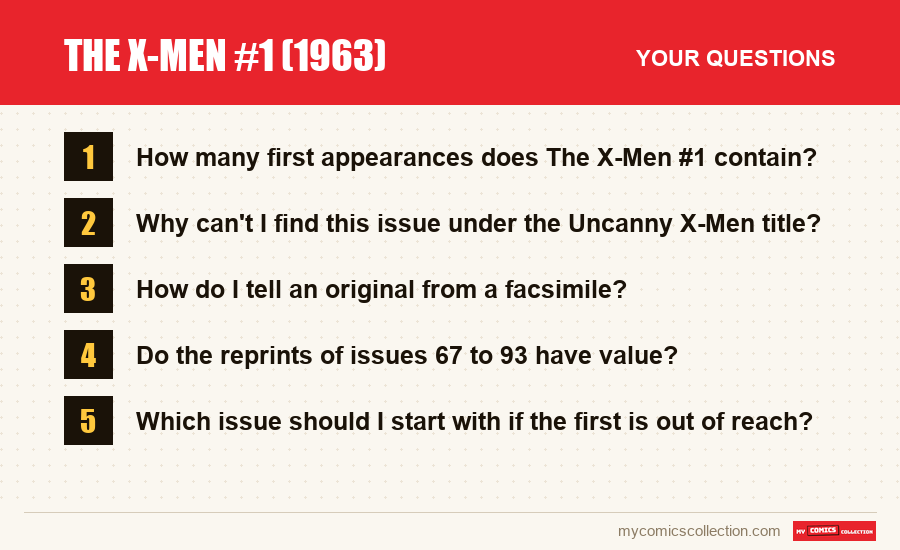
Frequently asked questions
Seven figures debut in it: Professor Xavier, Cyclops, Marvel Girl, the Beast, Iceman, Angel, and Magneto as the adversary. The accumulation of these in a single thirty-two-page booklet explains the demand, since no earlier issue offers any of them.
Because the 1963 series is called The X-Men and stops at issue 141. Uncanny X-Men is a separate series in the catalogue, which resumes the numbering at 142. Searching for Uncanny X-Men number 1 therefore leads to a different entry, never to the September 1963 booklet.
By the indicia and the paper, never by the cover, which the facsimile reproduces on purpose. An original from 1963 shows a twelve-cent price and characteristically yellowed paper. Require a readable photo of the indicia and the spine before any remote purchase.
They have reading value and a place in a complete run, but they do not replace the original episodes they reprint. Their main interest is to fill a series without paying the price of the first issues of the previous decade.
Issue 4, for the Brotherhood and the early appearances of Quicksilver and the Scarlet Witch, or issue 14 for the Sentinels. If you are aiming for the modern team, the relaunch with issue 94 offers an entry point that is much easier to find in good condition.