
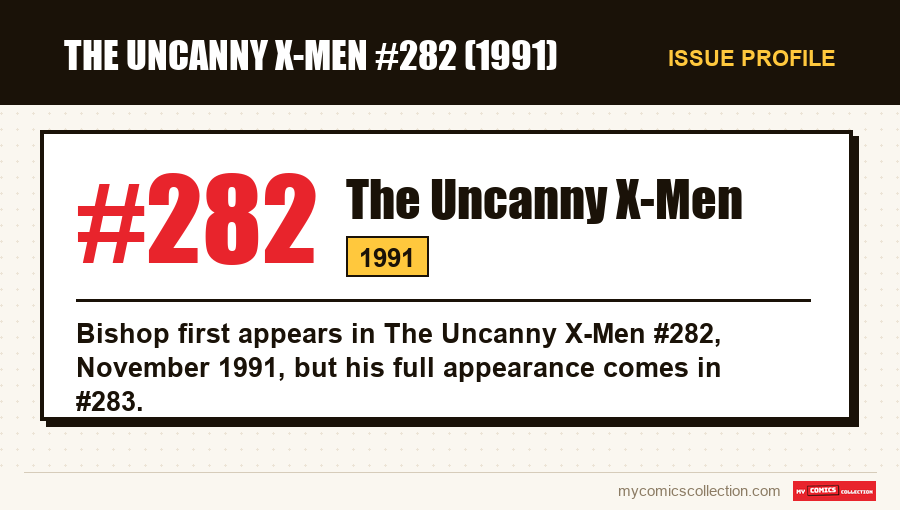
Bishop first appears in The Uncanny X-Men #282, dated November 1991, drawn by Whilce Portacio, inked by Art Thibert and written by John Byrne from a plot co-credited to Portacio. He occupies only the final pages: his squad surges in while chasing Trevor Fitzroy. His full first appearance comes in the following issue, which makes #282 a sought-after issue with a short appearance.
Buying this issue means choosing between two things that do not overlap: the first appearance, which is here, and the first truly readable appearance, which comes right after. A seller offering a #282 sells a precedence; a seller offering a #283 sells pages. Both are right, and that is exactly what makes this pair of issues unstable on the second-hand market. On top of that, there is a physical difficulty: #282 circulated in several cover treatments whose rarities are not equal, and many listings do not say which one is in the bag.
As always on this guide, only verified information (creators, numbers, dates) is stated as fact; the analysis is our own, with no reproduction of panels or protected dialogue.
What The Uncanny X-Men #282 actually contains
The issue carries the cover date of November 1991. Whilce Portacio pencils it, Art Thibert inks it, and John Byrne writes it, from a plot worked out with Portacio. This split matters to a collector, because it places the issue at a moment when the series had just changed creative teams, and because Portacio's signature is one of the resale arguments most often put forward in listings, sometimes more than Bishop himself.
The plot does not revolve around Bishop first. It follows Trevor Fitzroy, introduced shortly before in the series, and the mutant squad led by Storm. Bishop only enters at the very end, with two teammates, Malcolm and Randall, in the posture of a pursuer: he hunts Fitzroy, not the X-Men. He is seen neither for long nor in full light, and he does not introduce himself.
For someone who opens the copy hoping for a portrait of the character, the disappointment is real. For someone who collects first appearances in the strict sense, it is exactly what is needed: the character is there, named, identifiable, and no earlier publication contains him. This asymmetry between content and status is the heart of the matter.
Why the catalogue lists "The Uncanny X-Men" from 1981
If you look for this issue in the catalogue and do not find it under the name you expect, the reason is a registered title. The series appears under the title The Uncanny X-Men, and its indexed numbering starts in 1981 at number 142. #282 therefore sits within that sequence, not in an entry beginning at number 1.
The practical consequence is simple: a search for "X-Men 282" without the qualifier risks sending you to another homonymous series, and a manual entry in a collection can create a silent duplicate if you attach the copy to the wrong title. Check the title before validating, then check the year associated with the number.
This indexing detail also explains a good number of confusions between sellers and buyers. Two people can talk about the same object using two different series names, and wrongly conclude that they are not talking about the same comic.
How this issue became a key despite a brief appearance
A first appearance only acquires its value once the character becomes important, sometimes several years later. Bishop followed that path: first a tracker from the future, then a full member of the team, then the protagonist of long storylines that established him durably. Each step pushed demand back up toward the issue where he first appears.
There is also an adaptation effect. Each time the character is taken up outside printed pages, in animation or elsewhere, demand for #282 wakes up, then settles again. A collector who buys right after a media announcement almost always pays more than one who waits six months. This rhythm is anything but a smooth curve, and it is better to anticipate it than to suffer it.
Finally, the brevity of the appearance does not penalise as much as one might think. The market for first appearances rewards precedence before quantity of pages. However, that brevity fuels the selling argument of the following issue, and that is where the division of value is decided.
Sharing the value between #282 and #283
The #283 contains Bishop's first full appearance. The market therefore treats the two numbers as two distinct keys, not as a key surrounded by a neighbour. Both sell, both are sought after, and their values often move in the same direction without ever merging.
For a collector, three strategies are possible. Buy #282 alone, if your personal rule is strict precedence. Buy both, which costs more but closes the subject and makes a later resale as a lot easier. Or buy #283 alone, if you prioritise the readability of the character and accept not owning the very first occurrence.
What we advise against is buying one believing you are buying the other. Listings happily maintain the confusion with phrasings such as "first appearance of Bishop" attached to the #283, which is accurate from the standpoint of full appearance but misleading for someone looking for precedence. Read the issue number on the cover, not the title of the listing.
Newsstand or specialist shop: two objects, two scarcities
At that date, Marvel distributed its titles through two channels. Newsstand copies were sold through the general press network; copies intended for specialist shops went through dedicated distribution, with no possibility of return for the retailer. The same issue therefore exists in two versions, and their printed proportions are not comparable.
The distinction is read at the bottom left of the cover, in the space reserved for the barcode. Newsstand printings carry a barcode meant for mass-market checkouts; shop printings show a different illustration or mention in that spot. Look at this box before anything else: it is the quickest and least disputable identification.
The less common of the two versions normally trades above the other at comparable condition, and the gap widens at high grades. But the hierarchy cannot be guessed, it has to be verified: depending on the title and the year, it is sometimes the newsstand copy and sometimes the shop copy that is the rarer print. Before paying a premium for a supposed "rare version", ask the seller for a clear photo of the barcode box and compare it with comparable sales of the same treatment.
One point is often overlooked: newsstand copies were handled on display, standing up, by readers who did not always buy them. Their average condition is lower, which adds scarcity through wear to scarcity through print run.
Do you collect this series?
Track what you own, what you are missing and what your collection is worth. 7-day trial.
Start my trial →
Reprints, variants and fake issues
Reprints of this issue have been reported. They do not carry a different issue number, which makes them easy to confuse with the first print. The check is inside, on the legal notices page, where the print run indication appears. If the seller cannot photograph it, consider the point unestablished and adjust your offer accordingly.
Be wary too of trade paperbacks and hardcover editions that reprint the episode. They contain the same story but are not the issue, and they do not carry the issue's value. In a collection catalogue, a reprint and a collected edition are filed as separate entries, never as substitutes for the original: otherwise you believe you own a key when you own a reading.
Finally, remember that a cover variant is not an extra issue of the series. If a copy is presented to you as a "variant" at this date, ask for details: at that time, alternate covers on the series were far from systematic, and a listing that invokes one without proof deserves verification rather than trust.
The traps when buying this specific issue
The first trap is the spine. Comics of this period often show marked spine creases, because staples and paper handle an open-flat reading poorly. A visible spine crease is enough to drop an issue several grades, and it cannot be corrected. Ask for a photo of the spine, not just of the cover.
The second trap is the illustration photo. Some listings show a reference image rather than the copy on offer. On an issue where the cover treatment determines part of the value, this is disqualifying: you have no means of knowing what you will receive. Ask for photos of the actual object, including a close-up of the lower left corner.
The third trap comes from lots. #282 is regularly offered within a bundle of neighbouring issues, at an attractive lot price. Check that the #282 in the lot is indeed present and that it is not the most damaged copy of the bundle, which happens more often than chance would suggest. A well-built lot shows consistent condition across its pieces.
Neighbouring issues that also matter in the same sequence
Beyond #283, #281 deserves your attention: that is where Trevor Fitzroy, the antagonist Bishop is chasing, makes his entrance, and it is also a creative-team transition issue. It still sits at more accessible levels, and it completes the reading of #282 far better than a collected edition would.
If you are building a thematic collection around arrivals from the future, the other obvious landmark is the set of issues linked to Cable, who appeared a few years earlier in another title of the franchise. And if your entry point is the team rather than the character, the X-Men hub will give you the other anchor points of the same period.
A useful rule: complete before you expand. Owning #282 and #283 in a uniform condition is worth more, at equal budget, than owning six mismatched neighbouring issues. A coherent set is always simpler to resell.
What grading changes, and how to track the issue
On a 1991 comic, grading does not reward age but perfection. Print runs were large, so correct copies are plentiful: the gap in value concentrates in the very last grades of the scale, where the cover is flawless, the centring is sharp and the spine is free of defects. Between an average copy and a very high-grade copy, the multiple can be an order of magnitude, whereas the gap between two average copies remains small.
The question to ask before grading a copy is therefore arithmetical. The cost of grading is justified only if your copy has a real chance of reaching the higher grades, and if the print concerned, newsstand or shop, is the one the market values. An average copy sealed in a slab remains an average copy, with an invoice on top.
For collection tracking, record three pieces of information in addition to the issue number: the distribution channel, the print run if identified, and the grade or your own condition estimate. Without these three fields, your record describes "an X-Men 282" rather than your copy, which makes any later valuation approximate. Our blog guides detail this discipline of record-keeping.
To sum up, this issue is an authentic key whose content does not live up to the promise of its status, and whose value is decided by material details: which barcode box, which print run, which spine. A buyer who checks these three points rarely goes wrong. A buyer who relies on the printed number on the cover alone often pays for a common print at the price of a rare one.
You hold a copy of The Uncanny X-Men #282 and you are not sure whether it is the newsstand or the shop printing? Have it identified before you sell it or insure it.
Estimate my comic
Frequently asked questions
Both statements coexist because they do not describe the same thing. Bishop is present in The Uncanny X-Men #282, on the final pages, with Malcolm and Randall. His full first appearance, the one where he occupies the episode, is in #283. Precedence belongs to #282, the readability of the character to #283.
If your collecting rule is strict precedence, #282 and only #282. If you want the episode where the character unfolds, #283. Both resell, and a set of the two in uniform condition trades more easily than a single copy. Above all, avoid buying one believing you are acquiring the other.
Look at the bottom left corner of the cover. The newsstand copy carries a barcode meant for mass-market retail, while the copy from the specialist channel shows different content in that spot. This is the quickest check, and the only one to do before paying a premium for a supposed rare version.
Because the registered title is The Uncanny X-Men and its indexed numbering starts at number 142 in 1981. #282 belongs to that sequence. If you enter it under another title starting at number 1, you create a record that does not match the object and risk a duplicate in your collection.
Only if it can reach the higher grades. The 1991 print run was large, so correct copies are numerous and the premium concentrates on near-perfection: no yellowing at the folds, a clean spine, regular centring. On an average copy, the cost of grading is not recovered on resale.