
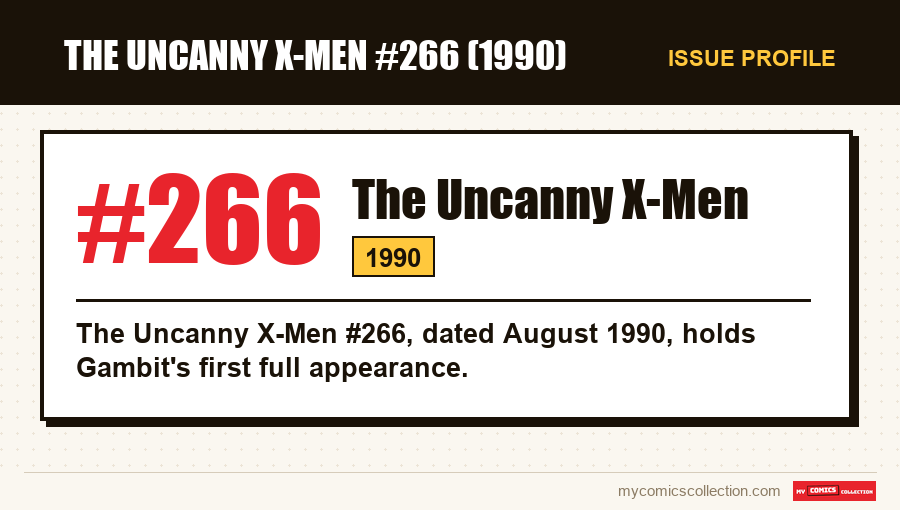
The Uncanny X-Men #266, dated August 1990, contains the first full appearance of Gambit, Remy LeBeau. Chris Claremont writes the script, Mike Collins handles the pencils, Josef Rubinstein the inks. The New Orleans thief crosses paths with Storm, aged back into a childlike state and without her memory, and sides with her. Collectors seek this issue because an earlier, partial appearance in an anthology contests the title of "first", without taking it away.
Few 1990 issues force you to open a debate about definitions before even talking about condition. This one does: buying The Uncanny X-Men #266 means taking a position on what "first appearance" means, and the market distinguishes two objects whose values have nothing in common. Before overpaying for one or neglecting the other, you need to know what you hold in your hands.
As always on this guide, only verified information (creators, numbers, dates) is stated as fact; the analysis is our own, with no reproduction of panels or protected dialogue.
The issue: date, creators, what happens in it
The Uncanny X-Men #266 bears the August 1990 date on its cover, following the American practice of showing a date several weeks ahead of the actual on-sale date. This gap, harmless elsewhere, becomes the core of the subject here: it is what makes the order of Gambit's arrival on the newsstands debatable.
Chris Claremont writes the issue, Mike Collins draws it, Josef Rubinstein inks it. The configuration is worth noting: in 1990 the series often changed its art team from one issue to the next, and Collins is not one of the artists usually associated with that period. A key issue whose pencils are not signed by a star of the moment affects how the market treats it, and we come back to this.
On the story side, Remy LeBeau is presented as a thief operating in New Orleans, master of a power that charges matter with kinetic energy, and he crosses paths with Storm, at that point reduced to a childlike state and stripped of her memory. He does not join the X-Men in these pages: he partners with an isolated mutant, which is precisely the situation of the series at that moment.
The editorial context: a fragmented series, a renamed title
In the catalogue, the series is called The Uncanny X-Men and starts in 1981 at number 142; the earlier issues, up to 141, belong to the title The X-Men. This break is not a classification subtlety: if you look for #266 in a list ordered by series, it sits under The Uncanny X-Men, and confusing the two titles makes you miss the entry.
By 1990, Claremont had held the title for more than a decade and the team was scattered. The mutants are separated, some reduced to another form or another age, and the series works through parallel threads rather than collective missions. This setup allows Gambit's arrival: a newcomer can enter through a side door, next to a single character, without a recruitment meeting.
The period is also one of massive print runs. The X-titles of 1990 sell hundreds of thousands of copies, and the relaunch the following year, with the launch of a second X-Men title, pushes those figures even higher. Keep this in mind for what follows: absolute scarcity is not the selling point of this issue.
Why this issue became a key
Gambit became, within a few years, one of the most recognisable mutants in the Marvel catalogue, carried by the animated series of the early 1990s and then by a continuous presence in the X-teams. A character of this profile mechanically pushes the value of his introductory issue upward, and #266 is the only issue of the main series that can claim the full first appearance.
Demand concentrates all the more because the alternative is uncomfortable. Anyone who wants "the" first Gambit without getting into definition debates takes #266: it is identified, plentiful, well documented, and nobody disputes its status as a full appearance. It is a purchase without nasty surprises about the nature of the object, which is not nothing in this segment.
The decisive nuance: the earlier, partial appearance
An earlier, partial appearance of Gambit does exist, in a side publication: the anthology Marvel Comics Presents, issue 62. It is generally described as a brief, incomplete appearance, the kind the market calls a cameo. The point of debate is not its existence but its ranking relative to #266, and that debate plays out on two fronts.
The first is the actual chronology. The dates printed on the covers of the two titles do not read in the same order as their on-sale dates, the anthology being bimonthly at the time whereas the X-series was monthly. Sources do not all agree on the exact gap, and we have no basis here to settle something that requires a survey of release dates: to be checked rather than assumed.
The second is definition. Depending on whether one holds to "first appearance in any format" or "first full appearance", the issue designated changes. Both readings are defensible and coexist in listings. The practical consequence: two issues at very different values circulate under an almost identical label, and vigilance applies to the wording of the listing as much as to the condition of the book.
What makes the value vary: condition, edition, print run
On a 1990 issue produced in very large numbers, condition makes almost all of the price. Correct copies are abundant, truly flawless copies are much rarer than people think, and the gap between a high grade and a middle grade is counted in multiples, not percentages. One step up the grade can be enough to double the value in the upper range of the scale.
The paper of this period is white and light-coloured covers are unforgiving: the slightest rubbing on the spine fold shows immediately. For this issue specifically, check the corners and the spine edge before anything else; those are the two areas that most often downgrade a copy the seller thought was perfect.
The edition variable then weighs in, and it is particular to 1990: the distinction between the newsstand edition and the edition reserved for specialist shops changes the relative scarcity at high grades, without the interior content being different.
Telling one edition from the other
On Marvel releases of 1990, the position of the barcode is decisive: the newsstand edition carries a printed barcode, while the shop edition shows, in that same space, an illustration or a distribution mention instead. Get into the habit of photographing this corner of the cover before buying at a distance; it is the detail a listing most often leaves out.
The indicia, on the inside page, confirms the exact title, the issue number and the publication mention. This is where you check that you are being sold the #266 of The Uncanny X-Men and not a neighbouring issue, and it is also where a reprint shows: a later edition does not reproduce the 1990 legal mentions exactly.
On reprints, be methodical rather than confident. The content of this issue has circulated in collected editions, and facsimile editions reproduce the original cover while announcing it in their mentions. If a copy looks too fresh for its age, the indicia and the advertising pages will answer before any visual impression does.
Do you collect this series?
Track what you own, what you are missing and what your collection is worth. 7-day trial.
Start my trial →
The traps when buying
The first trap is the drift in vocabulary. A listing that writes "1st Gambit" without specifying "full" may be referring to the anthology, or may be trying to pass off #266 as something it is not quite, under the other definition. Always ask which issue and which title are being sold, and in what wording the first appearance is claimed.
The second is numbering confusion. Between the nearby issues of the series and the second X-Men title launched in 1991, badly kept lists mix up entries. Check that the title given is indeed The Uncanny X-Men, and not the earlier title in two words nor the following series.
The third is the lot. This issue often circulates in bundles of the series, where it arrives without individual protection and comes out with a handling crease. If you are aiming for a high grade, the lot is not your hunting ground; if you are after a reading copy, it is on the contrary the most rational purchase.
Neighbouring issues that also matter
#267 is the obvious companion: Gambit is again present, and the issue benefits from Jim Lee's passage on the series, which gives it its own demand, independent of the first-appearance question. Many buyers take both together, and the second is often found in better condition because it was handled less.
#268 of the same sequence is sought for its cover, again for graphic reasons rather than a first character appearance. And the first issue of the X-Men title launched in 1991 marks Gambit's entry into a regular team with a very high print run, which makes it an abundant but structurally important step in the character's trajectory.
Finally, the anthology Marvel Comics Presents #62 should be considered on its own, whatever position you take on the ranking: it is an anthology issue, less well preserved than the main series, and this difference in treatment affects its availability in high grades.
What grading changes
On an issue this available, having a copy graded only makes sense in the upper range. Below that, the cost of the exercise often exceeds the value gap it reveals, and a truthfully described copy sells very well without a slab. Grading serves here to prove an exceptional quality, not to reassure about authenticity, which is not in question for a 1990 release.
The second contribution of grading is descriptive: the label states the title, the number, the year, and most often mentions the nature of the appearance. For an issue whose main feature is precisely disputed, this written mention is worth more than an exchange of messages with a seller, and it reduces the discussion at resale accordingly.
How to follow it in a collection
Record it under The Uncanny X-Men, number 266, not under the earlier title: that is the only way to find it in a collection ordered by series. At the same time, note the edition, newsstand or shop, because that is the information you will no longer have in front of you once the book is filed in its sleeve.
If you also own the anthology, keep the two records linked by a note stating the nature of each appearance, full on one side, partial on the other. This will spare you rebuilding the reasoning from scratch in two years. The character hubs for Gambit and the X-Men give you the rest of the sequence to complete.
For value tracking, condition and edition are the only two variables to watch: the issue will not gain any new scarcity, only the demand around the character will move, at the pace of his appearances outside print.
Conclusion
The Uncanny X-Men #266 is a solid, clearly identified key issue, whose only point of uncertainty is its relationship to an earlier partial appearance. Treat that uncertainty as a piece of buying information rather than as a risk: know which of the two definitions the seller is using, check the barcode and the indicia, and focus your budget on condition, which is here the real differentiator.
You own the 1990 #266, or the anthology that precedes it, and you want to know which of the two weighs more in your collection?
Estimate my comic
Frequently asked questions
It is his first full appearance, and nobody disputes that point. A partial appearance precedes it in the anthology Marvel Comics Presents #62, and depending on the definition used, either any format or full appearance only, the issue designated as "first" changes. Both readings circulate in listings.
Mike Collins on pencils and Josef Rubinstein on inks, from a script by Chris Claremont. It is therefore not an issue carried by a star artist of the moment, unlike the neighbouring #267 which benefits from Jim Lee's passage on the series. Its value rests on the character introduced, not on the art team.
In the catalogue, The Uncanny X-Men begins in 1981 at number 142; the earlier numbers, up to 141, belong to the title The X-Men. #266 is therefore filed under the three-word title. Searching under the old title simply makes you miss the entry in a list ordered by series.
Look at the frame reserved for the barcode on the cover. On Marvel releases of 1990, the newsstand edition carries a printed barcode, while the edition aimed at specialist shops shows an illustration or a distribution mention in that space. The interior is identical in both cases.
Only if the copy is clearly in the upper range of the scale. A 1990 issue printed in very large numbers raises no authenticity question, and grading here serves to prove a rare quality, not to secure the purchase. In middle condition, the cost of the exercise exceeds the gain it reveals.