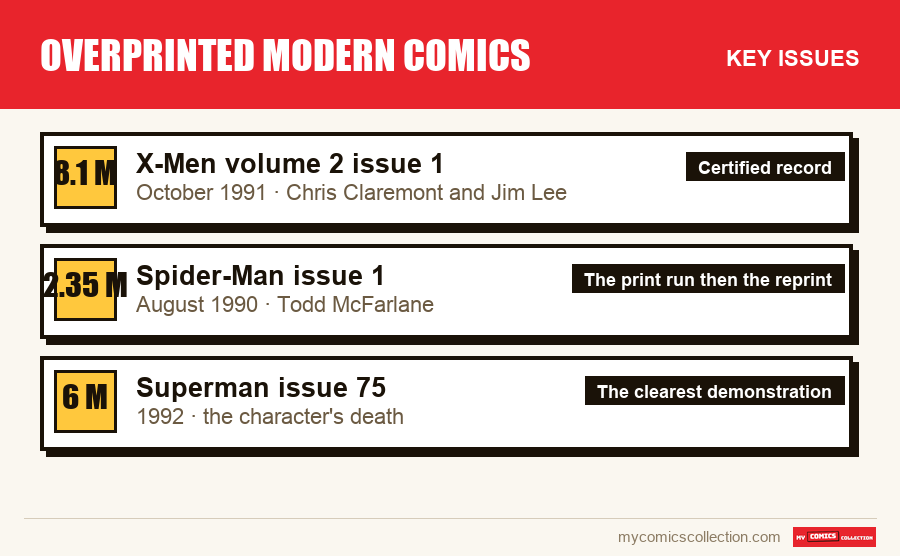
A modern comic almost always disappoints for a mechanical reason: it was printed in sufficient quantity for everyone to find one, and kept in good condition by everyone. The reference precedent is documented. X-Men volume 2 issue 1 (October 1991) was printed at more than 8.1 million copies, a record certified by Guinness, obtained with five different covers. Superman issue 75 (1992) passed six million copies and its first printings resold at cover price a few months later. The same engine runs today: Absolute Batman issue 1, out on October 9, 2024, was printed at about 250,000 copies and had its eleventh reprint in March 2026. The useful criteria before buying come down to three questions: how many copies, bought by whom, and for what purpose.
There is a very particular collector's disappointment, which almost everyone has lived once. You open a box stored ten or fifteen years earlier, pull out an issue chosen at the time because it "was going to rise," and discover it now trades around its cover price, even below it once shipping is deducted. Nothing was done wrong: the copy is clean, it was protected, it was never read twice. And it is worth nothing more.
This disappointment is no bad luck. It is the arithmetic consequence of a decision made at purchase time, and this decision can be examined in advance. An issue printed at several hundred thousand copies and bought by people who keep it intact is an abundant object, and an abundant object does not become rare with age.
This article does not argue against the modern. It describes the mechanism that produces the letdowns, checks it against published figures, shows where it still runs in 2026, then gives the very real cases where a recent comic did gain value. The goal is operational: knowing what to look at in front of the rack, before pulling out your card.
The historical precedent, checked against figures
The reference period runs roughly from 1985 to 1993 for the frenzy, then from 1993 to 1997 for the fall. It rests on four mainsprings, and each has a contemporary equivalent.
First mainspring: the press turned the single issue into an asset. The amounts reached by pre-war rarities made headlines, the symbolic million-dollar mark being crossed by a copy of Action Comics issue 1. A reader learning this does not deduce that 1938 comics are rare, but that comics gain value. The confusion between an object surviving by accident and an object produced to be kept sets in there.
Second mainspring: publishers manufactured the scarcity they could not have. Since demand was for special objects, it was enough to make each issue special. The processes piled up: sealed bags, metallic embossing, inlaid holograms, laser cuts, embossed reliefs, phosphorescent inks. The blind spot is simple: a treatment applied to millions of covers distinguishes nothing.
Third mainspring: the multiplication of entry points. Catalogs swelled to hundreds of simultaneous titles at the same publisher, and each relaunch offered a new issue 1. It is the ideal format for the bet: it requires no knowledge of the series, and sells to people who will not read issue 2.
Fourth mainspring: buying in multiples. It is the one that does the damage. Buying one copy of an issue you like is a reader's decision. Buying five is a financial stance, with no information on the print run, by someone with no counterpart to resell to. Hundreds of thousands of people took this stance at the same time, on the same titles.
The crash was brutal. Two-thirds of North America's specialty shops closed between 1993 and 1997. A historic publisher, which had in the meantime bought its own distributor to distribute itself, found itself with warehouses full of reprints and unsellable "collector" editions, and filed for bankruptcy in 1997 while continuing to publish. By the 2000s, the print runs of the most popular titles had fallen to 90% below their peaks.
Three figures that say it all
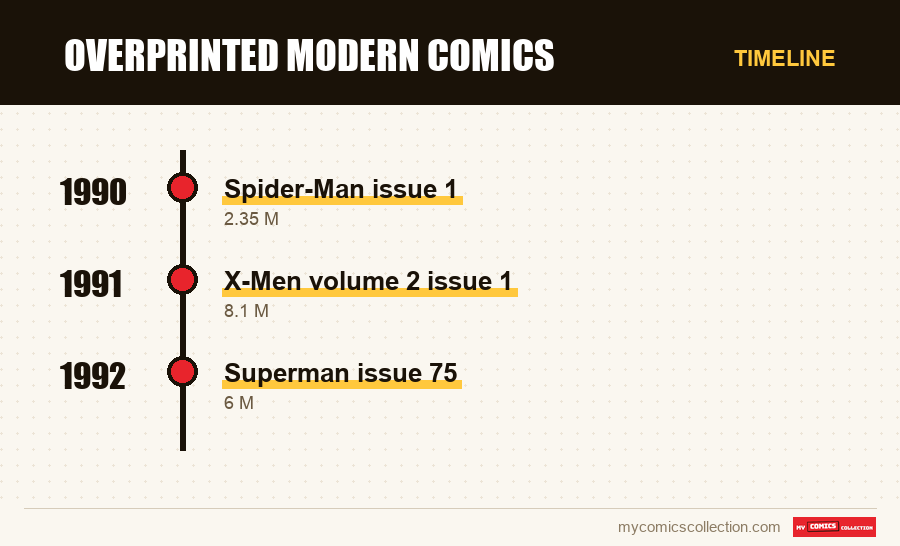
Resale amounts from thirty years ago are poorly documented. The printed volumes, for their part, are known, and they are what counts: it is the denominator of the equation.
More than 8.1 million copies, making it the best-selling single issue in history, a record recognized by Guinness. The result is not due to the success of the X-Men alone: it was obtained by publishing the issue with five distinct covers, four of which, put side by side, reconstitute a single image, and a fifth gatefold presenting that complete image. The device pushes you to buy four copies to have the picture, and a fifth to have it in one piece.
Spider-Man issue 1
The first printing was set at 2.35 million copies, an already considerable figure, to which 500,000 additional copies were added to meet demand. Approximate total, all editions and variants combined: about 2.5 million. This case shows a detail often forgotten: when a launch sells well, the publisher reprints. Supply adjusts to demand, which is exactly the opposite of the condition needed for lasting appreciation.
The issue passed six million copies sold and was the biggest success of 1992, with 30 million dollars generated on the very first day of sale. Between 2.5 and 3 million copies were shipped on release day, and a bagged edition with a black armband, a poster, stickers and a collectible card was sold at a higher price than the standard edition. A few months after release, buyers could no longer resell their first printings above cover price.
What has changed since, and what has not moved
It would be dishonest to claim the 2026 market is that of 1993. Three evolutions truly count.
Volumes have been divided by dozens. A very big contemporary launch counts in hundreds of thousands of copies, not millions. It does not make these issues rare, but it changes the scale: a title printed at 30,000 copies in 2026 is objectively less abundant than a title printed at 2 million in 1991. Part of the modern is therefore few in number, which was almost never true during the bubble.
Certification professionalized the top of the market. The arrival of grading providers in the late 1990s made condition measurable, therefore negotiable remotely. A consequence rarely stated: certification splits the market in two. On a rare issue, it creates value by guaranteeing exceptional condition. On an abundant issue, it mostly creates a cost, because thousands of perfect copies exist and one more was missed by nobody.
Public information on print runs has disappeared. It is the most important and least commented change. For decades, you could consult monthly order estimates, title by title, published by the historic distributor of the American specialty market. These monthly records stopped after April 2022, replaced by partial weekly reports, themselves no longer circulated to the press from September 2025. The distributor in question placed itself under bankruptcy protection in January 2025, a procedure converted to liquidation in December 2025. In the meantime, the two biggest publishers had left this exclusive circuit, one in June 2020, the other in October 2021.
Practical consequence: the 2026 buyer can no longer verify the print run of a recent issue before buying it. The figures circulating are publisher announcements, professional estimates or rumors. Caution is therefore more necessary than in 1991, when orders of magnitude were at least known after the fact. Our article on estimating a comic's print run and real scarcity details the possible workarounds.
What has not moved, on the other hand: the psychological spring is intact. The four 1991 mechanisms still work, with smaller volumes and a renewed vocabulary.
The same engine, in 2026: a figures case
The most instructive launch of the recent period is documented with enough precision to serve as a demonstration, and it is no editorial failure, quite the contrary.
Absolute Batman issue 1 came out on October 9, 2024, first title of a parallel-universe line. Its initial print run was set at around 250,000 copies, and the issue became the best-selling comic of 2024, with a cumulative total of a little under 400,000 copies adding the first three printings and a black-and-white edition. The wave's two other launches followed closely: about 150,000 copies ordered for Absolute Wonder Woman issue 1, about 180,000 for Absolute Superman issue 1. In December 2025, the line passed 8.5 million units sold, nearly 3 million of them for the Batman title alone. In March 2026, issue 1 received its eleventh reprint.
Let's take these figures for what they are. They describe a massive commercial success and a line that found its audience, which is excellent news for a reader. They also describe, exactly, the conditions in which an issue does not become rare: a quarter million copies in the first printing, eleven reprints in seventeen months, and a buyer base part of which set its copy aside without reading it.
The eleventh reprint is the decisive detail: the publisher answers any residual demand with new supply. As long as this tap stays open, no shortage can form, and it is shortage, not popularity, that makes a price rise. The dynamic is that of the 500,000 copies added in 1990, within an order of magnitude.
The warning signs, to check before paying
Here are the clues that, taken together, signal an issue bought for the wrong reasons. None is eliminatory alone: it is their accumulation that should make you back off.
- The rack is still well stocked three weeks after release. An issue still easy to find a month later will be in ten years. The simplest, most reliable signal, and free to note.
- A reprint is announced. Flattering for the publisher, bad for scarcity. From the second printing, supply is driven by demand and no longer lets it get ahead.
- The number of covers exceeds what you can name. At ten, twenty or thirty dressings, the complete collection becomes impossible and each version loses the attention it demanded. See our variants guide and our analysis of ratio variants.
- The sales pitch is about the object, not the story. Cover process, sealed bag, "limited" print run with no figure communicated: packaging arguments, invented during the bubble and which never protected anyone, as our review of 1990s gimmick covers shows.
- You are considering taking more than one copy. The plural is the symptom. A second copy is only justified if you read one and keep the other, never because "two will be worth more than one."
- The reason to buy is an announcement, not a release. A casting, a series rumor, a trailer: these triggers move prices for a few weeks, not a few years.
- Nobody can say how many copies exist. Since 2022, it is the default case. When in doubt, assume there are many.
- The first appearance invoked is a cameo, or is not one. Labels are easily stuck on and as easily peeled off: see our article on first appearances and cameos.
The honest counterexample: when the modern truly rises
Claiming that nothing recent gains value would be false, and a false caution costs as much as a false boldness. Modern comics have clearly appreciated. What is instructive is their common profile.
The clearest case is that of an independent series launched in October 2003. Its first issue was ordered at 7,266 copies by North American shops, ranking it 233rd of the month's releases; the best-ordered title exceeded 162,000. This issue was therefore distributed at less than 5% of the leader's volume, in relative indifference, at a time when nobody had a reason to set a copy aside. Seven years later, a television adaptation made it a worldwide phenomenon, and the series ran more than fifteen years. Between a demand turned massive and a starting stock of a few thousand copies, only a fraction intact, the gap could only be resolved through price. See its dedicated page and its hub.
The second profile is that of the first appearance turned central. Two dated examples. An alternate Spider-Man was introduced in issue 4 of a miniseries released August 3, 2011, written by Brian Michael Bendis and drawn by Sara Pichelli; he became the hero of a feature film released December 14, 2018, which won the Oscar for best animated feature. Another version of Gwen Stacy appeared in the second issue of a 2014 anthology, signed Jason Latour and Robbi Rodriguez; demand was such that a series of her own was granted, and its first issue was the third best seller of February 2015 with more than 300,000 copies.
Note the chronology of the second case. The issue that counts is the 2014 one, printed in the anonymity of an anthology, not the 2015 one sold at 300,000 copies when everyone had understood. Both are Spider-Man. Only one was rare.
From these three successes emerges the same triptych: a low starting volume, an importance invisible at release, and a demand that came later. None of these conditions comes together on a heavily ordered launch that everyone talks about the same day. It is not a question of quality: excellent titles printed at 250,000 copies will not rise more for that.
What is still worth buying in modern
The conclusion is not to avoid recent releases, which would be absurd and a little sad, but to assign them the right role. Four uses of the modern stand perfectly.
What you want to read, in a single copy
The only purchase whose return is certain, since it is consumed: a single issue read has given what was asked of it, whatever its later price. Take the cover you like, not the one that is supposedly sought.
Low-circulation series you really follow
It is the modern collector's only structural advantage. A title printed at a few thousand copies, at a publisher with no firepower, that you read because it interests you, brings together by construction the condition big launches cannot. You have no way of knowing which will succeed: that is why the purchase must be justified by reading. If one in thirty takes off, it will be a bonus, not a plan.
Complete runs by writers you will reread
A coherent, complete set has a usefulness an isolated issue 1 does not: it reads, passes on, and resells as a block to someone looking for that block. Logic compared in our article on complete runs versus key issues.
Replacing a damaged copy
A modest and perfectly rational use: on an abundant title, abundance works for you. You replace a dog-eared issue for a price near cover, and the operation improves your collection without a bet.
Three reflexes complete the list. Keep an inventory, because overbuying is mostly detected by seeing in black and white that you already own three copies of the same issue. Wait for issue 3 before deciding a new series deserves collecting: it is between the first and second issue that orders drop most. Finally, certify a modern issue only for a nameable reason, other than the hope of a gain; the question is framed in our article on the right time to grade a comic.
Summary in four questions
Faced with a recent issue, four questions are enough to decide, and they take less than a minute.
How many copies circulate? If you do not know, and it is the default since 2022, read the rack: abundant today means abundant tomorrow.
Who buys it, and for what? Readers who will open it destroy copies and therefore produce future scarcity. Buyers who shelve it sealed produce an intact stock that will come out at the first sign of a rise.
Why today rather than in six months? If the only answer is a recent announcement, the urgency comes from the announcement and not from the object.
Would you be happy to have it if its price never moved? A frank yes validates the purchase, whatever follows. A no means you are taking a financial position in an object produced in hundreds of thousands of copies, exactly the decision that filled the forgotten boxes of 1992's collectors. Our article on issue 1s and their strategy and our review of 1990s comics thirty years later complete the picture, and the free estimate as well as the collection management app do the inventory work for you.