The Our Worlds at War reading order covers DC's summer 2001 Superman crossover: it runs from August to October 2001 across the Superman family of titles, with Imperiex as the cosmic threat and Brainiac-13 in his wake. Jeph Loeb, Joe Casey, Mark Schultz, Joe Kelly, Phil Jimenez, Peter David and Geoff Johns are among the writers on the event. Lay the four Superman monthlies side by side and follow their cover dates. Add Wonder Woman, Supergirl and Superboy, then finish with the one-shots.
There is no central miniseries carrying the event: Our Worlds at War is a crossover spread across twenty-one titles and thirty-eight single issues, and that is exactly what makes its reading order tricky. Here is a path by series family, with the issue ranges we found, the extras you can live without and a method for the collected editions.
As always in this guide, we only state verified information (creators, issue numbers, dates); the analysis is our own, with no reproduction of protected pages or dialogue.
What to read first
The useful starting point is the first appearance of Imperiex, in Superman vol. 2 #153, published in February 2000. This cosmic entity becomes the central adversary of the summer of 2001, and meeting him in his original context gives the showdown more weight. Nothing else is mandatory: the crossover is designed for a reader who knows the basic figures of the Superman family and of the DC universe of the early 2000s.
If you are new to this period, three landmarks are enough. Superman and his Metropolis circle hold the center of the saga. Darkseid commands the coalition formed against Imperiex, which brings together Earth, Apokolips and the survivors of worlds already destroyed, and Lex Luthor weighs heavily in the conduct of the war. To brush up on the basics of the main character, lean on the Superman reading guide and on the history of Superman in comics.
- Superman vol. 2 #153: the arrival of Imperiex, in February 2000.
- The four monthlies that carry the core of the saga, detailed in Phase 1.
- A basic familiarity with Wonder Woman, Lex Luthor and Brainiac, useful for placing the stakes.
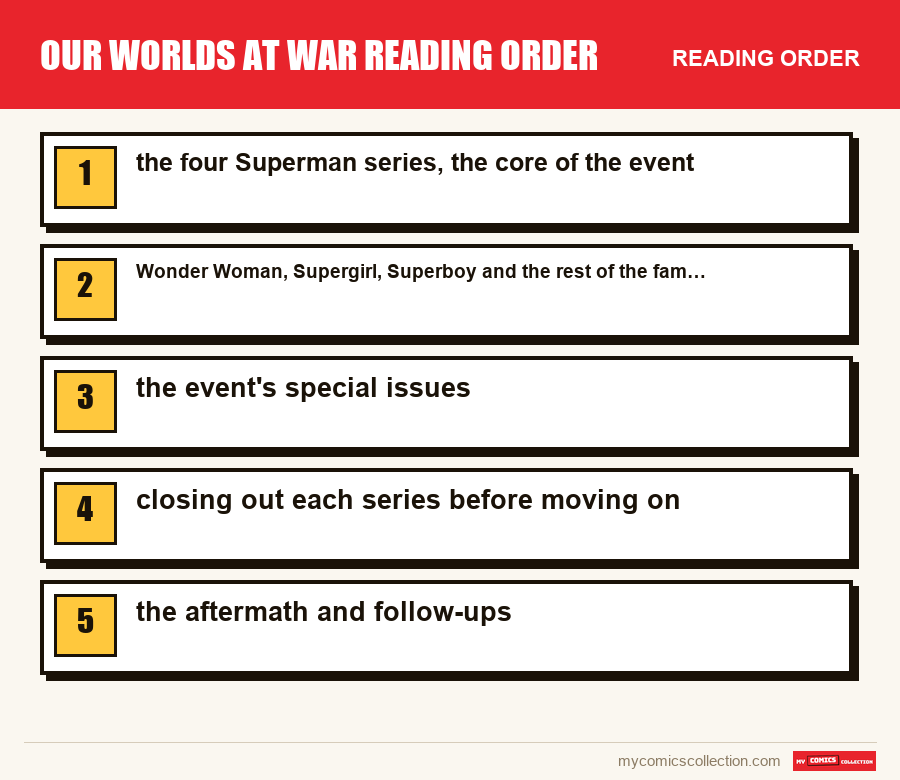
Phase 1: the four Superman series, the core of the event
The heart of the reading sits in the four monthly Superman series. Each one carries part of the story, and the issue ranges are as follows:
- Superman vol. 2 #171 to #173;
- Action Comics #780 to #782;
- Adventures of Superman #593 to #596;
- Superman: The Man of Steel #115 to #117.
That makes thirteen single issues, of which Adventures of Superman is the series with the most, at four. The most comfortable method is to set the four stacks side by side and move forward by cover date, alternating from one title to the next, rather than reading one whole series and then the next. The plot threads answer each other from one issue to the next: reading series by series means learning the consequences before the causes.
The event's overall credits bring together several writers. Jeph Loeb, Joe Casey, Mark Schultz and Joe Kelly are among the writers of the saga, and the artists include Ed McGuinness, Doug Mahnke, Ron Garney, Leonard Kirk, Angel Unzueta and Mike Wieringo. This large team explains the sometimes contrasting tone from one title to another: each series keeps its own voice while the story moves forward.
Phase 2: Wonder Woman, Supergirl, Superboy and the rest of the family
Once you have read the Superman core, or in parallel, the saga extends to the neighboring series:
- Wonder Woman vol. 2 #171 to #173;
- Supergirl vol. 4 #59 to #61;
- Superboy vol. 3 #89 to #91;
- Young Justice #35 and #36;
- Impulse #77;
- Batman #593 and #594.
For this phase, tie each series to its own characters: Wonder Woman follows the Amazon, Supergirl and Superboy their respective heroes, Young Justice and Impulse the young team, Batman #593 and #594 the Dark Knight. If you mostly follow one of these figures, the dedicated guides to Wonder Woman and Supergirl show you where this event sits in the rest of their bibliography.
These issues are full chapters, not mere nods, but they read more easily when you have the broad outline of the threat in mind, which is why it pays to start with Phase 1.
Phase 3: the event's special issues
The event comes with a series of one-shots, each titled with the Our Worlds at War subtitle:
- Batman: Our Worlds at War #1;
- The Flash: Our Worlds at War #1;
- Green Lantern: Our Worlds at War #1;
- Harley Quinn: Our Worlds at War #1;
- JLA: Our Worlds at War #1;
- JSA: Our Worlds at War #1;
- Nightwing: Our Worlds at War #1;
- Wonder Woman: Our Worlds at War #1;
- World's Finest: Our Worlds at War #1;
- Young Justice: Our Worlds at War #1;
- Superman: Our Worlds at War Secret Files and Origins #1.
They accompany the monthly series and widen the cast: the Justice League, the Justice Society, Nightwing, Flash, Green Lantern, Harley Quinn and others each get an issue. The simplest approach is to read them at the end of each block, once the matching monthly chapter has sunk in, or all together after Phase 2 if you prefer a continuous read of the Superman line. The Secret Files and Origins is a reference issue: you draw character information from it, but it does not replace a chapter.
Phase 4: closing out each series before moving on
The top number of each core series, Superman #173, Action Comics #782, Adventures of Superman #596 and Superman: The Man of Steel #117, marks the end of your run in that title. Save these four issues for the moment when you have read Phases 2 and 3, so you keep the big picture until the end.
Spoiler warning: the event includes several disappearances of important characters, and some of these deaths were later reversed in other series. This is covered further down, in the key issues section, so you can choose whether or not to read it.
Do you collect this series?
Track what you own, what you are missing and what your collection is worth. 7-day trial.
Start my trial →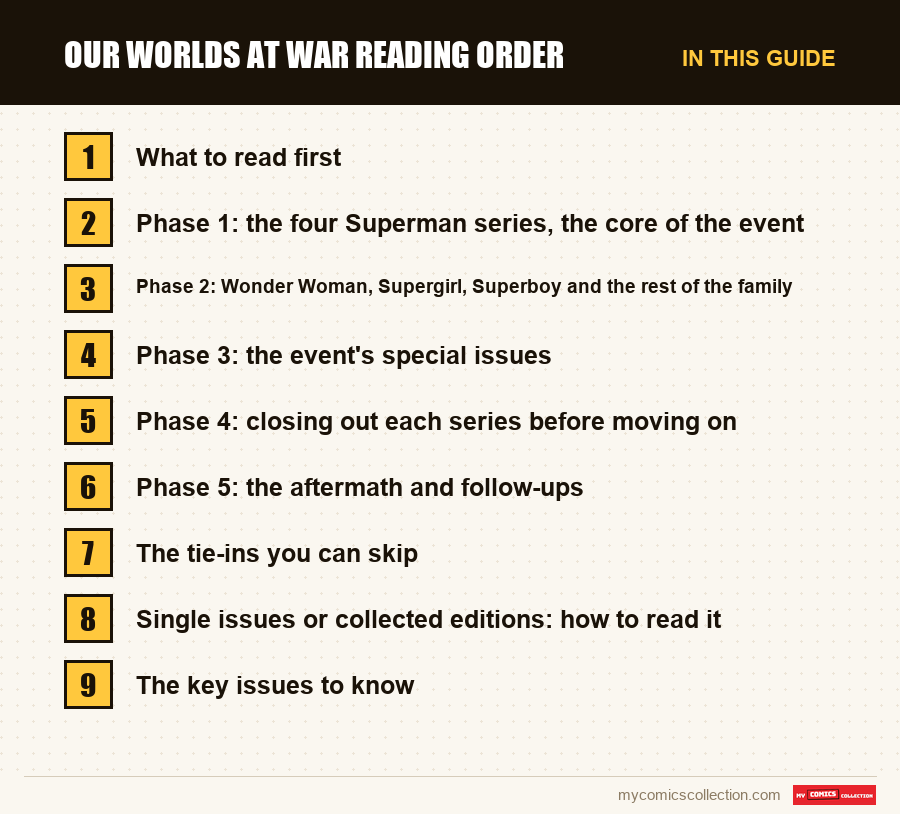
Phase 5: the aftermath and follow-ups
The saga continues in the Superman series, which resumes at issue 174, dated November 2001. Years later, the Superman/Batman series returns to its consequences, with issues #64 and #68 to #71, published in 2010: issue 64 is its prologue. These issues are aimed at a reader who has read everything, because they rely on memory of the event.
To place the episode in the wider logic of DC crossovers, also browse the Superman crossovers. For another event that shakes the whole DC universe, you can follow up with the Infinite Crisis reading order, which touches the entire DC universe.
The tie-ins you can skip
The setup can be read selectively, without taking anything away from the creators' work: these issues are real chapters, but skipping them does not stop you from following the thread of the threat. Here are three scenarios.
- You do not follow the Superman line: skip the Phase 3 one-shots about teams you do not read, for example JSA: Our Worlds at War #1 or Harley Quinn: Our Worlds at War #1.
- You want the short version: read the thirteen issues of Phase 1, add Wonder Woman #171 to #173, and skip the rest.
- You only collect one character: read that character's series plus the core, which contains the decisive events.
The Young Justice #35 and #36 and Impulse #77 issues are the ones most readily set aside for later: they tell the crisis from the point of view of a team of young heroes, and a reader who does not know those series will find fewer landmarks there.
Single issues or collected editions: how to read it
Three collected editions cover the material. Superman: Our Worlds at War Vol. 1 runs 256 pages, Vol. 2 runs 247, and Superman: Our Worlds at War: The Complete Edition runs 512 pages in one volume. The two volumes and the complete edition are not equivalent assemblies on paper: the complete edition has the advantage of unity, while the two volumes are easier to hold.
The choice depends on your goal. To read the story, one collected edition is enough, because it arranges the chapters in a reading order already decided. To collect, the original single issues remain the reference format: each issue carries its cover date, any variants and its condition, which you can compare from one copy to another. If you hesitate, read in the collected edition and buy single issues only for the numbers that interest you for their place in the story.
For storage, an event this scattered raises a practical question: ten monthly series, with numbering that does not run in sequence. File them in reading order, not by title, in a dedicated event box with a summary sheet, and you will find a chapter without rebuilding the saga each time.
The key issues to know
The issue that matters most at the origin of the saga is Superman vol. 2 #153, dated February 2000, which introduces Imperiex. For a collector, the first appearance of the central adversary is the natural landmark of the saga, to be chosen by the condition of the copy rather than by its reputation alone.
For collecting landmarks, three leads are worth the detour. The closing issues of each Superman series are one: Superman #173, Action Comics #782, Adventures of Superman #596 and Superman: The Man of Steel #117. The Secret Files and Origins is another, because this type of issue serves as a reference for collectors. The Wonder Woman vol. 2 #171 to #173 trilogy is a third.
Spoiler warning: several characters are presented as dead or missing during the event, among them Hippolyta, Sam Lane, Aquaman, Maxima and Jonathan and Martha Kent. Hippolyta, Aquaman, Sam Lane and the Kents are later revealed to have survived, in other series and other years. For a collector, the issues where these characters return are natural companions to the saga, to be identified once the event has been read.
As for variants, method beats inventory: first identify the issue, then the alternate covers actually printed for that issue, relying on the indicia and the cover date, not on a sale description. To place a 2001 copy, check it against completed sales of the same issue in equivalent condition. The free estimate gives you a basis for comparison.
Recap: the complete order
- Superman vol. 2 #153: the Imperiex background (2000), as a prelude.
- Superman vol. 2 #171 to #173, with Action Comics #780 to #782, Adventures of Superman #593 to #596 and Superman: The Man of Steel #115 to #117, alternating by cover date.
- Wonder Woman vol. 2 #171 to #173.
- Supergirl vol. 4 #59 to #61 and Superboy vol. 3 #89 to #91.
- Young Justice #35 and #36 and Impulse #77.
- Batman #593 and #594.
- The Our Worlds at War one-shots: Batman, The Flash, Green Lantern, Harley Quinn, JLA, JSA, Nightwing, Wonder Woman, World's Finest, Young Justice, all issue 1.
- Superman: Our Worlds at War Secret Files and Origins #1.
- Superman vol. 2 #174 (November 2001), the follow-up in the regular series.
- Superman/Batman #64 and #68 to #71 (2010), for the memory of the event.
Frequently asked questions
The core fits in thirteen single issues of the four Superman series, plus Wonder Woman #171 to #173, Supergirl #59 to #61 and Superboy #89 to #91. With the one-shots and the neighboring series, the whole runs past thirty single issues. A short read stops at the core and Wonder Woman.
No, Our Worlds at War is a crossover spread across the monthly series of the Superman family and one-shots. The story jumps from one title to another, which is why it pays to read by cover date and alternate between series, rather than reading each title in a block.
Imperiex, a cosmic entity, is the central threat, first appearing in Superman vol. 2 #153 in February 2000. Brainiac-13 steps in with Warworld, and figures such as Darkseid and Lex Luthor get drawn into the conflict. Alliances shift along the way, depending on the chapters.
Yes: Superman: Our Worlds at War in two volumes, of 256 and 247 pages, and Superman: Our Worlds at War: The Complete Edition, at 512 pages. The collected editions are for reading; the original single issues remain the collecting format, with their cover dates and variants.
Carry on in the Superman series from issue 174, dated November 2001. If you want to see how the event is picked up later, the Superman/Batman series returns to it with issues #64 and #68 to #71, published in 2010. Another major DC event, Infinite Crisis, is a good follow-up.
Do you have Superman family single issues from 2001 in your boxes? Get them appraised before filing them away by event.
Estimate my comic