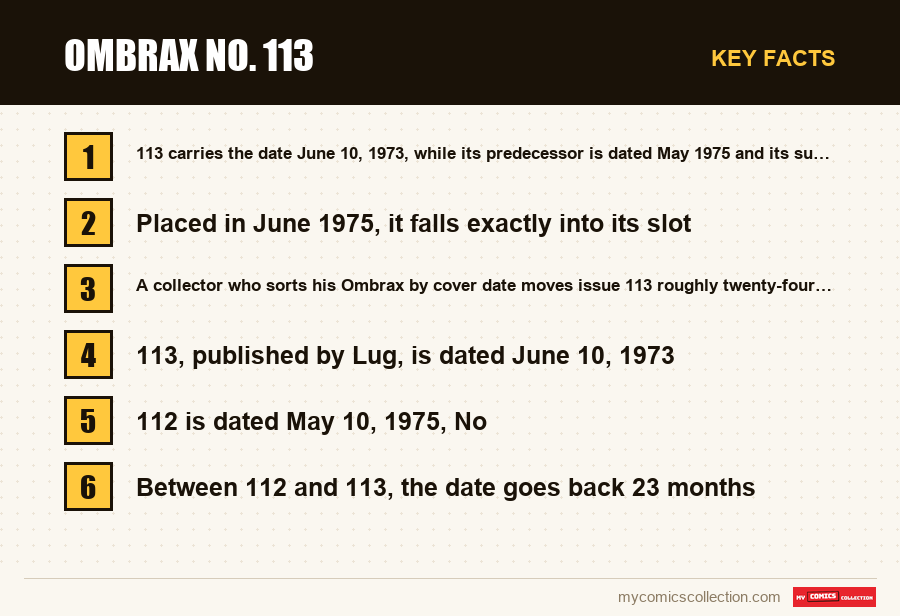
In the checklist, Ombrax No. 113 carries the date June 10, 1973, while its predecessor is dated May 1975 and its successor July 1975. It is the only spot where the checklist leaves the monthly rhythm. Placed in June 1975, it falls exactly into its slot. To file it, rely on the issue's number, not on this date.
A collector who sorts his Ombrax by cover date moves issue 113 roughly twenty-four ranks, without knowing it, and ends up with an apparent hole in June 1975 and an apparent duplicate in June 1973. This entry measures the discrepancy, tests the simplest correction, and states what the data lets us claim and what it leaves open.
As always on this guide, only verified information (creators, issue numbers, dates) is stated as fact; the analysis is our own, with no reproduction of panels or protected dialogue.
The issue: title, date and credits as the checklist gives them
Ombrax No. 113, published by Lug, is dated June 10, 1973. The catalog assigns it a story title, "Opération Albert Ryan", which appears in no other number of the checklist. The data associates only one title with this issue, and nothing indicates that it summarizes the contents: the rest of the contents is read on the copy.
The credits are given at the level of the issue: three names as writers (Nicola Del Principe, Franco Bonvicini, Franco Frescura) and three on art (Jean Frisano, Eugenio Benni, Franco Bonvicini). The page therefore does not say who wrote or drew the episode "Opération Albert Ryan" in particular, only who is credited on the issue.
What the two immediate neighbors say
No. 112 is dated May 10, 1975, No. 114 July 10, 1975. Between 112 and 113, the date goes back 23 months; between 113 and 114, it moves forward 25 months. Between Nos. 112 and 114, which frame 113, only two months actually elapse: that is what one expects of a monthly that slips in an issue.
The checklist has 242 entries, and therefore 241 passages from one number to the next. From No. 1 (February 1966) to No. 242 (March 1986), 239 of these passages fall one month apart.
The other two are the two edges of 113. All ranks from 1 to 242 are present, with no rank duplicated: the break is carried by a date, not by the numbering.
The test: what does the date say if the year is corrected?
The most economical correction changes one digit of the year: 1975 instead of 1973. With a 113 placed in June 1975, the sequence of 112, 113 and 114 gives May, June, July 1975, a one-month step on each side. No other entry needs touching, and the rhythm becomes monthly again.
The test can also be checked against the calendar. In the checklist, 1973 counts 13 dated entries and 1975 counts 11; the other full years, from 1967 to 1985, count 12 each, excluding 1973 and 1975. With 113 in 1975, we get 12 and 12. The correction therefore repairs both the local sequence and the annual count.
A date shared with No. 89
The date June 10, 1973 is not free: it already belongs to No. 89, whose story is titled "La vengeance de Nuage Noir [partie 1]". Its neighbors, No. 88 in May 1973 and No. 90 in July 1973, form a normal sequence with it. Two different issues therefore carry the same date in the checklist, twenty-four ranks apart.
This has a practical consequence. A sort by date places 113 next to 89, and shifts the twenty-three numbers 90 to 112 by one rank. A tool that looks for duplicates on the date would flag the pair 89 and 113 as suspicious, although the two story titles and the two sets of credits are distinct. It is the date that is at fault, not the presence of two copies.
Do you collect this series?
Track what you own, what you are missing and what your collection is worth. 7-day trial.
Start my trial →
The credits point the same way
The date is not the only clue. Franco Frescura is credited as writer from No. 101, dated June 1974; No. 89, from June 1973, does not carry him, and the checklist credits him on no number earlier than 101. Yet he appears on 113. As for the spelling "Franco Bonvicini", it is credited as writer on Nos. 113 to 116; before that, the checklist writes "Bonvi" (as writer on Nos. 106 and 112, and on art on Nos. 106 and 111).
Conversely, No. 113 carries neither EsseGesse nor Roy D'Amy, who frame 89 and its immediate neighbors. The credit set of 113 resembles that of Nos. 111 to 116, not that of Nos. 88 to 90. Three independent clues, rank, rhythm and credits, therefore converge on 1975.
What the checklist cannot tell us
The checklist shows an inconsistency, not its origin. It does not say whether the year 1973 is printed on the copy, copied from a secondary source, or mistyped. Nor does it establish that 1975 is certain: that is the value the sequence, the calendar and the credits impose, without the issue having been checked here.
If sources disagree, the authority is the object itself. A date of 1973 genuinely printed on the issue would be a fact to document, not to correct by default. And if the issue reads 1975, the checklist simply contains a data-entry error.
Recognizing the copy and shelving it without error
Three checks suffice. Look for the number 113 on the cover or the spine: it is the number that governs. Note the printed date and record it as it is, even if it surprises you. Read the announced story title and compare it with "Opération Albert Ryan", without concluding that the rest of the contents is known.
In a list of gaps, enter 113 at its numerical place, between 112 and 114, and not by year. If your list is sorted by date, add a rank column and sort on it. Add a comment such as "checklist date: June 1973, sequence: June 1975": that way, a future apparent duplicate will not make you buy an issue you already own.
Frequently asked questions
The checklist gives June 10, 1973, but this date contradicts Nos. 112 and 114, which are dated 1975. Everything points to 1975, though the checklist does not prove it. The arbiter is the issue itself: read the printed date.
No. File it between 112 and 114. In the checklist, all ranks from 1 to 242 are present and the magazine is monthly: the rank is the reference, the date is only an indication to check against the object.
No. The two numbers share the date June 10, 1973 in the checklist, but their story titles and credits differ. They are two distinct issues, separated by twenty-four ranks.
Nothing in the checklist suggests it. An inconsistent date in a catalog is a gap in information, not a distinguishing feature of the issue. Only a printed date that differs from the sequence would be worth noting.
The checklist gives only one story title, "Opération Albert Ryan", and credits at the level of the issue. The rest of the contents is not known from this data and must be checked on the copy.
In short: file by rank, note the date, check the object
Ombrax No. 113 is the point where the checklist's calendar contradicts itself: a 1973 date between two 1975 issues, which in passing reproduces the date of No. 89. Rank, the monthly rhythm, the annual count and the credits all point to June 1975, but only the issue itself can confirm it.
For your collection, the approach is simple: sort by number, record the date as it is read on the object, and add a comment on the discrepancy.