In short
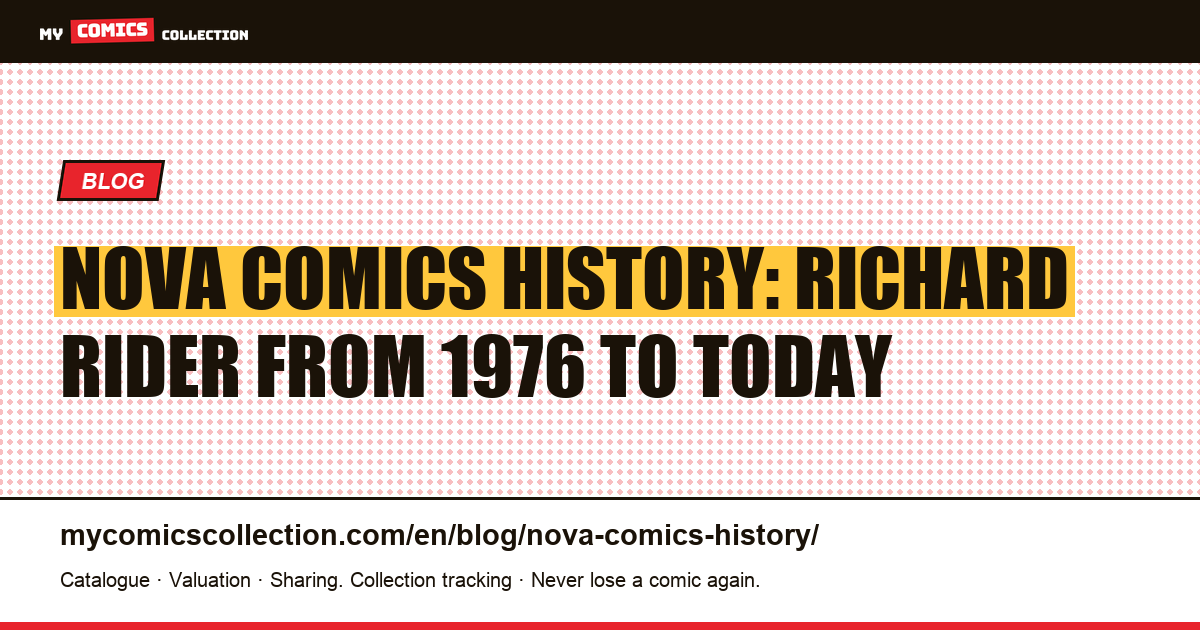
Richard Rider, the original Nova, debuts in Nova #1 (cover date September 1976), created by Marv Wolfman and John Romita Sr. and drawn in that issue by John Buscema. He moves from a short-lived Bronze Age series to the New Warriors, then becomes Nova Prime, the last known Nova Corps member, in Annihilation (2006). The Abnett and Lanning series (2007 to 2010) and The Thanos Imperative (2010 to 2011) are the later turning points.
Few Marvel heroes have been shelved as often as Richard Rider and then pulled back to the center of the cosmic line. His publication history is a sequence of endings, relaunches and rescues, and each one changes what the character is for. Reading it in order explains why a modest 1976 series still anchors a shelf of Marvel space stories.
Credits, cover dates, run lengths and issue numbers in this timeline were checked before writing. The reading of each era as a turning point, and the advice on how to follow the character, are our own analysis.
A fanzine idea before Marvel, 1966 to 1976
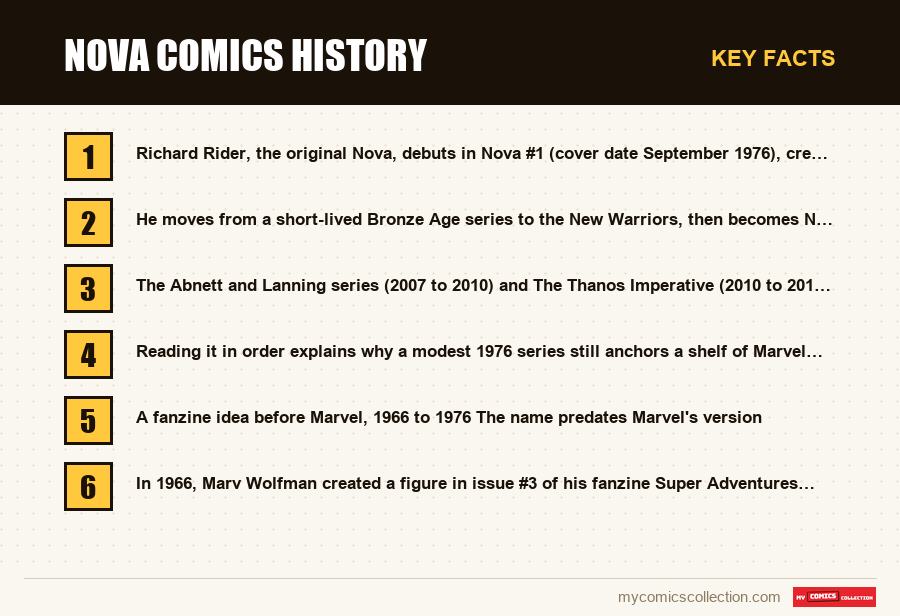
The name predates Marvel's version. In 1966, Marv Wolfman created a figure in issue #3 of his fanzine Super Adventures, an alien doctor named Denteen who went by the Star. In issue #6, Wolfman and Len Wein reworked the idea into a prisoner called Kraken Roo, who becomes Black Nova. Those pages are separate from Richard Rider as a person, but they show where the name and the idea of a uniformed cosmic hero began.
The version that reached newsstands came in the mid-1970s, when Wolfman worked with John Romita Sr. on a redesigned costume and a new origin. The credited creators of the Marvel character are Wolfman and Romita Sr. The artist of the first issue is a third name, John Buscema, and keeping those roles apart matters when a listing names only one of them.
The premise is a Spider-Man style bet in a cosmic setting. Richard Rider is a New York high school student. In Nova #1 the dying Nova Centurion Rhomann Dey chooses Rider as his successor and hands over the Nova Force. A teenager with school, family and a power he did not ask for was a formula Marvel knew well, and moving it to space was the novelty.
The first series and its loose ends, 1976 to 1979
The Man Called Nova #1 carries a September 1976 cover date. Wolfman is the writer, Buscema the interior artist, and the cover credit goes to Rich Buckler with Joe Sinnott. The series runs 25 issues and ends with a May 1979 cover date, a short life by the standards of the decade.
The early issues assemble a rogues gallery of their own. Powerhouse appears in #2, Diamondhead in #3 and the Corruptor in #4. The Sphinx arrives across #6 and #7 and returns in #10 and #11. Near the end, Rider travels to Xandar in Nova #24 and #25, helps defeat the Skrulls there in Fantastic Four #206 to #209, and gives up his powers to return to Earth in Rom: Spaceknight #24. That sequence closes his Nova Corps story for a decade and explains why later writers can bring him back as someone who has to earn the role again.
Cancellation left loose ends, and Marvel did not tie them up in the series itself. The resolution came in nine issues of Fantastic Four, #206 to #214, with Wolfman writing, plus Rom: Spaceknight #24. For a collector, those nine Fantastic Four issues are an unusual detail: following the Bronze Age story to its end means buying books outside the Nova title.
Thor #411 and the New Warriors, 1989 to 1996
After a decade away, the character returns in The Mighty Thor #411 (December 1989) as a member of the original New Warriors. The team then gets its own title: The New Warriors ran 75 issues plus four annuals, from 1990 to 1996. This second era changes the role. Rider is a member of a group of young heroes, and the stories turn on friendship and Earth-based plots.
The details are specific. Night Thrasher helps Rider regain his powers in New Warriors #1. Rider becomes close to Speedball and dates Laura Dunham and Namorita during the run. In issues #40 to #42, Garthan Saal strips his powers, and Rider witnesses the Nova Corps being reformed and receives the rank of Centurion Prime. Those three issues are the bridge between the 1976 mythology and the later cosmic stories, and they matter most to a Nova collector inside a 75-issue run.
Solo tries and team relaunches, 1994 to 2005
Alongside and after the New Warriors run, Marvel kept trying to give the character a stable solo book. A second Nova series ran 18 issues, from January 1994 to June 1995. Nova the Human Rocket followed with seven issues from May to November 1999. The team book was relaunched too: The New Warriors volume 2 ran #0 to #10 from October 1999 to July 2000, and a third volume of six issues ran from July to December 2005.
The pattern is a character relaunched in short runs, none longer than the 25 issues of the first series. For collectors this period has the least consensus on what to buy. It rewards completists and New Warriors readers, but it is rarely where a newcomer should begin. It also sharpens the next turning point, because a character who could not hold a monthly book in the 1990s becomes the lead of a company-wide event within a few years.
Annihilation, 2006: the last Nova
The change comes with the Annihilation project. The setup volume is Annihilation: Nova, a four-part miniseries released between April and July 2006. Dan Abnett and Andy Lanning script it and Kev Walker pencils. The six-issue Annihilation series follows, dated August through December 2006: Keith Giffen writes, Andrea Di Vito pencils, and Gabriele Dell'Otto paints every cover.
The setup is the end of the old order. The Annihilation Wave destroys Xandar, and Rider is the last known surviving Nova Corps member. In Annihilation: Nova #1 the Xandarian Worldmind uploads itself and the Nova Force into him, and he becomes Nova Prime. In the main series he leads the United Front and kills Annihilus. The character moves from an unsustained solo property to the human face of a cosmic crisis.
One detail ties the event to older material. Drax and Cammi survive the attack because they had been delivered to Xandar before it happened, which brings two older cosmic characters into the new crisis. The miniseries sets up the state of the Corps and the main series uses the result, so the reading order matters.
Do you collect this series?
Track what you own, what you are missing and what your collection is worth. 7-day trial.
Start my trial →
The 2007 series and the cosmic crossovers
The event led directly to a new ongoing book. Marvel launched a fourth Nova series that lasted 36 issues, April 2007 to April 2010, scripted by the Abnett and Lanning pair. Three large Marvel events touch this series along the way, and each leaves a mark on the plot: Annihilation: Conquest, then Secret Invasion, then War of Kings.
Several plot points can be traced in order. Rider is infected with the transmode virus and cured on Kvch by Warlock and Tyro, across issues #4 and #5 and #11 and #12. During Secret Invasion, the Worldmind is extracted from his brain to revive Quasar, in #17. Ego is recruited into the Corps in #19 and #20, Rider is removed from it in #21, and he takes up the quantum bands to become Quasar in #24. After War of Kings he regains his status as Nova Prime in #23 to #25. The closing stretch, Realm of Kings, runs in #30 to #36 and involves the Fault, Zan Philo training recruits and Namorita's return.
For a collector this is a modern cosmic run with a clear beginning and end, short enough to complete, and the bridge between Annihilation and the Guardians of the Galaxy of 2008.
The Thanos Imperative and the Cancerverse, 2010 to 2011
With the solo book finished, the character does not leave. He joins the cast of Secret Avengers in 2010 and appears in its first four issues, dated May to August 2010.
The Thanos Imperative runs six issues plus two bookend one-shots, from May 2010 to February 2011, and resolves threads left open when the 2007 series ended. Rider, Star-Lord and Thanos end up trapped in the Cancerverse, and Rider uses the Nova Force to hold Thanos back so that Star-Lord can escape. Rider and Star-Lord receive a statue in their honor on Hala. The consequence is a long absence for the original Nova, and the name passes to a younger hero. That the Mad Titan is on the other side of the original Nova's last major story of this period is our own observation, and a useful way to organize a shelf next to the Thanos books.
Sam Alexander, the return, and the present
Sam Alexander is a later Nova with his own series and his own debut, and his books are a separate collecting target. Alexander locates the Worldmind in Nova volume 6 #10, and it reveals that Rider survived. A seventh Nova series, collected as Resurrection, shows Rider learning in #1 that his father has died after escaping the Cancerverse, and Alexander freeing him in #7.
Rider also figures in the 2014 Guardians of the Galaxy storyline tied to Original Sin, in Guardians of the Galaxy volume 3 #18 to #20. After Empyre, Rider calls in the Guardians to investigate the murder of Emperor Stote, in Guardians of the Galaxy volume 5 #6.
Alternate versions exist outside the main continuity. Zombies kill him in Marvel Zombies #5 (December 2006), and an alternate Rider serves the Sphinx in The New Warriors #11 to #13. These are curiosities, not required reading.
The key issues across Richard Rider's history
- Nova #1 (1976): Richard Rider arrives, with Marv Wolfman scripting and John Buscema on the interior art.
- Nova #24 and #25 (1979): Rider travels to Xandar as the first series closes.
- The Mighty Thor #411 (1989): Nova returns as a member of the original New Warriors.
- New Warriors #1 (1990): the team's own series begins, and Night Thrasher helps Rider regain his powers.
- Annihilation: Nova #1 (2006): the Worldmind uploads itself and the Nova Force into Rider.
- Annihilation #1 to #6 (2006): Rider leads the United Front and kills Annihilus.
- Nova volume 4 #1 (2007): the Abnett and Lanning ongoing series begins.
- The Thanos Imperative #1 to #6 (2010 to 2011): Rider and Thanos are trapped in the Cancerverse.
Building a Richard Rider shelf
Start with the modern cosmic material, because it is the most coherent. Read Annihilation: Nova, then the main Annihilation series, then the 2007 Nova series, and finish with The Thanos Imperative. That gives a complete arc, and the issues are far easier to find than Bronze Age books.
Then go back. The 1976 series is a separate project of 25 issues, with its ending spread across Rom: Spaceknight #24 and Fantastic Four #206 to #214. The New Warriors run is the third block, 75 issues plus annuals.
Two numbering traps deserve attention. There have been several Nova series, so a listing that says only Nova #1 can refer to 1976, 1994, 1999, 2007 or a later volume: check the cover date. And Richard Rider and Sam Alexander are different characters with different debuts, so read the issue number, not the name. The French magazine also called Nova is a different publication with no link to this character. For a condensed list, see the key issues guide. For the event that shaped his later career, the Annihilation: Conquest reading order is the natural next step, the Guardians of the Galaxy reading guide covers the team that follows, and the Thanos comics history places the Cancerverse story in context.
Frequently asked questions
Marv Wolfman and John Romita Sr. are the credited creators of the Marvel character, who debuts in Nova #1 with a September 1976 cover date. John Buscema handles the interior art of that issue, and the cover credit is Rich Buckler with Joe Sinnott. Wolfman had sketched a different fanzine character in 1966.
The first series ran 25 issues, from the September 1976 cover date of issue #1 to a May 1979 cover date. Issues #24 and #25 take Rider to Xandar, and the loose ends are resolved in Fantastic Four #206 to #214 and in Rom: Spaceknight #24, where he gives up his powers.
Begin with Annihilation: Nova (2006), then the six-issue Annihilation series, then the 2007 Nova ongoing by Dan Abnett and Andy Lanning. That gives a self-contained cosmic arc. Add the 1976 series and the New Warriors afterward, once you know you want the full history.
No. Sam Alexander is a later Nova with his own series and his own debut. Alexander locates the Worldmind in Nova volume 6 #10, and it reveals that Rider survived the Cancerverse. When you buy, read the issue number and the cover date, not just the name.
The link runs through the cosmic line. Drax survives the Annihilation Wave because he was delivered to Xandar before the attack, and The Thanos Imperative (2010 to 2011) leaves Rider and Thanos trapped in the Cancerverse. The two stories bracket the character's modern era.
If you own a copy of Nova #1 or another Richard Rider key issue, an estimate shows where it stands.
Estimate my comic