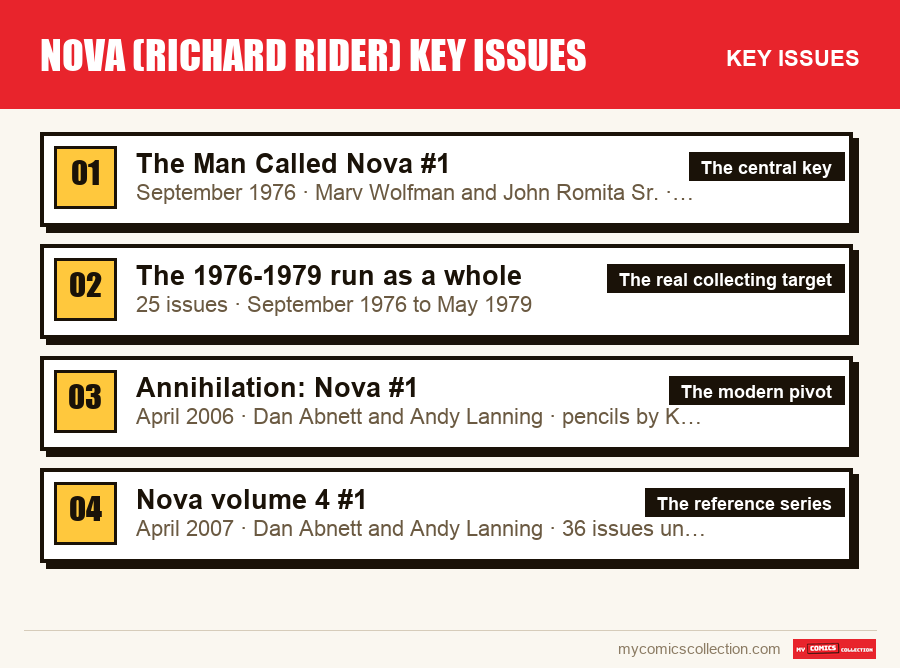
Richard Rider, the first Nova, debuts in The Man Called Nova #1, dated September 1976, conceived by Marv Wolfman and John Romita Sr. with art by John Buscema. The series lasted only 25 issues, from September 1976 to May 1979, which makes it a Bronze Age key with a modest print run and not an abundant catalog piece. Two other milestones truly matter: Annihilation: Nova #1 to 4 (April to July 2006), where Dan Abnett and Andy Lanning put him back at the center of Marvel's cosmic line, and the solo series that follows, Nova volume 4, 36 issues from April 2007 to April 2010. Not to be confused with Sam Alexander, the Nova who appeared in Marvel Point One #1 (November 2011), who is a different character with his own first appearance.
There is a category of characters whose market follows not comic sales but the studios' calendar. Richard Rider has been one for about fifteen years. His name comes up in every list of "likely upcoming arrivals" in cinema, a project about him was confirmed in development, then slowed, then suspended, then relaunched in another form. At each of these stages, the same four or five issues suddenly become hard to find, and a few months later the interest dissipates.
This article does not try to predict whether the film will come out. It does something else, more useful for collectors: establish the exact map of the issues that matter, say for each what its value rests on, and separate what would hold with no adaptation from what rests only on the announcement. This distinction is the only serious protection against a rumor cycle, because it tells you in advance what you risk losing if the project stops once again.
A point of vocabulary before going into detail: "Nova" designates at least two distinct characters at Marvel, and confusion between the two is the first cause of a failed purchase on this name. We devote a whole section to it, because it is worth more than a footnote warning.
Richard Rider and Sam Alexander: two characters, two first appearances
Let us start there, because everything else depends on it. There have been several bearers of the Nova helmet, and the two who actually circulate on the market are Richard Rider and Sam Alexander.
Richard Rider is the first. A New York teenager, he receives the Nova Force from a dying Xandarian officer, in an origin mechanic deliberately modeled on that of the publisher's heroes of the previous decade. He first appears in The Man Called Nova #1, dated September 1976.
Sam Alexander is much more recent. He is a different character, with another family, another city and another narrative voice. His first appearance is in Marvel Point One #1, from November 2011, a launch collection signed Jeph Loeb and Ed McGuinness, and his own solo series starts in February 2013. Nothing concerning Sam carries over to Richard's issues, and vice versa.
Why this matters concretely. First because adaptation announcements have not always designated the same character, and a hurried buyer can end up with one's first appearance while believing they hold the other's. Second because the two books have strictly nothing in common as collectibles: one is a 1976 newsstand issue whose preservation is hit-or-miss, the other a 2011 issue printed in the specialty market era, findable in very fine condition without difficulty. Confusing the two is not getting a character wrong, it is getting a market category wrong.
Finally, a detail that makes the difference when buying: Marvel Point One #1 is a collection of short stories, not a solo title. An unscrupulous seller can present any issue of Sam's series as "the" first appearance. Check the exact title, not just the character's name in the listing.
The 1976 series: a short Bronze Age key, and that is the essential
The most important fact for collecting is not that Nova debuted in 1976. It is that his series stopped very quickly.
The Man Called Nova lasted 25 issues, from September 1976 to May 1979. The plots left hanging were resolved elsewhere, in the pages of Fantastic Four and Rom: Spaceknight, which says well enough what the character's status was at the time: a canceled title whose accounts are settled in other people's series.
For a collector, this brevity has three very concrete consequences.
The first is that the complete run is attainable. Twenty-five issues is a realistic target over two or three years of patient buying, where a Fantastic Four run of the same era is counted in hundreds of issues. Many Nova collections are built this way, by the run, and not by the #1 alone.
The second is that the print runs of a series canceled after two and a half years are by nature lower than those of an established title. The market often forgets it: the relative scarcity of the last issues of a short run is anything but anecdotal, because orders were already falling when they came out.
The third is that 1976 belongs to a newsstand distribution period, with copies handled, folded, exposed to the sun. The average available condition is mediocre, and demand concentrates on a very narrow high fringe. That is why, on this character, the question of condition always precedes the question of adaptation.
The Man Called Nova #1
It is Richard Rider's first appearance, and it is also a series #1, therefore a book that combines two motives of demand. There is no cameo-versus-full-appearance subtlety here: the character is introduced in his own title, under his name, on the cover. This bibliographic clarity is precious in a cosmic segment where most of the great keys are debated.
The 1976-1979 run as a whole
If you collect the character rather than bet on him, this is where the essential plays out. A short, complete run in uniform condition tells something an isolated #1 does not, and it resells to a different population of buyers, clearly less sensitive to casting rumors.
The 1990s: the New Warriors detour
Between the 1979 cancellation and the return to favor of the 2000s, Richard Rider had a second life that buyers still map poorly.
He reappears in Thor #411, dated December 1989, then becomes a founding member of the New Warriors, a team whose main series covered 75 issues and four annuals, from July 1990 to September 1996. It is a long period, much longer than his original series, and it is where whole readerships discovered the character.
For the collection, the interest of this sequence is twofold and must be taken for what it is. On one side, early-1990s comics were printed in considerable quantities, bought in duplicate by a generation of speculators, and kept sealed. The abundance of copies there durably caps values, and no adaptation announcement changes that supply datum. On the other, these are accessible issues, often findable in very fine condition on a modest budget, which makes them an excellent ground for anyone who wants to read a complete period without financial trade-offs.
In other words: Nova's 1990s are good news for the reader and a bad investment thesis. Both statements are compatible, and it is more honest to say so than to let people believe a 1990 issue is waiting for its moment.
2006-2010: the period that made Nova a serious character
This is the turning point, and also the part of the file the market understands best.
In spring 2006, Marvel opens a large-scale cosmic undertaking. A one-shot, Annihilation: Prologue, comes out on March 15, 2006, followed by four limited series launched in April, including Annihilation: Nova #1 to 4, published from April to July 2006, written by Dan Abnett and Andy Lanning with pencils by Kev Walker. The main series, Annihilation #1 to 6, starts in August 2006.
In this story, Richard Rider becomes the last survivor of the Xandarian corps and accepts the entirety of the Worldmind, Xandar's collective intelligence, into his own consciousness. He comes out of it with the full power of the Nova Force and a command role in the resistance. The narrative detail matters less than its editorial effect: a second-tier character becomes, in a few months, the pivot of a whole stretch of the Marvel universe.
The event itself is the subject of a separate reading guide on this blog, to which we refer for the complete reading order and the satellite series. We do not detail it here. What concerns us is what this period produced in terms of issues to aim for.
Annihilation: Nova #1
It is the issue that opens the version of the character almost everyone has in mind today: the Nova Prime bearing the Worldmind, a surviving soldier rather than a costumed teenager. If a film were to draw on an existing tone, it would draw it from this period, and not from 1976.
Nova volume 4 #1
The solo series born of Annihilation's success. Thirty-six issues, from April 2007 to April 2010, by the same writers, running through the period's great cosmic sequences, including Annihilation: Conquest, Secret Invasion and War of Kings. It is the run to recommend to anyone who wants to understand why the character is regularly cited for an adaptation.
The sequence closes with The Thanos Imperative, six issues framed by two one-shots, published from June 2010, again by Abnett and Lanning. Rider and Star-Lord deliberately stay behind there to contain Thanos in the Cancerverse, a universe where death has disappeared, at the moment of its collapse. It is a character ending written as such, and it explains his prolonged absence.
His return happens later: his consciousness awakens inside the Worldmind, which Sam Alexander eventually locates, during the Nova series published between 2015 and 2017. Since then, the two characters coexist, and Richard Rider is again available in current continuity. It is a point to know before buying: nothing in the character's present state prevents him from being used, which was not always the case between 2010 and 2015.
The adaptation rumor cycle, documented
Here is what is verifiable about the project, and only that.
- March 2022: it is reported that the studio is developing a project devoted to Richard Rider, with Sabir Pirzada on script. At this stage, the announced format is that of a series.
- February 2023: development is described as slowed.
- February 2025: the project is presented as suspended.
- July 2026: it is reported that the project has been rethought as a film, with Michael Waldron on script. No release date is announced.
Four and a half years, two writers, a change of format, no date. It is not a particular failure: it is the ordinary trajectory of a studio project about a second-tier character. But it is also, exactly, the material a price cycle feeds on.
The mechanism is always the same, and it does not depend on the character. An announcement comes out. The most reactive buyers move to a very small number of issues, because the map of keys is simple and known. Short-term available supply is inelastic: copies of a 1976 comic cannot be manufactured, and sellers who hold them do not react within days. Asking prices therefore rise before completed sales follow, then the flow of buyers runs dry, and the level falls back toward a base closer to the one before.
We deliberately cite no amount in this article. The figures circulating during these episodes most often come from asking prices, not from completed transactions, and therefore do not describe the market. The only measure that makes sense is the trend of actually concluded sales, for a precise issue and a precise condition, observed over several months. If you follow this character, it is this data series you should keep, and a collection tracking app is precisely for this: keeping track of your cost basis and of what you have actually observed, rather than relying on an impression.
What holds without an adaptation, and what depends only on it
This is the heart of the matter. Here is how we separate the two.
What has independent collecting value. The 1976 first appearance remains the first appearance of a character who has existed for fifty years, whose series is short, whose creators count in the publisher's history, and whose copies in fine condition grow scarcer mechanically over time. The complete 25-issue run remains a coherent and finished object. The 2006-2010 sequence remains one of the publisher's best cosmic sets, readable and completable, and its reading value does not evaporate if a film is canceled.
What depends only on the announcement. Everything else. The peripheral issues whose interest is rediscovered the day after a rumor, the recent variants bought in hope of a quick resale, the copies hastily graded at the peak of attention. On these lines, the buying thesis is the announcement itself, which means it disappears with it.
The practical consequence is simple: the size of what you commit should reflect which of the two categories you are buying. A historic key supports a normal position, because it has a cultural floor. A catalyst bet supports only a sum whose loss would be a matter of indifference to you, because it has none. This reasoning is not specific to Nova, it recurs across the whole segment of cosmic first appearances, and it is particularly visible on characters whose notoriety was created by a film rather than reinforced by it, as Guardians of the Galaxy in 2014 showed.
How to approach this character, in order
First decide whether you are reading or betting
The two approaches do not lead to the same purchases. To read, start with Annihilation: Nova then the 2007 series: it is where the character is at his best, and they are accessible comics. To build a collection piece, the discussion is about 1976, and it is entirely a discussion of condition.
Check the exact title, not the character's name
The original series is titled The Man Called Nova. Later volumes are simply called Nova, and one of them belongs to Sam Alexander. A listing that says "Nova #1" therefore tells you almost nothing. Demand the full title and the year.
Never buy during the week of an announcement
It is the only timing rule that stands up to examination on this character. The flow of reactive buyers concentrates on a few days, supply does not move at the same speed, and asking prices come unmoored from the reality of transactions. Let it pass. The copies will still be there.
On a 1976 comic, inspect the spine and corners first
The defects that weigh most on a Bronze Age newsstand issue are spine creases, blunted corners and paper yellowing. Ask for sharp photos of the spine flat and the four corners, systematically, before even talking price. Our guide to CGC grading details what each condition notch really covers.
Record what you buy the day you buy it
Price paid, condition observed, provenance. On a cyclical character, it is the only way to know later whether you bought in a trough or at a peak, and therefore not to repeat the mistake. An issue-by-issue tracking record is enough, provided you keep it at the time of purchase and not six months later.
What we do not know, and must own
For clarity, here are this file's limits.
We do not know whether the film will be made, nor in what form, nor on what date. No release date has been communicated, and the project's history, three redirections in four years, rules out any serious projection. Anyone who announces a release window to you today is extrapolating.
We cite no amounts because we have no dated and verifiable series of concluded sales to present to you for these issues. It would be easy to write a figure and pass it off as a market value. It would also be the least useful thing we could do, because a figure with no date, condition or sales method lets you make no decision.
We do not quantify the amplitude of past cycles. That demand rises on an announcement and then ebbs is a well-established mechanism across the whole cosmic segment, and we have already observed it on other characters, notably in our dossier on the impact of adaptations on the Thanos market. But the precise amplitude of each episode on Nova, issue by issue, would require a transaction record we have not compiled. We therefore describe a mechanism, not a curve.
What we do know is enough to act: the map of issues is clear, the dates and creators are established, and the distinction between historical value and announcement bet is operational today. For the rest, waiting costs nothing, and on this particular character, it tends rather to pay.