New Warriors #1, dated July 1990, opens the series of the young hero team written by Fabian Nicieza and drawn by Mark Bagley. Night Thrasher, Nova, Namorita, Marvel Boy, Firestar and Speedball share a single title for the first time. People look for it for three reasons: it launches a 75-issue series, it comes sixteen years before the Stamford tragedy that triggers Civil War, and it holds Bagley's debut on a regular title.
A collector who already owns the 1976 Novas, Steve Ditko's Speedball and a few Uncanny X-Men from the 1980s finds a gap: these isolated characters never came together before July 1990. New Warriors #1 is the single issue that fills that gap, and it is also an issue whose reputation depends more on an entire series than on a specific scene.
As always on this guide, only verified information (creators, issue numbers, dates) is stated as fact; the analysis is our own, with no reproduction of protected pages or dialogue.
New Warriors #1: date, creators and team lineup
On the cover, the month shown is July 1990. Fabian Nicieza wrote the script, Mark Bagley handled the art. The series that starts then covers 75 issues and four annuals, until September 1996, which places it among the most durable team titles of the decade at Marvel.
The cast of the first issue brings together six characters: Night Thrasher, Nova, Namorita, Marvel Boy, Firestar and Speedball. None is a stranger in 1990, and that is precisely the title's bet. Nova is a hero of the 1970s, Firestar comes from a cartoon later adapted into comics, Speedball was imagined by Steve Ditko for his own 1988 series, Namorita is Namor's cousin, and Marvel Boy will later become Justice. Only Night Thrasher, the gang leader, is in practice a new character, built to carry the team.
We do not detail the issue's plot. Its function is to set the roles: a dark, wealthy leader, a team of volunteers who do not share the same age or experience, and a tone closer to a teenagers' story than to one of great veterans in tights. It is this tone that gave the title its identity.
Thor #411 and the team's prehistory
The New Warriors do not fall from the sky in July 1990. The catalog links their birth to Thor #411, dated December 1989, where Richard Rider reappears after several years of absence and where the team is primed before the eyes of the readers of the god of thunder. This is a practice Marvel readily used at the time: test a concept in an established series before giving it its own monthly.
This setup raises a filing question that every buyer meets: where does the team begin? For a first collective appearance, the most defensible answer is Thor #411. For the first issue of the series, it is New Warriors #1. Sources diverge on what should be called each member's first appearance, since several characters predate it, and we settle the matter only for Night Thrasher, insofar as his link to Thor #411 is established.
The series is also part of a broader editorial movement. Marvel had just noticed that a young team drawn by an artist with a fresh line could sell, and New Mutants #87, published four months earlier, already provided the model of a title in full mutation. The two launches do not address the same audience, however: one shifts a mutant series toward military action, the other invents an urban band unrelated to the X-Men.
Why this issue became a key
The first reason is the status of issue one. In a collection, the first issue of a long series serves as an anchor point, and the 75 issues that follow are organized around it. This is what separates this single issue from a mere mid-run episode: it has an autonomous identity on shopping lists.
The second is the Civil War effect. In 2006, Marvel opened its Civil War saga with an accident that occurred in Stamford, Connecticut, during an operation by a New Warriors team filmed for television. This team is not the 1990 one; it belongs to a 2005 relaunch of which Zeb Wells is one of the writers. But the event brought the team's name back before an audience that was unaware of it, and it mechanically revived interest in the origins.
The third is Mark Bagley. Bagley would become the artist of long stretches of Amazing Spider-Man, then, with Brian Michael Bendis, of the Ultimate Spider-Man series at the turn of the 2000s. New Warriors #1 is one of the first issues where Bagley's line carries a launch alone, and it interests, as such, readers who follow an artist more than a character.
The fourth is Nicieza's signature. The same writer co-created Deadpool with Rob Liefeld in New Mutants #98 and wrote large parts of X-Force. The same months of 1990 and 1991 therefore owe several launches to Nicieza, and this single issue is the calmest version of them, the least sold to speculation and the most pleasant to read.
The price of New Warriors #1: condition, print run, demand
Demand has nothing in common with that of an issue in which a major character makes a first appearance. Here, nobody is looking for a new hero: they are looking for a series starting point and an artist. The price therefore settles in an intermediate zone, much lower than the great keys of the era, but above ordinary 1990 issues.
The factor that moves the price most is the grade. Single issues from 1990 suffer from spine creases, blunted corners and paper that yellows depending on storage. Between a copy that is merely readable and a copy near the top of the scale, the price can more than double; two notches in the middle of the scale, on the other hand, are barely noticeable. The useful question before buying is therefore whether you want a reading copy, a series link or a piece to keep in a slab.
The print run plays a limited role: a first issue of a regular series from this era was printed widely, and the available stock remains vast. Prices do not soar, except when an outside event, such as a certain adaptation announcement, brings the team back to attention. Without such an announcement, you are buying a title at the market's pace, not at the pace of a wave. Be wary of a seller who talks about scarcity: this argument is false for a single issue from this series.
Telling one edition from another
The 1990 New Warriors came out in two sets of single issues identical in content: a print run for comic shops, marked with an illustrated box at the top left, and a run for newsstands, where this box gives way to a barcode. New Warriors #1 is no exception to this rule. Look first at this corner, then at the back of the single issue.
Reprints exist, but they should not be confused with the original. The collected editions devoted to the team, of the "Classic" type, gather several episodes in a softcover volume: they are for reading, not for collecting a first issue. Their exact contents vary by volume, and we do not detail here which ones contain #1, since the composition of each book must be checked on the back cover before buying.
To know whether you are holding a 1990 original, compare the logo typography, the interior paper and the presence of the cover date mention. The paper of an old single issue is matte and slightly porous, that of a more recent reprint is often whiter and smoother.
Do you collect this series?
Track what you own, what you are missing and what your collection is worth. 7-day trial.
Start my trial →
Buying pitfalls
The first pitfall is volume confusion. Marvel relaunched the team several times, in 1999, in 2005 and later, and each relaunch had its own issue one. A listing that simply titles "New Warriors #1" with no year can designate any of them. Insist on the year in the title, and check the cover date in the photo.
The second pitfall concerns the cover. If the listing's cover does not match the one you expect, check that it is not another series or an alternative cover of a recent relaunch. The ratios and print runs of modern alternative covers do not concern this issue.
The third is exaggeration about scarcity. A seller who presents the single issue as impossible to find is wrong. The stock is large, and it is the quality of the condition that sets the price. Compare several sold sales of the same grade rather than a single listing, then take the median of what you have observed.
The fourth concerns lots. Sets of the whole series sometimes offer damaged isolated issues mixed with a #1 in good condition. Check each single issue in the lot, not only the one that motivates the purchase.
The neighboring issues that also matter
Around #1, several landmarks structure a collection. Thor #411 provides the team's setup. The first 1976 issues of Nova, scripted by Marv Wolfman, belong to the character's foundation, and you will find them described in the guide devoted to Richard Rider. Speedball #1, drawn by Steve Ditko in 1988, gives the origin of the most whimsical of the members.
Uncanny X-Men #193, from 1985, introduces Firestar in the comics after her screen appearance. These earlier issues each have their audience, and they often weigh more than the team's #1 when reasoning in price ratio. If your goal is long-term value, that is where to look first.
Later, Civil War #1 from 2006 does not contain the 1990 team, but it reactivates the name. The issues of the 2005 relaunch, with Zeb Wells, are natural candidates for anyone interested in the chain that leads to the event. As for the following issues of the 1990 series, they read better than they price: their interest lies in continuity, not in a new appearance.
What grading changes
For a 1990 single issue whose stock remains large, professional grading mainly has a sorting effect. It guarantees condition and authenticity, closes the discussion on a spine defect that the photo hides, and fixes a comparison reference.
It does not create scarcity, however. Before paying for a slab, measure the ratio between a raw copy in fine condition and the same issue already graded near the top. If the ratio is low, grading is a luxury; if it is high, it becomes insurance on condition. For a title with a moderate price, having your copy graded is often profitable only if it reaches the top of the table.
A slab does not prevent getting the wrong edition. Check on the label that the title carries the 1990 volume and not a relaunch, then compare the edition mention, direct or newsstand, with the seller's photos.
How to track it in a collection
The most useful way to shelve this issue is to attach it to two sets. The first is the whole 1990 series, from #1 to #75, with the four annuals. The second is the group of characters: Nova for Richard Rider fans, Speedball for those who like Ditko's series, Firestar for readers of the X-Men universe.
Note for each copy the volume year, the edition (direct or newsstand), the estimated condition and the purchase price. This last element is the most useful when you later assess the gap between what you paid and what the single issue is worth. With a short and up-to-date record, you no longer buy the same issue again by mistake under another volume.
Also keep a line for collected editions. A softcover book that contains #1 can replace the single issue on your reading shelves, while the original stays in your storage box. Separating the two uses avoids handling the most fragile copy.
Conclusion
This single issue opens no first appearance in the strict sense, and that is why the purchase is reasoned without haste. It is worth its role as the start of a 75-issue series, the signatures of Nicieza and Bagley, and the path that links the 1990 team to Civil War. If you are looking for scarcity, move on; if you want a solid link in an early-1990s Marvel collection, it is a good candidate to buy in clean condition, volume and edition checked.
Frequently asked questions
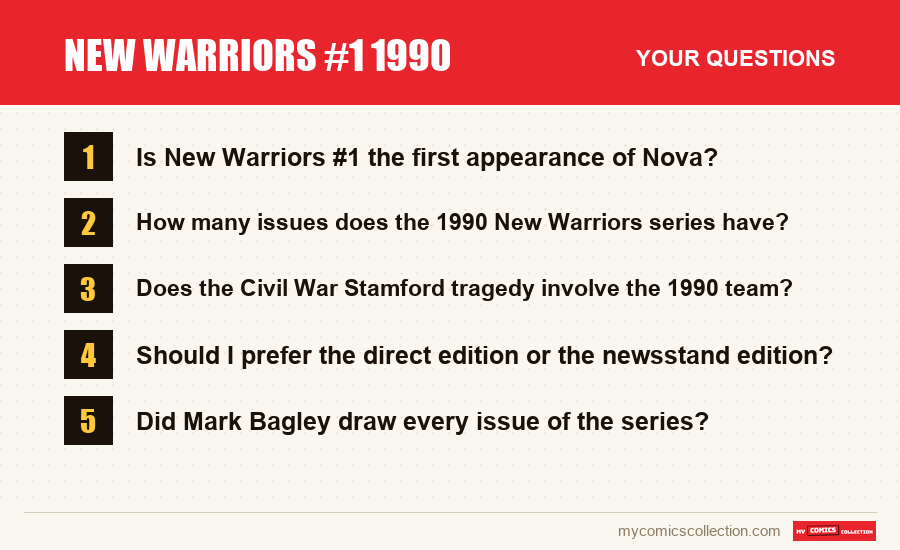
No. Nova, Richard Rider, has existed since the 1976 series and returns in Thor #411 in December 1989. New Warriors #1, from July 1990, is the first issue of the team series where he becomes a founding member. For his true first appearance, look to the 1976 Novas.
The series has 75 issues, from July 1990 to September 1996, plus four annuals. This length makes it easy to complete if you aim for the whole set, but the last issues, less in demand, are also those whose unit price varies least from one seller to another.
Not directly. The Stamford accident, which opens Civil War in 2006, involves a New Warriors team from the 2005 relaunch, filmed for television. The name is the same, the lineup and the era differ. It did, however, bring the original team back into the light for readers.
Both exist in 1990. The direct edition, with the illustrated box in the corner, is the most common at the top of the grading scale; the newsstand edition, with a barcode, is often more damaged by handling. Sources diverge on the price gap, so check it against recent sales of the same grade.
Bagley draws the start of the series, including #1, then other artists take over over the course of the 75 issues. Sources do not agree on the exact date of that departure, and we do not fix it. Check the credits of each issue before buying for its art.
Do you have a New Warriors #1 from 1990? Estimate it according to its volume, edition and condition before having it graded.
Estimate my comic