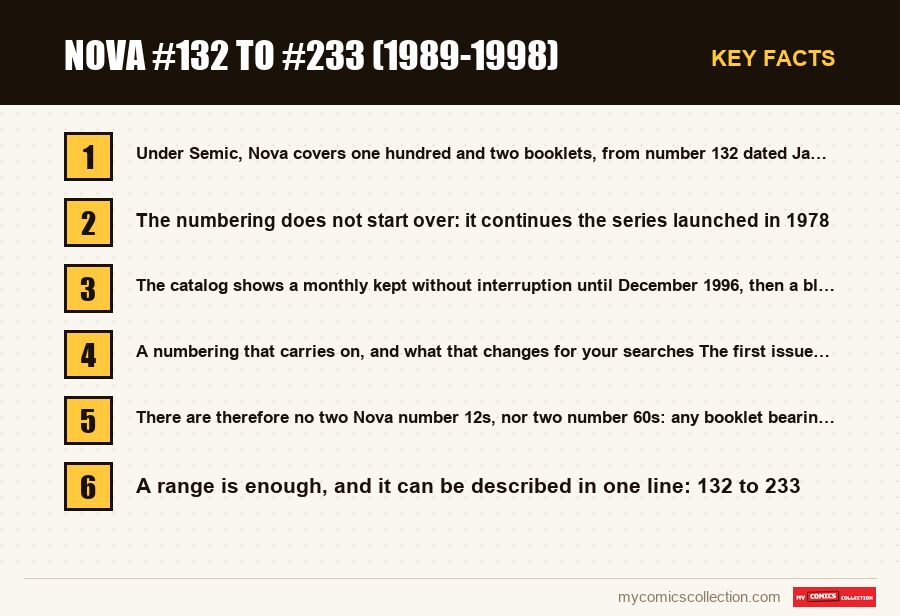
Under Semic, Nova covers one hundred and two booklets, from number 132 dated January 1989 to number 233 dated May 1998. The numbering does not start over: it continues the series launched in 1978. The catalog shows a monthly kept without interruption until December 1996, then a blank year, then six final issues whose credits no longer have anything Marvel-style about them. This chronology dictates the hunt.
You open a box, you come across a Nova numbered in the 150s or the 190s, and the question comes up straight away: does this issue belong to the series you are trying to complete, or to another one? For this magazine, the answer is simpler than one fears, and more demanding than one hopes. Simpler because the counter never reset. More demanding because owning every issue of a period does not mean owning every story they contain.
As always on this guide, only verified information (creators, issue numbers, dates) is asserted; the analysis is our own, with no reproduction of protected art or dialogue.
A numbering that carries on, and what that changes for your searches
The first issue of the Semic period bears the number 132 and a cover date of January 1989. There are therefore no two Nova number 12s, nor two number 60s: any booklet bearing a number below 132 belongs to the previous period, and any booklet above it belongs to this one. This continuity is the best news a collector can receive, because it makes sales listings readable without a photo of the publisher's imprint.
The practical consequence is immediate. When you draw up your list of gaps, you do not need to duplicate it or add a "which series" column. A range is enough, and it can be described in one line: 132 to 233. The magazine's last booklet is dated May 1998, which places the close almost ten years after the opening of the period, with no break in the counter between the two.
Be wary, however, of a common shortcut in listings: some sellers describe the high numbers as belonging to "a new series", because the cover and the content visibly change toward the end of the run. The change is real, and we come to it, but it does not touch the numbering. If a listing offers you a number 12 and presents it as post-1989, the error is in the listing, not in your list.
What the titles reveal about the content
The catalog keeps only one story title per booklet, and yet these titles are enough to sketch an editorial line. "Au-delà du trou noir", "Galactus contre l'Intermédiaire", "Les pouvoirs du Surfer d'Argent", "Mon nom est Thanos !!", "Thanos et Méphisto": the magazine of this period is first and foremost a cosmic one. The two figures who come up most often in the titles are the Silver Surfer and his eternal adversary, and two issues from 1995 titled "La princesse de Zenn-La" and then "La guerrière de Zenn-La" show that the editorial team followed the arcs right into their world of origin.
This coloring is not exclusive. "Photo choc !" and "Consécration ou Jonah est ébranlé !" point to material linked to the Web-Slinger, "Miss Hulk son film !" refers to She-Hulk, two consecutive issues from 1994 both carry the title "Magnéto", and two others, the same year, are titled "Dents de Sabre" as the character is called in the French version. In other words: the contents are varied, and the mutant register takes up more room as the 1990s advance.
One title deserves to be flagged for what it is not. Issue 187, dated August 1993, is recorded under the title "Nouveau mensuel pour la naissance d'un nouveau monde !". This is not an episode title; it is an editorial tagline that the catalog kept for lack of any other title. It tells you that the magazine used its pages to announce its own launches, and it spares you from hunting for a story bearing that name.
A monthly kept going for ninety-six months
This is the figure that structures the whole period: between issue 132 of January 1989 and issue 227 of December 1996, there is not a single month without an issue. Ninety-six cover dates for ninety-six consecutive months, with no duplicate and no skip. For you, this means that an issue missing from your list is one you do not have, and never one that never existed. Regularity is the collector's ally: it removes the category of imaginary gaps.
It also affects value. A magazine that came out every month for eight years was printed in comparable quantities from one end of that stretch to the other, and the price differences observed within it depend much more on condition and cover subject than on any scarcity of printing. This is useful to know when a seller justifies a high price by the supposed difficulty of a mid-series issue.
The catalog holds a curiosity for lovers of precision: thirty-eight of the one hundred and two issues carry a day in addition to the month, always the 5th, and they arrive in blocks. The others carry only a month and a year. This documentary irregularity says nothing about the magazine itself; it says how the information was recorded. When you date a copy, rely on what is printed on it and treat the catalog date as a point of comparison.
The creators who carry the period
One name dominates everything: Sal Buscema is credited on art for half the booklets of the period, and his presence runs from the first year through the last Marvel years. If you are looking for a visual thread that gives unity to this stretch of the magazine, it is his. No writer reaches this constancy, but Gerry Conway is credited from issue 135 and remains present through issue 173, which covers most of the early years.
The relay is clearly visible. Steve Englehart signs from issue 135 to issue 153 and accompanies the most cosmic sequence of the magazine. Then comes a signature that always intrigues attentive readers: "John Harkness", credited on seven consecutive issues, from 151 to 157, exactly in the zone where Englehart fades out. Sources differ on how to interpret this name; the catalog records it as it is, and it is in this form that you will find it in sellers' databases.
The last major era carries another name. Paul Ryan appears on issue 178, dated November 1992, and is then credited, as writer and as artist, on a large majority of the remaining issues. Walter Simonson occupies the hinge, with a particularity that will serve you: the catalog records him sometimes as "Walter", sometimes as "Walt". The same goes for an artist from the very end, spelled "Pasqual" and then "Pascual" from one issue to the next.
Two French names in an American lineup
Among these American credits, two names stand out. Ciro Tota is credited on art for twenty-two booklets, heavily concentrated in the first four years: he is present on each of the first eleven issues of the period, then intermittently up to issue 182. Jean Frisano, for his part, appears only once, and in a notable spot: issue 200, dated September 1994.
What exactly this credit covers, the data does not say. A booklet of this era stacked several episodes, and the catalog does not tie each name to a specific episode. It would therefore be wrong to claim here which page bears the signature of one or the other. What can be verified, and is already telling, is that the magazine had French artists working alongside the American material, and that this practice is concentrated in the first half of the period before dying out.
For a collector, this information has value as a visual landmark. The early issues of the period can be recognized from afar once you have the eye for it, because they do not come out of the same graphic studio as those at the end. If you are buying at a distance, ask for a full cover photo rather than just the number: it places you immediately in the right stretch of years.
Do you collect this series?
Track what you own, what you are missing and what your collection is worth. 7-day trial.
Start my trial →
Broken stories: the trap of missing parts
Here is the point that no list of gaps reveals, and which disappoints many buyers once the lot has arrived. The catalog records, in two consecutive issues from 1995, the titles "Retour sur Terre : 2" and then "Retour sur Terre : 4". The odd-numbered parts are not in Nova. The same phenomenon shows up elsewhere: one issue carries "L'épreuve du feu, 2ème partie", another, three issues later, "L'épreuve du feu, 5ème partie".
Other titles say the same thing in a different way: "L'œil du Puma, 2° partie", "Poursuite - 4° partie", "Au bord du gouffre, 4ème partie". Each time, the magazine publishes a numbered fragment of a larger whole whose other fragments went elsewhere. Where exactly, the data does not say, and we will not invent it: it has to be checked title by title. But the consequence is certain, and it is harsh. A full run from 132 to 233 gives you every booklet of the magazine, not every episode of its stories.
Draw the corresponding buying rule from this. If your aim is to read a story in full, the magazine's issue number is not your starting unit: the arc's title is. If your aim is to own the magazine, the range is enough, and you accept in advance that some stories stop in the middle of a sentence.
The 1997 gap and the last six issues
After issue 227, dated December 1996, the regularity stops dead. The following booklet is dated December 1997: twelve months separate the two. This is the only discontinuity in the whole period, and it is also the most useful boundary to know, because it separates two magazines that share nothing but their title and their counter.
The credits of these last booklets change register completely. One no longer reads the regulars of the cosmic series, but names attached to American studios of the 1990s, Alan Moore, Warren Ellis, Jim Lee, Brett Booth, Travis Charest, Barbara Kesel among them. The titles follow: "Catharsis", "Catéchisme", "Chasse à l'homme". The published material is no longer the same, and a buyer looking for the cosmic magazine of 1989 to 1996 will be surprised on opening one of these issues.
The ending has something ironic about it. The last two booklets, dated April and May 1998, are titled "Nouveau départ - 1ère partie" and "Nouveau départ - 2ème partie". The magazine stops on a story that announces a fresh start. For the hunt, remember above all this: these last six issues, published after a one-year break and in a new format, are the ones most often missing from lots offered as "complete".
Dating and assessing a copy
Start with the printed number, check it against the range of the period, then against the cover date. Three consistent pieces of information, and you know what you are holding. If the number and the date contradict each other, for example a number from the years of monthly publication with a date of 1997, the seller's description is at fault, and you have a legitimate reason to ask for an additional photo before concluding.
For condition, the useful checkpoints on this type of booklet are the spine, the four corners, and the hold of the staples. A marked spine, blunted corners and a sun-faded cover are negotiated differently from a copy that stayed flat. Ask for a photo of the spine head-on: that is where the defects that listings describe least tend to concentrate.
One last reflex: have the copy confirmed as complete with all its interior pages. A missing page in the middle of an episode does not show in a cover photo, and the question costs a minute.
Completing the series and following its value
Build your hunt in three batches rather than as a list of one hundred and two lines. The first batch, from 132 to the end of the Englehart years, is found in lots: these issues circulate together because they were bought together. The second, the long central period, is the easiest and cheapest to buy one by one, since nothing there is rare in the printing sense. The third, the six issues after the interruption, is the only one that requires patience and a permanent alert.
On value, reason in ratios rather than amounts. A very fresh copy of an ordinary issue from the central period often sells for several times the price of the same issue read and dog-eared, whereas the gap between two different issues in the same condition remains modest within this stretch. In other words, on this magazine, condition weighs more than the issue number, except at the end of the run, where scarcity of supply reverses the reasoning.
Finally, keep your tracking by issue number and not by lot. A magazine collection is lost through duplicates as much as through gaps: you buy the same booklet twice because your memory mixes up two neighboring issues with similar covers, and you let pass the one you truly needed. An inventory you can consult when the listing appears solves the problem.
Frequently asked questions
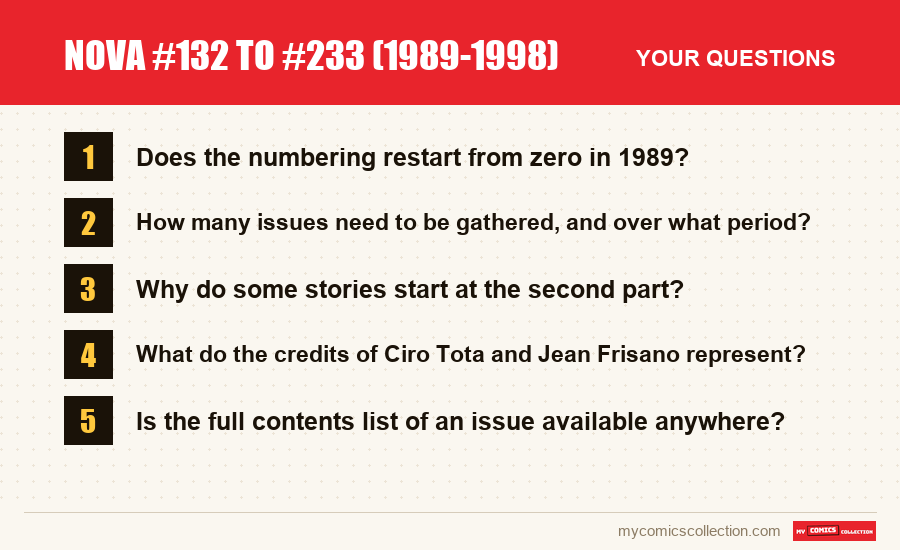
No. The first booklet of this period bears the number 132 and the date of January 1989, and the series continues up to number 233. There are therefore no two Nova carrying the same low number: a number below 132 necessarily points to the previous period. Your list of gaps can be described as a single range.
One hundred and two booklets, the first dated January 1989 and the last May 1998. Publication is monthly with no missing month until December 1996, then a one-year break precedes the last six issues. That final stretch is the one most often missing from lots advertised as complete.
Because the magazine published only some parts of certain arcs. The catalog records "Retour sur Terre : 2" and then "Retour sur Terre : 4" in two consecutive issues, and "L'épreuve du feu" in its second and then fifth part. The missing fragments appeared elsewhere, which has to be checked arc by arc before buying to read.
The catalog credits Ciro Tota on twenty-two booklets, concentrated in the early years up to issue 182, and Jean Frisano on issue 200, dated September 1994. What each one signed precisely is not indicated, because a booklet stacked several episodes without the names being tied to them. Their presence marks the first half of the period.
Not in the catalog, which keeps only one title per booklet although each contained several episodes. You can therefore say what that title indicates, for example a cosmic story or a mutant episode, but you cannot draw up the contents or establish which American issue it corresponds to. The rest is checked on the copy itself, with the contents page in hand.