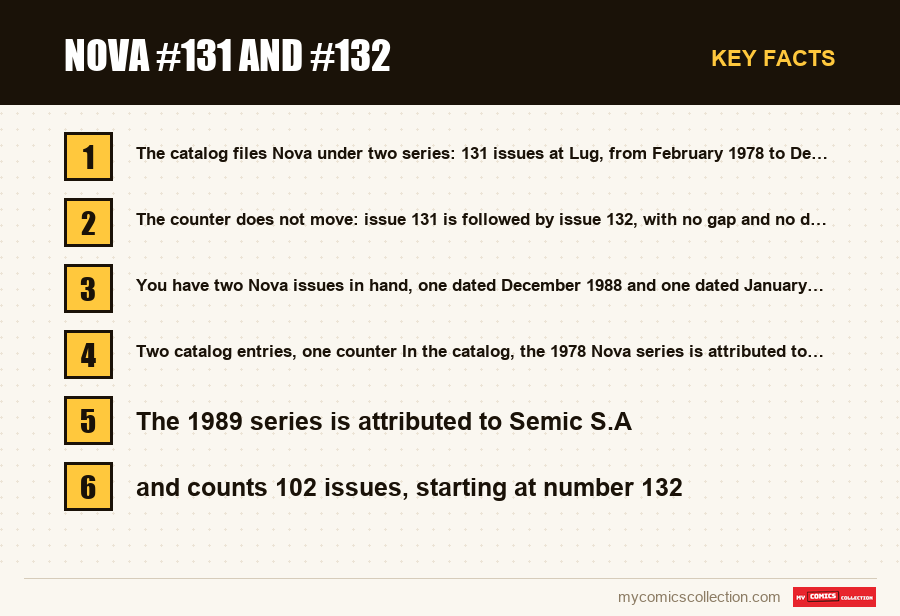
The catalog files Nova under two series: 131 issues at Lug, from February 1978 to December 1988, then 102 at Semic, from January 1989 to May 1998. The counter does not move: issue 131 is followed by issue 132, with no gap and no duplicate. The boundary is therefore drawn by the publisher, not by the numbering. To sort a stack, read the issue number, the date and the publisher's imprint on the copy.
You have two Nova issues in hand, one dated December 1988 and one dated January 1989, and a single run of numbers. Should you shelve them together, or in two series? The answer depends on what you are looking for: the reader's continuous run, or the collector's publisher-by-publisher listing.
As always on this guide, only verified information (creators, issue numbers, dates) is asserted; the analysis is our own, with no reproduction of protected art or dialogue.
Two catalog entries, one counter
In the catalog, the 1978 Nova series is attributed to Editions Lug and counts 131 issues, from number 1 to number 131. The 1989 series is attributed to Semic S.A. and counts 102 issues, starting at number 132. The arithmetic works out: the two totals added together give 233, the last number. No issue is missing between the two entries, and none appears twice.
This is what makes the boundary misleading. On a shelf there is only one magazine. In a list of gaps built entry by entry, there are two, and an issue 132 looked for under the 1978 entry will not be found there. The first publisher accounts for 56% of the complete run: more than half of what has to be gathered is filed under its name.
December 1988, January 1989: no gap in the calendar
Issue 131 is dated December 1988 and issue 132 January 1989. The two months follow one another. On the Lug entry, the issues occupy consecutive months, from February 1978 to December 1988, with no month skipped.
The Semic entry picks up the following month and keeps the same rhythm for eight years, up to issue 227. What this tells us: the change of publisher was not accompanied by any visible interruption in the dating. That said, this holds for the cover dates in the catalog, not for what the copy announces on its title page: that point has to be read on the object.
Where the date changes face before the boundary
The catalog does not give the same precision everywhere. The first issues carry a day, the 10th, then the 5th from issue 58. From issue 123, only the month remains. The last nine Lug issues are therefore already in the "month and year" form that is found afterwards at Semic, where most entries carry no day at all.
For the boundary, the practical consequence is this: you cannot tell two neighboring copies apart by the day. December 1988 and January 1989 are compared by month, and another clue is needed to say which publisher you are dealing with. This is not an anomaly of the boundary itself; it is a change in how precisely the record is kept, which comes nine issues before it.
What the credits show on both sides
The catalog credits are set at the level of the booklet, with three names on writing and three on art. Issue 131, "Le non-humanoïde !", pairs John Byrne, James C. Owsley and Steve Englehart on writing; on art, Marshall Rogers, John Byrne and Alan Kupperberg. Issue 132, "Masques !", carries John Byrne again and adds Roger Stern and Peter David; on art, Ciro Tota, John Byrne and Jerry Ordway.
The point that matters: John Byrne is listed on writing for every issue from 101 to 131 on the Lug entry, that is 31 in a row, and then again on issue 132. Fifteen consecutive issues, from 118 to 132, credit him for both writing and art. The publisher boundary therefore cuts a run of credits in the middle, without breaking it.
The sequel shows that it does not carry on indefinitely. On the Semic entry, after issue 132, Byrne's name on writing does not come back until issue 152. If you arrange your Nova around this creator, the Semic entry will not give you an unbroken run of his bylines: it opens on him, then moves away from him.
A last caution: a credit at booklet level does not say which episode belongs to whom. A name present on writing and on art for one issue does not establish that the person signed the same episode on both sides.
Do you collect this series?
Track what you own, what you are missing and what your collection is worth. 7-day trial.
Start my trial →
What the title of the booklet proves, and what it leaves open
The catalog records only one story title per issue. Issue 131 is "Le non-humanoïde !", issue 132 "Masques !". The following issues run on with "Miroirs d'argent !", "Mantis !" then "Tout feu tout flamme !". These titles do not describe the contents: the catalog keeps only one title per booklet.
One case sets issue 130 apart: its title reduces to the single word "Nova", the only issue of the Lug entry to bear that title. The three issues preceding the boundary (129, 130, 131) therefore have no demonstrated storyline connection with those that follow. To claim that a story continues from one booklet to the next, or that it begins with issue 132, goes beyond what the data allows.
Recognizing the copy at the boundary
Three checks can be made on the object. The first is the printed number: if it is 131 or below, you search the Lug entry; from 132 on, the Semic entry. The second is the cover date, which must match the month of the entry. The third is the publisher's imprint, on the cover or on the legal page, which confirms the entry.
If the three do not agree, do not decide from memory. An issue 131 carrying a different publisher's imprint from the one expected, or an issue 132 dated December 1988, would be a case to note as it is, with a photograph of the page in question. The catalog records a rule; the object may depart from it, and that is precisely what interests an individual copy's record.
Entering the boundary in a list of gaps
Two ways to proceed. Either you keep a single run from 1 to 233, and issues 131 and 132 sit side by side; or you follow the catalog's split, and you enter issue 131 in the Lug entry and issue 132 in the Semic entry. In both cases, note the publisher on each line, because the publisher is what finds a copy again when the number alone is ambiguous.
If you complete the run in lots, the boundary is a good stopping point: issue 131 closes a block of 131 monthly issues, and issue 132 opens another of 102. You can thus measure what is missing on each side, and know which publisher concentrates your gaps. A lot that stops at 131 and another that starts at 132 never overlap.
A second break, later in the Semic entry
A review of the whole run turns up another discontinuity that is worth knowing before you sort by date. Issue 227 is dated December 1996 and issue 228 December 1997, a year later. The following issues restart in January 1998. The year 1997 therefore has only one issue in the catalog.
This may reflect a real interruption, an unusual cover date or a data entry error to correct; the data does not settle it. The lesson for the 1988-1989 boundary: it is clean because the counter and the months follow one another there, which is not the case everywhere in this series. Do not treat it as the only checkpoint to examine.
Frequently asked questions
No. The counter carries on: issue 132 follows issue 131 directly, and the Semic entry opens at that number. Only the publisher changes in the catalog. The number 1 of this magazine belongs to the 1978 Lug entry.
According to the catalog, 233: numbers 1 to 131 at Lug, then 132 to 233 at Semic. This total rests on the listing, which flags no missing issue; check it against your own copies.
Not with the catalog. The last nine Lug issues carry only the month: issue 131 is given as December 1988. The day appears only on the earlier issues, with the 10th then the 5th.
The data does not allow us to say so. The two titles, "Le non-humanoïde !" then "Masques !", are the titles of one episode among others. Only reading the two booklets would establish a storyline connection.
Yes, if you think in terms of a reading run: 131 and 132 are consecutive. In an application or a binder sorted by publisher, they separate. In both cases, note the publisher's name on each line.
In the end, the boundary between issue 131 and issue 132 is a matter of the catalog entry more than of the object: the numbers, the months and even a writer's name cross it. You are better off recording it explicitly in your tracking, with each copy's publisher, than trying to guess it from the number alone. For the rest of the series, issue 228 will call for the closest attention.