Nightwing: a series of one hundred and fifty issues for less than two dollars each
As of August 30, 2026, the search for “Nightwing 1 1996” on a general American auction site returned 163 unverified advertisements, with a minimum at $0.99, a median at $8.99 and an isolated maximum at $499.99. These are amounts requested by sellers at a given time, not completed transactions, and a single photograph says nothing about a trend. The cheapest ads go down to less than two dollars, including for copies described in very good condition, and one of them offers a choice of any number between 2 and 152 at the same unit price. On this type of series, the expense is not based on the price of an issue but on their number, and the only real financial risk is called duplication.
There are two ways to spend money on comics. The first is spectacular: a rare issue, a sought-after cover, a verified copy whose price is in the hundreds of dollars. The second is silent: fifty issues at one dollar and eighty, then fifty more, then another fifty, until one day the cumulative sum far exceeds the spectacular purchase we had refused to make. The second case is not exotic. This is the most widespread method of collection, and it is precisely the one that long, regular series encourage.
The August 30, 2026 statement on current announcements clearly illustrates this mechanism. On the unverified segment of the "Nightwing 1 1996" query, the lowest point is $0.99 and the median query value is $8.99. The five cheapest ads posted that day are worth reading one by one, because they tell the same story in five forms: a number 58 of the 1996 volume describes "Near Mint/NM" at $0.99, a number 67 dated 2002 in "VF/NM" at $1.76, a number 66 of the same volume and the same year, also "VF/NM", at the same price of $1.76, an issue #9 of the 1996 series for $1.79, and finally a catch-all ad titled "DC COMICS NIGHTWING VOLUME 1 #2-152 MULTIPLE ISSUES/COVERS AVAILABLE!" » offered at $1.99. The latter is the most informative of all: it puts on sale, at a single price, any of the numbers between 2 and 152.
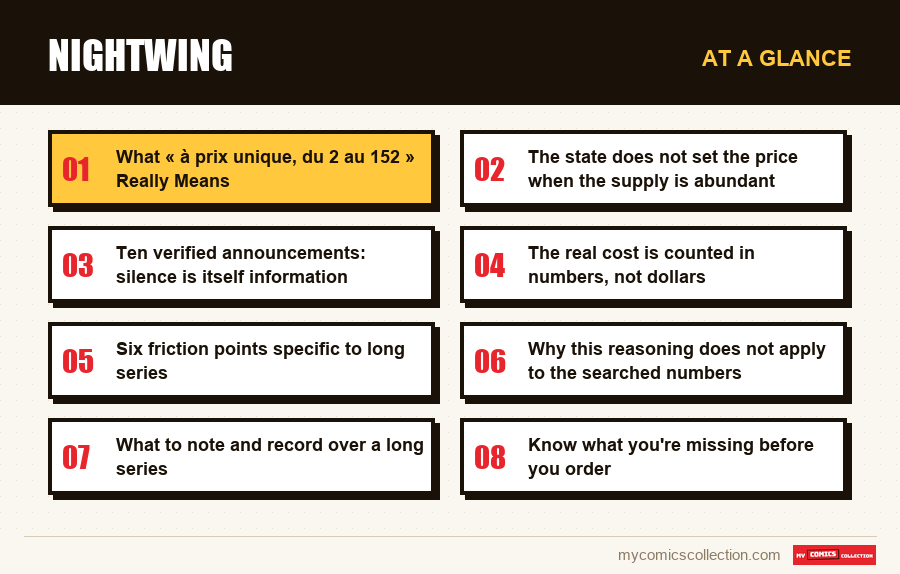
What « à prix unique, du 2 au 152 » Really Means
An ad that offers one hundred and fifty-one different numbers at the same price changes the nature of the purchase. The seller no longer values an object, he liquidates stock by weight. He does not claim that number 40 is worth the same as number 120: he notes that neither justifies the effort of pricing them separately. The price displayed then measures neither the rarity, nor the condition, nor the demand for a specific episode. It measures the handling cost of an ordinary issue.
For the buyer, this lack of differentiation has an immediate and rarely anticipated consequence. As all the numbers cost the same, the choice is no longer made on the price but on a single question: which ones am I missing? Faced with an ad that opens up one hundred and fifty-one possibilities, someone who knows their collection orders six specific numbers and fills in a blank. Anyone who doesn't know it orders six numbers at random, two of which they already have. Both paid the same unit price. One advanced, the other spent for nothing.
This is where inventory ceases to be a convenience of the meticulous collector. Over a short series of twelve issues, we keep in mind what we have. In a series that exceeds a hundred issues, memory no longer follows, and it especially no longer follows at the precise moment when it should follow: in a shop, in front of a bin, with a pile in hand and a queue behind you.
The state does not set the price when the supply is abundant
Very nice condition under a dollar
The cheapest ad in the statement describes its copy as « Near Mint/ NM » and charges $0.99 for it. Two others, advertised « VF/NM », ask $1.76. An excellent condition therefore produces nothing here: it does not add a premium, because the premium assumes a rarity that this segment does not have.
The state becomes a sorting criterion again
When dozens of copies of the same issue are available at the same price, the state no longer serves to set a price, it serves to choose which one to take. It is a selection argument between equivalent offers, not a determinant of value.
163 ads on a single query
The volume of unverified offers recorded on August 30, 2026 mechanically explains the level of low requests. Where the offer is large, a seller in a hurry goes down to a symbolic amount to stand out from the crowd.
A maximum that does not make a deal
The high point of the unverified segment reached $499.99 on the same day. A single figure of this nature expresses what a seller hopes to get, not what a buyer has agreed to pay. It doesn't compare to the median of $8.99.
This dissociation between condition and price is often surprising, because it contradicts a solid intuition: better preserved should be worth more. The intuition is not false, it is simply conditional. It assumes that examples in good condition are in the minority. On a monthly series printed in large quantities and purchased by readers who, many of whom, carefully put it away from the start, the condition is not met. Good condition is the common case, not the exception, and electricity cannot be paid for.
All amounts cited here come from a single statement, carried out on August 30, 2026, on advertisements then online. These are amounts claimed by sellers, never sales concluded. A measurement taken on a single date cannot by construction show any movement: nothing in these figures indicates an increase, a decrease or stability.
The copies passed by the verification bodies are counted separately and never mixed with the others. In this segment, the survey found only ten advertisements: minimum $110.00, central value $267.50, maximum $480.00. Ten is too little to establish a price level, and we refuse to draw a conclusion on this segment.
Ten verified announcements: silence is itself information
The contrast between the two segments is striking. On one side, 163 ordinary ads with a median request of $8.99. On the other, only ten verified listings, the lowest of which demands $110.00. One might be tempted to conclude that verification multiplies value. This would be a misreading, and for two reasons.
The first is the number. Ten observations do not constitute a usable sample. A single ambitious announcement is enough to move the central value, a single withdrawal is enough to bring it elsewhere. With such a small number, we describe what we saw and we stop there.
The second is more interesting. These ten ads do not say that verification turns an ordinary issue into an expensive item: they say that no one verifies a two-dollar issue. The process has a fixed cost, independent of the value of the object. It only makes economic sense for copies that are already exceptional: by their conservation, by their provenance, by a particularity of the print run. In other words, the verified segment does not represent the same population as the ordinary segment: it is the self-selected end. Comparing the two is like comparing a crowd and the few individuals that we considered useful to photograph.
This reasoning applies well beyond this series. We find it as soon as a character has benefited from long regular publications, which is the case for most of the publisher's lasting figures: the phenomenon also crosses the long editorial history of Batman than the titles devoted to its recurring antagonists. Wherever the circulation has been large and publication continues, the ordinary issue is exchanged for almost nothing and only a tiny fringe stands out from the lot.
The real cost is counted in numbers, not dollars
A two-dollar booklet costs nothing. One hundred and fifty two-dollar issues are another matter. The calculation is trivial and yet we almost never do it, because the expense never arrives all at once: it is distributed over months, in batches of five or ten, each too small to trigger reflection. On arrival, the collector committed a sum comparable to that of a single purchase that he would have weighed for a long time, without ever having had the opportunity to weigh it.
Added to this expense is a constraint that we forget even more: volume. One hundred and fifty issues are pockets, boxes, shelves, a physical place in a home. The paltry entry price masks a cost of ownership which is not insignificant. A long series collection comes up against storage before it comes up against the budget.
The third cost is the most insidious, and the only one that is entirely avoidable: duplication. In a format where we buy by the handful, without checking number by number because the unit price does not seem to merit this verification, repurchasing a booklet already owned is not an accident. This is the expected result. You just have to buy often enough, in sufficient quantities, without an up-to-date list, for the overlaps to occur on their own.
And the duplicate costs twice. It costs the price paid, modest. It costs above all the space it occupies and the illusion of progress it gives: the pile grows, the number of missing numbers does not change. On a series of this length, a collector who accumulates without records may have spent the equivalent of the entire series while still being far from having finished it.
Collecting this series?
Track what you own, what you are missing and what your collection is worth. 7 day trial.
Start my trial →Six friction points specific to long series
Retrouver ce qu'on possède
Beyond a hundred numbers, memory systematically fails, and it fails at the worst time: in front of a baccalaureate, with a decision to make in a few seconds.
Distinguer les volumes
The survey announcements mix a series launched in 1996 and numbers dated 2002. The same number can exist in several successive series: without a volume marker, we come across different identities.
Interpret status mentions
“Near Mint”, “VF/NM”: these mentions are declared by the seller on the unverified segment. They guide the choice between two offers at the same price, they do not guarantee anything by themselves.
Absorber les lots
An ad that opens one hundred and fifty-one issues at the same price invites you to order in bulk. Without a list of shortages, a bulk order mechanically produces redundancies.
See the shape of the holes
Isolated numbers are rarely missing: slices are missing. Knowing that you have 40 to 58 then 66 to 67 is better than a total, because these are the limits that you question when buying.
Reconciling reading and completeness
A reader wants an entire arc, a completist wants an uninterrupted sequel. The two objectives do not call for the same purchases and contradict each other as soon as they are not explicitly distinguished.
These six frictions have one thing in common: none is resolved by more money. A doubled budget still doesn't say which numbers are missing. They are all resolved by the same thing, information kept up to date and consultable at the time of purchase. This is what makes this format so special: elsewhere, an inventory improves the comfort of the collector; here it determines whether the collection is progressing or going in circles.
Why this reasoning does not apply to the searched numbers
It would be wrong to generalize the above to all comics. On the fascicles actually searched, the logic is reversed point by point. The supply is narrow, so the state once again becomes decisive and pays for itself. Verification becomes economically rational, so the verified segment is populated and becomes readable. The risk is no longer the duplicate but the overbidding: you do not buy twice a number that you have only acquired at the cost of a long-considered decision.
This opposition is useful because it provides a simple criterion for conduct. On a rare number, the question to ask is the price and the condition. On an ordinary issue from a long series, these two questions are largely neutralized by abundance, and the only one that remains concerns possession: do I already have it? A collector who applies the rare number grid to a two-dollar issue wastes his time on ineffective criteria, and neglects the only one that counts.
The same shift is observed on other titles in the same editorial universe. A lastingly published antagonist sees his ordinary appearances exchanged for almost nothing while a handful of booklets concentrate the attention and the amounts: it is a recurring motif, readable as well in l'historique éditorial du Joker than on the regular series that surround it. What changes from one title to another is not the mechanism, it is the place where the border passes between the ordinary issue and the one which is no longer so.
What to note and record over a long series
The limits of your slices, not your total. Knowing that you have "a hundred numbers" is of no use in the face of an ad that offers from 2 to 152. What you need to have in front of you are the intervals: from this number to that number, then the hole, then the next slice. This is exactly the form in which the question arises when ordering.
The volume to which each copy belongs. The survey combines a series started in 1996 and numbers bearing the year 2002. The same number can therefore designate several distinct objects depending on the series concerned. Noting the number alone, without its volume, creates an ambiguity which will turn into a duplicate the day the homonym is purchased.
The declared state, to arbitrate and not to value. In this segment, recording that a copy was announced as “VF/NM” or “Near Mint” is not used to estimate a price: the data from August 30, 2026 shows excellent mentions under two dollars. This is used to know if a copy deserves to be replaced the day we come across something better at the same price.
The date and nature of each price statement kept. An amount noted without its date and without the clarification that it was a request, not a sale, becomes unusable in a few months: we will no longer know if it described the market or the hope of a seller. The maximum of $499.99 recorded that day clearly belongs to the second category.
The numbers you're looking for, separate from the ones you have. In a format where you buy in batches, a list of shortages is a different object from an inventory, and it must be consultable on its own. We open it to a catch-all ad, not the list of what we have. A collection without this list is purchased twice.
Not necessarily. In a segment where 163 ads are competing for the same request, a seller who wants to sell quickly goes down to a symbolic amount regardless of the condition of the item. The statement remains declarative and only binds the person who writes it, but a low price does not in itself prove that it is exaggerated: it firstly reflects the abundance of the offer.
Because a staff of ten does not support any generalization: a single ambitious announcement moves the central value, a single withdrawal brings it elsewhere. Added to this is a selection bias, since only examples already deemed exceptional justify the fixed cost of verification. We therefore describe these ten observations without drawing a price level.
No, and it is structural: an observation made on a single date does not contain any movement information. It would take at least two comparable readings, spaced over time and constructed in the same way, to speak of an increase or decrease. What we show is a snapshot of the amounts requested that day.
It's interesting provided you know precisely what to ask. The single price eliminates any economic arbitrage between numbers: the only criterion that remains is your list of shortages. Without it, a bulk order almost certainly produces redundancies, and the apparent gain of the batch is absorbed by the duplicate copies.
Taken in isolation, no. Repeated on a series of this length and on purchases by the handful, yes: it consumes budget, takes up physical space and above all gives an impression of progress without reducing the number of remaining issues. The problem is not the amount lost on an issue, it is the frequency with which the error reoccurs.
Know what you're missing before you order
On a series of one hundred and fifty numbers purchased in batches, the only information that matters is the list of missing sections, which can be consulted from a telephone when you decide. My Comics Collection keeps this inventory up to date, distinguishes the homonymous volumes and notifies you of an issue already owned before you pay for it again.