On the 1984 issue where Nightwing adopts his final identity, the one hundred and twenty-three unverified offers noted on August 29, 2026 ranged from $24.99 to $1,000.00, median $65.00. The figure to remember is not the median but the floor: no seller went below $24.99, including for very tired copies. A high floor says that there is continued demand, capable of absorbing even the worst conditions. It reads in a second, it's almost impossible to fake by sample composition, and virtually no one looks at it. These amounts are sums claimed on this date, not completed transactions.
When a collector opens a results page, their eye goes to the middle of the pile. He is looking for “the price”, that is to say a central value which would tell him how much the object costs. This is a reasonable reflex and is often a methodological error, because the central value of an announcement list depends entirely on who put what online that week. Three collective lots sold off by a garage sale, two examples certified in an exceptional state of conservation, and the median moves by several tens of dollars without anything having changed in the real world. The lower terminal does not move like that.
The reading of August 29, 2026 on this issue provides a textbook case, because the two lower limits are documented and they are abnormally close. Unverified side: one hundred and twenty-three proposals, the most modest at $24.99, the most ambitious at $1,000.00, with a median at $65.00. Verified side: sixty-five proposals, from $49.99 to $999.00, median $195.95. In other words, the verified floor is only double the unverified floor, while the medians are separated by a factor of three. The two segments almost touch each other at the bottom while they separate clearly in the middle. This configuration deserves our attention, and that is the whole point of this article.
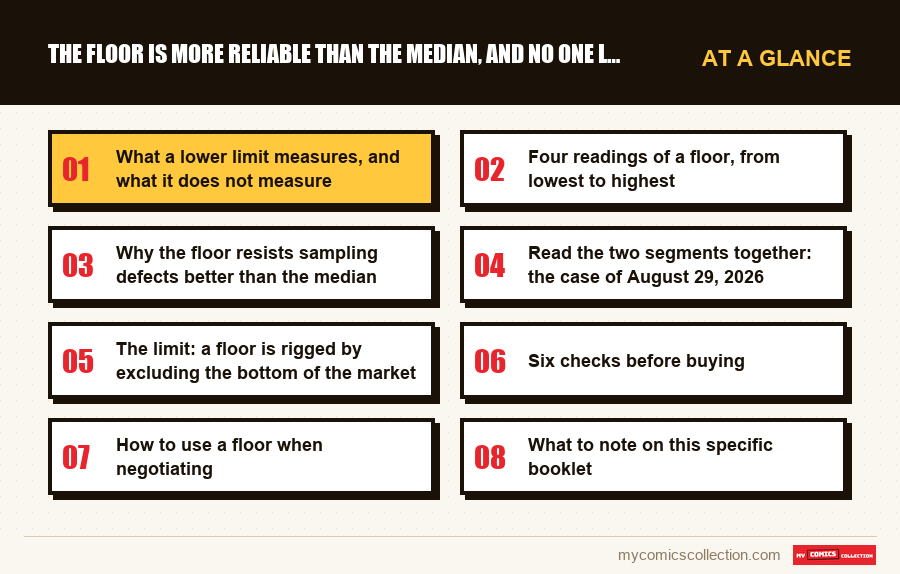
What a lower limit measures, and what it does not measure
A floor is not a price. It is a behavioral boundary: the point below which no owner of the object, at the time of the survey, agrees to part with it. It doesn't describe the item, it describes the population of those who own it and are considering selling it. This is precisely what makes it interesting. An average price aggregates states, presentations, professional and occasional sellers, shipping costs included or not; he mixes things that are not comparable. The lower limit answers a single question, very narrow and very concrete: what is the lowest amount that someone has agreed to display?
We must immediately clarify what we are reading. The one hundred and twenty-three unverified amounts from August 29, 2026 are requested amounts, posted that day by sellers hoping to obtain them. None of these amounts attests that a transaction was concluded at this level. A survey carried out on a single date also shows absolutely no movement: we cannot deduce from this that the issue is rising, falling or stagnating, for lack of a second point of comparison. These are two snapshots (one for the unverified segment, one for the verified segment) and nothing more.
On the other end, the $1,000.00 asked by the most optimistic seller doesn't mean anything either. An isolated maximum reflects an individual expectation, possibly an entry error, sometimes an anchoring strategy. Retaining it as a “high value” would be absurd: it only takes one person, out of one hundred and twenty-three, to create this figure. The floor has the opposite advantage. For it to rise, it is necessary that tout le monde refuses to go below. It is a collective property, not an isolated fad.
Four readings of a floor, from lowest to highest
Almost zero floor: the object serves as filler
When the lower limit falls to a few coins, the object has no value of its own. It circulates within batches, it completes a shipment, it is used to create volume in a box sold by weight. No one bothers to describe it or photograph it separately, because the time spent doing it would cost more than the booklet. The available quantity exceeds demand so much that a seller prefers to get rid of it rather than store it.
Low but not zero floor: episodic demand
A low lower limit without being derisory describes an object which finds a buyer, but intermittently. Holders know that they will have to wait, and some of them prefer to sell straight away. The dispersion of amounts is then very wide because everyone decides differently between time and price. This is the most common configuration on abundant fascicles.
High floor: demand is continuous
This is the configuration of the statement of August 29, 2026 on the 1984 issue: $24.99 at the bottom of one hundred and twenty-three unverified proposals. No holder saw fit to sell off, even in mediocre condition. This means that sellers anticipate a buyer in the near term regardless of the condition offered. Demand is not concentrated on fine examples: it bites right down to the low end.
Two floors touching each other: permeable segments
Here, the verified floor ($49.99) is worth about twice the unverified floor ($24.99), while the verified median ($195.95) is worth about triple the unverified median ($65.00). The gap widens in the middle and closes at the bottom. This indicates that the low-end verified copies are not protected by their certification: they directly compete with the correct raw copies.
These four cases are not administrative categories but market regimes. The same issue can pass from one to another depending on the period, and this is precisely why a single statement is never enough to establish a trend. On the other hand, a single reading is perfectly sufficient to establish which of these regimes we are in at the moment of measurement. It is information of a different nature: not a trajectory, a state.
The distinction is more than a detail of vocabulary. Saying “this booklet is worth $65” is to confuse an ad median with a transaction value, which the data does not allow. Saying “as of August 29, 2026, no one was offering it under $24.99” is an accurate, verifiable statement, and much more useful when negotiating.
Remember the wording: we do not measure what the object is worth, we measure what its holders refuse to accept. The two sometimes come together. They are not identical.
Why the floor resists sampling defects better than the median
Any announcement list is a biased sample. It does not contain copies that are lying dormant in collections, nor those sold from hand to hand, nor those that have just left. It contains what is online at the time you are looking, which depends on the convention calendar, seasonal sales, and the mood of a big seller who decides to destock. A median calculated on this inherits all these biases, because a median is a composition statistic: move the proportion of fine examples and the central value moves mechanically, without any seller having changed their mind.
The minimum does not obey this logic. It does not depend on the distribution of advertisements but on the behavior of a single person: the least demanding seller of the lot. Add fifty high-end copies to the list, the median soars, the floor doesn't move a cent. Remove half of the listings at random, the median becomes unstable, the floor remains the same as long as the cheapest seller is still there. It is an order statistic, insensitive to what is happening above it.
This robustness has a counterpart that must be frankly named: the floor is an extreme, and the extremes are fragile in the opposite sense. It is based on a single observation. If that seller removes their listing, the floor jumps to the next amount. The right way to use it is therefore not to treat it as an exact number, but as an approximate threshold: “around $25, we find something”. Out of one hundred and twenty-three proposals, there is a good chance that several announcements will be in the first dollars above the minimum, which gives the threshold real depth.
There is a second, less obvious gain. The floor can be immediately interpreted without knowing the details of the states. A $65.00 median doesn't tell you what it's made of. A floor at $24.99 tells you one specific, actionable thing: even the worst copy in circulation that day is deemed to be worth that amount by whoever holds it. You don't need any additional information to understand what this implies about the depth of the request.
Read the two segments together: the case of August 29, 2026
The survey opposes two populations. Sixty-five verified propositions compared to one hundred and twenty-three unverified: the ratio is approximately one to two, which is a considerable proportion of verification. On an ordinary fascicle, the certified part is marginal; here, a third of the visible offer has passed through a verification body. This signals that holders consider the certification investment economically justified, which in itself is information on the anticipated level of demand.
Then comes the announced anomaly. We normally expect that the two segments are clearly disjointed: the more expensive of the raw copies remains below the cheaper of the certified copies, because certification adds a fixed cost and a quality floor. This is not the case here. The verified floor at $49.99 is well above the unverified floor at $24.99, but it remains below the unverified median of $65.00. Concretely: more than half of the raw proposals are displayed more expensive than the cheapest verified ad.
Two general mechanisms can produce this superposition, and the survey alone does not allow us to decide between them. First mechanism: some of the verified examples are in weak states, where certification mainly attests to authenticity without promoting conservation; these pieces then find themselves in direct competition with good rough examples. Second mechanism: sellers of raw copies display ambitious amounts, counting on the relative scarcity of supply to maintain them. The two can coexist. What we can safely say is that the certification, on this booklet and on this date, does not create a watertight price boundary.
A word on the medians, since we have discarded them as the main compass. They retain descriptive usefulness: the difference between $65.00 and $195.95 measures the average premium associated with the verified segment, and this premium is substantial. But the gap between medians and the gap between floors tell different stories, and it's reading them together that's instructive. Just one of these two figures, isolated, would have given a false image.
The limit: a floor is rigged by excluding the bottom of the market
We must now turn the argument around, because it has a serious weakness and it cannot be dealt with in a footnote. The floor is only robust if the sample actually contains the bottom of the market. However, default searches very often exclude it, and in several ways at the same time.
A search on a specific number does not retrieve batches. However, the lots are precisely where the least desirable copies circulate: the booklet is sold there with ten others, without individual mention of its condition, at an implicit unit price which is sometimes very low. A search by exact title also does not turn up poorly titled ads, approximate descriptions, incorrect spellings, and these ads are statistically those of occasional sellers, therefore those with the lowest prices. Finally, incomplete copies, missing a page or a staple, are frequently listed under other labels or classified separately, when they are not purely excluded by the filters.
The result is mechanical: the floor that we observe is the floor of the segment we questioned, not the floor of the object. If the research cut out the lots and the damaged copies, the $24.99 is no longer the real lower limit but the lower limit of presentable individual advertisements. It's still useful information, but it's no longer the same. Presenting the second number as the first is to make the data say something that it does not say.
There is one particularly treacherous case. The more a booklet is sought after, the more sellers take care of their advertisements, therefore the more presentable the bottom of the market is, therefore the closer the observed floor is to the actual floor. Conversely, on an ordinary booklet, the bottom of the market is almost entirely invisible in nominative searches. The bias is therefore not constant: it is stronger where the floor would be lowest. In other words, the method systematically overestimates items in low demand, and barely overestimates items in high demand. It is the meaning of the bias that must be kept in mind, not just its existence.
The solution is simple to state and tedious to apply: voluntarily broaden the research before concluding. Remove status filters, include results deemed “less relevant”, also search by series name and number without any other qualifier, take a look at group sales. If the lower terminal does not move after this widening, it is solid. If it collapses, we have just learned that the assumed continued demand only existed in the subset we were looking at.
Collecting this series?
Track what you own, what you are missing and what your collection is worth. 7 day trial.
Start my trial →Six checks before buying
Raise the lower terminal first
Before you look at the middle of the list, note the lowest amount and how many listings sit in the few dollars above it. An isolated minimum is fragile; a minimum followed by five close announcements defines a real threshold. It's this threshold, not the median, that tells you what you're likely to pay at worst.
Date the measurement and do not extrapolate anything
A statement has a date. The one presented here is that of August 29, 2026, and it does not allow any assertion on an increase or a decrease: there is only one point. If you want a trend, repeat the same measurement later with the same search scope, otherwise you will be comparing two different samples.
Separate the verified from the unverified
Mixing the two segments produces a bimodal distribution whose central value does not correspond to any reality. Count them separately: 123 raw propositions on one side, 65 verified propositions on the other, with their own limits and medians. It is by comparing them, and not by merging them, that we learn something.
Pick up the prizes
Group sales are the bottom of the real market and they escape nominative searches. Consult them explicitly before concluding that a floor is high. If the booklet appears regularly as part of the batch, the individual lower limit that you have noted is an optical illusion produced by your filter.
Beware of low numbers
Under a dozen announcements, no price level conclusion holds, neither on the floor nor on the median. The 123 and 65 proposals in the survey are comfortable numbers; many fascicles have only three or four. In this case, the only honest answer is that we don't know.
Ignorer le maximum
The top $1,000.00 of the unverified list and the top $999.00 of the verified list are individual requests. They prove nothing about the level of the market and mainly serve to make the announcements just below seem reasonable. Mentally cut them off before reasoning.
How to use a floor when negotiating
The floor has a practical virtue that the median does not have: it defines a fallback position. If you know that at the time of your search no one was below a certain amount, you also know that anything below that merits careful inspection rather than immediate enthusiasm. An abnormally low price, on an object whose market price is well maintained, generally signals something else: an undescribed defect, confusion over the edition, an incomplete copy, or an announcement that it is better not to honor.
It also defines a waiting terminal. On an object with a high lower limit and a large number of people, waiting costs almost nothing: there will be other copies, and the low threshold is stable because it is supported by the behavior of many sellers. On an object whose lower limit is very low, the urgency is even less, for the opposite reason: the object will come back constantly, often in batches, and there is no justification for paying a speed premium.
Finally, the floor serves as a test of consistency on a specific ad. Take the requested amount and bring it to the observed minimum, not the median. A copy offered at twice the floor for a superior condition is consistent. A copy offered at ten times the price for a comparable condition requires explicit justification in the description (a signature, a variant, a printing feature) otherwise it is simply a seller testing the market. This reading by multiple of the floor is more readable than a reading by deviation from the mean, because the denominator is stable.
One last reflex: write down your statement somewhere. The floor only has comparative value if you can compare it to the same figure measured elsewhere or later, with the same research method. A dated three-line note is worth more than a rough memory, and that's exactly the kind of information that a structured collection tracker makes it effortless to retain. The complete method for managing your collection details how to keep this type of history.
What to note on this specific booklet
The unverified floor at $24.99 is the structuring figure of the statement. Out of one hundred and twenty-three proposals posted on August 29, 2026, none fell below this amount. This is what should be recorded first, even before the median, because it is the only number that tells you something about the depth of demand rather than the transient composition of supply.
The ratio 65 verified to 123 unverified should be noted as is. A third of the visible offer passed by a verification body is a high proportion, which reflects an economic calculation of the holders. This ratio is an indicator in its own right, independent of the amounts, and it can be compared from one issue to another much more easily than a price.
The overlap of the two segments is the least trivial observation. The verified floor at $49.99 falls below the unverified median of $65.00: the two populations overlap instead of succeeding each other. Record this fact, because it changes the way of deciding between a polished raw copy and an entry-level verified copy.
The two maximums, $1,000.00 and $999.00, should be excluded from the reasoning. Write them down for the record, but mark them as non-actionable: these are sellers' expectations, and their near equality between the two segments suggests a psychological threshold effect rather than market convergence.
The scope of the search matters as much as the numbers. Note what your statement included and excluded: lots counted or not, incomplete copies retained or not, search by number or title. Without this mention, your floor is not comparable to another floor, and you will not be able to tell in six months whether a difference comes from the market or from your method.
The median is resistant to outliers, not to compositional changes. If the proportion of high-end copies in the ads increases, the median rises without any seller having changed their price. The minimum does not depend on this proportion: it only depends on the least demanding seller. Both statistics are robust, but to different things.
No. This is the lowest amount claimed by a seller on August 29, 2026, not a transaction price. Nothing in this statement indicates that a buyer accepted this amount, nor that he would accept it. The distinction between what is requested and what is concluded is the first precaution to take with this type of data.
That certification does not create, on this issue and on this date, a clear price boundary. The cheapest verified listing at $49.99 is below the gross median of $65.00, so below more than half of the uncertified listings. A comparison shopper should review listings individually rather than assuming the verified segment begins where the other leaves off.
Absolutely not. There is only one measurement point, that of August 29, 2026. An increase or decrease requires at least two readings carried out with the same research perimeter on separate dates. Any assertion of trend from a single measurement would be an unsupported extrapolation.
Redo the search by removing status filters, including secondary results, and looking at group sales. If the lower terminal remains at the same level, it is reliable. If it falls sharply, your first research excluded the bottom of the market, and the conclusion of continued demand falls with it.
Keep track of your statements
A floor only has value compared to another, measured elsewhere or later with the same method. Record your dated observations, your search scope and the condition of your items in the same place as your collection, and you will stop starting from scratch with each purchase.