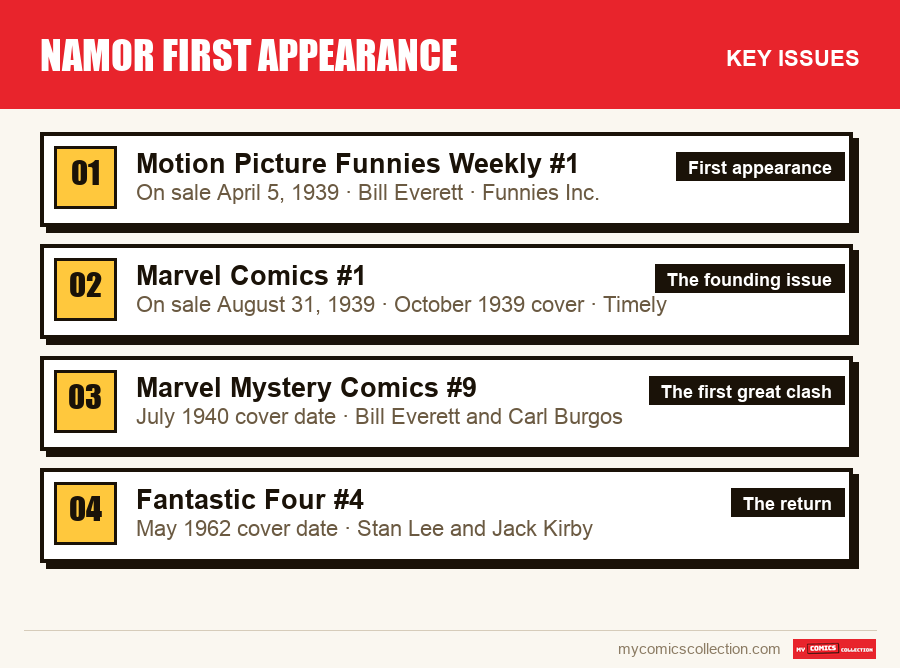
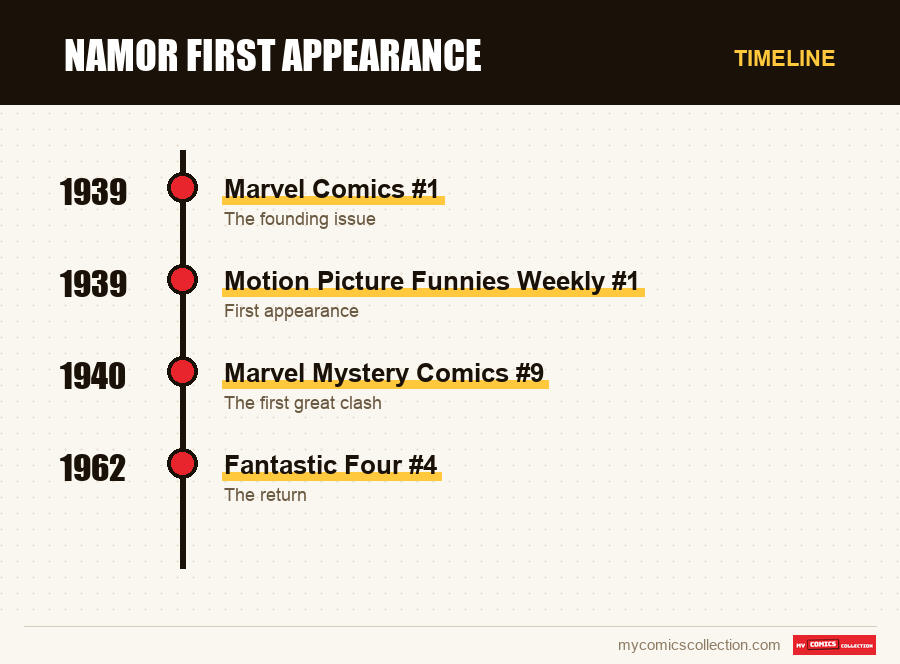
Namor has two first publications in 1939, and they must be told apart. The very first is Motion Picture Funnies Weekly #1, on sale April 5, 1939, a promotional publication meant for movie theaters, where Bill Everett signs "Here is the Sub-Mariner!" The second, the best known, is Marvel Comics #1, on sale August 31, 1939 and dated October 1939, the first comic of the publisher that would become Marvel, where Everett's story is reused alongside Carl Burgos's Human Torch. The first is the first appearance in the strict sense; the second is the one that made the character known. The modern return takes place in Fantastic Four #4 (May 1962), and cinema reinvented Namor as the sovereign of Talokan in Black Panther: Wakanda Forever (2022).
Most characters have a first appearance, and only one. Namor has two, published the same year, and this doubling is the key to any serious discussion of his collecting value. It is not a cameo versus a full appearance, nor a prototype version versus the definitive character: it is the same story, by the same creator, published twice in two very different formats. One circulated in a handful of copies, the other launched a publisher.
This article does not retell the history of the Sub-Mariner series, which our history of the Sub-Mariner in comics covers, nor the analysis of an isolated issue like Fantastic Four #6. It answers a single question, that of status: which issue is Namor's first appearance, why the answer is not obvious, and what that changes for a collector, as Tenoch Huerta Mejía's return in Avengers: Doomsday, expected on December 18, 2026, approaches.
First publication: Motion Picture Funnies Weekly #1
In 1939, a comics production studio, Funnies Inc., run by Lloyd Jacquet, makes stories on behalf of publishers. It launches an original project: a small illustrated booklet distributed free in movie theaters, to bring children to the screenings. The first issue, Motion Picture Funnies Weekly #1, is dated for sale April 5, 1939. Bill Everett signs there, on script, art and inks, the Sub-Mariner's first story: "Here is the Sub-Mariner!"
The project does not get beyond the trial stage. Distribution in theaters was not continued, and the issue circulated very little. The copies known today can be counted on the fingers. That is what makes this issue an almost theoretical object for most collectors: it exists, it carries the first appearance, but it is not an object one really tries to buy. It is known through catalogs, exceptional sales, and reproductions.
Motion Picture Funnies Weekly #1
"Here is the Sub-Mariner!" First publication of Namor, in a promotional booklet meant for movie theaters, whose distribution was not continued.
The launch of a publisher: Marvel Comics #1
Namor's story then joins that of a magazine publisher, Martin Goodman, who wants to enter the comics market. He buys from Funnies Inc. the content of his first title. The issue, titled Marvel Comics #1, comes out on August 31, 1939, with an October 1939 cover date. It opens with Carl Burgos's Human Torch, an android who bursts into flame on contact with air, and contains Bill Everett's Sub-Mariner, taken from the theater project.
It is this issue that made Namor a public character. Motion Picture Funnies Weekly #1 was read by a few children in a few theaters; Marvel Comics #1 was distributed at newsstands, sold, and had to be reprinted. The reprint carries a November 1939 cover date, which lets you tell it apart from the October edition. The issue's success pushes the publisher to continue under the title Marvel Mystery Comics starting with the next issue.
Marvel Comics #1
First comic of the publisher that would become Marvel. It contains the first appearance of the original Human Torch and the first newsstand publication of the Sub-Mariner. It is one of the most important issues in the whole history of American comics.
Which is the "real" first appearance?
The factual answer is not in debate: Motion Picture Funnies Weekly #1 was published before Marvel Comics #1, and it contains the character. It is therefore the first appearance. The character's reference databases retain it as such. The debate exists only on the ground of use, and it is more interesting than it seems.
In practice, the market treats Marvel Comics #1 as the major issue, for several reasons that add up. It is the first issue of a publisher that became central, which gives it a historical value that goes beyond Namor. It contains the original Human Torch. And it is truly accessible to the market, in the sense that copies change hands, whereas the theater issue appears only at very long intervals. An issue you cannot buy does not organize demand.
We find here a logic already met elsewhere: the strict first appearance is not always the one that carries the reference value. Our guide first appearance, cameo or full appearance details these situations. Namor's case is particular, because both issues contain the same story: the difference lies not in the content but in the format, the distribution, and the second one's editorial importance.
For a collector, the honest formulation is therefore as follows: Motion Picture Funnies Weekly #1 is Namor's first appearance; Marvel Comics #1 is his first newsstand appearance, and the market's reference issue. A listing that presents Marvel Comics #1 as "the first appearance of Namor" without further precision is not false in usage, but it is imprecise.
After 1939: the appearances that matter
Namor does not remain a one-issue character. He becomes one of Timely's stars during the war, then disappears, then returns, and each of these passages left issues that collectors follow.
Marvel Mystery Comics #9
The Human Torch versus the Sub-Mariner. The title's two stars face each other in a shared story, which makes it one of the first great crossovers in comics history.
Fantastic Four #4
"The Coming of... Sub-Mariner!" Johnny Storm, the new Human Torch, finds an amnesiac vagrant in a New York flophouse and realizes he is Namor. The character returns to the modern Marvel universe, as an ambiguous adversary of the Fantastic Four.
After Fantastic Four #4, Namor becomes a pillar of the Marvel universe. He crosses paths with Doom in Fantastic Four #6, shares the series Tales to Astonish with Hulk in the mid-1960s, then gets his own series in 1968. Our history of the Sub-Mariner details these stages, which we do not need to retell here.
Talokan: what cinema changed
In Black Panther: Wakanda Forever, released in November 2022, Namor is played by Tenoch Huerta Mejía. The film keeps the character, his ankle wings, his strength, his dual nature as an underwater sovereign and a man who despises the surface. But it entirely moves his kingdom. The comics' Atlantis becomes Talokan, an underwater civilization of Mesoamerican inspiration, and Namor is revered there under the name K'uk'ulkan.
This change is deeper than a set. The 1939 Namor is a hybrid born of a surface sailor and an Atlantean princess, and his anger at the surface comes from the tests and destruction it inflicts on the oceans. The 2022 Namor is the protector of a hidden people, whose anger comes from colonization and from the threat that the discovery of vibranium represents. The two versions share a temperament, not a history. Our comparison Wakanda Forever, the film versus the comics develops these gaps.
For Avengers: Doomsday, Tenoch Huerta Mejía is in the cast announced by Marvel Studios in March 2025. Nothing more is official about his role. The film may bring attention back to the character's historic issues, as Wakanda Forever did in 2022.
Collecting Namor without owning 1939
Let us be realistic: the two 1939 issues are out of reach for almost all collectors, by a long way. It is not a problem, it is a framework. A collection devoted to Namor can be rich, coherent and interesting without any Golden Age issue.
Aim for Fantastic Four #4
It is the most accessible historic appearance. Even in modest condition, it represents the character's return and a founding moment of the modern Marvel universe.
Complete with the 1968 series
The first issue of the 1968 Sub-Mariner series and its follow-ups offer a coherent set, clearly more affordable than the 1940s.
Read 1939 in reprint
Everett's stories have been reprinted in collections devoted to the Golden Age. You can thus read the first appearance without owning it, which is the only realistic route.
Beware of reproductions
The mythical 1939 issues have been the subject of facsimiles and identical reissues. A facsimile is not a counterfeit, but it does not have the original's value: always check the legal notices and the format.
To place these issues in their era, our guide Timely Comics 1939-1949 describes the period when the publisher was still called that, and the history of Marvel Comics from 1939 to 2026 places Marvel Comics #1 in the long term.