In the title of a French review, the word “Special” does not announce an exceptional issue: it is simply part of the name of the publication, which appeared at regular intervals with its own continuous numbering. The August 30, 2026 report on the French market (and therefore in euros, which changes from the usual American observations on this site) concerns sixty-nine advertisements demanding from €4.00 to €129.00, for a central value of €9.50. These are amounts requested on a single date, not completed sales, and no verified copies appear in the set. Five of these advertisements concern different issues and years of the same magazine, all displayed at €4.00 with identical wording: they obviously come from the same seller.
The French-speaking collector looking for appearances of Mystique in period magazines quickly comes across a vocabulary trap. He reads “Special” in a title, he understands “special issue”, and he begins to look for an editorial object which has never existed in this form. The survey carried out on August 30, 2026 on the request “Special Strange Lug Of these sixty-nine offerings, five explicitly bear different numbers (65, 67, 69, 77 and 78) spread over five distinct years, from 1989 to 1992. A publication that reaches number 78 is not an exceptional release: it is a long-term series, with its own cadence and numbering.
The practical consequence is twofold. First, anyone who wants to buy “the special edition” will find nothing, because they are looking for a non-existent category; secondly, anyone who believes they have a rare object because the word “Special” appears on the cover overestimates what they have. It should be added that all the amounts cited here are prices asked on August 30, 2026, taken in one go. A measurement taken at a single moment says nothing about an increase or a decrease: there is no time series behind these figures, only a snapshot. And of the sixty-nine advertisements observed, not a single one offered a copy passed by a verification body.
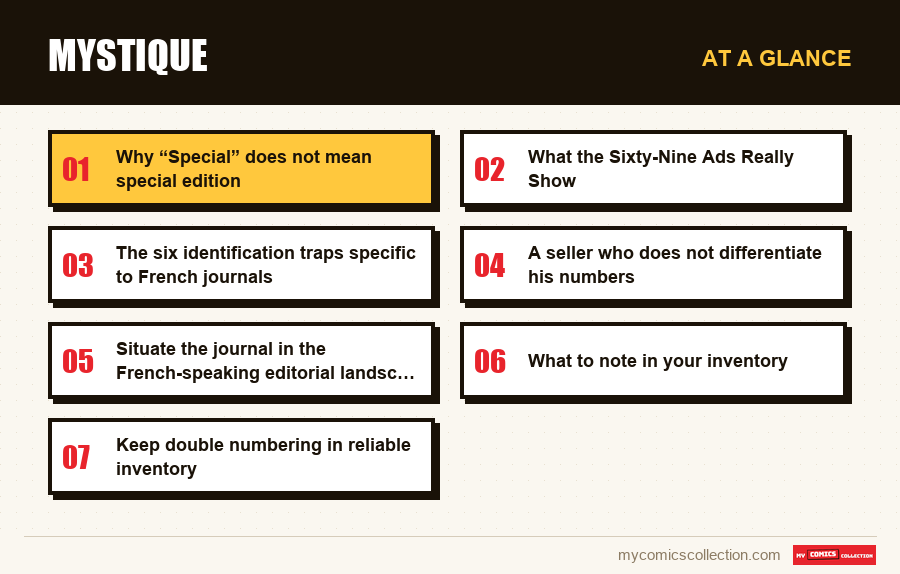
Why “Special” does not mean special edition
In everyday French, the adjective “special” describes what is out of the ordinary. In periodical press vocabulary, it often carries a second value: an additional issue, published outside the usual rhythm, generally thematic and sometimes numbered separately. It is this second meaning that the reader spontaneously projects onto a cover. Now in the case that concerns us, the word belongs to the title itself, like any other noun of a journal name. The publication is simply called that, and it appeared under that name for years.
The proof lies in the numbers recorded. The announcements observed on August 30, 2026 mention the 65 in 1989, the 67 and the 69 in 1990, the 77 in 1991, the 78 in 1992. A special issue does not produce a series of seventy-eight deliveries spread over several years: it appears punctually, often once, sometimes annually. A numbering which progresses regularly and a periodicity which covers at least four consecutive years in our sample describe, without ambiguity, a regular series.
This confusion is not anecdotal for the buyer. It determines what he types into a search engine, what he thinks he should pay, and how he classifies the object once received. A reader who notes “special issue” in his inventory loses the only information that really matters for finding the issue later: the number. The same problem of identification arises in another register, that of the confusion between a number and the character it contains, which we treat in a number is not an identity.
What the Sixty-Nine Ads Really Show
A floor at €4.00
The lowest amount requested within the set is €4.00. This floor is not a market value: it is the price that a seller has decided to display on a given day, and it turns out that it is the five advertisements from the same origin that occupy it. A floor held by a single actor is not a market floor, it is the pricing policy of a seller.
A median of €9.50
The central value of the whole is at €9.50, a little more than double the floor. This is the most useful figure in the entire survey, because it resists extremes: it indicates the level around which half of the announcements ask for less and the other half for more, on August 30, 2026, without saying anything about what was actually paid.
An isolated summit at €129.00
The most expensive ad asks for €129.00, more than thirty times the floor. A solitary maximum of this amplitude expresses the hope of the one who set it, not an observed level. Using it as a reference would amount to confusing the ambition of a seller with the behavior of all buyers.
Zero copies verified
None of the sixty-nine advertisements offer a copy passed by a verification body. In this segment of French journals, certification simply does not exist. The amounts observed therefore relate entirely to copies described by their seller, in the terms that the latter has chosen.
These four markers are read together and not separately. The gap between €4.00 and €129.00 is considerable, but the median at €9.50 shows that the mass of offers is concentrated at the bottom of the range: the top is an exception in the cloud, not its center of gravity. We must also remember that the currency changes everything here. The statements usually published on this site relate to the American market and are expressed in dollars; this concerns the French market and is expressed in euros. Directly comparing these two price universes would amount to adding different units.
Five advertisements, five distinct issues, five different years of publication, and yet a strictly identical amount: €4.00: accompanied by wording that is also identical right down to the mention of the condition. The conclusion is obvious: these five offers come from the same source. Counting ads therefore never amounts to counting sellers.
This reservation weighs on the reading of the workforce. Sixty-nine listings may correspond to a significantly lower number of sellers, and a seemingly comfortable workforce may mask real concentration. Before interpreting a volume as a sign of availability, we must ask ourselves how many distinct hands make it up.
The six identification traps specific to French journals
Search for a non-existent category
Querying an engine with the word “special issue” does not bring up anything useful, since the publication is not one. The productive query combines the full title of the journal and the number sought, without a qualifier added by the buyer himself.
Confusing year and number
The advertisements noted bear years ranging from 1989 to 1992 for numbers ranging from 65 to 78. The year alone is never enough to designate an issue: several issues share the same year, as shown by numbers 67 and 69, both dated 1990.
L'accent manquant
The observed labels write the word without its accent. A search entered with an accent therefore misses part of the offer, and a search without an accent misses another. You have to launch both forms, it's a constraint specific to the French-speaking market.
The port omitted from the calculation
A booklet priced at €4.00 costs more once shipped, and the cost of transport becomes decisive when the unit price is so low. The only figure that allows an honest comparison between two offers is the total amount actually disbursed.
Take the workforce for diversity
Sixty-nine ads suggest a wide choice, but five of them share the same origin. The gross headcount measures the number of offers published, never the number of available contacts nor the number of distinct booklets offered.
Believing that the price describes the content
A seller who aligns five different numbers on a single price has not prioritized his stock. Its price reflects a lot policy, not the particularity of this or that issue: it cannot therefore serve as an indication of what a specific issue contains.
Collecting this series?
Track what you own, what you are missing and what your collection is worth. 7 day trial.
Start my trial →A seller who does not differentiate his numbers
The most actionable fact in the statement is not a price, it’s a behavior. Five issues with distinct numbers and years are offered at the same amount, under the same terms. This seller does not sort: he applies a uniform price to a set of copies that he treats as interchangeable. This practice, very commonplace for those selling a complete fund, has two implications directly useful to the buyer.
The first is an opportunity. Anyone looking to complete a sequence of numbers will find a single contact person capable of providing several items at once, without negotiation number by number and, often, with consolidated shipping. Buying five booklets from five different sellers costs five postage; buying them from one usually costs one. When the unit price is €4.00, this saving is not marginal: it can represent half of the expense.
The second is a warning. A uniform price means precisely that the seller does not claim anything special about any of its numbers. This price should therefore not be read as an evaluation of the content, and even less as a confirmation that a given booklet would be devoid of interest. The price here describes the logic of the offer, not the nature of the object. This is exactly the reasoning that we apply elsewhere to the question of the first appearance, in the price of the full appearance.
Still, five ads from the same origin form a tiny sample. Five offers do not allow us to assert any price level for the entire publication: they describe the policy of a seller, on a given day, and nothing more. It is the median of the whole, calculated on the sixty-nine announcements, which remains the only somewhat robust benchmark, and even then, with the reserve of concentration already mentioned.
Situate the journal in the French-speaking editorial landscape
Understanding why such a publication exists sheds light on the initial misunderstanding. The format of the American monthly issue has never been the natural format of the French comics press: French publishers have recomposed the imported material into thicker collections, published periodically, often bringing together several stories under a single cover. The word “Special” has the value of a collection label, in the same way as other words used by publishers to distinguish their different lines of magazines.
As a result, French numbering and American numbering do not correspond. An issue of the French journal is not equivalent to an issue of the original title: it potentially contains several, and the order of publication may differ. This is the source of the second great confusion for French-speaking collectors, that which consists of searching, under French numbering, for content identified by its American reference. For the chronology on the American side, our editorial history of the X-Men provides the framework.
Practically, this means that a French-language inventory must record two things instead of one: the reference of the French magazine as printed on the cover, and, when known, the correspondence with the original material. Entering only one of the two guarantees that you will waste time later, either by searching for a booklet in the wrong numbering system, or by unknowingly repurchasing content already owned under another cover.
This double reference also explains why the prices of the two markets do not compare. An amount in euros relating to a French collection and an amount in dollars relating to an American issue do not cover the same object, nor the same volume of content, nor the same relative rarity. Bringing them together systematically produces false conclusions, in one direction or the other.
What to note in your inventory
The exact title of the journal, including the word « Spécial ». Do not abbreviate, do not replace with “special issue”, do not remove the word under the pretext that it is only a qualifier. It is the name of the publication and it is part of its identity: without it, the inventory line becomes impossible to compare to a future announcement. Also note, in a free search field, the form without accent as it appears in the sellers' descriptions, since this is the one that is actually circulating.
The issue of the French review, separately. The numbers observed on August 30, 2026 are 65, 67, 69, 77 and 78. It is this value, and not the year alone, which identifies an issue within the series. Save it in a dedicated field rather than buried in a description, otherwise you will not be able to sort your suite or spot any gaps.
The year of publication, next to the number. The advertisements noted cover 1989 for number 65, 1990 for numbers 67 and 69, 1991 for number 77 and 1992 for number 78. Recorded with the number, the year serves as a consistency check: it makes it possible to immediately detect an advertisement whose dating does not match the position in the series.
Provenance, when several numbers come from the same seller. If you buy the 65, 67 and 69 from the same person, write it down. This information will serve you twice: to return to this source when you are missing a neighboring number, and to remind you that the prices paid come from a single pricing policy and do not constitute three independent observations of the market.
The unit price actually paid, shipping included. A booklet priced at €4.00 did not cost €4.00. Divide the total paid, items and shipping, by the number of issues received, and enter this quotient. This is the only value that allows you, months later, to honestly compare a group purchase and an individual purchase, and to evaluate what your suite really cost you.
Questions fréquentes
No, not in the case observed here. The word is part of the name of the publication, which appeared regularly with its own continuous numbering. The announcements noted on August 30, 2026 mention numbers up to 78, spread from 1989 to 1992: this is the profile of a long-term series, not that of an exceptional delivery. Looking for a “special issue” under this name leads nowhere.
Because this report concerns the French market, unlike the American observations usually published here. The magazine concerned is a French publication, it is exchanged between French-speaking collectors, and the amounts requested are therefore expressed in euros. Above all, these figures should not be compared to dollar amounts on American issues: neither the currency, nor the object, nor the market are the same.
Of the sixty-nine advertisements noted, none offered a copy passed by a verification body. This indicates that certification is not practiced in this segment of French journals. In practical terms, the advertised condition is based entirely on the seller's description, and therefore one must examine the photographs and question the seller rather than waiting for an independent assessment.
He is not. This amount comes from five announcements which share identical wording and clearly come from the same source: it is a pricing policy, not a market level. The central value of the set is €9.50, more than double. And as the reading was carried out on a single date, it does not show any evolution: it photographs the offer of August 30, 2026, nothing more.
This is an advantageous situation. A seller who displays five numbers at the same price generally agrees to ship them together, which spreads a single postage over several issues: a considerable gain when the unit price is around a few euros. First list the numbers you are missing, then check which ones this source covers, before looking for the others elsewhere.
Keep double numbering in reliable inventory
Full title, French number, year, origin and real price including shipping: these five pieces of information do not fit into a scribbled list. My Comics Collection records them for each copy, identifies gaps in a sequel and saves you from having to repurchase content already present under another cover.