The August 30, 2026 reading places the full appearance of Mystique, in issue 18 of Ms. Marvel dated June 1978, above the preview spotted two issues earlier: the five cheapest listings of issue 18 range from $67.68 to $82.50, compared to $33.78 and $44.00 for two copies of issue 16 described as a "cameo" of the same character. Please note: these amounts are prices displayed by sellers on a general auction site in the American market, not concluded transactions, and they were taken on a single date: they therefore say nothing of an increase or a decrease.
Two issues separate a character's discreet entrance from their overt entrance, and this tiny gap in a series is enough to create two distinct markets. The case of Mystique is a good field of observation because the interval is short, the series identical, the year identical, and the price difference cannot therefore be attributed to seniority, the publisher or the format. What remains, once all these variables are neutralized, is how sellers characterize the appearance, and how buyers pay for it.
The survey carried out on August 30, 2026 on a general auction site, American market, presents a particularity which deserves to be noted from the outset: it is clean. On the query for issue 18, the five cheapest ads all actually match the booklet you're looking for, and all describe it as the character's first full appearance. No indirect lot, no reissue, no derivative object polluting the bottom of the ranking. There is nothing automatic about this cleanliness, and it is precisely what makes the figures usable here when they would not be so elsewhere.
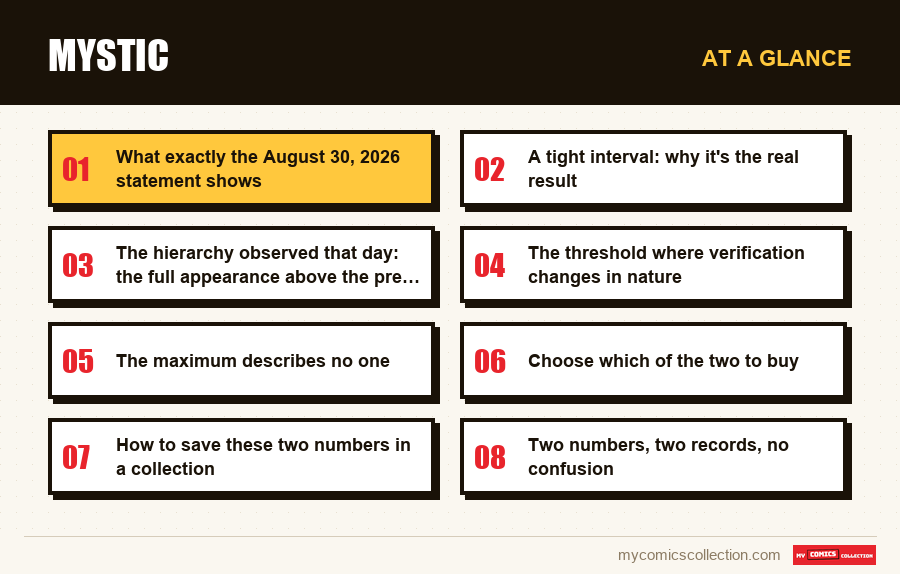
What exactly the August 30, 2026 statement shows
The query “Mystique Ms Marvel 18 1978” turned up 46 unverified listings, with a claimed minimum of $67.68, a median of $150.00, and a high of $3,795.00. Copies passed through a verification agency were counted separately: 63 ads, minimum $71.92, median $280.00, maximum $13,949.99. These two sets cannot be compared term to term, since they do not describe the same object: on the one hand a booklet described by its seller, on the other a booklet accompanied by an external opinion on its condition. Mixing them together would produce an average that would amount to nothing purchasable.
A word on the nature of these amounts, because confusion is frequent and costly. Each figure cited here is what a seller is asking at a given time, on an ad that is still open. No one necessarily agreed to pay this amount. A displayed price expresses an intention to sell; a concluded price expresses an agreement between two parties. The distance between the two can be considerable, especially at the top of the ranking, and nothing in an ad report allows it to be measured.
Second point, just as structuring: this photograph was taken on a single day. A single measurement does not draw any trajectory. To assert that this number “goes up” or “goes down” based on these numbers alone would be like describing a movement from a stationary point. It would take at least two spaced surveys, carried out under the same conditions and on the same segments, to start talking about developments, and again, on announcements and not on sales, caution would remain in order.
A tight interval: why it's the real result
Quinze dollars d'amplitude
The five cheapest listings range from $67.68 to $82.50. Fifteen dollars difference on five copies of the same booklet is a small dispersion. When the bottom of a ranking tightens to this extent, it becomes a readable entry point rather than a simple statistical accident.
States declared neighbors
These five announcements display close states, around FN according to their descriptions. The homogeneity of states partly explains the homogeneity of prices, and vice versa: we observe the same object in the same approximate condition, not five different objects.
No intruders at the bottom of the ranking
The five lots all correspond to the booklet sought. This is the rarest point of the survey: in most requests, the minimum is occupied by an object which is not what we think, which immediately distorts any reading of the floor.
Une qualification unanime
All five descriptions claim the character's full appearance. The sellers' vocabulary converges, indicating that the market has agreed on what this number represents: an agreement that does not always exist and which, when lacking, drives prices apart.
The lesson in method is there: a survey can only be used if its floor is checked line by line. When the minimum displayed is produced by an object which is not the issue sought (a single cover, a mismatched lot, a later edition) it does not indicate a low price, it indicates a collection error. Here, manual checking of the first five lines confirms that they describe the intended object, and it is this confirmation, more than the number itself, which authorizes its use.
A tight interval on neighboring states indicates that a single object is being measured. A wide interval, on the contrary, almost always indicates that several things have been mixed under the same query: very different states, different editions, or objects which only have a few words in common in their title.
Before choosing a number, the question to ask is not “how much?” » but “how much of what?” ". The first useful reflex is to open the five least expensive ads and check that they all talk about the same issue. If one of them describes something else, the minimum reading does not exist.
The hierarchy observed that day: the full appearance above the preview
An earlier statement made the same day, relating to number 16 of the same series, showed two copies described as a « cameo » of the same character, fetched $33.78 and $44.00. Compared to the floor of number 18, these amounts represent approximately half. The hierarchy is therefore established here in the direction that we intuitively expect: the complete appearance dominates the fleeting appearance.
This formulation deserves to be weighed. This is a dated observation, not a rule. On other characters, the order is reversed: the preview, sometimes rarer, sometimes more highlighted by the sellers, costs more than the plate where the character finally appears in full page. Nothing in the market structure guarantees that the completeness of an appearance takes precedence over its anteriority. What matters is what the buyers of a moment have decided to consider as the real starting point.
It is also necessary to point out the weakness of the squad for number 16: only two announcements. Two lines do not constitute a price level. They indicate that on that date, two sellers requested these amounts; they do not allow us to say what the issue is worth, or even what we can hope to spend on it. The “around half” ratio must therefore be read as a specific order of magnitude, to be re-verified on a larger workforce before making it an argument for purchase.
Still, this ratio of one to two, even fragile, sheds light on one important thing: the difference in price between the two numbers is not marginal. It does not depend on rounding or state. It reflects a distinction that the market makes explicitly, and that a collector cannot ignore on the pretext that the two issues come out with the same title a few weeks apart. On this point, the logic is similar to that found in the fact that a number is not enough to designate a booklet: the number printed on the cover says nothing until it is linked to a series, a year and a nature of appearance.
The threshold where verification changes in nature
The minimum of the verified segment stands at $71.92. This figure falls within the range formed by the five cheapest unverified listings, between $67.68 and $82.50. In other words, the two segments meet at the bottom: at that date, there were copies accompanied by an external opinion on their condition offered at the same level as copies simply described by their seller.
It is a configuration that completely changes the way of reasoning. In the ordinary case, verification is paid for: it adds an additional cost that must be accepted or refused depending on what we intend to do with the booklet. When the floors meet, this additional cost disappears at the bottom of the market, and the question becomes purely a question of guarantee. At a comparable price, a copy whose condition has been assessed by a third party reduces uncertainty; a copy described by its seller leaves it intact.
The practical consequence is simple to state. If the two segments touch when searching, it's worth seriously considering the checked option before deciding: not because it would be superior in itself, but because the usual reason to reject it, its price, no longer applies. That said, the medians remain very far apart: $150.00 versus $280.00. The rapprochement only concerns the floors, and it does not extend to the heart of the market.
This last clarification matters, because it prohibits a tempting generalization. We cannot conclude from meeting the minimums that verification would have become free on this number. We can only say that at that date, on the very first lines of the ranking, it cost nothing more. It's a narrow window, and it requires you to check yourself that it is still open at the time you buy.
Collecting this series?
Track what you own, what you are missing and what your collection is worth. 7 day trial.
Start my trial →The maximum describes no one
Both segments show spectacular highs: $3,795.00 on the unverified side, $13,949.99 on the verified side. These amounts do not indicate any price level. They describe one or two particular examples, and above all the hopes of their sellers. There is no evidence that anyone paid these amounts, or even that a buyer considered them.
The ratio between the maximum and the median shows this well: more than twenty-five times the median on the unverified side, around fifty times on the verified side. A distribution where the high end moves that far from the center is a distribution where the mean becomes meaningless. Using the maximum as a reference, or even mentioning it without caution, amounts to letting an isolated case tell the story of the entire market.
The useful reading of a statement therefore passes from the bottom and from the center. The floor, once checked, indicates what must be expected to enter; the median indicates where the supply actually stands. The summit deserves to be noted as a curiosity (sometimes a copy in exceptional condition, sometimes an ad left online with no real intention of selling) but never as an objective or as a valuation.
Choose which of the two to buy
Check the nature of the appearance
Before any arbitrage, you need to know what the ad is selling: a preview or a full appearance. The five cheapest ads in number 18 say this explicitly. An ad that remains vague on this point sells doubt, whatever its price.
Attach the booklet to its date
Issue 18 is dated June 1978. The date serves as a safeguard against reissues and homonymous numberings of other series. Without it, a number alone does not designate anything specific in a catalog.
Read the declared state as a declaration
The states advertised around FN on the five least expensive listings come from the sellers themselves. These are assertions, not observations. They are used to compare advertisements with each other, not to establish the actual condition of an item.
Compare segment by segment
A verified copy is compared to verified copies, a copy described by its seller to equivalent copies. Crossing the two families produces illusory differences which have nothing to do with the booklet itself.
Beware of low numbers
Two ads on number 16 are not enough to establish a price. On this side of the comparison, the information available is an index, not a measurement, and it must be presented as such in any purchasing decision.
Décider selon l'usage visé
Whoever builds a narrative whole around the character has an interest in both issues. Anyone looking for a single representative issue will opt for the one that the market mainly recognizes: here, the complete appearance, based on the day's reading.
The decision really comes down to a question of budget and intention. Number 16, at about half the price, offers anticipation and first insight; number 18 offers market recognition and a much more abundant supply, therefore a real choice between several copies. Buying both, when the budget allows, solves the question by removing the arbitrage: provided you then know which is which, which brings us to the next point.
How to save these two numbers in a collection
Distinguish the two numbers upon entry. Two neighboring booklets from the same series tell here the same arrival of a character in two different forms. If the card only bears the number, nothing will later allow us to know which of the two we have, nor why one cost twice as much as the other. The number alone is insufficient information as soon as a character has several entry points in the same series.
Write the nature of the appearance next to the number.“Preview” and “full appearance” are not decorative comments: they are the two labels that explain the observed price gap. Included in the file, they make the inventory rereadable years later, even by someone who was not present at the purchase. Omitted, they condemn us to reopen each issue to remember what we have.
Record the segment from which the price paid came. A copy purchased verified and a copy purchased by description are not comparable. Noting this distinction at the time of entry avoids later building a total which adds objects of different nature, and allows you to find out why two apparently identical issues appear at distant amounts.
Date the reference amount. The statement in question here is valid for August 30, 2026 and for that day only. A card that bears a number without a date carries information that ages silently. The date transforms a perishable value into a usable observation: we know what it measures and when to recheck it.
Mark the remaining booklets to be acquired in the same series. When a character's arrival spans several issues, the collection is only complete once everything is assembled. Explicitly reporting the missing number, rather than leaving it in an implicit void, avoids inadvertently repurchasing the one you already have and makes visible what remains to be looked for.
No. These are exclusively amounts requested by sellers on advertisements still open as of August 30, 2026, on a general auction site on the American market. No transactions are evidenced by these figures. A displayed price expresses an expectation; only a concluded price expresses an agreement between a buyer and a seller.
No, and not from this data. All were collected on the same day. A single observation describes a state, not a movement. To speak of an increase or decrease, there would need to be at least two separate surveys over time, carried out with the same method and on the same ad segments.
Because they do not constitute the same offer. A copy whose condition has been assessed by an external organization and a copy described by its sole seller do not carry the same degree of uncertainty. Combining them in the same calculation produces a median which does not correspond to any announcement actually available.
Not necessarily. This is what the record of this date indicates for this character, with a ratio of approximately one to two, but the order is reversed for other characters. The hierarchy depends on what the market considers the true starting point, and there is nothing universal about this convention.
Nothing related to the price level. This amount comes from an isolated ad and reflects the hope of its seller. It deviates from the median of the same segment by a ratio of approximately fifty times. An extreme of this nature is noted as a curiosity, never as a reference for valuation.
Two numbers, two records, no confusion
My Comics Collection allows you to enter for each issue its series, its date, the nature of its appearance and the amount paid with its reference date. Your neighboring numbers stop being interchangeable, and your inventory stops adding up objects where one is worth twice the other.