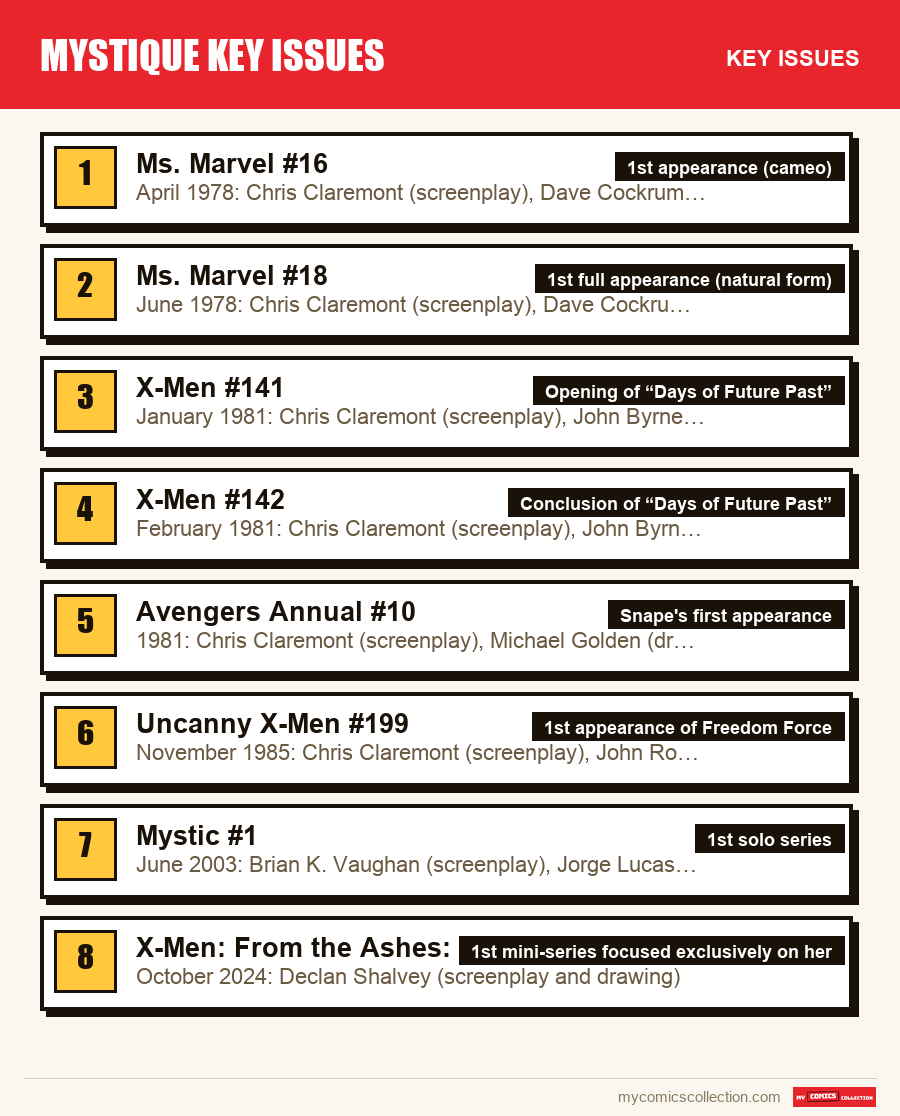
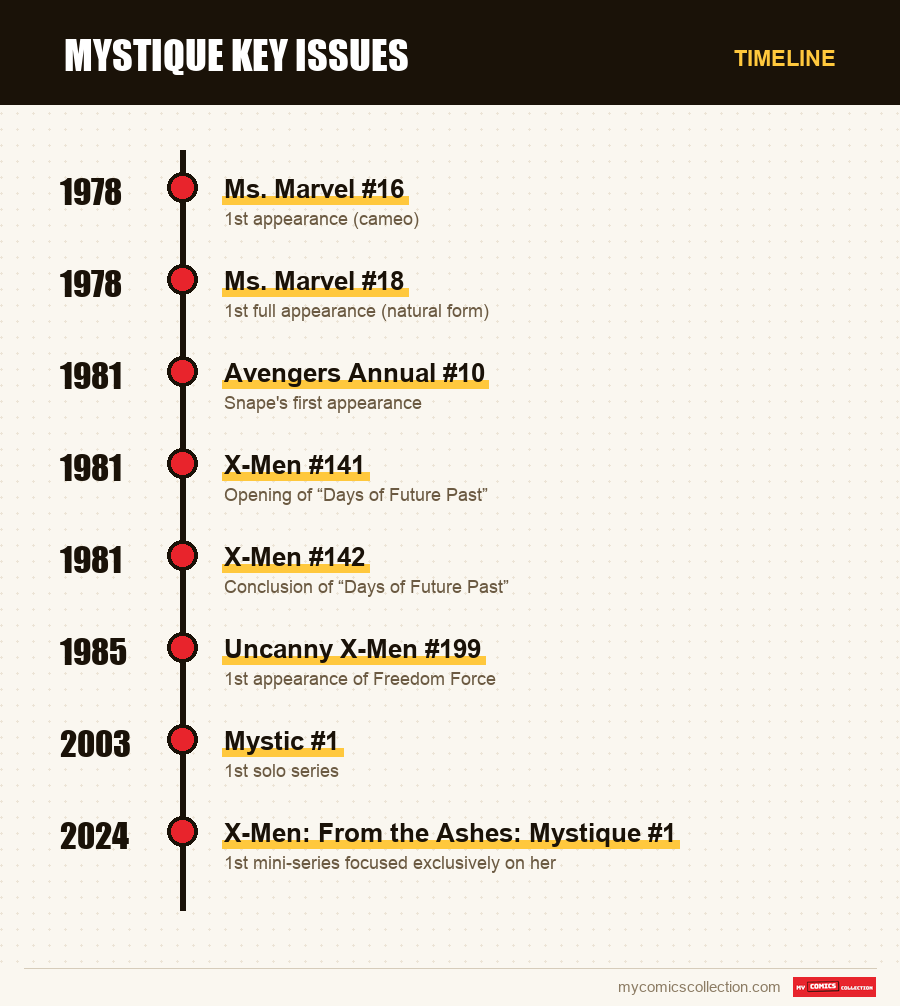
The real key to Mystique is Ms. Marvel #16 (April 1978): her very first appearance, in a disguised cameo. Two issues later, Ms. Marvel #18 (June 1978) shows its true blue form for the first time. Next come X-Men #141-142 (1981, “Days of Future Past”), where she leads the Brotherhood of Evil Mutants, and Avengers Annual #10 (1981), first appearance of Snape. These five issues form the heart of any serious collection dedicated to the character.
Unlike mutants whose editorial career is based on a single founding event, Mystique has been built over time: nearly fifty years of stories where she goes from a simple silhouette glimpsed to group leader, adoptive mother of Rogue, government agent, then finally heroine of her own series. This longevity complicates the collector's task, as there are almost as many "Mystique moments" as there are story arcs in which she participated. Certain numbers are indisputably key in the literal sense of the term (first appearances, group debuts, solo series launches) others are more of a nostalgic anecdote.
This guide focuses exclusively on numbers to have and on what we really know about their value and their rarity, without falsehood or invented figures. For the complete biography of the character, his history of betrayals and reversals, head to our article dedicated to Mystique's story in the comics: here, the angle is deliberately narrowed on investment and collection. Also find all the information on the character on his dedicated sheet.
How Mystique established herself in the Marvel editorial universe
Mystique was born from the pen of Chris Claremont and the pencil of Dave Cockrum, at a time when the screenwriter was already methodically constructing the mutant universe that would become Uncanny X-Men. It first appears in the pages of Ms. Marvel, Carol Danvers' solo series, and not in an X-Men title: a revealing editorial choice, since Mystique was initially thought of as a recurring adversary of Carol Danvers before becoming a centerpiece of mutant mythology a few years later.
His entrance onto the scene is deliberately enigmatic. Claremont gives her neither name nor clear origin at first: she appears disguised as an agent, observes, manipulates, disappears. It is only over the following issues that her nature as a shapeshifter is confirmed, then her past (her relationship with Destiny, her role as Nightcrawler's biological mother, her status as Rogue's adoptive mother) is revealed in fragments, over several years and several series. This gradual construction explains why collectors carefully distinguish the strict "first appearance" (a disguised cameo) from the "full first appearance" (its true blue form revealed).
The major turning point came in 1981 with the diptych “Days of Future Past” in X-Men #141-142, where Claremont and John Byrne make Mystique the leader of a reconstituted Brotherhood of Bad Mutants, responsible for an attack which precipitates a dystopian future dominated by the Sentinels. It is this story, more than the 1978 cameo, that permanently establishes Mystique as the leading antagonist of the X-Men franchise, and which explains its renewed popularity after the 2014 film adaptation.
Ms. Marvel #16
This is where it all begins, but discreetly. Mystique appears disguised as a German agent under the name "Leni Zauber", observing Carol Danvers' research on Tiger Shark. Her natural blue face is never shown and the name "Mystique" is not yet pronounced: it is a cameo in the strict sense, which does not prevent this issue from being considered the absolute reference for the character by all collector's guides.
Ms. Marvel #18
Two issues after her cameo, Mystique finally reveals herself: her blue skin and her nature as a shapeshifter appear for the first time, for a single panel, without disguise. It is this publication that many specialists qualify as the “real” first appearance, since it visually confirms the identity of the character that #16 was content to suggest. The Avengers (Wasp, Yellowjacket, Vision, Scarlet Witch, Wonder Man) also appear in this issue.
X-Men #141
Mystique reforms the Brotherhood of Bad Mutants around Destiny, Blob, Pyro and Avalanche with the aim of assassinating Senator Robert Kelly, an anti-mutant figure in full political ascension. This planned attack is the triggering event for the nightmarish future where the Sentinels have exterminated almost all of North America's superhumans: the future that Kitty Pryde, projected into the past, tries to prevent. This issue also introduces Rachel Summers in her future self.
X-Men #142
Second half of the diptych: the dystopian future closes in on the adult X-Men while, in the present, the assassination attempt orchestrated by the Brotherhood of Mystique is narrowly foiled. The issue cemented Mystique's status as the mastermind of the original attack, a role that would structure her character for the following decades, until her film adaptation.
Avengers Annual #10
At this time still a member of the Brotherhood of Mystique, Rogue permanently absorbs the powers and part of the psyche of Carol Danvers: a theft that she will never be able to completely undo. The annual also marks the first appearance of Madelyn Pryor and lays the narrative foundation for the adoptive mother-daughter relationship between Mystique and Rogue, exploited in countless subsequent X-Men stories, all the way to the cinema.
Uncanny X-Men #199
Faced with rising anti-mutant distrust in the United States, Mystique makes a radical decision: disband the Brotherhood of Bad Mutants and negotiate amnesty for its members (Blob, Pyro, Avalanche, Destiny, Spiral) with government advisor Valerie Cooper, in exchange for their services under the name Freedom Force. This shift, from wanted terrorist to quasi-official government agent, is one of the character's most notable repositionings.
Mystic #1
Twenty-five years after her cameo in Ms. Marvel, Mystique finally gets her own series. Brian K. Vaughan's premise: Charles Xavier unofficially recruits her for espionage missions that the X-Men cannot carry out in broad daylight, exploiting precisely what makes her unique: lying and infiltration as a way of life. The series ran until 2005.
X-Men: From the Ashes: Mystique #1
In the "From the Ashes" editorial era, Mystique notably faces Nick Fury in a five-issue miniseries built solely around her, with no supporting X-Men standard-bearer. This is the first time that the character carries a full story from start to finish as a sole protagonist, and no longer as the antagonist or supporting role of a group.
Collecting this series?
Track what you own, what you are missing and what your collection is worth. 7 day trial.
Start my trial →The impact of adaptations on the rating
Mystique is one of the few X-Men antagonists to have received near-continuous cinematic exposure. Rebecca Romijn plays him from the first film X-Men in 2000, then in the two sequels to the original trilogy: a screen presence significant enough to remain associated with the character for more than a decade. Jennifer Lawrence then reprises the role from X-Men: First Class (2011), with a clearly enhanced status: in the prequel trilogy, Mystique ceases to be a simple executioner of Magneto to become a narrative pivot in her own right.
The most significant case remains X-Men: Days of Future Past (2014), direct adaptation of the diptych X-Men #141-142. The film significantly modifies the original plot: in the comics, the Brotherhood of Mystique targets Senator Robert Kelly; in the film, it is Mystique herself, acting alone, who prepares to assassinate Bolivar Trask, the creator of the Sentinels. This storyline change makes Mystique the central character of the film, much more than in the original story where she is just one leader among others, and mechanically brought the founding comic back into the spotlight to a wider audience at the time of the film's release.
This dynamic repeats itself with each new media appearance of the character: casting or release announcements linked to Mystique traditionally generate renewed attention on its founding issues, in particular Ms. Marvel #16 and #18 as well as To objectively assess the value of an item you own or are aiming for, the best approach is to compare recent actual sales rather than relying on general trends.
Buying guide
Collecting Mystique involves navigating between two very different realities: Bronze Age issues almost fifty years old, fragile and sometimes tricky for the uninformed buyer, and modern series that are widely available. Here are the points of vigilance that make the difference.
- Don't confuse cameo with full appearance: Ms. Marvel #16 (disguised cameo) and #18 (natural form revealed) are two separate keys, with different ratings and demand: always check which issue you're actually buying before paying a "first appearance" price.
- Favor “white pages” copies for the issues from 1978-1985: the newsprint from this period yellows quickly, and the condition of the pages weighs heavily in the final grade and therefore in the value.
- Systematically compare grades before investing: the difference in rating between a 9.6 and a 9.8 can be considerable on a sought-after Bronze Age: our guide on the difference between CGC 9 and 9.8 details precisely what justifies the discrepancy.
- Beware of Facsimile Editions: Marvel has reissued several key period issues in facsimile format, clearly identifiable on the cover but sometimes resold without this precision: the price of an original and that of a reissue have nothing to do with each other.
- Follow Rogue alongside Mystique: Avengers Annual #10 is a Rogue key as much as a Mystic key; her rating often moves in tandem with the media exposure of Rogue herself.
- Start with Modern Era if you're on a tight budget: Mystique #1 (2003) and the From the Ashes miniseries (2024) offer an affordable entry point before considering four-digit Bronze Age numbers.
- Document your collection as you go: tracking the condition, origin and rating of each acquired issue greatly facilitates future resale:our collection management application allows this monitoring to be centralized.
- Check actual demand before buying or selling: the prices displayed in stores or on marketplaces do not always reflect the sales concluded: cross-referencing actual sales data remains the most reliable reflex.