Writing "Ms. Marvel #16" on a list doesn't mean anything specific. The same wording is carried by at least four separate items, published decades apart, and the sellers mix them up without reporting it. The August 30, 2026 statement shows this bluntly: questioned without a year, this wording brings together 149 unverified advertisements whose median amounts claimed fall to $15.00; by simply adding “1978” to the query, on the same day, there are 76 listings remaining and the claimed median rises to $72.64. Nothing has changed between the two measurements: it is the whole measured which has changed. The identity of an issue lies in its series and its year, never in its number alone.
The first mistake a collector makes when holding their issues by hand is almost never a mistake in condition or price. It's a case of mistaken identity. We note a title, we note a number, we believe we have designated an object, and we have in reality designated a family of objects which only have three words and two numbers in common. The case discussed here is exemplary because it is banal: a series title taken up several times by the same publisher over the decades, a number low enough to exist in each of these times, and a sought-after event lodged in only one of them. Everything comes together so that the handwritten list, the homemade spreadsheet and the quickly typed query get the wrong subject.
The following figures come from a survey carried out on August 30, 2026 on the then current advertisements of a general auction site, American market. These are amounts claimed by sellers, not concluded transactions: no one paid these sums, they express a demand. Copies passed by a verification agency are counted separately from others, because mixing the two populations would make any median unreadable. And as it is a single photograph, taken on a single day, it says absolutely nothing about an increase or a decrease: no evolution can be read in an isolated point.
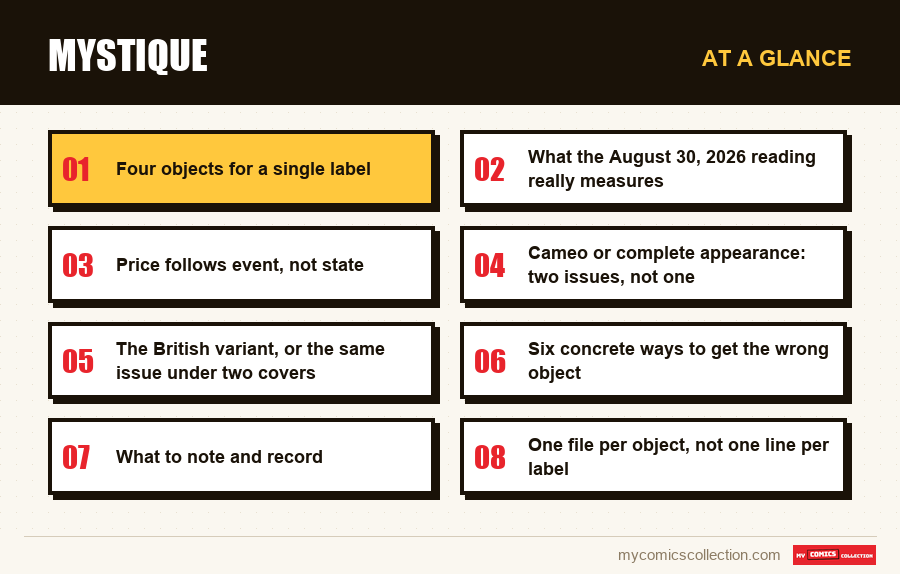
Four objects for a single label
In the broadest request, the one which only includes the title and the number, we find fascicles side by side which have no relation to each other. A copy dated 2015, rated VF+ 8.5, costs $2.39. A copy dated 2017, rated VF/NM 9.0, fetches $2.36. Two copies of a series entitled “Magnificent Ms. Marvel”, also number 16, are listed at $1.99. And among them, drowned out, are the copies of the 1978 series: the ones the person typing this query is really looking for.
Four objects at least, therefore, under the same label. They share neither the era, nor the creative team, nor the content, nor the editorial format. They share a string. That's enough for a search engine to group them together, enough for a spreadsheet to confuse them, and more than enough for a busy buyer to make a mistake. The confusion is not caused by dishonest sellers: their ads are, for the most part, accurate. It is the query that is ambiguous, and the ambiguity is structural.
What the August 30, 2026 reading really measures
Request without year, raw copies
149 unverified listings. Lowest amount claimed is $1.50, median $15.00, highest $349.00. This low median does not describe the 1978 issue: it describes a mixture where modern reissues, much more numerous and much less expensive, pull the middle down.
Request without year, copies checked
24 ads placed by a verification agency, from $43.00 to $2,099.00, median at $130.75. The number remains modest and the range very open; the high is an amount asked by a single seller, not a market level.
Query with year, raw copies
76 unverified listings, $5.42 to $349.00, median $72.64. The floor quadrupled and the median increased nearly fivefold: without any price changing, since the measure was taken on the same day.
Request with year, copies checked
47 listings, $74.99 to $3,477.75, median $176.20. We note in passing that specifying the year makes augmenter the number of verified copies retained: the broad query was not only noisy, it was also incomplete.
The important point is not any of these four figures in isolation. This is their gap. Two unverified medians taken on the same day, on the same platform, for what the user believes to be the same object: $15.00 on one side, $72.64 on the other. A ratio close to five, produced only by adding four characters to the search field. No seller changed their price between the two measurements. What has changed is the population observed.
A median only makes sense if we know what it summarizes. Here, the median at $15.00 summarizes a heterogeneous group including booklets from the 2010s sold for two dollars; the median at $72.64 summarizes a set already filtered by year. The second figure is not “truer” in absolute terms: it is simply calculated on a set which corresponds to the question asked.
Practical consequence: when you compare two estimates found elsewhere, the first thing to ask is not the date of the statement but the query used. Two figures built on different sets cannot be compared, even if they have the same label.
Price follows event, not state
A second lesson comes from the same statement, and it contradicts the most widespread intuition among beginners: that which wants the state to control everything. In the request specified by the year, a copy of number 16 described as VG+, with the cover detached at the bottom staple, is requested $44.00. In the same request, a copy of number 13 of this same series from 1978, described as "NM++ 9.6 Or Better, Unread, White Pages", is asked for $39.00. A damaged booklet asked for more than an almost new booklet published a few months earlier in the same collection.
The explanation is not mysterious: what is valued here is not the object but what it contains. The number 16 is the one that the ads describe as bearing the first appearance: in this case in the form of cameo, we come back to it: of a sought-after character. Number 13 bears no such thing. With equal content, the state would effectively control the price; with unequal content, it falls to second place. This is why the notion of “key number” is never reduced to a conservation note, and why a collection which only records states without recording what each issue contains loses most of the information.
Be careful not to overinterpret: these are two listings, not two sales, and two listings do not constitute a measurement. They illustrate a mechanism, they do not quantify it. Retaining “the event takes precedence over the state” is legitimate; deducing a numerical relationship between the two numbers would not be.
Cameo or complete appearance: two issues, not one
The announcements found in the specified request are explicit on this point. One is titled “MS. MARVEL #16 [...] 1st cameo Mystique [...] UK Price 1978 FN” and asks $33.78. Another, “Ms. Marvel #16 VG+ 1st Mystique Cameo 1978 Cover Detached At Bottom Staple,” asks $44.00. The word that matters is cameo. He points out that the apparition contained in this issue is brief, partial, distinct from the developed apparition which comes next in the publication.
This nuance separates two issues in a collection, and it separates two in a sales catalog. A person who notes "first appearance" without specifying which one finds himself, a few months later, unable to say whether he has the booklet he thinks he has, or whether he is still looking for a second one. The subject deserves to be treated for its own sake: the page devoted to the first appearance and its different forms details this distinction, and the guide de collection shows how to record it unambiguously at the time of entry.
The British variant, or the same issue under two covers
Two adverts list a UK price printed on the cover. This is a sign that the same issue has circulated with covers bearing different prices depending on the destination market. For the buyer, this means that a copy corresponding in all respects to their search (same title, same number, same year, same content) may nevertheless not be the same object in the eyes of a meticulous collector.
We must remain general here: the August 30 statement does not provide any separate measurements for these variants. Two advertisements do not allow us to estimate their frequency in the offer, nor to say whether they are demanded more or less expensively than standard copies. What they establish is only their existence, and therefore the need to provide, in one's own nomenclature, a field capable of noting it. A list that cannot distinguish between two covers of the same issue will eventually merge them, and the merger is irreversible once the copies are resold or exchanged.
Collecting this series?
Track what you own, what you are missing and what your collection is worth. 7 day trial.
Start my trial →Six concrete ways to get the wrong object
La requête trop courte
Typing the title and number alone aggregates unrelated series. The result is not wrong, it simply answers a broader question than the one you were asking. Adding the year reduces the noise immediately.
The year missing from the file
A table with a “title” column and a “number” column, but no “year of publication” column, automatically produces duplicates that are impossible to separate later.
Le titre approchant
“Magnificent Ms. Marvel” is not “Ms. Marvel.” A word added to the title designates another series. Copying a title partially, or abbreviating it, amounts to erasing this difference.
La variante non notée
A different cover price depending on the market is enough to create two distinct objects. Without a dedicated field, we note one and believe we have noted the other.
The low and recurring number
The lower the number, the more there is in each relaunch of the series. A number 16 is found in almost all covers; a number 300 is much more discriminating on its own.
L'événement mal qualifié
Noting “first appearance” without specifying whether it is a cameo or a developed appearance amounts to describing two different issues with the same mention.
Why do estimates found online differ so much?
The above highlights a phenomenon that annoys all collectors: two sources consulted on the same day give, for “the same” issue, figures that have nothing to do with each other. The temptation is to conclude that one of the two is wrong, or that the market is erratic. The survey shows a much more prosaic explanation. If one of the sources aggregates the bare wording and the other filters by year, they do not measure the same thing, and the difference of one to five observed here is entirely explained by this difference in scope alone.
Added to this is the question of verified copies. Counting them with the others would crush the measurement: in the specified query, raw copies start at $5.42 while verified copies start at $74.99. Two populations with floors ten times apart cannot share a common median without making it unintelligible. Every serious source separates them; any source that does not specify this should be read with caution.
Finally, you have to be wary of the maximums. $349.00, $2,099.00, $3,477.75: These highs do not describe a level reached, they describe a particular seller's hope on a particular listing. An isolated maximum only binds the person who displays it. The median, calculated on several dozen advertisements, resists this type of extreme value much better: provided, once again, that you know on which group it was calculated. THE key numbers of a neighboring series pose exactly the same reading problem, with equally ambiguous wording.
What to note and record
L'année de publication, systématiquement. It is the field which, by itself, takes this search from 149 heterogeneous announcements to 76 coherent announcements. Without it, your sheet describes a family of objects; with her, she describes one. No other information provides a comparable service for such a low input cost.
The exact title of the series, word for word. Copying “Ms. Marvel” when the object belongs to “Magnificent Ms. Marvel” creates irreparable confusion, because the two series have the same number. The title must be transcribed as it appears on the cover, without abbreviation or personal standardization.
The nature of the contained event, and its degree.“First cameo” and “first complete appearance” are not synonymous, and the survey shows that the sellers themselves take care to specify this in their titles. Using this distinction in your own file prevents you from purchasing the same status twice, or from thinking you have acquired a booklet that you do not have.
The coverage variant, including pricing. Two advertisements indicate coverage at UK prices. Provide a field for this information even if you do not have any today: variants are only detected at the time of entry, never retrospectively on a list where they have not been distinguished.
The verification status, separate from the declared status. A raw copy announced VG+ and a copy passed by a verification body do not belong to the same market: the floors raised on August 30, 2026 separate them by a factor of ten. Mixing the two in the same status column makes it impossible to read your own collection later.
Because the query defines the measured set. Without year, it brings together issues from 1978, 2015, 2017 and a series with a similar title; the most recent, very numerous and costing around two dollars, pull the median down. With the year, this ensemble is reduced and refocused. The $15.00 and $72.64 recorded on August 30, 2026 are therefore two correct answers to two different questions, not a contradiction.
No. These are announcements in progress as of August 30, 2026, that is to say sums requested by sellers. None of these amounts have necessarily been paid. A claimed amount expresses an intention to sell; it constitutes a plausible upper limit, never a confirmation of value.
It shows neither. A measurement taken on a single date is a point, and a point does not draw any trajectory. Establishing a trend would require several surveys spaced over time, constructed with exactly the same query and the same counting method: otherwise we would measure changes in scope again while believing we are measuring the market.
When it's not the same number, yes. The statement contains a number 16 in VG+ with detached cover asking for $44.00 compared to a number 13 described as almost new and unread asking for $39.00. The first contains the desired event, the second does not. With identical content, on the other hand, the state once again becomes the determining factor.
In your inventory, yes: it is a separate object and it must be able to be noted as such. In terms of amounts, on the other hand, the statement does not allow any conclusion: only two advertisements mention this variant, a number far too small to deduce a price level or a difference with the standard copies.
One file per object, not one line per label
Exact series, year, cover variant, nature of the event, verification status: these are five fields, and they are what separate a searchable collection from a list that will one day have to be taken over entirely. My Comics Collection records them for each copy and finds the correct booklet without using ambiguous wording.