Mystique: an album numbered 3246 in a collection which does not include a hundred
On the French market, the same seller offered on August 30, 2026 an “album no. 1” and an “album no. 3246” from the same pocket collection, at the same price of €3.49. Four figures in a collection which has never published four thousand titles: this number is not a publication rank, it is an internal publisher reference. The issues of the same series have two-digit numbers - 53, 63, 77. Two numbering systems therefore coexist on the same shelves, and sorting a French collection by the number printed on the cover alone produces a false classification. All amounts cited here are in euros and recorded in France, unlike the usual American dollar statements on this site.
The collector who follows the trail of Mystique in French editions always ends up hitting the same wall, and this wall has nothing to do with rarity. It is due to a typographical detail: the number printed on the cover does not mean the same thing from one object to another. On a booklet, it most often designates a position in a sequence. On an album, that is to say a collection which brings together several issues under a cardboard or reinforced cover, it can designate something completely different: an internal catalog reference, a management code, an entry in the publisher's accounts. Nothing indicates this on the object. Nothing indicates this in the ad either. The number is there, it's big, it's readable, and it lies about its own nature.
This text is based on a survey carried out on August 30, 2026 on the French market, in euros, for the query “Etrange Aventures Aredit”. One hundred and seventeen advertisements were then visible. The lowest amount requested was €3.49, the median amount was €10.00, the highest amount was €50.00. No copies verified by an independent organization appeared in this set: zero out of one hundred and seventeen. We must emphasize from the outset what these numbers are and are not. These are amounts claimed by sellers at a specific time, not completed transactions. No one paid these amounts in front of my eyes. A reading taken on a single date does not describe any movement, neither rise nor fall: it photographs a display, it does not tell a story.
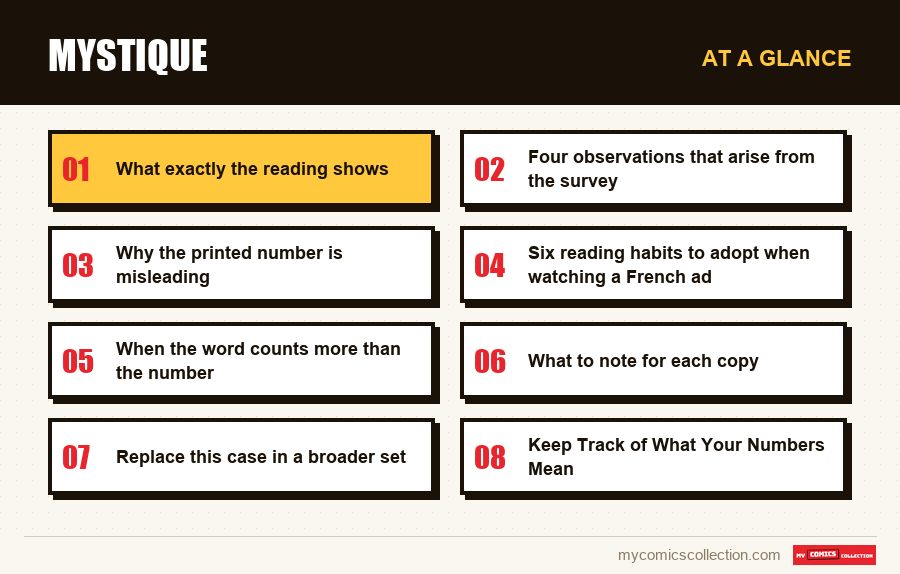
What exactly the reading shows
Let's detail the affected ads, because it's their juxtaposition that makes the problem obvious. A copy described as « Artima / Arédit ÉTRANGES AVENTURES ALBUM N° 1 comics pocket » was offered at €3.49. Another, described as « Artima / Arédit ÉTRANGES AVENTURES ALBUM N° 3246 comics pocket », was offered at the same price of €3.49, by the same seller. A third item, « ETRANGES AVENTURES 53 Alpha le Mutant Marvel Arédit Comics Pocket 1976 », was priced at €3.50. A fourth, « Artima / Arédit COMICS POCKET ETRANGES AVENTURES N° 77 », at €3.99. A fifth, « ETRANGES AVENTURES 63 COMICS POCKET AREDIT 1979 », at €4.00. Five objects, five numbers: 1, 3246, 53, 77, 63.
Put them in a line and the anomaly is obvious. Three two-digit numbers, one single-digit number, one four-digit number. If all were part of the same suite, it would be necessary to admit that the collection published more than three thousand two hundred titles, which no element of the survey supports. The remaining reading is the only one that holds: the two-digit numbers belong to a numbering of fascicles, and the four-digit number belongs to something else. An internal code, a catalog reference, a management identifier: the announcement does not allow you to decide between these hypotheses, and I will not decide for you. What the survey establishes with certainty is that a four-digit number coexists with a one-digit number in the same family of objects, from the same seller, at the same price.
Four observations that arise from the survey
3246 cannot be a rank
For an album to have rank 3246, there would need to be 3245 albums before it. Nothing in the statement indicates such a volume, and the presence of an “album No. 1” from the same seller at the same price makes the hypothesis untenable. The number is therefore a reference, not a position. What it refers to precisely, the ad does not say, and we must have the honesty to stop there.
Two numbers in the same collection
The issues identified bear 53, 63 and 77. The albums bear 1 and 3246. These are not two different series which would have crossed paths in a search: it is the same pocket collection, with two superimposed numbering systems. The second is not ordered like the first, and there is no guarantee that it is ordered at all.
The price does not distinguish anything
Album No. 1 and album No. 3246 were priced to the nearest cent at the same amount, €3.49. On this statement, the number printed on the cover therefore had no translation into the asking price. Hoping that the market itself signals which object is which, by a price difference, is an illusion: here, it signals nothing.
No independent verification available
Out of one hundred and seventeen advertisements, none had a copy controlled by a verification body. The usual recourse (relying on a third party who opened the object, described its condition and sealed its identification) did not exist here. The buyer remains alone in front of the photo and the text of the ad, and identification is based entirely on what he can read.
These four observations reinforce each other. The number is unreliable, the price does not compensate, external verification is absent. There remains only one exploitable resource: the textual description of the advertisements, and in particular the episode titles when the sellers take the trouble to copy them. In the statement, an announcement mentions “Alpha the Mutant” next to the number 53. This kind of mention is worth infinitely more than an isolated number, because an episode title cannot be reused from one collection to another with the casualness of a management code.
A methodological remark on the workforce, because it conditions everything above. The five announcements detailed above form a tiny sample within the one hundred and seventeen noted. Five observations do not allow any conclusion on a price level: they only serve to illustrate the coexistence of two numbering systems, which a single pair of advertisements is sufficient to demonstrate.
The median of €10.00, calculated over all one hundred and seventeen advertisements, is the only level benchmark that I consider readable here. The maximum of €50.00 is a single point: it expresses what a seller hopes to obtain, not what a buyer has agreed to pay. Treating this maximum as the high value of the collection would amount to confusing a request with a result.
Why the printed number is misleading
The reflex which pushes us to read a number as a rank is not irrational: it is simply imported from elsewhere. The American tradition of periodicals has accustomed collectors to continuous numbering, where the next issue appears after the previous one and where the gap between two numbers measures a duration. This grammar is so well integrated that we apply it without thinking to objects that do not share it. The French pocket editions had their own organizational logic, and they had no reason to conform to foreign usage.
The problem becomes concrete as soon as you open a spreadsheet. A “number” column which accommodates 1, 53, 63, 77 and 3246 indifferently produces a sorting in ascending order which no longer has any physical meaning: the album which perhaps opens the series is found before booklets published years later, and album 3246 is found alone at the end, three thousand rows from all the rest. A lack no longer appears as a lack, a continuity no longer appears as a continuity. The classification no longer describes anything.
The second trap is more discreet: that of the spelling of the publisher's name. In the statement, it appears in two forms, with and without accent: “Arédit” in some ads, “AREDIT” in others. A search engine does not always reconcile these two spellings. An accented query will leave out part of the ads, and a query without emphasis will leave out another. The collector who questions only one form thinks he sees the whole market when he only sees a fraction of it, and he draws conclusions about rarity which are artifacts of his own query.
These two traps combine in the worst possible way. A partial search brings back a subset of advertisements, this subset is sorted by a number which does not mean what we think, and the collector deduces that he is missing pieces that he already owns, or that he has duplicate pieces even though he has two distinct objects. This is exactly the mechanism described by the principle according to which a number is not an identity: a number alone does not designate anything as long as we do not know which system it belongs to.
Six reading habits to adopt when watching a French ad
First locate the word “album”
Before reading the number, look for the word in the title of the ad that describes the item. “Album” and simple “number” do not refer to the same system. In the statement, this word is the only clue that separates the two-digit regime from the four-digit regime.
Remember the year when it is given
Two announcements in the survey bear a year: 1976 for issue 53, 1979 for issue 63. A date, even approximate, anchors the object in time where an internal code floats. When the year is missing, note that it is missing rather than estimating it.
Query the two spellings of the editor
Start the search with the accent, then without. The two forms coexist in the advertisements noted and neither covers the other. Doing without the second request means deciding not to see part of the market while believing that you have measured it.
Do not deduct state from price
The five detailed ads range from €3.49 to €4.00, a difference so small that it cannot carry any status information. On this sample, the price says neither the freshness of the object nor its completeness. The condition can be read in the photos and in the description, or not.
Treat any long number as suspicious
Whenever a number exceeds in length what the collection can reasonably have published, consider it an internal reference by default. Copy it as is, but never use it as a sort key until its nature is established.
Privilégier le titre d'épisode
"Alpha the Mutant" appears in a statement announcement. A title of this type constitutes an identification key independent of the number, and generally more solid: it makes it possible to recognize content even when the numbering of the cover is unusable.
Collecting this series?
Track what you own, what you are missing and what your collection is worth. 7 day trial.
Start my trial →When the word counts more than the number
The lesson goes beyond the case of this pocket collection. Each time the numbering becomes illegible, it is the words of the announcement that take over: the name of the collection, the title of the episode, the publisher's mention, the year. These elements have a decisive advantage over numbers: they carry their own context. “Comics Pocket” indicates a format, “album” indicates an object type, “1976” indicates a period. None of these words can be confused with a management code, while a number still can.
This shift from number to word requires an organizational effort. It involves copying character strings rather than filling in numeric boxes, which is less convenient to sort and takes longer to enter. But that's the price of accuracy in a market where numbering is not a shared standard. A collection described by words remains searchable; a collection described by ambiguous numbers becomes a set of enigmas that the collector will have to reopen one by one, often years later, when he has forgotten what each line denoted.
We must also accept an assumed gray area. The statement does not say what 3246 refers to. It shows that this number exists, that it is printed on an object sold, that it coexists with an album No. 1, and that nothing in the ad allows us to go further. Recording “album, reference 3246, nature of number unknown” is an honest and useful record. Writing “album no. 3246 out of a series of at least 3246” would be a false entry, and it would permanently contaminate everything based on it.
The same reasoning applies to mentions that resemble categories without being them. A word placed on a cover may belong to the title itself rather than to an editorial classification, just as a number may belong to a catalog rather than to a sequence. This is shown by the case where « special » designates a title and not a special issue: the surface of the object suggests a structure that does not exist.
What to note for each copy
The type of object, before its number. First note whether it is a booklet or an album, then only the number printed. The order matters: a « album 3246 » and a « fascicule 3246 » would have nothing to do with each other, and the only way to never confuse them is to make the type the first field in the form. In the statement, it is precisely this word that separates the two-digit regime from the four-digit regime.
The episode title, copied exactly. When the announcement provides one, such as “Alpha the Mutant” for issue 53, transcribe it as is, without standardizing or translating it. This is the most robust identification key you have when numbering is unusable, and it is also the one that will allow you to recognize the item in a future advert written differently.
The collection and the publisher, in the two spellings encountered. Write "Strange Adventures" and the publisher's name in the exact form of the ad, then add the spelling variation. The survey shows that this name circulates with and without accent; a sheet that only retains one shape will cause you to miss half of your own subsequent searches in your inventory as well as on the market.
The year of publication when it appears in the ad. 1976 and 1979 appear in two of the advertisements noted. Report this year, and leave the field empty when it is absent rather than replenishing it. An actual year provides a temporal anchor that no catalog code provides; a guessed year introduces an error that is likely to survive in your memory.
The price paid, shipping included. Record the amount actually paid, including shipping costs, and date it. The statement amounts: €3.49, €3.50, €3.99, €4.00: are requests posted on August 30, 2026, not payments. Only your real price, including shipping, constitutes data whose value you know, and it is the only one that can one day be compared to something else.
Replace this case in a broader set
A French paperback collection is never an isolated object: it is part of an ecosystem of reissues, covers and translations which each have their own internal logic. Understanding why an album has a four-digit number means understanding that a publisher organizes its catalog for its own needs (production, stock, accounting) and not to facilitate the work of a collector who will come fifty years later. There is neither negligence nor malice here, only two purposes which do not coincide.
For the reader who follows a mutant character through its French editions, this non-coincidence has a practical consequence: we must give up the idea that a series is completed by filling in numbered gaps. The right question is not “what numbers am I missing?” » but “what contents am I missing, and in what forms were they published here?” ". The detour through the editorial history of the X-Men helps to formulate this question in the right terms, because it gives the framework of the contents independently of the national presentations.
This approach also has a pleasant side effect on the budget. A collector who seeks contents rather than consecutive numbers automatically expands the number of objects likely to suit him, and finds himself less often competing for a specific piece described by a specific number. The benchmarks collected in The X-Men's budget-friendly shopping approach are all the more valuable in this context as the median noted here, €10.00, places the whole in an area where the identification error costs more than the object itself.
There remains the question of verification, and it deserves to be asked frankly. Zero copies checked out of one hundred and seventeen advertisements: this is not a temporary deficit, it is the description of a segment where the use of a third party is not common practice. In such a segment, the documentary rigor of the collector is not an extra soul, it replaces an absent infrastructure. The form you write is the only certificate that will exist for this object.
Questions fréquentes
Five points of friction come up systematically among collectors confronted with the numbering of French pocket editions. The answers below stick strictly to what the statement of August 30, 2026 allows us to say.
Compare it to what the collection plausibly published. A four-digit number in a collection whose identified issues bear 53, 63 and 77 cannot be a publication rank. The word that accompanies the number also helps: in the statement, objects described as “album” have 1 and 3246, while the others have two-digit numbers. When doubt persists, write down the number without assigning a function to it.
In this statement, no: both were displayed at €3.49, from the same seller. This is a one-off observation on two announcements, not a market rule, and it does not allow us to conclude on prices in general. It only establishes that the printed number had no price translation that day. Remember that these are amounts requested on August 30, 2026, not sales made.
Because this statement relates to the French market, which is not the usual case for measurements published here, generally carried out on the American market in dollars. The pocket editions concerned circulated in France and are still sold there. No conversion has been applied and no comparison with a foreign market is made: the amounts quoted are those which were displayed, in euros, in France.
Neither, and that’s important. A measurement taken on a single date cannot by construction show any evolution: it would take at least two measurements spaced over time to speak of movement. The median of €10.00 describes the central position of the one hundred and seventeen requests visible on August 30, 2026, nothing more. The maximum of €50.00, isolated, reflects the expectation of a seller and not an observed price.
Report the requirement on your own documentation. Out of one hundred and seventeen advertisements noted, none concerned a copy controlled by an independent organization. You cannot therefore rely on an external certificate for identification or for status. Photograph what you receive, record the type of object, the title of the episode, the collection, the publisher, the year and the price including shipping: this sheet becomes the reference.
Keep Track of What Your Numbers Mean
A French collection mixes booklets, albums and internal references which are not placed in the same column. My Comics Collection lets you save the item type, episode title, edition, and price paid including shipping, so each line remains readable long after purchase.