
In short
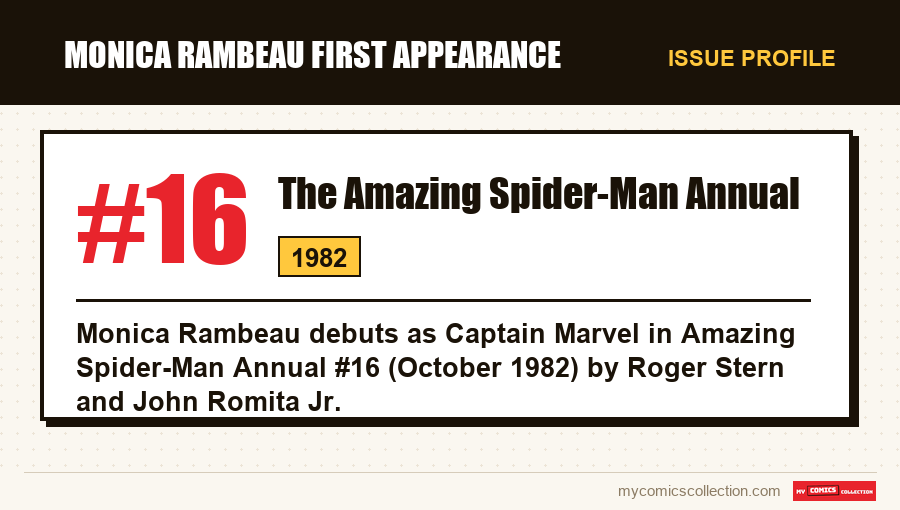
Monica Rambeau debuts in The Amazing Spider-Man Annual #16 (October 1982), a creation of writer Roger Stern and artist John Romita Jr. A New Orleans harbor patrol lieutenant, she gains an energy-conversion power and is dubbed Captain Marvel by the press. Her first Avengers appearance follows in Avengers #227, which makes the annual the issue to find.
A debut that arrives inside an annual is easy to overlook. Amazing Spider-Man Annual #16 is a thick special that sits beside the monthly series, and yet it carries one of the most durable character introductions of the early 1980s. This guide stays with that single book: what it contains, why the date matters, and how to evaluate a copy.
Transparency note: dates, creators and issue numbers for Rambeau were cross-checked against publishing history, the annual's inker, letterer and colorist are omitted as unconfirmed, and the inspection tips are our own analysis.
What Amazing Spider-Man Annual #16 is: date, credits and format
The title page of this special reads The Amazing Spider-Man Annual #16, dated October 1982. An annual is a once-a-year, oversized special, numbered in its own sequence and separate from the monthly Amazing Spider-Man count. That distinction produces the first trap for newcomers: "ASM #16" and "ASM Annual #16" are completely different books, and a search that drops the word Annual returns an early issue of the monthly series.
The creation credit is shared by Roger Stern, who wrote the story, and John Romita Jr., who drew it. For inks, letters and colors, the printed credits box in your own copy is the right place to look.
The cover date is a collecting fact worth stating plainly: October 1982. Newsstand-era comics were dated ahead of their on-sale month, so the book reached shelves before the date on the cover. In every catalog and grading record, the issue is identified by the cover date, and that is the date to use in a tracker.
The number tells you something else as well. As a thicker special, the annual puts more stress on its spine than a monthly issue does, which is why the inspection section below spends time on the staples and the spine.
How Monica Rambeau is introduced
In the 1982 special, Rambeau holds a lieutenant's post with the New Orleans harbor patrol. While helping a friend of her late grandfather to stop a dangerous weapon, she is exposed to extradimensional energy and gains the ability to convert her body into energy. The media then give her the name Captain Marvel. Ben Grimm of the Fantastic Four tells her that the name had originally been used by the late Kree hero Mar-Vell, which sets the legacy she is stepping into.
That detail is the heart of the issue. The debut does not present a hero who has chosen a codename for herself; it presents a person to whom a name is handed by circumstances, then explained by a veteran hero. The editorial design is clear: the mantle is introduced as a responsibility before it is introduced as a costume.
The title of the book remains Amazing Spider-Man Annual, so Spider-Man is part of the volume, but the character who carries the long-term importance is the new one. For a collector this is the typical shape of a launch inside a guest-star vehicle: the established hero gets the cover and the title; the newcomer gets the future.
The New Orleans setting is also unusual for a 1982 Marvel debut. A Gulf Coast hero with a municipal job, far from the usual New York backdrop, gives the debut a distinct texture. It is part of why the character feels specific rather than generic, and the annual is where that original setup is told.
Who created her and the editorial context
Roger Stern and John Romita Jr. created Monica Rambeau. Stern then carried her into The Avengers, where he was the writer for a five-year stretch, and she appeared throughout it, rising from trainee to team leader. That continuity of authorship is rare and valuable: the same writer who introduced the character in an annual used the monthly series to develop her over years. The Roger Stern author page collects the guides to his work, and the guide to where to start with Roger Stern places this run among his best.
The artist side matters as well. The where-to-start guide for John Romita Jr. shows how this annual fits into a long career, and it helps a collector who follows the artist rather than the character.
The debut also comes after the death of Mar-Vell, the Kree hero who had carried the name, which left the Captain Marvel title free by the time the annual carried its October 1982 date. The annual does not need to be read as a replacement story to make sense, but the timing explains why a new Captain Marvel could arrive without a rival claim. For the original holder of the name, the guide to Mar-Vell's first appearance covers Marvel Super-Heroes #12.
Why the annual is a key issue, and what followed
Two arguments carry the case. The first is continuity: Monica Rambeau did not disappear after a guest shot. She joined the Avengers, led them, took on new codenames over the years and returned in later series. The second is scarcity of alternatives: her debut is a single issue that cannot be replaced by a collected edition if the goal is the original comic.
The sequence that followed is easy to verify. In Avengers #227 she becomes a member-in-training. Avengers #229 and #230, cover-dated March and April 1983, show the team helping her against Egghead, and Avengers #231 marks her graduation to full membership after a fight with Plantman. In Avengers #279, cover-dated May 1987, she replaces the Wasp as leader.
The name changes follow later. She adopted the alias Photon in Avengers Unplugged #5 (June 1996), then settled on Pulsar, a name she liked better, in New Thunderbolts #9 (August 2005). Those two issues are small, specific stops that show how the character moved away from the borrowed name the annual handed her.
For a collector, the practical reading is that the debut keeps its place because the character stays active. The history of Monica Rambeau follows the whole arc, so this page does not repeat it.
Do you collect this series?
Track what you own, what you are missing and what your collection is worth. 7-day trial.
Start my trial →
Reprints, collections and look-alike issues
The most useful reprint fact is that a collected edition titled Captain Marvel: Monica Rambeau, published in February 2019, includes Amazing Spider-Man Annual #16 among its contents. That volume suits a reader who wants the story, yet it is not the 1982 single issue. If your aim is the original, confirm the cover date October 1982 and the Annual numbering on the cover and in the indicia.
Three look-alikes catch buyers. First, the monthly Amazing Spider-Man #16, which has no connection to the character. Second, other annuals in the same run: the series kept publishing annuals, and the numbers on either side of #16 are sold in the same lots and in the same listings. Third, the first Avengers issue in which she appears, #227, which is an important companion but not the debut. A listing that calls #227 her first appearance is describing her first appearance in the monthly Avengers series, which is a narrower claim.
When you read a listing that says "first appearance of Captain Marvel," read the rest of it. The Captain Marvel name belongs to several characters over the years, and Mar-Vell's debut is a separate, earlier book. A listing for the annual should name Monica Rambeau and the year 1982, and a listing that does not is probably not specific enough to rely on.
On later series, Nextwave ran twelve issues, and Monica Rambeau: Photon launched in December 2022 and was collected in September 2023. These are modern books with their own dynamics and are not substitutes for the debut.
What to check before buying a copy
Annuals from the early 1980s present their own condition profile, and a methodical inspection is the best protection.
Begin with identification. Confirm that the cover says Annual and number 16, that the date is October 1982 and that the interior matches the issue. Mistakes happen in mixed lots, and a quick look at the first page and the credits box rules out a wrong book.
Then examine the spine. A thicker, 1980s-era special puts stress on the spine and the staples. Look for stress lines, color breaks and a spine that has started to split along the staples. A small amount of wear is normal, but visible whitening that runs through the cover art lowers the grade and should lower the price you accept.
Check the cover surface. Look for creases, scuffs and any sign of tape or glue. The cover gloss of the period shows fingerprints and handling marks, and a clean, reflective surface is easier to judge in natural light than under a lamp. Also look at the corners and edges: bumps and rounding show how much the copy has been handled.
Inspect the interior. Pages of this period are usually in better condition than those of 1960s books, but a copy that has been stored near moisture will show spotting and a smell. Check the centerfold and the staples from inside the book, and note any writing, stamps or cut coupons. A coupon cut from an interior or a back page is a documented defect and should be disclosed.
On graded copies, read the label. A slab label gives the grade, the page quality and notes, with restoration flagged by a separate label color. The guide to restored-copy labels explains why the market treats the two differently. For the annual, ask whether the label mentions restoration, and take the grade as one input among several.
Finally, record what you see. For each copy you consider, write the cover date, the page quality, the notes on the label or from the seller and the photo set. After a handful of comparisons you will notice how much two copies of the same book can differ, and you will be less likely to buy on a single image.
The appearances after the debut that matter
A shortlist of verified issues gives a clear next step once you own or have read the annual.
Avengers #227 is the natural next book, since it is her first Avengers appearance and the start of her training. Avengers #231 is the point where she becomes a full member. Avengers #279, cover-dated May 1987, is the leadership turning point. Nextwave #1 through #12 offers a very different tone, a team book in which she stars. And the Mighty Avengers relaunch of September 2013 puts her under the codename Spectrum as a lead character and field leader.
The guide to the key Amazing Spider-Man annuals places #16 among the other special issues of that run, and the Avengers hub lists the series where most of her story unfolds. Use both to decide how far you want to go beyond the debut.

Frequently asked questions
Ask for the 1982 annual, number 16 of The Amazing Spider-Man annuals, written by Roger Stern with John Romita Jr. on art; it introduces her as Captain Marvel. Make sure the listing says Annual, because the monthly Amazing Spider-Man #16 is a different, much earlier issue with no link to her.
No. Avengers #227 is her first appearance in the Avengers series, where she becomes a member-in-training. Her debut is the 1982 annual. Both issues matter to a collection, but only the annual is the character's origin issue.
Writer Roger Stern and artist John Romita Jr. created her in the annual. Stern then wrote her in The Avengers across a five-year run, during which she became team leader. Later writers used her in their own series, from Nextwave to the 2013 Mighty Avengers.
In the annual, the media give her the name after her powers appear, and Ben Grimm tells her it had originally been used by the late Kree hero Mar-Vell. With Mar-Vell dead, the name was available when the annual was cover-dated October 1982.
Yes. The collected edition Captain Marvel: Monica Rambeau, published in February 2019, reprints Amazing Spider-Man Annual #16 along with other issues. It is a good reading copy, but it is a modern book and not the 1982 single issue. Check the cover date and the Annual numbering when you want the original.
Own Amazing Spider-Man Annual #16 or another early Monica Rambeau issue? Note its condition and get an estimate.
Estimate my comic