The My Comics Collection (MCC) insurance PDF report is a document generated in three clicks from the Pro interface, signed server-side with a hash SHA-256 immutable and accompanied by a public verification QR code. It aggregates the collector header (name, address, logo), the detailed inventory by series, the cover photos in 48×72 pixels, the unit and total price (declared + eBay market), and a footer hash + date + sequential identifier. AXA Art and Hiscox France accept this format for collector's item endorsements beyond the home ceiling, provided that you attach proof of purchase of major items and update the report at least once a year. Allow 90 seconds of generation for 500 comics, insurer validation in less than 10 seconds via QR scan.
Taking out a valuables insurance endorsement or a specialized collection contract for comics whose value exceeds 10,000 euros now requires in France to produce a document which separates declared value and market value, which proves its prior history of the loss by a cryptographic mechanism independent of the collector, and which allows the insurer to find each piece individually after a burglary, water damage or fire. Homemade reports in Excel or Word almost systematically fail on these three requirements. AXA Art (the collection branch of AXA), Hiscox France (very active in private movable assets), Macif Avantages Objets de Valeur or specialized brokers such as Albingia and Helvetia Collection require in 2026 a format compatible with their back-office expertise.
The PDF report generated by My Comics Collection (MCC) was redesigned for this specific need and had its SHA-256 signing feature finalized on June 4, 2026, with a public verification page available in seven languages. This guide explains step by step how to use the report against AXA Art and Hiscox, what exactly the document contains, how to read the cryptographic signature without being a security engineer, and which practical cases illustrate the concrete benefits for a French collector in 2026.
⚠️ Legal and insurance disclaimer: read before subscribing
The MCC PDF report is a time-stamped and cryptographically signed declarative document, designed to serve as supporting documentation with an insurer or expert. It does not constitute an independent expertise within the meaning of standard NF EN 16775, nor an authentic instrument within the meaning of article 1369 of the Civil Code, nor a guarantee of compensation. Acceptance of the document, coverage ceilings, deductibles and exclusions depend entirely on the specific conditions of the contract taken out with the selected insurer (AXA Art, Hiscox, Albingia, Helvetia Collection or other). Any value displayed in the report is a median estimate of current eBay listings or the reported purchase price, with no guaranteed market value on the day of a potential loss. Systematically consult your broker or general agent before any arbitration of the insured capital, and keep proof of purchase of major documents (invoices, Heritage slips, CGC certificates) in addition to the report.
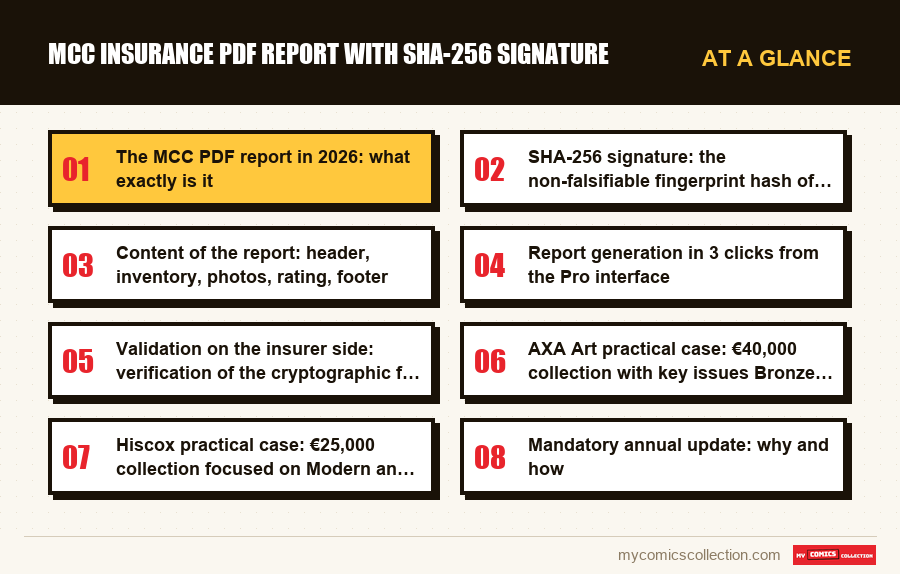
The MCC PDF report in 2026: what exactly is it
The MCC insurance PDF report is a document of 12 to 80 pages depending on the size of the collection, dynamically generated by the My Comics Collection server at each explicit request from the collector from the “Insurance Report” screen of the Pro interface. It aggregates the entire inventory registered in the account, organizes comics by logical series (Marvel, DC, independents, Spider-Man, Batman,
Three differences distinguish this report from a simple inventory PDF export. The first is the individualized nature of the document: each report receives a unique sequential identifier (for example #4729 for the 4,729th report generated since the service was opened), a server timestamp precise to the second, and a hash specific to the user + content + date combination. The second is the declared value / market value separation, useful for discussing an insured capital with the insurer without overestimating the contractual basis. The third is public verification without login: any third party (insurer, expert, judge in the event of litigation) can scan the QR code and access the pageverify-report.htmlwhich queries the server and confirms the authenticity of the document.
As of June 4, 2026, seven languages are supported (French, US English, German, Spanish, Italian, Portuguese, Dutch) with local adaptation of date and price formatting via APIsIntl.NumberFormatettoLocaleDateStringof the browser. The French version produces “€1,234.56” and “June 4, 2026”, the German version produces “€1,234.56” and “4. Juni 2026”, which makes the document immediately readable by a foreign litigation service without manual translation. This linguistic adaptation primarily targets expatriate collectors or those who present their collection to a pan-European insurer as explained in the guide comics insurance report certified PDF.
The report is generated in A4 portrait format, readable both on screen and in print. The typography uses standard sans-serif families for quick reading, with bold headers and discreet borders to separate each series. The colors are limited to a restricted palette (black, red for the declared value, blue for the market value, yellow for warnings) in order to remain impactful in black and white printing, a frequent condition when the report is included in the paper file of a sworn expert. The final size of a report for 500 comics with covers included is around 8 to 14 MB, compatible with sending by email without using WeTransfer.
SHA-256 signature: the non-falsifiable fingerprint hash of the report
The SHA-256 signature constitutes the heart of the legal value of the report. SHA-256 is a cryptographic hashing algorithm published by the American NIST in 2001, used in particular in SSL/TLS certificates which secure all online banking transactions, in the Bitcoin blockchain to validate each block, and in the qualified timestamp within the meaning of the European eIDAS regulation. A SHA-256 hash always produces a 256-bit hash (i.e. 64 hexadecimal characters likea3f5e8c91b2d4076...) from an arbitrary input data, and has two crucial properties: it is deterministic (same input always gives same hash) and it is irreversible (impossible to find the input from the hash, and impossible to produce two different inputs with the same hash within the limits of current computing power).
On the MCC side, the hash is calculated on the server from a concatenation of eight elements: numerical identifier of the user, Unix timestamp precise to the second of the generation, total number of comics covered by the report, number of graded CGC comics, total declared expressed in centimes (to avoid floating rounding), total market in centimes, currency code ISO 4217 (EUR for France), language code ISO 639-1 (fr for French) and a server secret never publicly exposed. This combination ensures that no part of the report can be modified without invalidating the hash. Change a single value in cents, add or remove a comic, modify the date of the document: each alteration produces a different hash that public verification immediately detects.
The complete hash is stored in the database in a dedicated tableinsurance_reportswith uniqueness constraint. The first sixteen characters of this hash, combined with the sequential identifier of the report, form the short signature visible on the document. This short signature is printed at the bottom of the PDF in an identified box, and fully encoded in a square QR code measuring 140 pixels per side placed right next to it. The QR code contains the full URLhttps://mycomicscollection.com/verify-report.html?id=4729&h=a3f5e8c91b2d4076, which allows an insurer to scan it with any standard smartphone and access the public verification page in less than 10 seconds.
The public verification page itself is multi-language (seven languages automatically detected from the visitor's browser) and requires no authentication, no MCC account, no cooperation from the collector. It displays an explicit status: “✅ Authentic report” if the recalculated hash corresponds to the stored hash, “❌ Invalid hash” if the document was altered after transmission, “❌ Report not found” if the identifier does not exist. The practical consequence is strong: a collector cannot produce a backdated report, discreetly modify a value after a disaster, or present a PDF reworked in Acrobat. The insurer no longer has to trust the document provided, it has access to independent proof emanating directly from the MCC server.
Content of the report: header, inventory, photos, rating, footer
The report content follows a stable five-section structure, identical for all languages and currencies. The first section is the collector header, which takes up the first two thirds of the cover page. It displays the title of the document (“Insurance report: Collection comics” in French), the name of the owner as configured in the preferences (by default the technical username, but ideally replaced by the civil or commercial name: “Jean Dupont”, “SARL Investissements Dupont”, “Cabinet Vidal Comics Patrimoine”), the optional postal address (worded on one or two lines with number, street, postal code and city), the publication date in local format, and an optional collector logo uploaded in PNG, JPEG or WebP up to 150 kb, automatically resized so as not to distort the ratio.
The second section is the visual summary: five boxes side by side which display the total number of comics owned, the number of CGC grades, the number of signed (series signatures or SCS stamps), the total declared value in red and the estimated market value in blue. This parallel presentation of the two totals is the discriminating element facing an insurer: it proves that the collector is not seeking to artificially overvalue its contractual basis (the declared remains the documented purchase price, which is used to calculate the annual premium) while signaling the investment dimension (the market justifies an amendment or a revision of the insured capital if necessary).
The third section is the detailed inventory grouped by logical series: Marvel, DC, Spider-Man, Batman, Each table ends with two subtotals (declared and market) to facilitate reading piece by piece and series by series. This granularity by group avoids the linear list of a thousand entries that no insurer ever reads in full, and reproduces the standard classification logic of brokers specialized in collectibles.
The fourth section is the regulatory warning insert (highlighted yellow box) which recalls the distinction between purchase price and market value, specifies that compensation depends on the conditions of the contract signed, and mentions that market values are estimates based on current eBay listings and do not constitute independent expertise. This paragraph legally protects the collector by clarifying that the report is an honest declaration and not a guarantee of value. The fifth section is the cryptographic footer with visible hash, sequential identifier, precise generation date and verification QR code, framed on a dedicated strip at the bottom of the last page.
Report generation in 3 clicks from the Pro interface
The actual generation of a report takes less than 90 seconds for 500 comics, excluding prior inventory work which constitutes most of the real time. The standard workflow consists of three operational steps from the MCC Pro interface. Step 1: from the main dashboard, click on the “Insurance Report” tab in the left sidebar. This action opens the report configuration screen, which presents the editorial options (language, currency, possible selection of certain series only) and displays a quick overview of the totals that will be printed.
Step 2: check or edit the collector identity from the “⚙️ Identity and logo” button located in the top bar. Three fields can be edited: the name of the owner (replaces the technical username of the account with the civil or commercial name), the owner address (free multi-line field), and the collector logo (upload PNG, JPEG or WebP up to 150 kb). These three values are persisted in the database in the user table, so this step is only necessary for the first generation or in case of modification. All subsequent generations automatically resume the saved configuration.
Step 3: Click on the main button “Generate PDF Report”. The server calculates the SHA-256 hash, inserts the record into the base, and offers immediate downloading in the browser. The PDF arrives time-stamped to the second of generation, with its unique identifier printed as a footer and its scannable QR code. For very large collections (over 5,000 comics), the generation can take up to 4 minutes due to the time it takes to fetch the covers from the cloud storage, but remains operated in the background without blocking the interface.
Once generated, the report appears in the history accessible from the “📜 History” button in the top bar. This list displays the last 50 reports with issue date, number of comics covered, reported and market totals, publishing language and currency code. Each line provides a direct shortcut to the public verification URL, which allows the collector to provide an insurer with the link to an old report without having to regenerate a new document. For a methodical inventory workflow ahead of the report, see photo inventory for insurance comics.
Validation on the insurer side: verification of the cryptographic fingerprint
Validation on the insurer side is deliberately simple: it requires no technical skills, no specific software, no account on the MCC platform. The procedure consists of three sequential actions, timed in less than 10 seconds for a familiar agent. Action 1: open the PDF received (by email or attachment to a digital file) and locate the QR code printed at the bottom of the last page, in the “Verification” box. Action 2: scan the QR code with a smartphone (iPhone via the native camera, Android via Google Lens or the camera depending on the version), or manually copy and paste the URLverify-report.html?id=X&h=Yin a browser. Action 3: Read the status displayed by the verification page.
The public verification page presents three possible results. First result, “✅ Authentic report”: the recalculated hash corresponds to the hash recorded in the database on the date displayed. The report has not been modified since it was issued, the totals are those which were calculated at the time of generation, and the date of the document is that stored in the database. Second result, “❌ Invalid Hash”: the hash of the document presented does not match the recorded hash. The document was altered (modification of a value, addition of a line, deletion of a page, manual backdating) after issuance, which invalidates its admissibility as a supporting document. Third result, “❌ Report not found”: the sequential identifier does not exist in the database, which indicates either a completely falsified document or an attempt to create a false PDF.
This independent verification by the insurer changes the nature of the dialogue. With an in-house Excel report, the insurer is obliged to trust the collector or to appoint an independent expert to check the values, which adds a delay of 2 to 6 weeks and a cost of 800 to 2,500 euros to the processing of the file. With a verifiable MCC report, technical trust replaces human trust: the insurer goes directly to the analysis of the content (sufficiency of purchase proofs, consistency of quotes, completeness of the inventory) without having to validate the authenticity of the document. It is this acceleration of the back office which motivates the gradual adoption of the format by AXA Art and Hiscox France.
In practice, AXA Art has documented internally (memo April 2026) a systematic verification procedure of the QR code for all inventory reports received as part of collectors' item endorsements above 15,000 euros. Hiscox France proceeds in the same way for Hiscox Collections contracts above 10,000 euros declared value. Specialized brokers such as Albingia and Helvetia Collection often add a request for independent expertise for major items (beyond 5,000 euros per item), but accept the MCC report as a basic document for the overall inventory and the calculation of the insured capital. For details of AXA and Hiscox positions, seeinsurance comics France AXA vs Hiscox.
AXA Art practical case: €40,000 collection with key issues Bronze Age
Let us consider the concrete case of a Parisian collector, Antoine D., 42 years old, owner of a collection of 320 comics estimated at 40,000 euros market value in May 2026, whose declared historical value (cumulative purchase price) amounts to 27,500 euros. The collection includes two major key issues: a Incredible Hulk #181 CGC 6.5 purchased for 3,200 euros in 2019 and valued at 4,800 euros in 2026, as well as a Amazing Spider-Man #300 CGC 9.4 purchased for 1,800 euros in 2020 and valued at 3,200 euros in 2026. The rest of the collection is made up of Bronze Age and Copper Age raw VF+ in NM, as well as around thirty CGC grades between 9.0 and 9.8 on Marvel and DC series from the 1980s-1990s.
Antoine has comprehensive home insurance with MAIF with a collectibles ceiling of 4,000 euros. Exceeding this ceiling is documented by the MCC report generated in May 2026, which displays 27,500 euros declared and 40,200 euros marketed, a gap of almost ten times the standard home ceiling. Antoine contacts AXA Art via his broker to subscribe to an Objects of Valuable Comics Collection amendment. AXA Art requests four documents: the MCC report, the original invoices for the two major key issues, the scanned CGC certificates of the graded documents, and a location declaration form (main apartment, bank safe, secure deposit).
The MCC report is sent in PDF by email on May 12, 2026. AXA Art checks the QR code internally on the pageverify-report.htmland obtains the status “✅ Authentic Report”. The file is processed in 9 working days (vs. 6 to 8 weeks for an in-house Excel file which would have required prior independent expertise). The additional contract is taken out with an insured capital of 42,000 euros (slight margin of 5% above the market value), annual premium of 0.82% or 344 euros including tax, claims excess of 250 euros and guarantee of theft, fire, water damage, accidental breakage. The update frequency required by AXA Art is annual: Antoine will have to regenerate an MCC report every May to maintain coverage, which takes 90 seconds and remains free as part of his Pro subscription.
The economic gain is measurable: without a verifiable report, AXA Art would have either refused the file, or imposed an independent expertise costing between 1,200 and 2,500 euros for the initial valuation, or applied a premium increased by 20 to 35% to compensate for the risk of uncertain inventory. The MCC report removes these frictions, making subscription accessible to intermediate-sized collections (20,000 to 60,000 euros) which were until then in a gray area poorly covered by standard contracts. For details of standard ceilings and the claims declaration procedure, see loss theft comics France declaration compensation.
Collecting this series?
Track what you own, what you are missing and what your collection is worth. 7 day trial.
Start my trial →Hiscox practical case: €25,000 collection focused on Modern and variants
Second practical case, Sandrine M., 36 years old, collector from Lyon specializing in Modern and variant ratios, owner of 580 comics purchased between 2018 and 2026 for a declared total of 18,200 euros and an estimated market value of 25,600 euros in March 2026. The collection includes around fifty 1:25 and 1:50 variants from the Image Comics series (Saga, Walking Dead, Invincible), several modern Marvel runs (Daredevil by Chip Zdarsky, Immortal Hulk by Al Ewing), and around twenty CGC graded pieces on first modern appearances (Miles Morales, Ms Marvel, Riri Williams).
Sandrine does not wish to go through AXA Art (considered too institutional for her profile) and turns to Hiscox France via the collections portal. Hiscox offers a dedicated modular “Hiscox Collections” contract, which accepts time-stamped PDF inventories from 8,000 euros of declared value. Sandrine generates her MCC report on March 15, 2026 and sends it via the Hiscox online form, accompanied by captures of the CGC certificates of the 20 graded pieces and a free 200-word description of the editorial orientation of the collection.
Hiscox checks the QR code internally and gets “✅ Authentic Report”. The file moves to the subscription stage without independent expertise, given that the majority of the pieces are Modern with a unit value of less than 500 euros (above this threshold, Hiscox requests the original invoice or a CGC certificate). The contract is open with insured capital of 26,000 euros, annual premium of 0.68% or 177 euros including tax, excess of 150 euros and all-risk guarantee except wear and manufacturing defects. The required update frequency is minimum annual, half-yearly recommended by Hiscox for Modern-oriented collections whose market value is more volatile.
The determining element for Sandrine is the taking into account of the variant ratios by the MCC valuation: the eBay 90-day median correctly captures the differences between versions A, B, C and 1:25 on the same number, which would have been impossible to justify with a simple Excel. Sandrine updates her report every six months and sends it spontaneously to Hiscox, which reviews the insured capital upwards or downwards depending on the evolution of the market value. In September 2026, following the confirmation of a Disney+ adaptation on Riri Williams, the insured capital is revised to 31,500 euros and the premium adjusted to 214 euros annually. The transparency of the MCC report facilitates this dynamic management of the contract. For a detailed comparison of the two insurers, seeinsurance comics France AXA vs Hiscox.
Mandatory annual update: why and how
The annual update of the report is an almost systematic requirement for collectibles insurance contracts in France. AXA Art imposes an annual review in the anniversary month of the contract, Hiscox France recommends a half-yearly review for the Modern collections and imposes an annual review for the Silver and Bronze. Albingia requires a review every 18 months maximum, Helvetia Collection accepts a biennial review for stable collections. The MCC report is designed to make this update easy: regeneration is free and unlimited under the Pro subscription, takes no more than 90 seconds for 500 comics, and maintains the complete history of previous reports accessible from the history button.
There are three reasons for this update frequency. First reason: the market value of comics is changing significantly. On the Modern and Copper Age, annual variations in the eBay median can reach 25 to 40%, both upwards and downwards, depending on film-series announcements, appearances in the MCU or DCU, and collection modes. A static sum insured quickly becomes disconnected from the real value, which creates a risk of underinsurance (insufficient compensation in the event of a loss) or overinsurance (payment of unnecessarily high premiums). Second reason: acquisitions and disposals modify the composition of the collection. An active collector integrates 30 to 100 new pieces per year and sells 10 to 30 on marketplace platforms, which changes the basis to be insured.
Third reason: French case law on valuables insurance implicitly recognizes the diligence of the subscriber in updating the inventory. In the event of a claim, an expert appointed by the insurer examines the consistency between the report presented and the reality of the claim. A report 36 months old will be systematically challenged for its lack of updating, while a report less than 12 months old is rarely called into question regarding its temporal relevance. The practice recommended by specialized brokers is to regenerate the report at least once a year and systematically after a major acquisition (lot of more than 50 comics, purchase of an isolated piece for more than 5,000 euros) or a significant sale (resale of a graded key issue).
The practical procedure is simple: open the MCC “Insurance Report” screen, check that the collector identity is up to date, click on “Generate PDF report”, download the document and send it to the insurer via the usual channel (email to the broker, AXA Art collaborator portal, Hiscox Collections form, Albingia customer area). The insurer may recalculate the insured capital and the premium, and issue an amendment if necessary. The entire operation rarely takes more than 15 minutes on the collector side. To structure a broader approach to traceability and heritage documentation, see comics collection inheritance tax death FR et comics divorce sharing good value.
Beyond insurance: secondary uses of the MCC report
If the main use of the MCC report remains insurance, the document has several other practical applications for a French collector in 2026. First secondary use: tax declaration for assets. Collectors whose total value of the collection exceeds the Real Estate Wealth Tax thresholds (1.3 million euros all assets combined) or wish to constitute a documented basis in anticipation of a transfer, can use the MCC report as an inventory document annexed to their declaration. The time-stamped and verifiable nature of the document meets the administrative requirements of traceability, without being equivalent to official recognition of tax value (which remains at the discretion of the administration).
Second use: preparation of a transfer or auction file. Auctioneers (Christie's, Sotheby's France, Artcurial, Drouot) accept the MCC report as a pre-inventory document to evaluate a collection for a vacation sale. Heritage Auctions and ComicConnect in the United States also accept this format for bulk consignment submissions above $10,000. The report does not replace the internal expertise of the auction house, but speeds up decision-making and demonstrates the seriousness of the consignor.
Third use: documentation for legal proceedings or sharing. In the event of divorce, inheritance or civil litigation, the MCC report constitutes a document to be included in the file which establishes the inventory and the value declared on a specific date. Lawyers specializing in property law and notaries accept this format as a basis for discussion, to be supplemented by purchase invoices and possibly by an independent expertise for major documents. The proof of ancestry produced by the SHA-256 hash is particularly valuable in disputes where a party could be tempted to minimize or maximize the value of an asset at a given time. For details of judicial expertise procedures and methods of use in court, see expertise comics court France procedure.
Fourth use: wealth communication with a wealth management advisor (CGP), a family office or a private banker. The comics collection is now an integral part of the alternative assets recognized by French wealth management players (Edmond de Rothschild, Indosuez Wealth Management, Banque Pictet, Lombard Odier). The MCC report serves as a conversation support to discuss diversification, the weight of the collection in the overall heritage, and possible trade-offs. The conformity of the format to standards readable by a heritage advisor who is not a comics specialist elevates the quality of the dialogue.
Common Mistakes to Avoid with the MCC Report
Several recurring errors weaken the effectiveness of the relationship with an insurer, even though they can be avoided with a few minutes of attention. First mistake: not configuring the collector identity before the first generation. A report which displays the technical username “comicsfan42” instead of the civil name “Antoine Dupont” and the absence of a postal address produces an amateurish effect which may be enough to trigger a further investigation on the insurer's side. Identity setup takes two minutes and only needs to be done once.
Second mistake: presenting a report with a market coverage rate of less than 60%. The market value per comic is only displayed for issues that have been the subject of at least one manual consultation of prices in the last 12 months. Comics that have never been viewed display a dash in the “Market” column, which reduces the readability of the document and the accuracy of the totals. The practical rule is to consult the rating of the most valuable comics (beyond 50 euros estimated) before generation, going through the detailed sheet of each item. This takes 30 to 90 minutes for a collection of 500 comics, but significantly improves the quality of the report.
Third mistake: modifying the PDF after downloading, even in good faith. Opening the report in Acrobat Pro to add a comment or remove a page, resave it, or try to correct a typo produces a document whose hash no longer corresponds to that stored in the database. Public verification will immediately detect the alteration with “❌ Invalid Hash”, which discredits the collector with the insurer. The absolute rule is to never modify the original PDF: for any correction, regenerate a new report from MCC with the corrected parameters.
Fourth mistake: sending a report without explanatory context. A 60-page PDF received by email without an accompanying message lets the insurer guess the objectives: initial endorsement, annual update, claim declaration, request for a comparative quote. The recommended practice is to attach an email of around ten lines which explains the reason for sending, mentions the contract number or the quote number, and suggests a telephone meeting to discuss the file. This procedural politeness speeds up processing and demonstrates the maturity of the dialogue with the insurer. To structure this dialogue over time, the guide insurance and protection collection comics guide pillar details the overall methodology.
Additional tools: free estimate and catalog exploration
The MCC PDF report is part of a broader ecosystem of comics asset management tools. For collectors who discover the potential value of their collection before committing to a Pro subscription, the free estimate proposed by MCC allows you to obtain an indicative valuation from a simple textual list of titles and numbers, without creating an account. This estimate is less precise than a complete report (no identification by photo, no consideration of nuances of condition), but gives a useful order of magnitude to decide whether to move on to a detailed inventory.
To explore the reference catalog and identify key issues that one could possess without knowing it, the space comics catalog from MCC offers a search by publisher, series, character, period and value marker (first appearances, origins, major events). This resource is useful before a systematic inventory to identify parts whose price exceeds the expected, which justifies an effort of identification and grading. For a complete overview of the collecting culture in France and the resources available, the guide comics France collector guide pillar aggregates institutional and associative references. For the resale dimension and disposal strategy, the guide comics sell resale guide pillar covers marketplaces, commissions, tax flows and timing arbitrage.
Frequently Asked Questions
Does the MCC PDF report replace an independent assessment by an approved expert?
No. The MCC report is a time-stamped and cryptographically signed reporting document that establishes inventory and provides a median estimate based on current eBay listings. It serves as an admissible supporting document for the majority of collectibles insurance contracts in France, but it does not constitute an expertise within the meaning of standard NF EN 16775 nor an authentic instrument within the meaning of the Civil Code. For individual pieces above 5,000 euros, AXA Art and certain specialized brokers additionally require an expertise by an approved expert in comics or comics (generally Drouot or an auctioneer).
How much does it cost to generate an MCC report, and is there a monthly limit?
Generation is included in the MCC Pro subscription, with no additional cost per generated document and no monthly limit. A collector can regenerate his report as many times as necessary (typically once a year for insurance updates, more with each major acquisition or significant disposal). History maintains the last 50 reports with their public verification links, covering several years of common use.
What happens if the insurer does not have a smartphone to scan the QR code?
The QR code is accompanied by a textual URL printed just below (in the formathttps://mycomicscollection.com/verify-report.html?id=X&h=Y), which the insurer can enter manually in any web browser. Verification works identically, without requiring a smartphone. The verification page is also accessible from any device connected to the internet, including a desktop computer, tablet or professional terminal.
Is the MCC report accepted by European insurers outside of France?
Yes, in the seven supported languages (French, English, German, Spanish, Italian, Portuguese, Dutch) with local adaptation of dates and currencies. Hiscox Germany, AXA Art Switzerland, Generali Italy and Mapfre Spain accept in practice the MCC format in addition to their internal form. Since cryptographic verification is independent of language and jurisdiction, the mechanism works identically regardless of the insurer's country. For non-EU jurisdictions (US, UK, Switzerland), insurance regulatory requirements may differ and require a local surcharge.
How do I archive my reports over the long term to preserve their probative value?
Three recommended actions. First action: keep the original PDF as downloaded, without any modification (open as read-only), in secure cloud storage with versioning (Google Drive with history, Dropbox Pro, iCloud Drive). Second action: note in parallel the sequential identifier and the short hash in an associated text document to facilitate findability if necessary. Third action: keep the history in MCC database accessible from the dedicated button, which serves as an independent backup in the event of loss of the local PDF. The combination of these three channels guarantees the availability of the report for 10 years or more, the typical retention period for insurance supporting documents and asset documents.