L'insurance and protection of a comic collection in France in 2026 is based on four inseparable pillars: a contract dedicated collection (AXA Art Versicherung or Hiscox Art Collection France) rather than a simple multi-risk home extension above €30,000 to €50,000, a double-sided photo inventory high definition accompanied by a certified PDF report with SHA-256 signature, a mandatory annual update of the valuation to avoid the proportional rule, and a controlled physical conservation framework (no damp cellar, no overheated attic, no storage room without controlled climate). The annual premium is between 0.3 and 1% of the declared value, i.e. €150 to €1,000 per €100,000. The excess varies from €500 to €5,000 per claim. For assets of €50,000 (10 CGC graded items plus 500 raw issues), count on an annual premium of €250 to €500, a physical protection budget of €800 to €2,500 (safe, sleeves, archive boxes, dehumidifier) and around ten hours per year for administrative management. This pillar guide covers the entire journey, from the initial decision to the declaration of loss.
A comic collection that exceeds €30,000 in value changes its legal and patrimonial nature. It ceases to be a simple accumulation of leisure activities to become an identified asset, transferable, shareable in the event of divorce, taxable in the event of inheritance and compensable in the event of a disaster. At this threshold, the default coverage of multi-risk home insurance becomes mechanically insufficient: the valuables ceilings of general public contracts (Maaf, GMF, Macif, MAIF, Matmut, Groupama, Allianz Particuliers) peak at around €30,000 in total value, with a sub-limit per item of between €1,500 and €5,000. A single Hulk #181 in CGC 9.4 valued at €6,800 already falls outside of this sub-limit, and the slightest structured collection exceeds the overall ceiling in a few pieces.
However, switching to a dedicated contract is only half the battle. The most relevant insurance policy is of no use if the photo inventory is unusable at the time of the claim, if the valuation has not been updated for three years, if the comics are stored in a humid cellar with 75% humidity or in an attic which peaks at 42°C in summer. The protection of a comics collection is an integrated system that combines contractual insurance, documentary traceability, up-to-date valuation and compliant physical conservation. Any failure in one of the four links weakens the entire chain.
This pillar guide covers the entire journey for a French collector in 2026: why insure (or not) their comics collection, how to choose between home extension and dedicated contract, the details of the two specialized offers on the French market (AXA Art and Hiscox), the precise calculation of the premium according to the declared value, the method for building a photo inventory and a SHA-256 certified PDF report, the rate of annual updating of the valuation, the complete procedure for reporting claims (theft, fire, water damage), the rules of physical conservation (cellar, attic, storage), and a detailed practical case for a collection of 500 comics valued at €50,000. Each section refers to the specialized guides of the heritage and insurance cluster to explore a particular point in more depth.
⚠️ Legal and insurance warning.
This guide presents the general framework applicable in France in 2026 and the practices observed in the insurance market for private collections of American comics and comic strips. He does not constitute personalized advice in insurance, law, taxation or investment. The thresholds, rates, deductibles, ceilings, exclusions and procedures described reflect the orders of magnitude observed with specialized insurers (AXA Art Versicherung, Hiscox Art Collection France) and general insurers (Maaf, GMF, Macif, MAIF, Matmut, Groupama, Allianz Particuliers) at the date of writing, and may change without notice.
Before any subscription, request several personalized written quotes, read the general conditions (CG) and specific conditions (CP) in full as well as the annexes (information notice, pre-contractual information sheet, standardized information sheet). For any specific situation (subscription, claim declaration, compensation dispute, inheritance, divorce, major sale, litigation), consult an ORIAS-approved insurance broker, a tax lawyer, a notary or an auctioneer specializing in comics, as appropriate.
My Comics Collection is neither an insurance intermediary, nor a broker, nor an agent. of AXA Art, Hiscox or any other insurer or intermediary. This guide does not engage the contractual liability of the publisher. The user remains solely responsible for his or her insurance, conservation, valuation and declaration choices. The links cited to third-party sites (insurers, graders, auction houses, specialized presses) are provided for information purposes only and do not constitute a commercial recommendation.
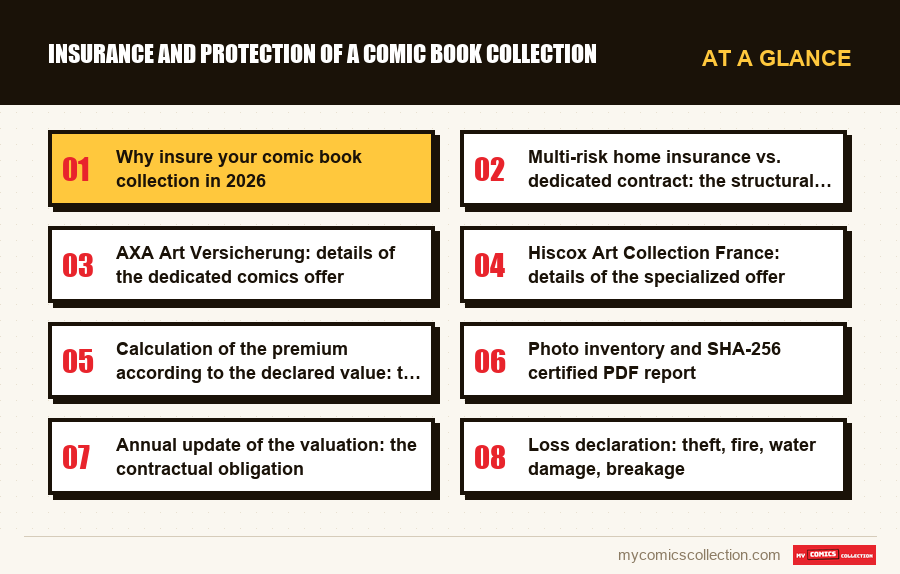
Why insure your comic book collection in 2026
The question of the threshold for triggering dedicated insurance arises for any collector whose assets exceed €10,000 to €15,000 in cumulative value. Below, the risk of major loss remains statistically low and the coverage by extension of valuable items of a comprehensive home insurance is sufficient in the majority of cases. But beyond that, three dynamics converge to make dedicated insurance not only useful but necessary: the concentration of value on a few items, the real liquidity of the secondary market (which transforms a loss into an objective economic loss), and the documentary traceability required by institutional actors (tax authorities, notaries, family court judges).
La concentration of value is the first mechanism. A standard mixed collection typically has 5-10% pieces that represent 60-80% of the total value. A collector who owns 800 Modern Age issues (average value €8), 150 Bronze Age issues (average value €45), 8 Silver Age issues (average value €350) and 3 CGC graded key issues (respective values €4,200, €6,800 and €11,500) totals approximately €36,200 in assets. The 3 key issues alone represent €22,500, or 62% of the value. A targeted intrusion that only steals the 3 key issues empties the effective value of the collection in a few minutes, and the valuables ceilings of a standard home insurance policy do not even cover a single one of the three titles. This concentration mechanism is studied in detail in the guide value of a comic collection: PDF report and insurance method.
La real secondary market liquidity radically changes the economic nature of the loss. A vinyl record from the 1970s, an articulated figurine from the 1980s or a paperback book from the same period does not, individually, have a structured public market that would allow a physical loss to be transformed into a quantified economic loss. American comics graded CGC, conversely, have public price databases (GoCollect, GPAnalysis), specialized auction houses which publish quarterly results (Heritage, ComicLink, ComicConnect), and very active direct sales platforms between individuals (eBay, MyComicShop, MileHigh). The market value of a Hulk #181 in CGC 9.4 is known to within €200 throughout the world market: the loss is immediately quantifiable, and therefore compensable without dispute. This transparency is what makes graded comics insurable in approved value, while many other categories of collectibles remain in questionable replacement value.
La documentary traceability required by institutions also imposes a formal framework. In the event of inheritance, the notary integrates the collection into the inheritance assets and triggers the calculation of rights on the declared value, unless a contradictory expert opinion is produced (see the guide comics collection inheritance and death taxation in France). In the event of divorce, the family court judge divides the property according to the matrimonial regime, and the collection may be the subject of a preferential allocation in return for a balance (see the guide comics and divorce: sharing a valued asset). In both cases, the existence of a dedicated insurance contract with approved value and annual expertise constitutes the strongest proof of the real value of the collection, enforceable against all parties.
Fourth mechanism, less obvious but often decisive: psychological protection of the collector. Without insurance, each room leaving the home (shipping to grading, ready for exhibition, transport to a convention, auction) becomes a point of anxiety disproportionate to the operation itself. The dedicated contract, by transferring the economic risk to the insurer, frees the relationship with the collection and allows active asset management. This is one of the reasons why insured collectors do on average 40 to 60% more CGC valuations per year than the uninsured, for comparable value, and participate more in conventions and exhibitions. To understand the role of conventions in valuation, the guide present your comics collection on the wall, display and museography covers in-home and out-of-home exposure arrangements.
Finally, dedicated insurance is increasingly required by professional third parties who handle the collection: specialized transporters (Crozatier, AGS Art), paper restorers (Lascaux workshop in Paris, Pelliot workshop in Bordeaux), auctioneers during pre-catalogue exhibitions, curators during temporary exhibitions. The absence of coverage transfers the risk to these professionals, who often refuse the mission or charge an additional premium of 10 to 25% to integrate their own temporary insurance. On assets above €100,000, the annual premium of a dedicated contract is lower than the cumulative additional premiums paid to third parties over the year.
Multi-risk home insurance vs. dedicated contract: the structural difference
The most common confusion among beginner collectors is to believe that the valuables extension of a home insurance policy can replace a dedicated contract. The legal and economic reality of the two contracts differs profoundly, and these differences are almost systematically revealed at the time of the loss, that is to say too late to correct them.
La multi-risk home covers by default the furniture, the general contents of the accommodation and personal objects, on the basis of a declared movable capital (often €30,000 to €80,000 depending on the contracts). The valuables extension adds specific coverage for jewelry, watches, works of art, musical instruments, high-end computer equipment and collections. The overall ceiling for this extension varies between €10,000 and €30,000. The sub-limit per item (maximum amount compensated for a single item) remains between €1,500 and €5,000 depending on the contracts. Compensation is based on the new replacement value or the value declared by the insured, subject to production of proof of purchase or an invoice. In the absence of an invoice (typical case of comics purchased through conventions or between individuals on eBay), the insurer can apply a discount or contest the claimed value.
Le contract dedicated collection changes three fundamental parameters. First, the value is approved for subscription piece by piece, validated by expertise, and enforceable against the insurer without possible dispute in the event of a claim. This approved value is revised annually and remains independent of the production of proof of purchase. Secondly, the overall ceiling is aligned with the total declared value, without arbitrary contractual ceiling: if the collection is declared at €250,000, the compensation ceiling is €250,000, and each individual piece is covered up to its own approved value. Third, the spectrum of risks covered is expanded: accidental breakage, transport, stay with the grader, public exhibition, handling by trusted third party, all risks falling explicitly within the approved value.
The price difference between the two solutions remains moderate compared to the protection gap. A valuables extension with a ceiling of €30,000 typically costs €80 to €250 per year, or 0.3 to 0.8% of the ceiling. A dedicated contract with an approved value of €30,000 costs €100 to €300 per year, or 0.3 to 1% of the declared value. The direct additional cost is therefore low (20 to 50 € per year), but the coverage goes from capped and contestable compensation to full compensation in agreed value. The economic calculation systematically leans towards the dedicated contract as soon as the collection exceeds €25,000 to €30,000 in cumulative value, or as soon as a single piece exceeds €4,000 in unit value.
A common pitfall concerns the proportional rule. On multi-risk home insurance, if the movable capital is under-declared at the time of the loss (actual furniture of €90,000 for €60,000 declared), the compensation is reduced proportionally (coefficient 60/90 = 67%). On the valuables extension, the same rule applies to the extension ceiling: a collector who declares €25,000 of extension but who actually has €45,000 of comics sees his compensation reduced to 56% in the event of a total loss, even before application of the sub-limit per item. The dedicated contract does not completely escape this mechanism, but the obligatory annual update of the valuation is precisely intended to avoid the progressive gap between declared value and real value.
La cohabitation of the two contracts remains possible and even recommended: home comprehensive insurance continues to cover general furniture and everyday objects in the home, the dedicated contract exclusively covers the identified collection. The multi-risk insurer must be informed of the existence of the dedicated contract to avoid accumulation of guarantees and double compensation, which is never authorized under French insurance law (article L121-4 of the Insurance Code). Concretely, the declaration of the collection to the multi-risk insurer by endorsement is sufficient, without modification of the premium.
AXA Art Versicherung: details of the dedicated comics offer
AXA Art Versicherung is the specialized operator of the AXA group for works of art, antiques, jewelry and private collections, founded in 1969 in Cologne and integrated into the AXA group in 2007. The dedicated Paris office, operational since 2009, manages subscriptions and claims on the French market. In the comics segment, AXA Art positions itself as the reference for heritage between €50,000 and several million euros, with a historical focus on static museum collections and family heritage passed down over several generations.
La AXA Art standard cover is based on six main guarantees in approved value. Theft with or without break-in is covered subject to filing a complaint within 48 hours with the territorially competent police station or gendarmerie. Fire and smoke are fully covered, including indirect damage caused by emergency services (splashing water, breakage of access furniture). Water damage includes leaks, pipe breaks, rising capillaries and flooding, provided that the storage is not in an undeveloped basement. Accidental breakage covers breakage of the CGC slab, tearing during handling and falling. Vandalism is included as standard. Transport and travel are covered up to a contractual ceiling (often €25,000 or €50,000 per shipment), with prior declaration required for CGC shipments to the United States. The details of the comparison of covers between AXA Art and Hiscox are covered in the guidecomics insurance France: AXA Art vs Hiscox.
La global geographic coverage is one of AXA Art’s differentiating assets. A comic loaned for exhibition in Lyon, a comic sent for grading to Sarasota at CGC, a comic sold at auction at Heritage in Dallas remain covered during transit, subject to prior declaration and compliance with transport conditions (approved carrier, declared value, compliant packaging). This coverage is particularly valuable for collectors who regularly grade their coins in the United States: without it, carrier insurance (UPS, FedEx, DHL) caps at $2,500 per shipment, totally insufficient for a Bronze Age key issue. The guide CGC lookup and certification verification details the risk chain during grading and the need for specific coverage.
THE classic exclusions of the AXA Art contract remain strict and deserve careful reading before subscription. Natural wear and tear, slow depreciation of paper, progressive yellowing, apparent defects not declared upon subscription, comics purchased after subscription and not added by amendment within the contractual period (30 to 60 days depending on the contract), armed conflicts, nuclear terrorism and confiscation by public authority are systematically excluded. Unexplained loss or disappearance is never covered: without an official report of theft with filing of a complaint, the claim does not trigger. The guide weight loss of comics paper: causes and degradation explains why the progressive degradation of paper, even rapid, remains excluded.
La AXA Art pricing structure is distinguished by a slightly more aggressive positioning on entry-level assets (€50,000 to €100,000) and by a progressive franchise scale on large assets. For €50,000 declared, the annual premium is between €200 and €450, with a standard excess of €500 or €750 per claim. For €150,000 declared, the premium rises to €600-1,200, with a deductible of €1,000 or €1,500 redeemable. For declared €300,000 and beyond, the premium is negotiated on a case-by-case basis and includes a physical visit by an expert to the home with a security audit. The minimum requirements for assets above €100,000 include a sealed safe A2P level 1 or 2 certified, an alarm connected to a 24/7 central unit and sometimes a camera with remote recording.
Le subscription process at AXA Art extends over 4 to 8 weeks: sending the file (detailed inventory, high definition photos, proof of purchase for major pieces), initial expertise (auctioneer, specialized bookseller or approved independent expert depending on the threshold), personalized quote within 10 to 20 working days, negotiation of deductibles and options, signature and activation of coverage within 48 to 72 hours with a 15-day waiting period for claims other than proven theft. The app Comics Manager allows you to generate inventory exports in Excel or PDF format directly accepted by AXA Art in just a few minutes.
Hiscox Art Collection France: details of the specialized offer
Hiscox is a British insurer founded in 1901, a historic syndicate of Lloyd's of London, present in France via a branch opened in 1995. The offer Hiscox Art Collection covers fine art, antiques, jewelry, wine, watches and specialty collections, including American comics and European comics. The positioning differs from AXA Art: Hiscox claims greater expertise in international travel, exhibitions, auctions and conventions. It is the natural choice of collectors who rotate their pieces (loans, exhibitions, conventions, grading in the United States).
The mechanism of Hiscox review combines two regimes according to the unit value of the parts. For comics above €2,000 or €3,000 in unit value (depending on the contract), the evaluation is done in approved value piece by piece, validated by initial expertise and revised annually. For comics below this threshold, coverage can be done in lump sum total value, declared by the insured, with breakdown by category (Modern Age, Bronze Age, Silver Age, Golden Age). This dual regime considerably simplifies the management of a mixed collection (5 to 10 major key issues plus 1,000 to 2,000 less valued issues): only the key issues require exhaustive individual documentation, the rest is covered as a whole.
Two notable features of the Hiscox offer deserve to be detailed. First, the exhibition clause automatically covers comics loaned for public exhibition (conventions, thematic exhibitions in libraries or galleries) for up to 60 days per year, without prior declaration and without additional premium. Beyond 60 days of cumulative exposure, a one-off declaration is sufficient. This flexibility is very appreciated by collectors who regularly participate in Comic Con Paris, the Lyon Comic Expo, the Toulouse Game Show or regional trade shows. Second, the option in international transit covers the entire grading chain in the United States (departure from home, air transit, stay at CGC or CBCS for 4 to 8 months, return transit) for a modest additional cost of €15 to €40 per shipment for a comic valued up to €10,000.
La geographic coverage Hiscox is global as at AXA Art, with particular attention to countries with high customs risk (Brazil, Russia, China, India, certain West African countries) for which a specific declaration may be required. International claims are managed through the Lloyd's network, which speeds up processing compared to a strictly national player. The average compensation times observed in France for comic book claims are around 30 to 60 days after submission of the complete file, compared to 45 to 90 days at AXA Art in cases reported by users.
La Hiscox pricing structure is closer to AXA Art but with a slightly higher positioning at the entry level and more competitive on major properties. For €50,000 declared, the annual bonus is between €250 and €500, i.e. €50 to €100 above AXA Art on average. For €150,000 declared, the premium converges with AXA Art at around €600-1,200. For €300,000 and above, Hiscox often offers more flexible terms on exhibition and transport options, which can more than offset the higher nominal premium. The trading margin via broker is 10-20% on the nominal premium in both cases.
Le Hiscox underwriting process is slightly faster than AXA Art (3 to 6 weeks instead of 4 to 8) thanks to a more advanced digital process. The initial file can be submitted via a secure online portal, the initial expertise can be done remotely using high-definition photos for structured assets below €200,000, and the personalized quote is generally provided within 7 to 15 working days. Electronic signature of the contract is available, which reduces the final phase to 24 or 48 hours. The waiting period remains the same (15 days for claims other than proven theft with filing of a complaint).
Calculation of the premium according to the declared value: the 0.3 to 1% grid
The annual premium for AXA Art and Hiscox dedicated comics contracts is calculated on the total declared value, with a variable rate of 0.3 to 1% per year. This wide range is explained by six multiplicative parameters which modulate the nominal rate: the nature of the pieces (key issues vs. mixed batch), the storage conditions (safe, alarm, video surveillance), the home security system, the collector's disaster history, the geographical area of the home, and the frequency of movements of the collection.
For €50,000 declared, standard profile (mixed collection with 5 or 6 pieces graded CGC between €3,000 and €8,000, plus 500 to 800 raw issues, residence in a peri-urban area, no claim history), the annual premium is between 200 and 450 € at AXA Art, and between 250 and 500 € at Hiscox. The Hiscox additional cost of €50 to €100 is offset by a more generous free exhibition clause and a faster digital journey. For the same profile in a dense urban area (Paris intramural, Lyon center, Marseille center), the premium increase is 15 to 30%, or €230 to €580 at AXA Art and €290 to €650 at Hiscox.
For €100,000 declared, standard profile (8 to 12 pieces graded CGC between €5,000 and €12,000, 1,000 to 1,500 raw issues, declared safe), the annual premium is between 400 and 800 € at AXA Art, and between 450 and 900 € at Hiscox. At this level, the standard excess rises to €1,000 or €1,500 per claim, with an option to buy back €500 with an increase of 5 to 10%. The minimum requirement for an A2P level 1 certified safe applies for coins above €10,000 per unit, otherwise the subscription is refused or the premium increased by 25 to 50%.
For €150,000 declared, standard profile (10 to 15 CGC graded pieces including a few key issues Bronze Age at €8,000-15,000, 1,000 to 1,500 raw issues), the annual premium is between 600 and 1,200 € at both insurers, with a convergence of prices around €800 for a standard profile. The factor triggering the differences between the two insurers is almost always the location of the home and the exposure-transport perimeter. A sedentary collector who does not grade in the United States and never exhibits pays less at AXA Art. An active collector who makes two to four CGC submissions per year and exhibits once or twice at conventions pays less at Hiscox.
For €300,000 declared (major collection with several key issues at €15,000-30,000 including possibly a Hulk #181 in CGC 9.6 or an Amazing Fantasy #15 raw, consistent Silver Age and Bronze Age set in high grade), the annual premium is between 1,200 and 2,700 €. Both insurers require a prior physical assessment (home visit by the mandated expert) and condition the subscription to reinforced security measures: sealed safe A2P level 2 certified minimum, alarm connected to a 24/7 central unit with remote monitoring contract, sometimes camera with remote recording from an independent service provider.
For €500,000 declared and beyond (very large collections with key issues Golden Age, rare reprints of Action Comics #1, complete Marvel Silver Age set in high grade), the annual premium is negotiated on a case-by-case basis, generally between 2,500 and 5,000 €, with options: extended public exhibition cover, transport conventions, restoration in the event of partial loss, clause for automatic renewal of the expertise every 12 months instead of 24. The margin for negotiation is real: a collector with an experienced broker (Marsh, Aon, Verspieren, Filhet-Allard, Diot-Siaci) typically obtains 10 to 20% reduction on the nominal premium in simultaneous competition between the two insurers and their re-insurers Lloyd's.
Three factors significantly modulate the rate beyond the declared value. The security device (certified safe, connected alarm, recorded video surveillance) can reduce the premium by 10 to 25%. The claims history over 5 years (declaration via the AGIRA file) influences both upwards and downwards. The geographical distribution of storage (collection spread over several locations versus total concentration) can be enhanced: a collector who stores major items in a bank safe and the rest at home often benefits from a reduced premium of 5 to 15%. To estimate the overall value before subscription, the tool free comics estimate provides a quick first reading in just a few minutes.
Photo inventory and SHA-256 certified PDF report
The photo inventory and the certified PDF report constitute the documentary basis of any dedicated insurance coverage. Without an up-to-date inventory and without an enforceable report, the contract remains theoretically valid but becomes unusable in the event of a disaster: the agreed value loses its basis, the proportional rule automatically applies, and compensation is made on the basis of questionable values. The standard method combines two deliverables: a detailed room-by-room inventory with high-definition photos, and a certified PDF report with a cryptographic signature enforceable against a third party.
L'detailed inventory lists for each piece in the collection: exact title (mention of the main series, spin-off or mini-series), issue number, exact publication date, publisher (Marvel, DC, Image, Dark Horse, Vertigo, Valiant, etc.), version (newsstand, direct edition, 1st print, 2nd print, variant 1:25, variant 1:50, etc.), state of conservation (precise CGC grade if applicable, or grade description Mint, Near Mint, Fine, Good, Fair for raw comics), date of acquisition, purchase price, current estimated value, precise storage location in the home (room, furniture, shelf, level, position). For a collection of 500 to 1,500 issues, manual creation takes 20 to 60 hours of work. The app Comics Manager automates this generation in a few minutes in Excel or tabulated PDF format.
THE high definition photographs accompany the inventory. For each comic whose unit value exceeds €1,000, AXA Art requires a front photo and a back photo in high definition (minimum 300 DPI, or approximately 3,000 × 4,500 pixels in standard 17 × 26 cm format). The lighting must be neutral (daylight or high color temperature LED lighting), without direct flash (which creates reflections on the slab and distorts the reading of colors), with a color test chart in the frame for pieces above €5,000 (Macbeth ColorChecker test chart or professional equivalent). Hiscox accepts photos of whole CGC slabs with perfectly legible label (CGC label, 10-digit number, grade, encapsulation date). For raw comics above €1,500, the two insurers also request details of apparent defects (fold, tear, yellowing, wear marks) on macro photos. The guide photo inventory for comics insurance details the technical shooting protocols.
Le certified PDF report with SHA-256 signature is the opposable format. The principle: the inventory PDF is cryptographically signed by a trusted third party (in practice, the server of the application generating the report or an eIDAS certified third party time stamp such as Universign, ChamberSign, CertiNomis), with an SHA-256 hash calculated on the full content of the file. This hash is written into the signature, and any subsequent changes to the PDF (even a single pixel or character) invalidate the signature. The report is therefore enforceable against the insurer, against a judge in the event of litigation, against a notary in the event of inheritance, and against an auctioneer in the event of a public sale.
La standard PDF report structure includes five mandatory sections. There cover page identifies the collector (full name, address, contact), generation date, report version, SHA-256 hash of the file, and the seal of the application or third party signatory. THE synthetic summary gives the total number of pieces, total declared value, breakdown by editorial age (Golden, Silver, Bronze, Copper, Modern) and by publisher. There detailed list lists the 15 or 20 inventory columns piece by piece (title, number, publication, publisher, version, grade, value, location, etc.). L'photographic annex groups together the double-sided stickers for each part above the contractual threshold. There legal notice specifies the valuation sources used, the reference date, and the scope of the report. The guide SHA-256 certified PDF comics insurance report details the complete format and signing procedures.
Four good management practices of the report deserve to be systematized. Store the report in triplicate copies: original signed with the collector (encrypted USB key and safe), copy with the notary or family lawyer (formal deposit), copy with the insurer (sending by signed email or secure portal). Regenerate the report at least once a year, on a fixed date (for example January 1st or the anniversary of the contract). Keep the history of previous reports (successive versions constitute a log of the evolution of the collection). Verify the validity of the SHA-256 signature each time the report is accessed, via an official eIDAS verification tool or a standard hash script.
Collecting this series?
Track what you own, what you are missing and what your collection is worth. 7 day trial.
Start my trial →Annual update of the valuation: the contractual obligation
Once the contract is signed, the annual update of the valuation is not an option but a contractual obligation, non-compliance with which exposes you to a partial or total refusal of compensation. This obligation is clearly written in the T&Cs of the two insurers and in the CP of the individual contract. Three modalities are accepted, with different costs and constraints.
La first modality, the most rigorous, consists of renew the initial expertise each year with the same expert (auctioneer, specialized bookseller or approved independent expert) or with a new approved expert. The cost is between 50 and 70% of the initial expertise, or €100 to €800 depending on the size of the collection. This method is required for assets above €300,000 at AXA Art and €500,000 at Hiscox, as well as in certain specific situations (acquisition of a major piece, disaster declared the previous year, change of main residence).
La second modality, the most flexible, consists of producing a self-signed valuation certificate by the collector, based on public market references (GoCollect, GPAnalysis, Heritage and ComicLink sales over the last 12 months). This certificate is accepted if the cumulative variation of the total value remains less than 15%. Beyond that, an independent expertise must be re-entered, with photos updated for items whose value has changed significantly. In a market which grew on average by 8 to 15% per year between 2020 and 2026, neglecting this update exposes itself to a brutal jaws effect: the collection increases in value without the contract following suit, and the proportional rule applies in the event of a loss.
La third modality, intermediate and now the most common, is based on the production of a certified PDF report with SHA-256 signature automatically generated by a recognized application, based on a price reference updated daily. This method combines the legal enforceability of the signed report (equivalent to an independent expertise for the majority of standard claims) and the simplicity of generation (a few minutes instead of several weeks of traditional expertise). The guide value of a comic collection: PDF report and insurance method details the complete method.
L'addition of new acquisitions by amendment is a critical point of vigilance. Any comic acquired after subscription must be added to the contract by amendment within the contractual period (30 to 60 days depending on the contract), otherwise it is not covered in the event of a disaster. The procedure is simple: declaration by email with photos and proof of purchase, addition by amendment issued by the insurer, calculation of an additional premium pro rata temporis for the remaining period until the annual deadline. An active collector who adds 50 to 100 issues per year must plan for a monthly reporting schedule to avoid delays. The Comics Manager application automates this declaration by monthly differential export directly transmitted to the insurer.
La transfer or sale of a part requires a symmetrical declaration: withdrawal from the contract with mention of the date of transfer, effective sale price and recipient. This traceability protects the collector in the event of a subsequent claim (typical case of a stolen comic identified in an eBay or Heritage sale). It is also useful in the event of a tax dispute: the declaration of transfer to the insurer constitutes proof of the date and price of sale, enforceable against the tax authorities in the event of an adjustment. For large sales (above €5,000), a private deed between seller and buyer remains recommended in addition to the declaration to the insurer.
Loss declaration: theft, fire, water damage, breakage
The claim declaration is the test of truth of the insurance contract. A poorly conducted procedure can lead to a reduction in compensation, a partial refusal or even a total forfeiture of coverage, even for a technically covered loss. Four categories of losses deserve detailed treatment: theft, fire, water damage and accidental breakage. The complete guide to the declaration procedure is covered in loss or theft of comics in France: declaration and compensation.
Le flight is the statistically most frequent disaster in comic collections, and it is also the one where the procedure is the most codified. Three mandatory steps follow one another within a tight deadline. First, the filing a complaint at the police station or the territorially competent gendarmerie, within 24 to 48 hours following the discovery of the theft. The report must specifically mention the stolen documents, with reference to the inventory or the PDF report of the insurance contract. Secondly, the declaration to the insurer within 5 working days (article L113-2 of the Insurance Code), accompanied by the report and supporting documents. Third, the declaration to comics databases (CGC stolen comics database, Heritage stolen items list, eBay reporting tool) which constitute a protection net in the event of the reappearance of the parts on the secondary market.
L'fire requires a different approach. Triggering goes through the firefighters and their intervention report, which constitutes the first official proof of the occurrence of the disaster. The declaration to the insurer must be made within 5 working days, accompanied by the fire brigade report, photos taken immediately after the disaster, and a detailed inventory of the affected parts (totally destroyed, partially damaged, saved). Contradictory expertise is almost systematic on this type of claim, with the intervention of an insurer expert and the option of an insured expert (whose fees are sometimes covered by the contract within the limit of 1 to 3% of the compensation). The compensation period is longer (60 to 120 days on average) because the assessment of partial damage takes time.
Le water damage is the most pernicious disaster because the damage is often progressive and difficult to date precisely. The declaration within 5 working days is valid from the date of effective observation damage, not the physical occurrence of the leak. A slow leak which has damaged the sleeves for several weeks before being detected triggers the reporting deadline upon discovery, subject to providing proof of prior history (for example testimony from the neighbor upstairs, plumber's report). Compensation distinguishes between direct damage (wet paper, damaged slab) and indirect damage (mold, accelerated foxing, chemical yellowing).
La accidental breakage is treated differently depending on whether the comic is graded CGC or raw. For a broken CGC slab, the standard procedure includes a CGC expertise to assess the post-breakage grade (re-encapsulation possible with "previously slabbed" mention or maintenance without re-encapsulation), and compensation relates to the difference between the approved pre-loss value and the post-breakage value, plus re-grading costs. For a damaged raw comic, the contradictory expertise determines the post-disaster descriptive grade and the compensation relates to the difference in value between the initial state declared in the contract and the post-disaster state, with a discount depending on the severity (10 to 80% depending on the case).
Le refusal of compensation by the insurer, even partial, opens the way to several appeals. There insurance mediation, free, accessible via the Insurance Mediator (approved independent body), processes around 15,000 files per year in France and results in 65% of cases in a decision favorable to the consumer in the event of a questionable refusal. There legal proceedings before the judicial court (competent up to €100,000) or the high court (above) is more costly and longer (12 to 24 months on average), but it allows the assessment of damages to be challenged by contradictory judicial expertise. The guide comics expertise in court in France: procedure details the steps, costs and deadlines.
Physical protection: cellar, attic, storage, optimal conditions
The most relevant insurance policy does not replace proper physical conservation. On the contrary, insurers impose minimum storage standards which, if they are not respected, result in either the refusal of subscription, an increase in the premium, or the exclusion of claims resulting from poor storage conditions. Three typical storage locations pose specific problems: the cellar, the attic and the storage room. The general conservation guide is covered in protect your comics: conservation guide.
La cellar is statistically the worst storage location for comics in France. The cellars of Paris, Lyon, Bordeaux and Marseille all have a natural humidity of between 65 and 85%, well above the recommended range of 40 to 60% for paper conservation. Winter condensation (temperature differential between the cool cellar and the more humid outside air) accelerates foxing (red-brown spots on paper due to micro-fungus), chemical yellowing and the proliferation of mold. A cellar without a professional dehumidifier and without thermal insulation automatically disqualifies the place for the storage of an insured collection. The guide storing comics in a damp cellar: mistakes details typical cases and corrective solutions.
Le attic presents a symmetrical problem: temperature. A non-thermally insulated attic peaks in summer at 38-45°C in mainland France, and drops to 2-8°C in winter. The annual amplitude (40°C or more) creates cycles of expansion and contraction of the paper which weaken the fibers and accelerate degradation. Glues and inks also react poorly to heat above 30°C, with migration of volatile compounds into the paper (accelerated chemical yellowing) and creep of binding glues. The ideal range is 16 to 22°C with an annual amplitude less than 10°C, which excludes any unfinished attic. The guide protect your comics in the attic: critical temperatures details the precise thresholds and planning solutions.
Le storage (self-storage) is a solution increasingly used for collections in excess of the main home. The main French players (Homebox, Une Pièce en Plus, Annexx, Shurgard) offer self-service boxes of 1 to 50 m², with badged access and 24/7 video surveillance. The problem: only 10 to 15% of sites have a controlled climate (regulated temperature and humidity). Standard sites, not air-conditioned, have annual thermal and hygrometric amplitudes greater than 25°C and 30% relative humidity, totally incompatible with the conservation of comics. Storage insurance coverage generally requires an air-conditioned site declared in the contract. The guide comics storage in France: what you need to know details the precise conditions and typical exclusion cases.
THE optimal storage conditions at home combine several measurable parameters. There temperature must remain between 16 and 22°C, with a daily amplitude less than 3°C and a seasonal amplitude less than 10°C. L'hygrometry must remain between 40 and 60% relative humidity, with an amplitude less than 15%. There direct light (sun, halogen) must be completely excluded: the pigments in the covers degrade under UV light in a few months. L'aeration must be sufficient to avoid air stagnation without creating rapid air currents. THE storage rack must be vertical, in standard archive comic boxes, with BCW Mylar sleeves or equivalent for major parts and covering edges to stabilize rigidity.
L'minimum recommended equipment for an insured collection costs between €500 and €2,500 depending on the size. A compact electronic dehumidifier (€180 to €400) maintains the humidity around 50% in a 15 m² room. A digital hygrometer-thermometer with recorder (€40 to €120) makes it possible to trace conditions over the year and produce usable readings in the event of a dispute. An A2P level 1 or 2 certified safe (€800 to €2,500) protects major items against theft and fire for 30 or 60 minutes depending on the class. Standard comic archive boxes (4 to 12 €/unit), archival Mylar sleeves (0.30 to 0.80 €/unit), covering borders (0.15 to 0.40 €/unit) complete the system.
Practical case: insurance of a collection of 500 comics valued at €50,000
To concretely illustrate the application of all the principles developed above, let us take the case of a French collector in the Lyon region, whose collection includes 500 issues distributed as follows: 8 pieces graded CGC between €2,000 and €8,000 (total €32,000), 50 raw Bronze Age and Silver Age issues between €80 and €400 (total €10,500), 442 Modern issues Age and Copper Age between €5 and €50 (total €7,500). Total declared value: €50,000. Collector profile: 38 years old, home in the peri-urban area of Lyon (Caluire-et-Cuire), no previous claims, MAIF home comprehensive insurance with valuables extension €25,000.
L'initial analysis of the risk/coverage couple immediately reveals the undercoverage by the MAIF extension: the ceiling of €25,000 only covers half of the value, and the sublimit per coin of €4,000 does not individually cover any of the three coins graded above this threshold (CGC at €5,200, €6,800 and €8,000). In the event of targeted theft of the 8 graded coins (€32,000 real value), the maximum compensation would be €25,000 sublimited to 8 × 4,000 = theoretical €32,000 but reduced to the overall ceiling of €25,000. That's a loss of €7,000 at best, and potentially more if the proportional rule applies.
La rational decision consists of subscribing to a dedicated Hiscox Art Collection contract with an approved value of €50,000, in parallel with maintaining MAIF comprehensive insurance for general furniture (the collection is explicitly excluded from the MAIF valuables scope by free endorsement). The Hiscox annual premium for this profile is around €320, or 0.64% of the declared value. The standard excess is €750 per claim. The initial expertise, carried out remotely on high definition photos by an independent Hiscox approved expert, costs €250 one shot and remains valid for 24 months.
Le implementation process extends over 6 weeks. Week 1: generation of the SHA-256 certified PDF report via the application Comics Manager, by exporting all 500 issues with double-sided photos for the 8 graded pieces and the 12 most valuable raw issues. Week 2: submission of the file on the Hiscox France portal with PDF report, macro photos of the apparent defects for the 4 raw pieces above €200, proof of purchase for the 3 recently acquired pieces above €3,000. Week 3-4: remote expertise by the approved independent expert, validation of the approved value piece by piece for the 8 CGCs and validation of the overall fixed value for the 492 raw. Week 5: personalized quote, negotiation of options (exposure clause activated for 2 conventions per year, international transit option activated for 1 CGC shipment per year). Week 6: electronic signature, activation of the contract within 48 hours, waiting period of 15 days on all claims other than proven theft.
L'additional physical equipment implemented represents a one-shot investment of €1,800. An A2P level 1 certified safe (Burg-Wächter Karat E520, €1,100) accommodates the 8 CGC graded coins in their individual pouch. An electronic dehumidifier (Pro Breeze 12L/day, €280) maintains the storage room at 48-52% humidity all year round. A recording hygrometer-thermometer (Inkbird IBS-TH2, €60) tracks conditions every 10 minutes with USB export. Standard comic archive boxes (15 units × €8 = €120), Mylar BCW sleeves (500 units × €0.40 = €200) and covering borders (500 units × €0.18 = €90) complete the system for the entire collection.
Le total annualized cost over 5 years is established as follows: annual Hiscox premium €320 × 5 = €1,600, initial expertise €250 amortized over 24 months i.e. €125/year × 5 = €625 (with renewal at mid-period), physical equipment €1,800 amortized over 10 years i.e. €180/year × 5 = €900, consumables (sleeves, Mylar bags, borders for new acquisitions) €80/year × 5 = €400. Total: €3,525 over 5 years, or €705/year on average, or 1.41% of the declared value. To be compared to a single possible uncovered loss of €7,000 to €20,000 without the dedicated contract.
La annual administrative management represents a moderate workload: 30 minutes to generate the updated SHA-256 certified PDF report via the Comics Manager application, 30 minutes to transmit the report and the valuation certificate to Hiscox, 1 to 2 hours to add new acquisitions by amendment throughout the year (monthly declaration), 30 minutes to check the storage condition records and adjust the dehumidifier if necessary. Total: 4 to 6 hours per year, or less than a day of work.
Frequently asked questions about comic book protection insurance
From what threshold does the dedicated contract become useful in the face of a simple extension of valuable objects?
The critical threshold is around €30,000 cumulative value or €5,000 unit value for a single piece. Below these two thresholds, the valuables extension of a general public home comprehensive insurance still correctly covers the assets. Above that, the expansion's overall cap of €25,000-30,000 is saturated, or the per-room sublimit of €1,500-5,000 excludes the most expensive room. The dedicated contract then becomes mechanically necessary. For assets between €15,000 and €30,000, competitive bidding is useful: AXA Art enters the range from a premium of €200, i.e. a moderate difference for more protective approved value coverage.
Does the SHA-256 certified PDF report generated by an application have the same value as a traditional expertise?
For the annual update of the valuation, yes: the two specialized insurers (AXA Art and Hiscox) accept the SHA-256 certified PDF report as a valuation certificate as long as the cumulative variation remains less than 15%. For the initial subscription and initial expertise, no: human expertise remains mandatory, either by auctioneer, by specialized bookseller, or by independent expert approved by the insurer. For the defense in the event of loss or litigation, the certified PDF report can be used as documentary proof but must be supplemented by the initial expertise and proof of acquisition. The PDF report is therefore a complementary tool to traditional expertise, not a substitute.
What recourse can be had in the event of refusal of compensation by the insurer after a reported loss?
Three levels of appeal exist in the following order. First level: the internal complaint to the insurer's claims department, by registered letter with acknowledgment of receipt, to which the insurer must respond within 2 months. Second level: the insurance mediation with the Insurance Mediator, a free independent body, which issues an opinion within 3 to 6 months (65% of opinions favorable to policyholders on evaluation disputes). Third level: the legal proceedings before the judicial court (up to €100,000) or the high court (above), with contradictory judicial expertise. The total period is 12 to 24 months, the cost (lawyer fees, legal expertise) is between €5,000 and €20,000 depending on the issue.
Can a cellar equipped with a professional dehumidifier accommodate an insured collection?
Yes, under strict conditions. The two specialized insurers accept storage in a converted cellar if three cumulative conditions are met. Firstly, the thermal and hygrometric insulation must bring the temperature between 14 and 22°C with an amplitude less than 10°C over the year, and the humidity between 45 and 60% with an amplitude less than 15%. Secondly, the condition tracing by recording hygrometer-thermometer must produce monthly readings that can be used in the event of a dispute (USB or cloud export). Third, the formal declaration in the contract the precise storage location and installed equipment. In the absence of these three conditions, the cellar remains excluded or the excess is doubled in the event of an accident in the non-compliant location.
How to combine insurance, inheritance and divorce on a comic collection valued at €200,000?
The articulation is based on three complementary documents. THE dedicated insurance contract with approved value constitutes the main proof of the real value of the collection, enforceable against the notary (inheritance), the family court judge (divorce) and the tax authorities (annual declarations). THE SHA-256 certified PDF report regularly updated documents the evolution of the collection and the precise identity of each piece, which prevents disputes over the inventory in the event of sharing. There declaration to the family notary within the framework of a mandate with posthumous effect or an anticipated donation-sharing allows the transmission to be organized according to the wishes of the collector, in complementarity with the insurance contract. The guides inheritance and death tax et divorce and division detail specific procedures.