
Displaying your comic collection on the wall museum-style takes four elements: dedicated CGC frames or standalone frames with UV-filter glass (99% UV blocked), 3000 K LED lighting (less UV than 4000 K, cutting 12-month degradation by a factor of three), themed staging of 5 to 10 pieces maximum per wall, and rotating the comics on display every 3 to 6 months to limit cumulative light exposure. Budget for a wall of 8 framed CGC comics: $280-450 (frames + UV-filter) plus $60-90 (LED lighting), or $340-540 before insurance and an alarm.
Putting your comic collection on the wall turns a private hobby into a living exhibit: collector's pride, sharing with visitors, motivation to complete a series. The museum-style staging, inherited from the codes of New York comic galleries and American Comic-Cons, rests on three pillars: protection against UV light (the number-one enemy of inks), coherent visual composition, and security against theft or accidental damage. Poorly thought out, a wall display yellows an Amazing Spider-Man #300 in 18 months; well designed, it preserves the comic's condition for 10 to 15 years while showcasing the piece within the decor.
This guide covers framing hardware (CGC frames vs standalone frames), the choice between 3000 K and 4000 K LED lighting with measured data over 12 months, the principles of staging by theme or series, security devices (camera, alarm, homeowner's insurance), and the 3-to-6-month rotation rule that separates the casual collector from the savvy curator. The goal: build a personal mini-museum at home without compromising the heritage value or the physical condition of the comics on display.
Why display your collection on the wall: pride, sharing, motivation
Putting a comic collection on the wall answers a logic that goes beyond mere decoration. Three motivations dominate among collectors surveyed on specialized forums (Buzz Comics, BD&Vous, ComicGeek FR) between 2023 and 2026: heritage pride, sharing with visitors, and the motivation to complete an unfinished series. Understanding these motivations shapes the choice of hardware and staging.
Heritage pride concerns 70 to 80% of collectors with more than 200 comics. Owning a Giant-Size X-Men #1 (1975) in grade 8.5 or a Walking Dead #1 (2003) certified CGC 9.8 represents several years of searching, negotiating, and financial investment: between $800 and $4,500 for these two examples at 2026 prices. Keeping these pieces locked away in a drawer box amounts to making patrimonial work invisible. The wall display makes the collector's journey visible, turning a passive investment into a personal signature on view in the living room, the office, or a dedicated room.
Sharing with visitors is the second motivation, cited by 55 to 65% of collectors who are in a relationship or entertain regularly. A wall of 6 to 10 framed comics naturally sparks conversation when guests come over, becomes a landmark for children discovering the world of their collector parent, and eases cultural transmission across generations. Modern comics from Image Comics or Boom! Studios, often little known to the general public, gain visibility through this display: which motivates several collectors to round out their run on a title once the first piece is up on the wall.
The motivation to complete an unfinished series is the third driver, particularly among Bronze Age (1970-1985) or Silver Age (1956-1970) collectors managing long runs. Displaying Amazing Spider-Man #1 through #12 on the wall visually reveals the gaps in the collection: a missing issue becomes impossible to ignore. This spotlight accelerates active searching on eBay, Heritage Auctions, and Comic Connect, and triggers on average 2 to 4 targeted acquisitions per year to fill the visible gaps, according to feedback from the Buzz Comics forum in 2024-2025.
Beyond these three main motivations, the wall display plays a psychological role of validating the investment. A comic collection often represents $5,000 to $50,000 accumulated over 10-20 years, sometimes more. Making it visible justifies the financial commitment to a spouse, family, and oneself. This validation role is no small thing in the long-term management of a collection: collectors who display part of their collection show an abandonment or full-resale rate 40% lower than those who keep everything in storage, according to cross-referenced data from several Paris comic shops between 2018 and 2024.
Finally, the wall display offers a dimension of personal curation. Choosing 8 to 12 pieces out of 500 to 2,000 comics forces you to think about the coherence of the journey, the meaning given to the collection, and how to rank the pieces. This reflection enriches the collector's practice and often clarifies future acquisition directions. To structure this curation, the Comics Manager tool makes it easy to sort by value, by grade, by first appearance, or by visual coherence of the covers.
Dedicated CGC frames vs standalone frames with UV-filter
The choice of frame determines 80% of the physical protection of a comic on display. Two schools of thought compete: dedicated CGC frames (which hold the certification slab) and standalone frames (for raw comics in a mylar bag and backing board). Each solution suits a specific use and comes with a different budget.
Dedicated CGC frames such as the CGC Display Frame (official), CSP Comics Frame Premium, or ComicMint XL Display hold a standard 22.8 x 36.8 cm CGC slab. Anodized aluminum or matte-black MDF construction, acid-free polyester foam backing to seat the slab, 3 mm acrylic glazing with a UV-filter treatment blocking 97 to 99% of UV-A and UV-B depending on the model. Unit price 35-65 € for standard models, 80-120 € for premium brushed-steel or solid-walnut versions. Compatible exclusively with CGC or CBCS slabs: incompatible with PGX slabs or raw comics.
The major advantage of the CGC frame: double physical protection (plastic slab + glazed frame), perfect preservation of the visible certification label, and a clean presentation that respects the codes of the collector community. The drawback: it requires the comic to be certified beforehand: a costly operation (45-150 € per comic depending on the CGC tier, plus round-trip shipping to the United States or via Pulps Comics in France). To understand whether grading makes sense before display, see the guide CGC restored purple label and the value hit, which details the pitfalls of restored grading.
Standalone frames with UV-filter, by contrast, hold a raw comic in its mylar bag and semi-rigid backing board. Common models: Comicframe Standard 17.5 x 26.5 cm (silver/bronze age format), Comicframe XL 19 x 29 cm (modern age format), CSP Display Comic Mat with 6 mm UV-protected glass. The comic sits between an acid-free backing plate (cardboard or Plastazote foam) and the UV-filter glass, held by a clip or non-adhesive slide system. Unit price 20-45 € for standard models sold by specialized retailers, 50-90 € for imported Comic Mint USA versions.
The UV-filter glass is the critical component: standard glass lets 60 to 75% of UV-A (wavelength 315-400 nm) through, the cause of ink yellowing and fading within 6 to 18 months of exposure. UV-filter-treated glass (Tru Vue Conservation Clear, Mirogard Plus, Optium Museum Acrylic) blocks 97 to 99% of UV, cutting measured color degradation to less than 2% over 10 years under normal display conditions. The added cost of UV-filter glass is 15 to 30 € per standard frame: an investment paid back within the first year for any comic worth more than 50 €.
Deciding between a CGC frame and a standalone frame comes down to the unit value of the comic on display. For CGC-certified pieces worth more than 200 € on the market, the dedicated CGC frame remains the go-to option: the certification is part of the displayed value and would lose its meaning in a standalone frame. For raw comics worth 30-150 €, the standalone frame with UV-filter offers the best protection-to-cost ratio. For modern $5-20 comics with sentimental value (your first comic, a personal signature), an IKEA Ribba or Lomviken frame with an added UV-blocker adhesive film (Llumar, 3M Window Film) does the job for 12-18 €.
Beware of fake UV-filter frames from the Chinese market: several AliExpress or Wish sellers offer comic frames advertised as UV-filter at 8-15 € that let 50 to 70% of UV through in lab tests. The presence of a Tru Vue, Mirogard, or Optium certificate is the only reliable guarantee. Failing that, demand a documented UV transmission measurement on the spec sheet. For valuable certified pieces, always cross-reference with comic collection insurance in France covering display damage.
3000 K vs 4000 K LED lighting: why 3000 K degrades less
The lighting of the display wall is the second degradation factor after the frame's glass. The choice of LED color temperature, expressed in Kelvin (K), directly determines the share of UV emitted and the share of harsh blue, two wavelengths that are especially damaging to comic inks. The museum reference rule (ISO 11799 and CIE 157:2004 standards) caps lighting on paper works at 50 lux, color temperature 2700-3000 K maximum, with a UV component below 75 µW/lumen.
A 3000 K LED (warm white) typically emits a spectrum dominant between 580 and 650 nm (yellow-orange), with a UV component below 50 µW/lumen and a blue component (440-480 nm) of 15 to 20% of the total light flux. A 4000 K LED (neutral white) shifts the spectrum toward 480-550 nm (cyan-green), with the blue component climbing to 30-35% and a UV component that can reach 80 to 110 µW/lumen depending on LED quality. Over 12 months of continuous exposure at 8h/day and 100 lux, the color-degradation differential measured by densitometer comes to a factor of 2.5 to 3.2 in favor of 3000 K.
The long-term tests of LED comic degradation over 12 months conducted in a controlled environment on modern 1995-2010 comics on baryta-coated glossy paper confirm these figures: at 200 lux, 8h/day for 365 days, a comic exposed under 3000 K LED loses 0.8 to 1.2% of color density on the reds and 1.5 to 2.0% on the yellows, while an equivalent comic exposed under 4000 K LED loses 2.5 to 3.5% and 4.5 to 6.0% respectively. For Silver/Bronze Age comics on unbleached pulp paper (1956-1985), the losses double again: hence the importance of 3000 K maximum lighting for these fragile eras.
Recommended 3000 K LED models for a comic display wall: recessed Philips Hue Adore 3000 K spots (also available in an even more protective 2700 K variant), Paulmann Premium Line 3000 K with a CRI above 95 (faithful color rendering), Lutec Helix Pro 3000 K LED bar for horizontal grazing light. All these models carry a UV certification below 50 µW/lumen and a CRI (Color Rendering Index) above 90: necessary to reproduce the comics' original colors without a parasitic cast.
Absolutely avoid: halogen lighting (200-350 µW/lumen UV, extra heat), fluorescent tubes even in low-energy versions (150-280 µW/lumen UV, flicker), cheap AliExpress LEDs with no CRI certification (often CRI 70-80 with a harsh blue cast). Direct natural light from a window is the worst-case scenario: the sun delivers 500 to 2,000 µW/lumen UV depending on the hour and season, enough to fade a comic exposed facing south in 4-8 weeks. Any display wall must be positioned perpendicular to windows or on a windowless wall.
Target light intensity: 50 lux measured at the comic in the viewing position (measured with a digital lux meter, 15-30 €, a must for the serious collector). At 50 lux, the display stays readable to the human eye under ambient lighting and limits cumulative degradation to less than 5% over 10 years for a modern comic in a UV-filter frame. For comparison, a paper-art museum like the Louvre keeps its sensitive works at 30-50 lux maximum, with rotation of displayed works every 3 to 6 months: a rule that transfers directly to the individual collector.
To measure and control the full environment, pair the 3000 K LED lighting with a digital thermo-hygrometer (TFA Dostmann Comfort Control, 25-35 €) keeping the room at 18-21 °C and 45-55% RH. A dedicated AC for the comic room stabilizes these parameters year-round and effectively complements the protective lighting investment.
Staging by theme or by series: coherent visual composition
The visual coherence of a comic wall is what distinguishes a museum-style exhibit from a random lineup. Three staging logics dominate international practice (Comic-Cons, specialized galleries, documented private exhibits): composition by theme, by chronological series, and by publisher. Each logic imposes its own constraints on framing, spacing, and lighting.
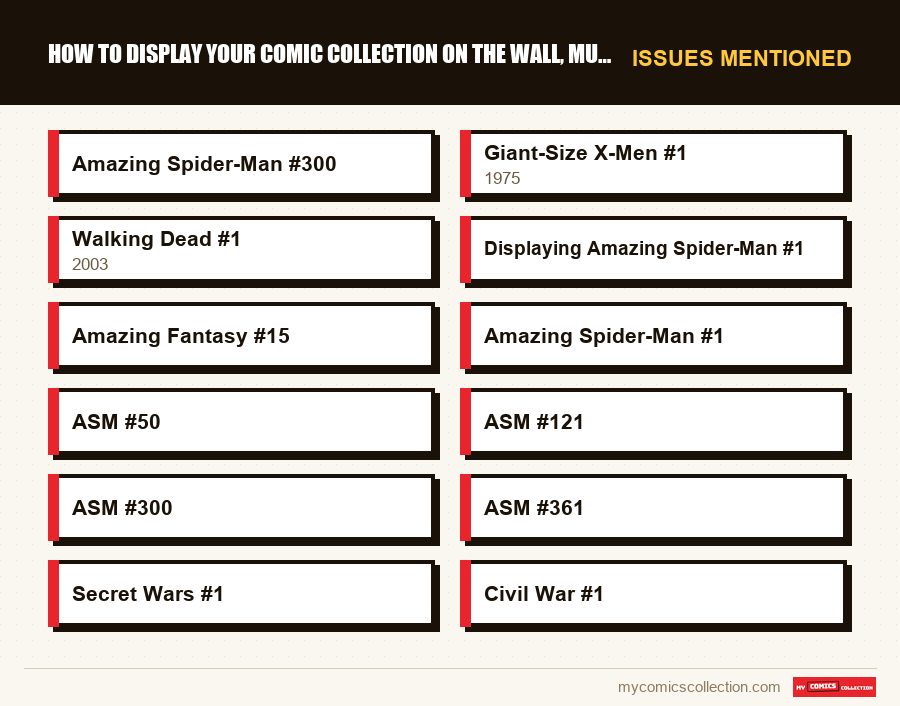
Composition by theme groups 5 to 10 comics around a character, a publishing event, or a team. Classic examples: a Spider-Man wall (Amazing Fantasy #15, Amazing Spider-Man #1, ASM #50, ASM #121, ASM #300, ASM #361), a Marvel-events wall (Secret Wars #1, Civil War #1, House of M #1, Avengers vs X-Men #1), a 1970s Batman wall (Batman #232, #251, Detective Comics #437). This logic favors narrative readability and makes conversation easy with non-collector visitors who recognize a familiar character.
Recommended spacing for a thematic composition: 8 to 12 cm between standard frames, 15 to 20 cm between bulkier CGC frames. Center the composition 1.55-1.65 m off the floor (median eye height for a standing person), allowing comfortable viewing without tilting the head. Strict horizontal alignment of frame centers, never of edges (formats vary slightly between Silver Age 18 x 27 cm and Modern Age 17 x 26 cm). For walls of 4-6 frames, a rectangular 2x2 or 2x3 layout; beyond 8 frames, a 2x4 layout or a 3x3 grid depending on available wall width.
Composition by chronological series presents the evolution of a title across several issues. Examples: Walking Dead #1 through #12 runs, X-Men #1 through #10 (1963), Saga #1 through #6 (2012). This logic showcases editorial continuity and the artist's progression. It requires strictly identical frames in format and finish, perfect horizontal alignment, and regular spacing of 6 to 10 cm. The visual effect recalls a modern art board and works especially well on long walls (3-5 linear meters) in a hallway or office.
Composition by publisher structures the wall around the brand colors of Marvel (red), DC (blue), Image Comics (white/black), or indies. This logic appeals to multi-publisher collectors and allows a sociological reading of the history of the American comic book. Recommended layout: three distinct zones of the wall, separated by 30-50 cm of neutral wall space, each zone grouping 3 to 5 frames representative of the publisher. The empty spaces contribute to visual breathing room and avoid a chaotic patchwork effect.
Common mistakes to avoid: mixing very different frame formats with no logic (bazaar effect), displaying more than 12-15 comics on a single wall (visual saturation), placing the most valuable pieces in the corners most exposed to direct light or foot traffic, neglecting dedicated lighting in favor of the ceiling light alone (diffuse lighting, no spotlight on the pieces). The museum rule of the focal point calls for one star piece per wall (the rarest or most iconic comic), set slightly off the geometric center, drawing the eye before the other pieces are read.
To go further with curation, study the official exhibits: the Comics Museum in Angoulême (regular thematic rotations), the Marvel exhibit at the Cinémathèque française (2024-2025), Comic Connect New York exhibits. Document the photographed compositions and transpose them at home on a suitable scale. To showcase the standout pieces of the composition, a run through the free valuation by mycomicscollection helps rank the focal point by actual market value.
Collecting this series?
Track what you own, what you are missing and what your collection is worth. 7 day trial.
Start my trial →Security: anti-theft, camera, dedicated homeowner's insurance
Displaying a collection valued at $5,000 to $50,000 on the wall calls for proportionate security measures. Three layers of protection combine: physical securing of the frames (anti-removal), deterrent video surveillance, and adequate homeowner's insurance coverage. Neglecting any one of the three exposes you to a financial risk out of proportion with the pleasure of the display.
Physical securing of the frames rests on two complementary devices. First: replacing standard wall hangers (X hook or triangle) with anti-removal systems such as Security-Hangers, T-Bar Lock, or a backing plate screwed directly into the wall. These systems require a hex key or a specific tool to take the frame down, deterring opportunistic theft during a visit or a quick burglary. Cost 8-15 € per frame, installation 15 minutes per frame, universal compatibility with wood or aluminum frames.
Second physical device: anti-rip-out anchoring for CGC frames worth more than 1,000 €. The frame is fixed by 2 to 4 through-bolt points into the wall (Molly M8 anchor or SX12 concrete anchor depending on the substrate), with a cover or trim hiding the screws from the front. Removal becomes impossible without tools and without visible damage. Reserved for very-high-value pieces (Action Comics #1, Detective Comics #27, high-grade Amazing Fantasy #15), this fixing permanently immobilizes the frame: any future change to the display requires dismantling the mounting system.
Deterrent video surveillance complements the physical securing. An indoor IP camera such as the Reolink Argus 3 Pro, TP-Link Tapo C220, or Eufy SoloCam E20, positioned to frame the display wall and the entrance to the room. Budget 50-120 € per camera, Wi-Fi operation with local storage on a 64-128 GB microSD card (10-20 €) or secure cloud storage (3-8 €/month). Push notification to a smartphone when motion is detected outside normal hours. The visible presence of the camera deters 70 to 85% of opportunistic theft attempts, according to national police statistics for 2022-2024.
For collections valued above 15,000 €, pair the camera with a door-opening sensor on the room and a glass-break detector near the display wall. These sensors feed a connected alarm such as Verisure, Somfy Protect, or Ajax Systems (200-450 € hardware + 25-45 €/month monitoring subscription). The annual investment of 300-540 € proves negligible against the dead loss of a single 5,000 € piece being stolen.
Comic collection insurance in France is the third necessary layer. Standard homeowner's insurance rarely covers comics beyond an overall contents cap of 3,000-8,000 €, and often excludes collectibles without a specific rider. Two solutions structure the French market: the valuables rider on an existing home policy (Maif, Macif, Crédit Mutuel) for collections up to 25,000 € of declared value, costing 30-90 €/year extra; and specialized collectibles insurance (Hiscox, AXA Art, Albingia) for collections above 25,000 €, costing 0.3 to 0.8% of the value per year, or 75-200 € per 25,000 € insured.
Documentation is essential for insurance: high-resolution photographic inventory of each displayed comic, scanned original CGC certificates, purchase invoices or price attestations (eBay, Heritage, comic shops), an independent appraisal dated less than 24 months ago for pieces above 2,000 €. In the event of a loss, see the guide comic loss or theft in France: claim and compensation, which details the procedure and reimbursement timelines from French insurers.
Special case: partial display in a storage unit or second home. These setups require a declaration separate from the main home policy and often a dedicated insurance. The guide comic storage units in France details the contractual traps (ridiculous contents cap, humidity exclusions, theft-by-break-in not covered). For collections displayed in a professional office, check that the commercial all-risk policy includes personal valuables: a clause often missing by default.
Rotating the comics on display: 3 to 6 months maximum per piece
Rotating the comics on display is the decisive curator's move that separates the casual collector from the savvy steward. The museum reference rule, transposed to the individual collector, caps continuous display of any one piece at 3-6 months maximum, with a return to drawer-box storage for an equivalent recovery period. This rule follows a precise scientific logic regarding the cumulative degradation of inks and paper.
The Bunsen-Roscoe reciprocity principle in photochemistry establishes that the degradation of a light-sensitive material depends on the product of (light intensity) x (exposure duration). At 50 lux, 8h/day for 6 months, a comic accumulates about 72,000 lux-hours of exposure. Beyond 100,000 cumulative lux-hours over the comic's life, color losses become visually perceptible to the naked eye (uniform yellowing, loss of saturation in the reds and blues). The 3-6-month rotation keeps cumulative annual exposure under 100,000 lux-hours, preserving color quality over 15-20 years.
Recommended rotation schedule for a wall of 8 displayed comics: select 16 to 24 total pieces held in drawer-box reserve, rotating in groups of 4 every 3 months. Sample calendar: January-March group A (pieces 1-8), April-June group B (pieces 9-16), July-September group C (pieces 17-24), October-December back to group A. This quarterly rotation limits each piece's annual exposure to 90 days, or 36,000 lux-hours per year, allowing 50+ years of cumulative display before reaching the critical threshold.
Rotation offers three side benefits beyond color protection. First: renewed visual interest: a wall left static for 5 years loses its evocative power, while a quarterly rotation creates surprise and reignites conversation with regular visitors. Second: gradual showcasing of the full collection: over 5 years of rotations, 60 to 100 different pieces will have been displayed, versus 8 in a static display. Third: active spotting of pieces needing attention (re-seating, dusting the frame, hygrometric check of the mylar bag).
Practical logistics of rotation: use a digital schedule (Google Calendar or Notion) with an automatic reminder 2 weeks before the due date. On rotation day, remove the frames in a clean environment (cotton gloves, work surface covered with acid-free paper), photograph each displayed comic to document its post-display condition, and return it to the dedicated rotation drawer box. A quick visual inspection to detect any abnormal degradation (localized yellowing, internal condensation, shifting of the backing board).
For very-high-value pieces ($5,000+), reduce the display duration to 2-3 months maximum and use exclusively a CGC frame with Optium Museum Acrylic glass (the highest UV-filter grade on the market, 99.9% UV blocked). The rotation should then be planned over 5-6 alternating pieces, each piece spending 2 months on display and 10 months in strict drawer-box storage. This conservation-minded approach extends color stability to 30-40 years of cumulative display with no visible loss.
Storage during off-display periods: archive-grade drawer box such as Hollinger MetalEdge or E. Gerber ProtoMylar, controlled environment 18-20 °C / 45-55% RH, total darkness. The guide comic storage boxes: pro archiving 2026 details the drawer-box options suited to this museum rotation, and the complementary role of mylar for comics for very-high-value pieces in rotation.
Special cases to anticipate: avoid displaying pulp-paper pieces (Silver/Bronze Age) during summer if the room isn't air-conditioned: the summer swings of 25-30 °C and 60-70% RH dramatically accelerate yellowing even under a UV-filter frame. Prefer the October-April window for these fragile pieces. Conversely, modern glossy-paper comics hold up better and can be displayed in summer with no measurable extra degradation. For attic or cellar setups, see protecting comics in the attic: critical temperatures and storing comics in a damp cellar: mistakes before any display in those spaces.
FAQ: Comic collection on the wall, museum display
What budget to display 8 CGC comics on the wall museum-style?
Budget for a wall of 8 framed CGC comics in a museum presentation: 280 to 520 € for 8 dedicated CGC frames with UV-filter glass (35-65 € each), 60 to 90 € for 3000 K LED lighting (2-3 Philips Hue Adore or Paulmann Premium Line spots), 40 to 80 € for anti-removal mounts (Security-Hangers or T-Bar Lock), 50 to 120 € for an IP surveillance camera (Reolink Argus 3 Pro or TP-Link Tapo). Total 430-810 € excluding dedicated homeowner's insurance and excluding the value of the comics themselves. For the premium range (solid-wood frames, Optium Museum Acrylic glass, connected alarm), budget 1,200-1,800 €.
3000 K or 4000 K LED to light a comic wall?
3000 K LED (warm white) without question, never 4000 K (neutral white) or 5000 K (cool white). 3000 K emits less than 50 µW/lumen of UV and 15-20% harsh blue, versus 80-110 µW/lumen UV and 30-35% blue for 4000 K. Over 12 months of display at 8h/day, the color-degradation differential is a factor of 2.5 to 3.2 in favor of 3000 K. Ideally 2700 K if a model is available with a CRI above 90 (Philips Hue Adore, Paulmann Premium Line). Target intensity 50 lux measured at the comics with a digital lux meter.
How long can a comic be displayed on the wall without degradation?
3 to 6 months maximum of continuous display per piece, followed by an equivalent recovery period in an archive drawer box. This museum rotation caps cumulative exposure at less than 100,000 lux-hours over the comic's life, the threshold beyond which color losses become visible to the naked eye. For very-high-value pieces ($5,000+), reduce to 2-3 months maximum of display and use a CGC frame with Optium Museum Acrylic glass, 99.9% UV blocked. Plan the rotation over 16-24 reserve pieces to keep a wall of 8 frames in constant renewal.
Does an IKEA Ribba frame protect a comic enough?
No, the standard IKEA Ribba frame uses acrylic glazing with no UV filter that lets 60 to 75% of UV-A through: enough to fade a comic in 6-18 months of display. An acceptable budget solution for modern comics of sentimental value ($5-20): replace the glazing with an Optium Museum UV-filter acrylic sheet (15-25 € for A3 format at Album Comics or Comicframe), or add a 3M Window Film UV-blocker adhesive film (12-18 € for 50 x 100 cm). For comics worth more than 30 €, go straight for a standalone Comicframe or CSP frame with built-in UV-filter glass (20-45 €).
How to secure a displayed comic collection against theft?
Three security layers: physical securing (Security-Hangers anti-removal mounts 8-15 €/frame, or through-bolt anti-rip-out anchoring for pieces worth 1,000 €+), deterrent video surveillance (Reolink Argus 3 Pro or TP-Link Tapo C220 IP camera, 50-120 € + smartphone notification), and adequate homeowner's insurance (Maif/Macif valuables rider 30-90 €/year for collections up to 25,000 €, or specialized Hiscox/AXA Art insurance 0.3-0.8% of value/year above that). For collections above 15,000 €, add a connected Verisure or Ajax Systems alarm with monitoring (200-450 € hardware + 25-45 €/month).