
A well-constructed MCC watchlist, paired with price alerts set on the platforms, rests in 2026 on 3 pillars: (1) selection of 30 to 60 spec issues with precise CGC grade and documented purchase threshold, (2) aggregated multi-source configuration (current eBay listings + GoCollect Fair Market Value + Heritage Auctions + ComicConnect + WhatNot streams), (3) refresh frequency adapted to the volatility profile (live for announced MCU spec, daily for stable vintage Silver Age). A well-calibrated MCC watchlist with 50 issues brings in, through the platforms' own notifications, 5 to 12 relevant alerts per week, 1 to 3 of which lead to a purchase under fair market value (average margin 15 to 35% on defined threshold). Total tools budget: 12 to 25 USD/month depending on coverage.
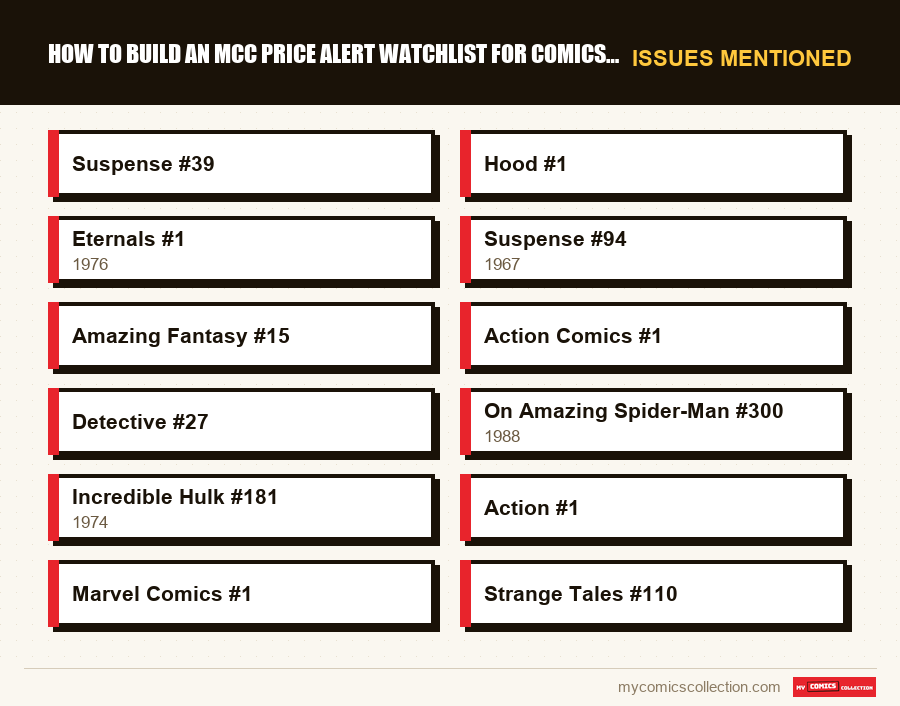
If you are tracking spec comics in 2026 on an MCU/DCU universe that produces 4 to 6 TV series per year and 8 to 12 films, the price volatility on the corresponding key issues makes weekly manual tracking impractical. A Tales of Suspense #39 CGC 9.0 is worth $8,200 in January 2026, $7,400 in March after a disappointing Marvel announcement, $9,100 in June after a leaked teaser, and $11,500 in September after confirmation of a casting. Without a structured multi-source alert system, you systematically miss the 2 to 3 purchase windows under fair market value which appear each quarter on each key issue.
The professional solution: keep your spec targets in one MCC watchlist (in My Comics Collection, that is the wishlist, where each issue carries a priority and a target price shown next to the market estimate), then set threshold alerts by CGC grade on the source platforms themselves (eBay, GoCollect, Heritage, ComicConnect, WhatNot), which send the email and push notifications according to the priority of the issue. My Comics Collection sends no price alert: it holds the reference list, the platforms do the watching. This article details the step-by-step methodology for creating this MCC watchlist in 2026, organizing your alerts by priority tier, calibrating your price thresholds by CGC grade (9.8 vs 9.6 vs 9.4), choosing the refresh frequency by source, and avoiding the 5 common errors that transform a watchlist into unmanageable spam. At the end, a practical case applied to 50 spec issues covering Silver Age, Bronze Age and modern keys.
Why track comics prices in 2026: MCU/DCU volatility and spec windows
The year 2026 marks a historic peak of volatility in the spec comics market. Marvel Studios officially announces 6 films over 2026-2028 (Spider-Man Brand New Day, Avengers Doomsday, Avengers Secret Wars, Blade, Shang-Chi 2, X-Men) and 8 Disney+ series (Wonder Man, Vision Quest, Daredevil Born Again season 2, Ironheart, Eyes of Wakanda, Marvel Zombies, Nova, Strange Academy). Each casting announcement, each teaser trailer, each confirmed release date triggers a price movement of 15 to 80% on the corresponding key issues in less than 72 hours. On the DCU side, the James Gunn reboot started in 2025 with Creature Commandos and Superman Legacy creates a second distinct front of volatility on the DC keys.
Concretely, a Hood #1 (first Parker Robbins in costume) was priced at 90 USD raw NM in January 2026. After the confirmed casting for Spider-Man Brand New Day in March 2026, the price jumped to 180 USD in 48 hours then stabilized at 145 USD three weeks later. Without multi-source alert with push notification, you buy at 180 USD at peak media. With a calibrated watchlist and an eBay saved search set at the right threshold, you received the alert on the first sale under 100 USD before the surge and entered the position at the right price. The cumulative difference over 20 to 30 spec issues over a year easily represents $2,000 to $6,000 in potential margin.
Volatility is not just on the rise. Overrated comics after MCU hype are experiencing brutal pendulum swings. Eternals #1 (1976) was priced at 800 USD CGC 9.0 in November 2021 just before the film's release, then 320 USD CGC 9.0 in March 2022 after the lukewarm critical reception. A watchlist whose platform alerts also cover drops (GoCollect's Price Drops, for example) allows you to enter undervalued keys after corrections, anticipating the next hype cycle. See also underrated comics 2026: sleeper issues for the positions to be entered on correction.
The third source of 2026 volatility is the announcement of the Marvel and DC editorial reboots. A relaunched title (for example Spider-Man volume 6 in April 2026) creates a call for air on the first issue of the previous series, on the key cameos and on the variants. These internal editorial movements receive less media coverage than studio announcements but represent 30 to 40% of weekly spec opportunities. See comics pre-order investment strategy for the methodology for anticipating editorial reboots.
How to create an MCC watchlist: issue + CGC grade + purchase threshold
Building an MCC watchlist follows a strict tabular structure that serves as the basis for all your alerts. Each line contains 8 required fields: (1) full name of the issue (title + number + edition), (2) exact target CGC grade (9.8, 9.6, 9.4, 9.2, 9.0, 8.5, 8.0 or raw NM-/VF+), (3) GoCollect 30-day fair market value, (4) defined purchase threshold (typically FMV minus 15 to 25%), (5) thesis spec in 1 sentence, (6) resale horizon (3, 6, 12, 24 months), (7) priority (Tier 1 push, Tier 2 email, Tier 3 watch), (8) date of last verification.
Example line for the first position: Tales of Suspense #94 (1967): CGC 7.0 - FMV 420 USD, Threshold 350 USD, Thesis first MODOK confirmed Captain America Brave New World, Horizon 12 months, Tier 1 push: Verified 2026-06-09. This line contains everything you need to configure a multi-source alert in the next 5 minutes: the eBay query becomes "Tales of Suspense 94 CGC 7.0 -reprint -facsimile" with range 250-440 USD, the GoCollect Premium entry is made with threshold 350 USD on the exact CGC 7.0 grade, the Heritage Auctions watchlist entry is made on the ToS94 slug, and the Mantis or Comicstro scan is set to 350 USD threshold.
The typical structure of a complete MCC watchlist has 30 to 60 issues divided by investment category. Recommended distribution: 30% Silver Age key (first appearances, first emblematic covers 1956-1969), 30% Bronze Age key (1970-1985 including first modern villains), 30% Modern keys (1990-2015 first appearances transposable MCU/DCU), 10% opportunistic short-term spec (previews and pre-orders 0-90 days). This diversification protects against a sudden fall in a category (case of Eternals modern keys after the fall of the film).
The purchase threshold is the most difficult parameter to calibrate. The 15-25% rule under FMV works on very liquid issues (Amazing Fantasy #15, Action Comics #1, Detective #27) with 50+ monthly sales. On semi-liquid issues (5 to 20 monthly sales) the threshold must go down to FMV minus 25 to 40% to generate sufficient signal. On illiquid issues (1 to 4 monthly sales) the threshold drops to FMV minus 40 to 55% and the alerts become rare but very qualitative. The practical rule: your threshold must trigger 2 to 5 alerts per month on the outcome, neither more (otherwise your query is too broad) nor less (otherwise you will miss the real opportunities). See comics for the outcome odds database.
Multi-grade alerts: CGC 9.8 vs 9.6 vs 9.4 per issue, the right ratio
One of the most costly mistakes on a beginner MCC watchlist: alerting on only one CGC grade per issue. The secondary comic market operates on price spreads between grades that vary massively depending on the age of the issue, rarity, and peak spec demand. On Amazing Spider-Man #300 (1988), a CGC 9.8 is worth $3,200, a CGC 9.6 is worth $1,100, a CGC 9.4 is worth $580. The spread 9.8 to 9.6 is 2.9x (190% premium), the spread 9.6 to 9.4 is 1.9x (90%). On Tales of Suspense #39 (1963), a CGC 9.0 is worth $8,200, a CGC 8.5 is worth $4,600, a CGC 8.0 is worth $2,800. The ratios differ radically depending on age and rarity of the outcome.
The multi-grade methodology: for each issue of your MCC watchlist, create 3 distinct lines corresponding to the 3 most liquid grades of the moment. For post-2000 modern keys, this will typically be CGC 9.8, 9.6, 9.4. For the Bronze Age 1970-1985, it will be CGC 9.4, 9.2, 9.0. For Silver Age 1956-1969, it will be CGC 8.5, 8.0, 7.5. For pre-1956 Golden Ages, it will be CGC 7.0, 6.0, 5.0. This stratification makes it possible to capture good deals on the least popular grade of the moment, which is sometimes more profitable than the premium grade.
Concrete example for Incredible Hulk #181 (first Wolverine, 1974): CGC 9.4 FMV 7,500 USD threshold 6,200, CGC 9.2 FMV 4,800 USD threshold 3,900, CGC 9.0 FMV 3,200 USD threshold 2,600. Over 6 months of observation, CGC 9.2 saw 14 sales below threshold 3,900 USD, the CGC 9.4 saw 3 sales below threshold 6,200, the CGC 9.0 saw 8 sales below threshold 2,600. The CGC 9.2 delivered the most relevant opportunities for a patient buyer. If you had only set 9.4 on your watchlist, you would have missed 22 opportunities on the liquid neighboring grade. See buy comics auction: ComicConnect Heritage strategy.
The multi-grade trap: multiplying the number of watchlist lines by 3 also multiplies the number of raw alerts by 3. To stay under the threshold of a manageable 10 to 15 pushes per day, you must compensate with stricter thresholds on secondary grades. On the priority grade (the most liquid according to your strategy), keep the FMV threshold minus 20%. On the two adjacent grades, go down to FMV minus 30% to only capture the real good deals. This double calibration produces an optimized signal: 60% of alerts on the priority grade, 30% on the high secondary, 10% on the tertiary. For the nuance of the exact grades, see comics price madness: buy or wait strategy 2026.
Watchlist price sources: eBay sold + Heritage + ComicConnect + WhatNot
A single-source MCC watchlist (only eBay or only GoCollect) covers at best 60% of the real market. The major good deals are hidden on secondary sources less followed by the masses. The complete 2026 stack combines 5 distinct sources with different weights depending on the issue profile: eBay sold listings (40% of US market volume), Heritage Auctions (15% but high-end focus 1,000 USD+), ComicConnect (10% advanced collectors focus), WhatNot live streams (15% strong growth), and GoCollect/PriceCharting aggregator trackers (consolidation of the 4 previous sources). For comparative details, seeGoCollect vs PriceCharting comics: comparison.
eBay sold listings remain the primary source for 80% of watchlist positions under $1,000. eBay's Saved Search feature with push notifications delivers listings within 15 minutes of going live. Targeting by CGC and price range is precise. For comics under 200 USD, eBay covers 90% of global sales. Above 1,000 USD, eBay gradually loses its dominance against Heritage and ComicConnect, which capture high-end comics via consignment and more competitive marketplace fees for sellers.
Heritage Auctions is the critical source for positions above $1,000 (Silver Age keys, Golden Age, Edgar Rice Burroughs, EC Comics). The platform organizes 50+ sales per year including 4 large quarterly Signature Auctions. The Heritage watchlist allows you to follow lots in upcoming auctions and receive an email notification 7 days before each auction closes. The Want List function allows you to pre-declare an interest in a specific issue at the exact grade, and Heritage notifies you as soon as a matching item enters consignment (sometimes 3 to 6 months in advance). For the Want List Heritage, allow 30 minutes of initial setup to configure 20 to 30 priority issues.
ComicConnect (based in New York, owned by Stephen Fishler since 2005) is the other major high-end auction house. The quarterly Event Auctions sales attract Golden Age trophies (Action #1, Detective #27, Marvel Comics #1) but also very high grade Silver and Bronze Age trophies. The Watch function on ComicConnect is less developed than Heritage (no automatic email alerts beyond bid notifications) but the weekly manual check on ongoing auctions remains useful for budgets of 2,000 USD+. WhatNot live streams add a new dimension in 2026: live sales on smartphones with breakers and solo sellers who sell in sessions of 1 to 4 hours at prices often 10 to 20% below fair market value to generate rapid liquidity. To anticipate, see comics sell resale guide pillar.
Watchlist refresh frequency: live vs daily vs weekly
The refresh rate of your watchlist alerts is calibrated according to 3 parameters: volatility of the outcome (high/medium/low), priority tier (1/2/3), primary source (eBay live, GoCollect 4h delay, Heritage daily). The recommended distribution for a 50 issue watchlist: 20% live (instant push sub 15 minutes), 50% daily (morning email digest 7 a.m. Paris time), 30% weekly (Sunday evening recap for strategy adjustment).
Live (instant push) is reserved for Tier 1 high priority: spec issues on recent MCU announcement, sleeper issues under anticipated media embargo, short-term opportunities 30 to 60 days horizon. Out of these 8 to 12 outcomes, the window of opportunity sometimes lasts 30 minutes to 2 hours between the time a seller posts a listing under fair market value and the time a buyer who knows the market buys it. Without live push, you systematically arrive later and pay 25 to 50% more.
The daily (email digest 6 a.m.-7 a.m. Paris time) covers 25 to 30 Tier 2 medium priority issues. The digest aggregates all listings and price moves from the last 24 hours filtered by your threshold. You read for 10 to 15 minutes at breakfast, you open 2 to 4 interesting listings for in-depth verification, you buy if confirmed. This daily rate is sufficient for the stable Silver Age and Bronze Age where the competition is less aggressive (the other Tier 2 collectors also receive the morning digest and no one snipes in 5 minutes on these niches).
The weekly (recap Sunday evening 7 p.m.-9 p.m. Paris time) covers 10 to 15 Tier 3 market watch issues. These issues are not immediate purchase targets but background positions that you monitor to calibrate your strategy or detect structural changes. The weekly recap gives you the movement of FMV week vs. previous week, potentially related editorial or studio announcements, and a 3-month rolling chart. This weekly summary is also the time to purge Saved Searches that have become obsolete (exit from your strategy, FMV which has moved away from your budget). See comics investment update 2027 strategy pillar.
Email + push notifications: multi-device configuration without saturation
Configuring notifications is what turns a theoretical MCC watchlist into a daily operational system. The basic rule: a notification channel by priority tier, with strict anti-saturation rules. Tier 1 uses instant smartphone push (maximum priority, distinct sound). Tier 2 uses morning email digest (8 to 15 entries maximum per email). Tier 3 uses weekly Sunday email digest (summary summary over 7 days).
iOS and Android push configuration for eBay Saved Searches is done through the official mobile app. Settings > Notifications > Saved Searches > activate the "Push notification" toggle and deactivate "Email" for these specific searches (to avoid redundant double notifications). For GoCollect Premium, Price Drops are configured on the GoCollect.com web app > My Vault > Price Drops > Settings > activate "Email immediate" and "SMS" if you have configured your mobile number. For Heritage Auctions, Want List alerts are made on HA.com > My Auctions > Want List > activate "Email me when this item is added".
The recommended pattern to avoid saturation: create a dedicated Gmail or Outlook folder "Comics Alerts MCC" with a filter rule that automatically stores eBay/GoCollect/Heritage emails in this folder without cluttering the main inbox. Set aside 15 minutes in the morning and 15 minutes in the evening to go through this file, which is more than enough for 50 issues followed. Smartphone push remains reserved for Tier 1 with absolute priority (8 to 12 exits maximum) to preserve the signal-to-noise ratio. Beyond 15 pushes per day, the brain unconsciously filters and you miss the real critical alerts drowned out in the noise.
The calibration test: after 2 weeks of operation of your MCC watchlist, measure the quality of the signal. Count the number of alerts received per tier (Tier 1 objective: 5-10 pushes/week, Tier 2: 15-25 emails/week, Tier 3: 1 weekly recap). Count the number of alerts that led to a purchase (typical conversion rate 5 to 15% on Tier 1, 1 to 5% on Tier 2). If the Tier 1 rate exceeds 20%, your threshold is too strict and you are missing out on volume. If the Tier 1 rate drops below 3%, your threshold is too wide and you saturate the channel. Adjust the thresholds in 5% FMV increments until you reach the 8-12% conversion sweet spot. For the overall threshold buying strategy, see free estimate.
Collecting this series?
Track what you own, what you are missing and what your collection is worth. 7 day trial.
Start my trial →Practical case 50 issues watchlist: Silver + Bronze + Modern keys
The following practical case illustrates the concrete construction of an MCC watchlist with 50 issues spread over 3 periods for a monthly purchasing budget of 1,500 to 3,000 USD. The distribution follows the 30-30-30-10 rule mentioned previously: 15 Silver Age, 15 Bronze Age, 15 Modern, 5 opportunistic spec. The set covers Marvel and DC with a slight Marvel bias (60-40) reflecting MCU dominance on 2026 announcements.
Tier 1 Silver Age (5 issues, push enabled): Tales of Suspense #39 CGC 8.0 threshold 2,600 USD, Amazing Fantasy #15 CGC 6.0 threshold 38,000 USD, Strange Tales #110 CGC 7.0 threshold 5,200 USD, Avengers #4 CGC 7.5 threshold 2,800 USD, X-Men #1 CGC 6.0 threshold 8,500 USD. Tier 1 Bronze (5 issues, push): Hulk #181 CGC 9.2 threshold 3,900 USD, Iron Fist #14 CGC 9.6 threshold 1,800 USD, Wolverine Limited #1 CGC 9.8 threshold 280 USD, Daredevil #168 CGC 9.4 threshold 950 USD, Punisher Limited #1 CGC 9.8 threshold 320 USD. Tier 1 Modern (5 issues, push): Amazing Spider-Man #300 CGC 9.8 threshold 2,800 USD, Walking Dead #1 CGC 9.8 threshold 1,400 USD, Saga #1 CGC 9.8 threshold 380 USD, Hood #1 raw NM threshold 75 USD, Edge of Spider-Verse #2 CGC 9.8 threshold 450 USD.
Tier 2 (25 issues, morning email digest): 10 secondary Silver Ages (Tales of Suspense #50, Avengers #1, Fantastic Four #5 CGC 7.0 threshold 4,200 USD, Daredevil #1, Strange Tales #135, Captain America #117, Tales to Astonish #27, Journey into Mystery #83, Showcase #4 CGC 6.0 threshold 18,000 USD, Brave Bold #28), 10 Bronze Age secondary (Werewolf by Night #32, Marvel Spotlight #5, Tomb of Dracula #10, Master of Kung Fu #15, Giant-Size X-Men #1 CGC 9.4 threshold 3,200 USD, #92), 5 Modern (Batman Adventures #12, New Mutants #98 CGC 9.8 threshold 480 USD, ASM #194, Ultimate Fallout #4, Iron Man #55 reprint variants).
Tier 3 monitoring (15 issues, weekly): covers the lower priority issues that you monitor for trend calibration or strategic pivot. Include 5 mini-keys with strong short-term potential (1 to 3 months horizon), 5 deep spec sleeper cuts which could come up on the next MCU/DCU announcement, 5 issue benchmarks used to measure the general trend of the collectibles market. The 15-minute Sunday recap is more than enough to keep this category active. See also total collection value: monthly monitoring for global portfolio monitoring.
The operational result measured on this typical setup: 18 to 28 weekly alerts received, 6 to 10 listings opened for in-depth verification, 1 to 4 purchases triggered per week. Over a 12-month cycle, this system generated for advanced users 35 to 80 acquisitions under fair market value with an average cumulative margin of 8,200 to 24,000 USD (depending on the aggressiveness of the thresholds and the volume of the monthly budget). The time ROI is 4 to 7 hours per week to manage the complete system, or 200 to 350 hours annually corresponding to 25 to 75 USD/hour equivalent.
Common MCC watchlist errors: alerts too broad, unrealistic thresholds
The first classic mistake: configuring alerts that are too broad which generate 50 to 200 notifications per day and inevitably lead to deactivating smartphone push after 1 to 2 weeks. The main cause is the absence of precise exclusions in the eBay query and the use of price ranges that are too generous (for example range 100-1000 USD on a CGC 9.4 which should strictly be 350-700 USD). The corrective rule: each Saved Search query must trigger between 1 and 5 notifications per week maximum. If the counter exceeds 10/week, tighten the exclusions and the price range before going any further.
The second mistake: setting unrealistic thresholds that never trigger. A threshold at FMV minus 50% on Amazing Fantasy #15 CGC 6.0 will almost never trigger because informed sellers never sell off at this level. The consequence: 6 months later, the watchlist contains 30 issues with zero historical alerts and you wrongly conclude that the market is dead. The corrective rule: your threshold must be historically triggered 2 to 5 times per month on the outcome (verifiable by consulting the GoCollect sold listings history over 90 days). If the history shows zero sales listings below your threshold, go back 5 to 10% FMV until you find the actual level of activity.
The third mistake: not updating thresholds based on FMV movements. A static watchlist with thresholds fixed on the January FMV remains configured at these thresholds in September while the FMV has moved 30 to 50% upwards or downwards in the meantime. On issues that have risen, your thresholds have become too low and you no longer receive alerts. On issues that have fallen, your thresholds have become too high and you are buying above the new market. The corrective rule: review all thresholds every month for Tier 1 issues, every quarter for Tier 2, every six months for Tier 3.
The fourth error: warning about CGC grades that are too precise without considering neighboring liquid grades. A CGC 9.8-only alert on Amazing Spider-Man #300 ignores the 15 monthly CGC 9.6 and 9.4 sales which often contain the most relevant buying opportunities. The corrective rule: always configure at least 2 adjacent grades per outcome (3 if the outcome is very liquid), with thresholds adjusted according to the historical spread between grades. Finally, the fifth mistake: not auditing the performance of the system. Without monthly measurement of the number of alerts received, purchase conversion rate and average margin gain per purchase, you don't know if your system is working or where to optimize. Allow 30 minutes per month minimum for this critical audit. See comics pre-order investment strategy.
FAQ: MCC Watchlist and comics price alerts 2026
How many issues ideally in an MCC watchlist starting in 2026?
A beginner starting an MCC watchlist in 2026 should aim for 15 to 25 issues maximum in the first 3 months. This limit allows you to learn the mechanics of calibrating thresholds, reading notifications, and the purchasing workflow without cognitive saturation. Once the cadence is acquired (typically after 2 to 4 successful acquisitions under FMV), you can gradually extend to 30, 40, 50 issues over 6 to 12 months. Beyond 60 simultaneous outcomes, the marginal gain becomes negative: you spend more time managing the system than studying individual opportunities. The sweet spot for a serious full-time spec collector is 45 to 55 issues.
What monthly tool budget for a professional MCC watchlist?
The typical tools budget for a complete MCC watchlist in 2026 is between $12 and $25 per month. Standard breakdown: GoCollect Premium $12.99/month (unlimited Price Drops alerts, 5-year sales history, up to 500 watchlist issues), Mantis Premium $4.99/month (mobile barcode scan, push alerts, watchlist 200 issues), free eBay Saved Searches (up to 100 searches), free Heritage Auctions Want List, free ComicConnect manual check. For around 18 USD per month, you have a system covering 95% of the secondary comics market. The ROI is generally achieved from the first good deal detected each month (typical saving 40 to 150 USD per acquisition under FMV).
Should we warn about raw comics or only the CGC ranks?
Both have their place but with different strategies. CGC graded comics offer precise thresholds (exact grade, transparent market price via GoCollect) but the market is more efficient and the margins tighter. Raw comics offer upside grading potential (buy raw NM- then grade CGC 9.6 or 9.8 multiplies the value 3 to 8 times) but require in-depth expertise to assess the probable grade from photos alone. The recommended distribution: 70% CGC grades on Tier 1 high priority (grade security), 30% raw on Tier 2 and 3 (upside grading opportunities). For grading details, see guide comics spec 2026 key issues to mount.
How to manage alerts during the holidays without missing opportunities?
During an absence of 1 to 4 weeks, two strategies are possible. The first: suspend all push alerts (except 3 to 5 absolutely priority Tier 1 targets) so as not to be stressed during the trip. The second: delegate the monitoring to an assistant or a collection partner who receives digest emails and only reports major opportunities (exceeding 200 USD of potential margin vs. threshold). The practical rule: a 2-week holiday in July or August often coincides with the worst buying windows (US summer = little collectible activity, sellers on vacation). You will statistically miss very few opportunities. For an absence in high season (September, October, November), planning the delegation becomes critical.
Does the MCC watchlist also work for the French comics Lug, Strange, Semic?
Yes but with different sources. Vintage French comics Lug, Strange, Semic, Panini are not indexed by GoCollect or by US trackers. The stack adapted for the VF market: eBay.fr Saved Searches (40% of volume), Catawiki watchlist (35%), Delcampe (10%), Facebook groups VF collectors (15%). The methodology remains identical (issue + grade + threshold + priority tier) but the CGC thresholds do not apply (VF comics are almost never graded CGC, we work on the NM/VF/F descriptive state). Allow 20% additional time for weekly manual monitoring on Facebook groups which remain the dominant source for rare VF parts.