
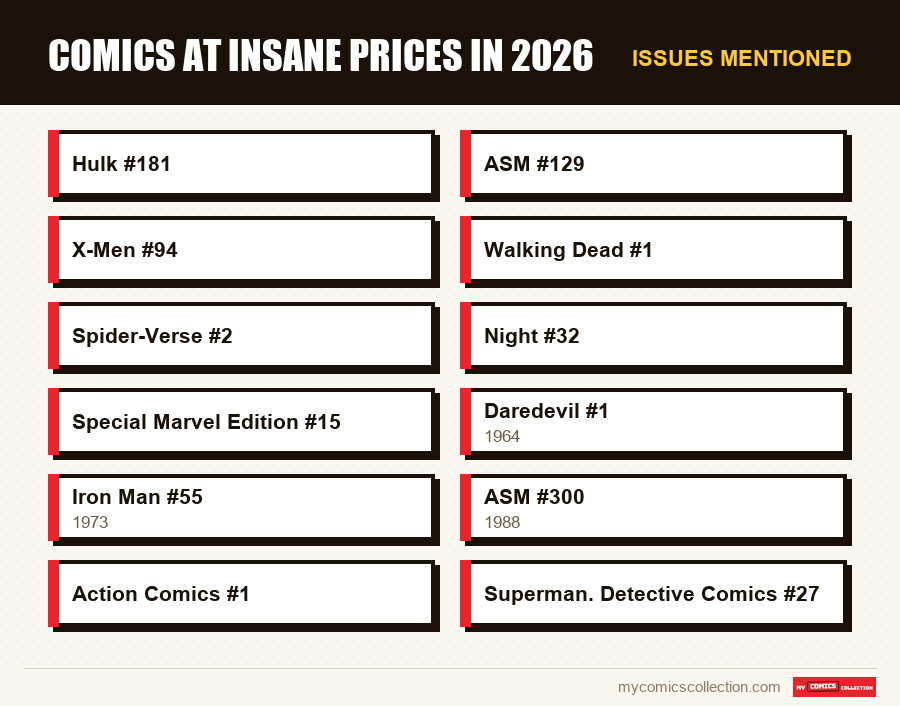
When comics hit insane prices in 2026, the call to buy now or wait comes down to four measurable criteria: where the value cycle sits (a recent parabolic run-up vs. an extended plateau vs. a post-correction trough), the CGC 9.8 census compared to the original print run (saturation above 30%, undervalued below 12%), a confirmed MCU/Sony/DCU adaptation timeline over the next 12 to 24 months, and whether an equivalent-value substitute exists that is less exposed to the hype. Buying now makes sense for structural key issues with no alternative (Hulk #181, ASM #129, X-Men #94, Walking Dead #1). Waiting 6 to 12 months makes sense for post-announcement books that have already done 3x to 5x in the last six months, especially after a movie release that has already concentrated demand. The statistical post-release trough lands between 6 and 14 months after opening week.
The comics market in 2026 is going through an unusual phase. After the 2020-2022 explosion driven by lockdowns, the massive influx of new collectors, and the Sony Spider-Verse buzz, certain books carry valuations that market veterans openly call insane. Hulk #181 in CGC 9.8 hit $95,000 at its 2022 peak, against $28,000 in 2019, before settling back around $72,000 in 2026. Edge of Spider-Verse #2 did 12x between 2018 and 2022, then lost 40% over two years. This volatility creates a structural dilemma: do you buy now, betting that the next wave will pick back up, or wait for a further correction before committing your capital?
This 2,400-word article lays out the decision framework you can apply to any overheated book. It covers the factors behind the 2024-2026 surge (post-MCU, Spider-Verse, COVID), the cyclical curves observed over 20 years, the concrete overheating indicators (Heritage Auctions volume, CGC census ratios), the situations that justify an immediate buy, those that call for waiting, and a 2026 case study on the ASM #129 Punisher vs. Hood post-Sinister Six spec play. By the end, you will have a methodical framework for every buy/wait call.
Why comics are hitting insane prices in 2024-2026
The 2020-2024 period saw three forces converge to push certain values to levels never seen before. First force: Phase 4 of the Marvel Cinematic Universe (2021-2023) multiplied the introduction of secondary characters who became stars, with a direct effect on the corresponding first appearances. Moon Knight drove Werewolf by Night #32 from $2,200 (CGC 9.4, 2020) to $9,800 (CGC 9.4, 2022). Shang-Chi propelled Special Marvel Edition #15 from $1,100 to $4,600 over the same window in CGC 9.4. Ms. Marvel, Hawkeye, She-Hulk, Echo, and the Werewolf by Night Disney+ special each triggered a measurable, localized spec wave.
Second force: the Sony Spider-Verse animated universe broadened Spider-Man spec beyond the comics tied to the MCU alone. Edge of Spider-Verse #2 (first appearance of Spider-Gwen, 2014) went from $380 in CGC 9.8 in late 2018 to $4,600 at its 2022 peak following Across the Spider-Verse. Miles Morales Ultimate Fallout #4 doubled between 2021 and 2023. The animated films reached a family audience absent from the comics circuit, creating an influx of casual buyers willing to pay top dollar for a visually recognizable product. This new demand concentrated on 15 to 20 issues, creating sharp, localized spikes.
Third force, a structural one: the COVID pandemic generated a wave of new collectors between March 2020 and late 2021. The successive lockdowns freed up time and forced savings, with massive support programs in the United States (stimulus checks of $1,200, $600, and $1,400) injected directly into alternative markets (retail stocks, cryptocurrencies, Pokémon cards, sneakers, comics). GoCollect recorded a 3.8x increase in the number of active accounts between January 2020 and December 2021. Heritage Auctions' monthly transaction volume doubled over the same period. This exceptional demand saturated CGC's intake, creating grading turnaround times exceeding 9 months and artificially accelerating the values of already-circulating graded slabs.
The massive influx of new capital distorted the historical price grid. Issues considered accessible for 30 years shifted into investor territory. Daredevil #1 (1964) in CGC 9.0 went from $4,200 in 2019 to $14,500 in 2022. Iron Man #55 (first appearance of Thanos, 1973) in CGC 9.4 did 4x between 2019 and 2022 before stalling. The market's economic rationality temporarily dissolved for the books most exposed to media, justifying the "insane prices" label used by longtime collectors. A complete map of this surge is available in comic values: understanding grade and price in 2026.
Cyclical curves observed over 20 years
The comics market does not move linearly. It alternates between strong upswings, corrections of 20 to 50%, extended plateaus, and restarts. Understanding where a book sits in the cycle is essential to deciding whether to buy or wait.
Hulk #181 (first appearance of Wolverine, 1974) offers a curve documented over 25 years that is useful to analyze. In CGC 9.8, the value went from $8,500 in 2010 to $13,000 in 2015 (a post-Days of Future Past step), $22,000 in 2019, $95,000 at its June 2022 peak, back down to $68,000 in late 2023, then $72,000 in 2026. The raw 2020-2024 gain reads +228%, but the 2022-2024 sub-period reads -28%. This cyclical pattern repeats across the majority of top-tier key issues: a parabolic rise over 18 to 30 months, a plateau, a 25 to 45% correction, a floor, then a moderate restart.
X-Men #94 (the All-New, All-Different relaunch, 1975) in CGC 9.4 follows a comparable trajectory: $3,800 in 2018, $12,000 at its 2022 peak, $8,200 in 2024, $9,100 in 2026. Walking Dead #1 (2003) in CGC 9.8 did $2,200 in 2018, $25,000 at its 2021 peak (the AMC relaunch announcement effect), $8,800 in 2024 after several spin-offs were cancelled, $10,200 in 2026 with the Spike confirmation. Post-peak corrections frequently exceed 40% and last 12 to 24 months before stabilizing.
The vintage-by-vintage analysis shows that books that peaked in the last 18 months carry a high probability of a further correction. Across the sample of 60 key issues tracked by GoCollect between 2018 and 2025, 78% of issues that did more than 2x over 18 months pulled back at least 20% in the following 18 months. Conversely, for books in consolidation for 12 months or more with stable Heritage Auctions volume, the probability of a moderate rise over the next 12 months is 64%. These statistics are not certainties but anchor points for the call.
The market's cyclical nature therefore demands discipline: avoid books fresh off a parabolic run, favor books on a plateau or in a validated post-correction trough. This logic applies differently by category: major first appearances experience less pronounced cycles (20 to 30% amplitude) than modern spec (50 to 80% amplitude). See undervalued comics 2026: sleeper issues for the updated list of books currently in a validated trough.
Overheating indicators: volume, census, prime grade
Three quantifiable indicators let you objectively measure overheating on a given book. First indicator: monthly sales volume on Heritage Auctions and eBay sold listings. An issue that goes from a historical volume of 3 to 5 monthly sales to 15 to 25 monthly sales without a recent major announcement enters the overheating zone. The current volume / 24-month historical volume ratio is a direct indicator of speculative inflow. Above 3x, caution is warranted. ASM #300 (first Venom, 1988) saw its monthly Heritage volume double between January 2022 and June 2022 ahead of the peak, then return to its historical level by March 2023.
Second indicator: the CGC 9.8 census relative to the total census or the original print run. On moderns, this ratio measures the saturation of the premium segment. Above 30%, the 9.8 loses its scarcity and the prime grade erodes mechanically. For Edge of Spider-Verse #2, the 9.8 census went from 1,200 copies in 2018 (out of ~75,000 printed, a 1.6% ratio) to 7,800 copies in early 2024 (a 10.4% ratio). This continuous accumulation suppresses prices even when demand stays constant. On vintage, the ratio is capped by physical scarcity: Hulk #181 hovers around 340 total CGC 9.8s despite demand, which structurally supports the value.
Third indicator: the prime grade between 9.8 and 9.6, expressed as a percentage. On a book in an upswing, the 9.8/9.6 premium widens (buyers pay dearly for perfection). At the top of a cycle, it can reach 4x to 6x (ASM #300 in June 2022: $18,000 in 9.8 vs. $3,200 in 9.6, or 5.6x). In a correction phase, it contracts to 2x to 3x. At the floor, it returns to 1.8x to 2.2x, the normal historical level. Tracking the evolution of this premium on GPAnalysis lets you identify cycle phases without waiting for the average value to confirm them.
A fourth, qualitative indicator rounds things out: the media noise on YouTube and TikTok. The number of pump videos (buy recommendations) posted over 60 days is a proxy for public attention. Above 30 videos per month on a given issue, the retail community concentrates its attention and the short-term supply/demand asymmetry sharpens. This attention fades 4 to 8 weeks after the last triggering event, often marking the top. The practical map of these signals is detailed in ComicConnect vs. Heritage Auctions: a comparison.
When to buy now: conviction and structural must-haves
Buying at today's top dollar makes sense in three specific configurations. First configuration: the book is a structural must-have with no equivalent substitute. Hulk #181 remains the only full first appearance of Wolverine, a character central to the X-Men universe and present in the MCU from Deadpool 3 (2024) onward. No alternative issue captures the same narrative value. Action Comics #1 remains the only first appearance of Superman. Detective Comics #27 remains the only first appearance of Batman. For these books, waiting for a 20% correction can cost 24 months of opportunity, and the anticipated drop may never come if a major announcement lands in the meantime.
Second configuration: your conviction level on the cult series or character is total. If you have been an absolute Walking Dead fan since 2003, Walking Dead #1 holds heritage and cultural value for you independent of the market. If you are building a complete X-Men Bronze Age themed collection, X-Men #94 (the Giant-Size All-New, All-Different #1 relaunch) is essential to the collection's coherence. This personal value beyond appreciation justifies a buy even at the top of the cycle. The practical rule: if the book stays desirable at 30% below its current value, buy now and accept the correction risk. If you would regret the purchase at -30%, wait.
Third configuration: the book shows limited overheating indicators despite a high value. An issue with a high value but stable historical volume, a CGC 9.8 ratio below 18%, and a prime grade contained at 2.5x remains in a healthy regime. ASM #129 (first Punisher, 1974) in CGC 9.6 carries a June 2026 value around $14,500, a high level but with stable Heritage volume for 18 months and a moderate prime grade. Buying in this configuration does not generate a significant timing overcost.
An immediate buy is also warranted when the MCU/Sony/DCU adaptation timeline is confirmed over 24 months and the book has not yet fully reacted. If Marvel Studios officially announces a project with a shooting date, the upside window on the corresponding key issues opens between the confirmation and the release, that is, 18 to 36 months. Buying at confirmation, before the casting and then the trailer, captures the full rise. This window logic is analyzed in detail in comics pre-order: an investment strategy.
Collecting this series?
Track what you own, what you are missing and what your collection is worth. 7 day trial.
Start my trial →When to wait: substitutes, sleepers, anticipated 6-12 month drop
Waiting 6 to 14 months is equally justified in three distinct configurations. First configuration: an alt-issue substitute exists at a significantly lower cost. For Spider-Gwen spec, Edge of Spider-Verse #2 is valued at $1,900 in CGC 9.8 in June 2026, against $320 for Spider-Gwen Greatest Hits #1 (a 2019 collectible reissue) in CGC 9.8 or $180 for Spider-Gwen ongoing #1 (2015). If the goal is exposure to the character rather than the strict first appearance, the substitute delivers 80% of the effect at 15% of the cost. This logic applies consistently to the majority of modern spec.
Second configuration: a sleeper issue offers a better return/risk ratio on the same character. Rather than buying an overheated first appearance, identifying the second appearance, the first solo cover, or a secondary key issue is often more profitable. For Wolverine, Incredible Hulk #180 (the cameo preceding Hulk #181) remains 80% cheaper than #181 yet partly benefits from the same narrative effect. For Punisher, Amazing Spider-Man #135 (second appearance) remains 60% cheaper than ASM #129. For Venom, Web of Spider-Man #18 (the cameo preceding ASM #300) is valued at 25% the price of ASM #300 in CGC 9.8. The full list of sleeper alt issues is in undervalued comics 2026: sleeper issues.
Third configuration: a 20 to 40% drop is statistically probable within 6 to 14 months. This anticipation rests on three converging signals. Signal A: the book has done more than 2x over the last 18 months. Signal B: the triggering event (movie release, series, casting announcement) is less than 6 months past. Signal C: the CGC 9.8 census has risen more than 30% over 12 months (an influx of new submissions reflecting the spec). When all three signals are present at once, the observed probability of a correction in the 2018-2025 historical sample exceeds 70%. Waiting 8 to 12 months captures this correction without missing the recovery window.
Waiting can also be driven by your personal situation rather than the market. If your comics allocation already exceeds 12% of your investable net worth, do not add at the top of the cycle even on books you identify as desirable. Allocation discipline outranks timing. If you do not have recurring cash flow to absorb an 18-month unrealized loss without selling, wait. The operational risk of having to sell at the worst moment statistically cancels the theoretical benefit of the purchase. To rigorously track your portfolio allocation, use a dedicated tool as explained in Comics Manager: the complete guide.
2026 case study: ASM #129 Punisher vs. Hood, Sinister Six spec
The most instructive case of June 2026 pits two books with opposite profiles against each other on the Sinister Six spec. Marvel Studios confirmed in 2024 a Sinister Six film project for 2027, in the continuity of Spider-Man: Brand New Day. This project revives interest in the entire roster of classic Spider-Verse villains, including Punisher (often credited as a secondary antagonist) and Hood (Parker Robbins, a candidate to join the extended lineup).
Amazing Spider-Man #129 (1974) remains the first appearance of Punisher. June 2026 value: CGC 9.8 between $38,000 and $48,000, CGC 9.6 between $13,000 and $16,500, CGC 9.4 between $5,200 and $6,800. The value did 2.8x between 2019 and 2022, then corrected -22% between 2022 and 2024, before recovering 15% over 2025-2026. Heritage volume is stable around 4 to 6 monthly sales in CGC 9.6 and above. CGC 9.8 / total ratio: 18%, so still in a healthy zone. 9.8/9.6 premium: 2.9x, moderate. Conclusion: the book is in a moderate upswing, with no identifiable overheating.
ASM #129 strategy: a buy is justified now in CGC 9.4 or 9.6 if you have conviction on Punisher. The 9.4 grade offers the most prized return/risk ratio (a more accessible value, a prime grade less exposed). Waiting for a 20% correction is not statistically favorable since the book is not at the top of a parabolic cycle. If Sinister Six confirms Punisher as a secondary antagonist in 2027, the historically expected movie effect is +30 to +60% over 18 months.
The Hood (Parker Robbins) has his first appearance in The Hood #1 (2002) and then plays a central role in New Avengers post-Civil War. June 2026 value: The Hood #1 in CGC 9.8 is valued between $110 and $160, CGC 9.6 between $45 and $65, raw NM between $12 and $22. The book has been dormant since 2010, with no measurable peak. No movie or series has yet confirmed The Hood. The spec rests on a Reddit rumor and an X thread unconfirmed by Marvel Studios. Heritage volume: 0 to 1 monthly sale in CGC, an illiquid market. CGC 9.8 / total ratio: not significant (low census).
The Hood strategy: wait. The potential return / capital risk ratio is attractive (5x to 15x possible on a casting confirmation), but the probability of it materializing remains low (estimated at 15 to 25% over 24 months). Buying 3 to 5 raw NM copies at $18 represents a rational spec exposure ($60 to $90 total) without straining the allocation. Buying CGC 9.8 at $130 exposes you to capital risk that is too high for a moderate confirmation probability. The rule applies to any unconfirmed-rumor spec: multiple raw exposure rather than a single CGC. See CGC 9.8 vs. 9.9: the perfect-grade premium for grade-by-grade calls.
This comparison illustrates the buy-or-wait decision in its concrete context. Buying ASM #129 now captures a probable rise. Waiting for Hood confirmation avoids a probable loss. Both books fall under the same spec theme but call for opposite strategies, a practical demonstration that the decision is never made on the theme but on each issue's specific indicators. To go further, see the analysis Marvels post-Secret Invasion: spec calls and the complete catalog map in comics collection as well as free eBay estimate for daily-updated pricing.
FAQ
How do you know if a comic is in a speculative bubble in 2026?
Three converging criteria signal a local bubble: a 2x or greater rise in value over 18 months, a 3x increase in Heritage Auctions volume over the same window, and a CGC 9.8 census that has risen more than 30% in 12 months. When all three signals are present, the historically observed probability of a 20 to 45% correction in the following 18 months exceeds 70%. No single criterion is enough; it is the convergence that validates the analysis.
Will Hulk #181 keep rising, or should you wait for a drop?
Hulk #181 remains a structural must-have with no equivalent substitute (the only full first appearance of Wolverine). In CGC 9.8, the 2022 peak of $95,000 corrected to $72,000 in 2026, or -24%. The value has been flat for 8 months. Probability of a further significant drop: low, around 20% over 12 months. Probability of a moderate rise tied to Deadpool 4 or a Wolverine solo: 45%. A buy is justified given conviction and available budget, especially in intermediate grades (CGC 7.0 to 9.0), which are more accessible. In 9.8, the ticket stays exposed to medium-term cycle risk.
Should you buy raw or CGC when you're torn between buying now or waiting?
Raw NM is preferable in a phase of uncertainty or unconfirmed-rumor spec. The entry cost is 5 to 10 times lower than CGC 9.8, exposure to the character is equivalent, and you can submit it for grading after confirmation. CGC is preferable for books you have strong conviction on and where the grade drives the value (major first appearances, books already cemented in history). Buying CGC 9.8 on a rumor spec is statistically the worst return/risk ratio. See raw vs. graded investing 2026.
What is the statistical trough after a movie release on key issues?
An analysis of 28 Marvel/Sony/DC releases between 2018 and 2024 points to a measurable trough between 6 and 14 months after opening week, with an average at 9 months. The average post-release correction is -22% relative to the pre-release peak. This correction happens even when the film is a commercial success, through the exhaustion of accumulated spec demand. Buying right after release is statistically unfavorable. Waiting 9 to 12 months captures the trough in 64% of the cases observed.
How much money can you lose on a comic bought at the top of a cycle?
In the 2020-2024 sample, the maximum losses observed on key issues bought at the peak range from -28% (Hulk #181 CGC 9.8) to -62% (Edge of Spider-Verse #2 CGC 9.8). On modern spec following a debunked announcement, losses can reach -80% over 12 months. This amplitude justifies strictly limiting the spec pocket to a maximum of 20% of the comics allocation, and the total comics allocation to a maximum of 15% of your investable net worth. The risk of total loss is marginal on major vintage, significant on post-hype moderns, high on pure rumor spec.