On modern key comics (post-2000), a CGC 9.9 trades for 5 to 50 times the value of a 9.8. The 9.9 census stays extremely thin (often 5 to 80 copies out of massive print runs), creating an artificial scarcity that justifies the premium. On Bronze Age books or non-keys, however, the 9.9 premium drops below 2x: liquidity dries up.
The jump from a CGC 9.8 to a CGC 9.9 looks tiny on the technical scale: half a point out of ten, a theoretical 5% difference. Yet in the U.S. market as in Europe, the financial gap between these two grades routinely exceeds a factor of 10, sometimes 50, on sought-after modern comics. This distortion puzzles American collectors and international buyers alike as they get to grips with the professional grading system and try to calibrate their buying budget or selling strategy on books ranging from $200 to $2,000.
Understanding the 9.9 premium (labeled "Mint" by CGC, sometimes called "near-perfect" by sellers) means weighing several variables at once: the scarcity of the CGC census title by title, the age of the comic (Modern Age vs. Bronze Age), the "key issue" status of a first appearance, the publisher's identity, and the speculative dynamics that cling to ceiling grades. This article breaks down those mechanics with concrete numbers, dated 2025-2026 price comparisons, and a decision framework for savvy buyers and sellers.
What the CGC 9.9 grade really means on the grading scale
The CGC 9.9 grade, labeled "Mint," sits on the second-to-top rung of a scale that peaks at 10.0 "Gem Mint." It signals a near-flawless copy: no defect visible to the naked eye, and a single microscopic flaw detectable only under raking light or a 10x loupe. CGC graders allow, for example, a missing color speck under 0.5 mm, a faint paper ripple over 2-3 mm, or an industrial inking defect that went unnoticed during printing. Beyond that, the step up to 10.0 demands the total absence of any defect, even under forensic inspection.
The line between 9.8 and 9.9 looks thin on paper but proves decisive in practice. A 9.8 "Near Mint/Mint" tolerates up to two minor defects combined: a slightly rounded corner, a tiny printing crease, an almost imperceptible color transfer. The 9.9 tolerates only one. That extra requirement eliminates 95 to 99% of submissions depending on the title. On a modern print run of a million copies, you'll routinely see 30,000 to 60,000 copies graded at 9.8 against just 50 to 300 at 9.9: a scarcity ratio of 1:200 to 1:1,000.
This scarcity isn't linear. It depends on how carefully a book was shipped between printer and distributor, the inking quality of the print run, how long it sat in storage before the Diamond carton was opened, and plain luck. Some titles suffer a systematic manufacturing defect (a fold crease, a staple flaw) that makes the 9.9 nearly impossible to reach, artificially inflating the premium. CGC publishes a census updated in real time that lets you verify the number of 9.9 copies recorded for a given issue before committing to any purchase.
The 9.9 is also more fragile legally: during a re-holder or a customer appeal, CGC can downgrade a book to 9.8 if a second grader spots an additional defect. That possibility creates a residual risk that seasoned collectors factor into their valuation.
The economic mechanics: why the 9.9 premium explodes on modern keys
On a modern key comic (a character's first appearance, a first cover, a landmark first crossover), speculative demand concentrates on the highest available grade. When the 10.0 stays exceptional (often fewer than 5 copies in the worldwide census, sometimes zero), the 9.9 becomes the "functional ceiling grade" for investors. The price curve then bends sharply upward.
Take a documented case: Edge of Spider-Verse #2 (2014), the first appearance of Spider-Gwen. In Q1 2026, the CGC 9.8 value hovers between $280 and $340 for the cover A. The 9.9 value, based on the rare documented sales on eBay and Heritage Auctions, tops $4,200. The multiplier comes out to 13-15x. On the same title, the cover B variant runs around $800 at 9.8, while the 9.9 climbs to $28,000. The multiplier rises to 35x. The cover B 9.9 census shows 11 copies against 4,200 for the 9.8.
This explosion stems from a combination of three forces: absolute scarcity (a near-frozen supply), institutional demand (fractional funds like Rally, Otis, and shared-ownership platforms) chasing status pieces, and the psychology of the wealthy collector who pays for the top spot in the CGC registry. When an investor wants the "best known" copy of a title, they aim for the 9.9 or 10.0. The 9.8, by design, interests this segment far less. To calibrate these gaps title by title, the modern comics investing guide 2020-2026 details the premium curves observed.
Publishers feed this mechanism unintentionally. A Marvel or DC print run of 250,000 copies fuels hundreds of CGC submissions. The larger the submitted base, the rarer the 9.9 statistically comes out as a proportion of the 9.8. Conversely, an independent comic printed in 8,000 copies will see few submissions overall: the 9.9 census stays low in absolute terms, but so does speculative demand, which keeps the premium under 3x. Scarcity alone isn't enough: it has to be matched by demand.
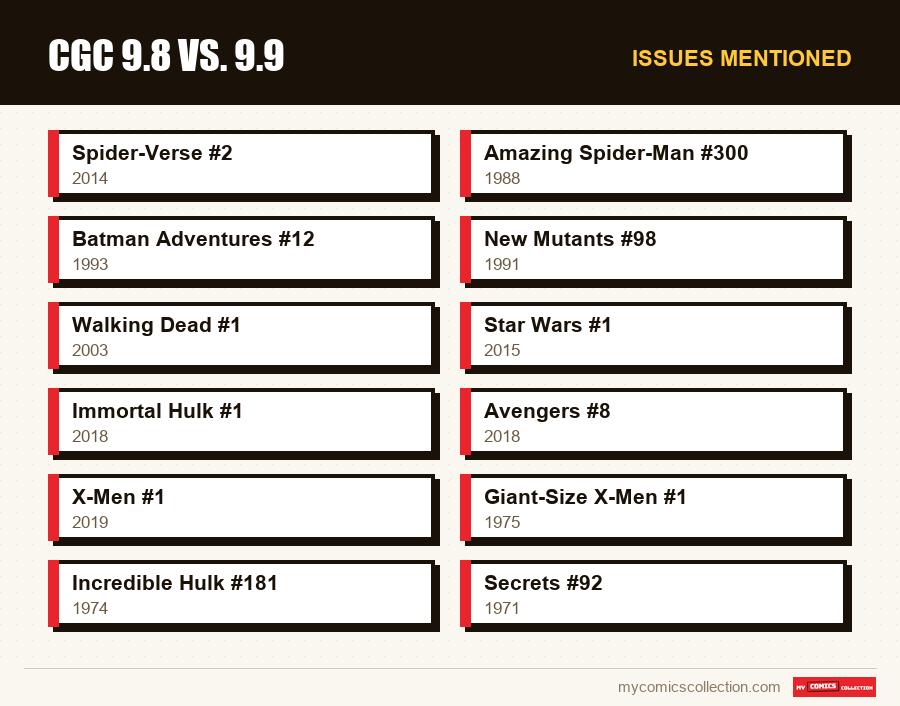
Concrete cases: 9.8 vs. 9.9 multipliers on 12 emblematic issues (2025-2026)
The reference table that follows summarizes the gaps observed in public sales (eBay completed listings, GoCollect, Heritage, ComicConnect) between January 2025 and April 2026. Values are expressed in U.S. dollars.
Amazing Spider-Man #300 (1988, first full appearance of Venom): CGC 9.8 valued at $2,400, CGC 9.9 last public sale at $64,000 (26x multiplier, 9.9 census = 38). Batman Adventures #12 (1993, first Harley Quinn): 9.8 at $1,800, 9.9 at $38,000 (21x, 9.9 census = 17). New Mutants #98 (1991, first Deadpool): 9.8 at $2,100, 9.9 at $95,000 (45x, 9.9 census = 14). Walking Dead #1 (2003 first print): 9.8 at $3,200, 9.9 at $78,000 (24x, 9.9 census = 22).
On the ultra-moderns: Star Wars #1 (Marvel 2015) Skottie Young variant cover: 9.8 at $380, 9.9 at $4,200 (11x, 9.9 census = 28). Immortal Hulk #1 (2018): 9.8 at $120, 9.9 at $1,800 (15x). Avengers #8 (2018, first Starbrand reboot): 9.8 at $95, 9.9 at $580 (6x). X-Men #1 (2019 Hickman): 9.8 at $85, 9.9 at $420 (5x).
On Bronze Age books, the gap compresses: Giant-Size X-Men #1 (1975): 9.8 at $28,000, 9.9 at $110,000 (just 4x, 9.9 census = 3 against 14,000 at 9.8). Incredible Hulk #181 (1974): 9.8 at $32,000, 9.9 nonexistent in the public census: the theoretical premium would top 50x, but the book has never traded publicly. House of Secrets #92 (1971, first Swamp Thing): 9.8 at $14,000, 9.9 at $42,000 (3x).
These multipliers shift month to month with market pressure. The 2026 sleeper issues roundup documents the issues where the 9.9 premium is just starting to climb without having exploded yet: a tactical window for forward-looking buyers.
When the 9.9 premium absolutely isn't worth the markup
Three setups make a 9.9 purchase economically absurd for a mid-budget collector. First, mass-print-run non-keys. An Amazing Spider-Man #350 at 9.9 costs $320 against $28 at 9.8 (11x multiplier), but the 9.9 has no liquidity whatsoever: no fund, no investor is scouring for this issue. On resale through Catawiki or eBay, the buyer will struggle to clear $180, a roughly 44% markdown within a few months. The premium paid will never be recovered.
Second, "late wave" variant covers of modern titles. Marvel and DC pile on 1:25, 1:50, 1:100, and 1:500 variants for their launches. Many reach 9.9 easily because the limited print run circulated in stores with cardstock protection from day one. The 9.9 census climbs to 40, 60, 100 copies within months. The scarcity vanishes. The 9.8/9.9 multiplier drops below 1.5x, and the 9.9 even loses value if the title disappoints critics and readers. The vintage vs. modern strategy guide details this risk.
Third, comics where the cover matters more than the state. On Bronze Age books, fans often hunt for a striking cover in 8.0-9.4 rather than a near-pristine 9.9 with a faded intro page. The market then values visual appeal over technical rigor. Buying a Spider-Man #129 (1974, first Punisher) at 9.9 for $95,000 when the 9.4 costs $18,000 and looks identical from a meter away is fund-grade arbitrage, not the joy of collecting. The grading analysis by publisher on Spider-Man illustrates this tension between value and visual.
Finally, the re-grading risk. A 9.9 bought for $5,000 can, on a second CGC submission five years later, come back at 9.8 worth $800. That drop represents an 84% loss. Cautious collectors keep their 9.9 in its original slab without attempting a re-holder, but the secondary buyer of an aging slab factors this risk into their purchase price, creating a progressive discount on older, un-revalidated 9.9s.
The CGC census: making sense of the numbers title by title
The CGC census, publicly accessible at cgccomics.com, records every copy graded to date by title, edition, and grade. It's the benchmark for assessing the 9.9 premium. Three metrics matter: the absolute 9.9 census (raw copy count), the 9.9/9.8 ratio (relative scarcity), and the quarterly trend (census growth signaling possible saturation).
On post-2010 modern Marvel books, the average 9.9 census ranges between 10 and 80 copies for recognized keys. Star Wars #1 (Marvel 2015) shows 28 copies at 9.9 against 9,400 at 9.8: a 1:336 ratio. Spider-Gwen #1 (2015) comes out to 41 at 9.9 against 6,200 at 9.8: a 1:151 ratio. Saga #1 (Image 2012) tops out at 17 at 9.9 against 3,800 at 9.8: a 1:223 ratio. The tighter the ratio, the more the premium is justified in terms of pure scarcity.
On modern DC books, the numbers stay comparable. Detective Comics #880 (2011, the cult Jock cover) shows 22 at 9.9 against 4,800 at 9.8: a 1:218 ratio, average premium 12x. Batman #1 (2011 New 52) shows 38 at 9.9 against 12,000 at 9.8: a 1:316 ratio, just a 7x premium because the title drew heavy submissions while speculative demand stayed measured.
On Image Comics and independents, the 9.9 census can climb proportionally higher because initial print runs are more modest. Walking Dead #1 (2003 first print) shows 22 at 9.9 against 1,800 at 9.8: a 1:82 ratio, 24x premium. The absolute scarcity (22 copies) stays low even if the ratio looks less extreme. It's this absolute scarcity that determines resale liquidity: under 30 known 9.9 copies, every public sale creates a market event and a new reference price. The most expensive comics ranking 2026 tracks these record sales.
International collectors should consult the census before any 9.9 purchase over $1,000. A rapidly growing census (jumping from 8 to 24 copies in six months) signals that a cohort of high-end 9.8 copies has been pressed and resubmitted. The premium could contract by 40 to 60% over the following 12 months.
Collecting this series?
Track what you own, what you are missing and what your collection is worth. 7 day trial.
Start my trial →Arbitrage strategies from 9.8 to 9.9: press or resubmit?
A collector who owns a comic graded CGC 9.8, raw or slabbed, may consider an upgrade strategy toward 9.9. Three routes exist: professional pressing, direct resubmission, and crack-and-resub. Each carries a cost and a risk that must be weighed against the expected premium.
CGC pressing (~$25-50 per copy at approved providers) corrects surface defects: handling creases, ripples, minor transfers. On a borderline 9.6 or 9.8, a well-executed press can gain half a point: moving 9.8 → 9.9 or 9.6 → 9.8. The success rate runs between 15 and 35% depending on the initial defect. For a comic whose 9.8 is worth $300 and whose 9.9 is worth $4,000, the expected value of a press at a 25% success rate and $40 cost is positive: (0.25 × $4,000) + (0.75 × $300) - $40 = $1,185 against $300 to start. The arbitrage holds.
Direct resubmission without pressing costs $25 to $150 depending on the CGC tier chosen (Modern, Economy, Standard, Express). It exploits the residual subjectivity of grading: two graders may assign 9.8 and 9.9 to the same book depending on how they read borderline defects. The upgrade rate on resubmission alone is estimated at 8-12%. On a 9.8 worth $300 with a 9.9 at $4,000, the expected value stays positive but marginal: (0.10 × $4,000) + (0.90 × $300) - $50 = $620 against $300. The breakdown of CGC tiers and pricing helps you size the budget.
The crack-and-resub (cracking the comic out of its existing slab, fully resubmitting it) adds a risk: handling can create a new defect. This route is only worth considering on books where prior pressing delivers a substantial visual gain. For books already perfectly preserved in their slab, the risk of damage often outweighs the potential gain. Savvy collectors only crack-and-resub borderline 9.6s toward 9.8 or borderline 9.8s toward 9.9, never clean 9.8s aiming for 10.0: the 9.9/10.0 gap on the majority of titles doesn't justify the risk.
On the selling side, presenting a 9.9 on the European market requires the right channel. Catawiki accepts 9.9 books, but the audience stays limited for transactions above $5,000. Heritage Auctions and ComicConnect draw international bidders and set reference prices. eBay remains viable for 9.9s under $2,000 with international offers enabled. For a preliminary estimate, the free appraisal lets you calibrate your asking price before listing.
FAQ: CGC 9.8 vs. 9.9 and the Mint grade premium
Is a CGC 9.9 always worth more than a 9.8?
On graded comics that trade actively, yes: the 9.9 consistently sits above the 9.8 because it's a strictly higher grade on the CGC scale. The premium, however, ranges from 1.3x to over 50x depending on key status, age, and census scarcity. On mass-print-run non-keys (Amazing Spider-Man #200-400 outside keys, X-Men #150-300 outside keys), the 9.9 trades for 3 to 10 times more but with no real liquidity: a seller can list it at $350 against a 9.8 at $35, yet won't easily find a buyer. On actively traded modern keys, the 9.9 reaches its full premium value. To calibrate these gaps, the public CGC census remains the most reliable data point.
Why is the CGC 9.9 rarer on moderns than on Bronze Age books?
Paradoxically, recent comics suffer more industrial defects than Bronze Age books, despite theoretically better storage conditions. Modern print runs use a glossy paper sensitive to micro-scratches, sometimes imprecise stapling techniques, and Diamond carton packaging that can create color transfers during transport. By contrast, Bronze Age survivors at 9.8-9.9 have already passed a fifty-year filter: the ones that remain were stored impeccably. The 9.9/9.8 ratio on Bronze Age books often exceeds 1:200, against 1:300 to 1:1,000 on moderns. The pure scarcity of the modern 9.9 is therefore more extreme in absolute terms on recent mass print runs.
Should you buy at CGC 9.9 if the price gap exceeds 20x the 9.8?
It all depends on your profile. A passion collector chasing aesthetic enjoyment will find little visible difference between a 9.8 and a 9.9: the markup brings no emotional payoff. An investor seeking a status piece for their CGC registry or a fractional asset (Rally, Otis) will find the gap justified because high liquidity rewards top-grade scarcity. A reseller betting on capital gains within two years should check the census: if fewer than 25 9.9 copies exist and the title is gaining recognition (a Disney+ adaptation, an MCU film), the premium can still double. Beyond 30 copies in the census, the scarcity effect weakens and the premium stabilizes.
Is a CGC 10.0 worth much more than a 9.9?
The CGC 10.0 "Gem Mint" stays exceptional: fewer than 5 copies on most titles, often zero. When a 10.0 exists and sells publicly, the premium over the 9.9 ranges between 2x and 8x. On Edge of Spider-Verse #2, the 10.0 cover A sold for $28,000 against $4,200 for a recent 9.9: a 6.6x multiplier. The absolute scarcity of the 10.0 creates a premium, but the 9.9 → 10.0 gap stays less violent than 9.8 → 9.9 on modern keys, because institutional investors often treat 9.9 and 10.0 as a single "top grade" category. On Bronze Age books, the 10.0 is nearly theoretical: no Hulk #181, no Giant-Size X-Men #1 has reached that grade in the public census.
Can a CGC 9.9 lose value?
Yes, in several scenarios. If the 9.9 census grows quickly (the pressing-and-resub effect of a 9.8 cohort), the premium contracts. If the title loses recognition (a canceled film adaptation, a scandal around the creator), speculative demand collapses even on top grades. If the CGC slab ages and a re-holder downgrades the 9.9 to 9.8, the book loses 80 to 95% of its value. Finally, the overall graded comics market moves in cycles: the 2020-2021 bubble saw some 9.9s lose 40 to 60% in 2022-2023 before stabilizing. A 9.9 is not a risk-free asset, contrary to what its apparent scarcity might suggest.