
For a Spider-Man comic, grading refers to professional grading by a third-party organization (CGC, CBCS or PGX) on a scale of 0.5 to 10.0, followed by a sealed clamshell (slab). CGC, founded in 2000, largely dominates the market and serves as a price reference; CBCS, launched in 2014-2015 by former CGC chief grader Steve Borock, additionally grades page quality separately; PGX, active since 2002, remains the third option but its notes are sold at a discount of 30 to 50% compared to CGC. On Spider-Man keys (Amazing Fantasy #15, Amazing Spider-Man #1 or #129), the difference between two rating notches can represent several thousand euros.
Grading a Spider-Man comic is not trivial. Unlike a simple visual estimate, grading transforms an item into a standardized financial object: a quantified note, a tamper-proof shell, a certification number that can be consulted online, and above all traceability which reassures the end buyer. For the character's iconic keys: the first appearance in Amazing Fantasy #15 (1962), the launch of his own series with Amazing Spider-Man #1 (1963), or later milestones like the Punisher's first appearance in Amazing Spider-Man #129 (1974): this difference in treatment can multiply the resale value by two, three, sometimes more between a raw copy and its high-grade equivalent.
But not all grading companies are created equal, and choosing the right organization directly determines what the market will be willing to pay. This guide details how CGC, CBCS and PGX actually work, their history, their rating scales, and gives numerical benchmarks from public censuses (population registers) to understand why a 9.8 is never "just a little better" than a 9.6.
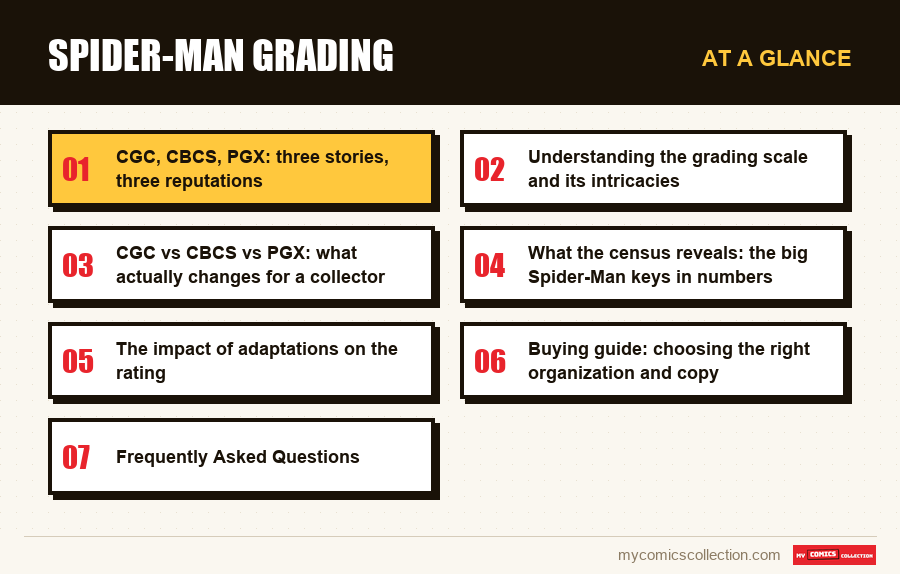
CGC, CBCS, PGX: three stories, three reputations
Certified Guaranty Company, better known by its acronym CGC, opened its doors in 2000 in Sarasota, Florida, and graded its first comics at the very beginning of the 2000s. In a quarter of a century, the company has become the essential reference on the market: on comics sold above 200 dollars, the vast majority of transactions are today on certified copies, and the CGC rating serves as a common language between sellers and buyers, sales rooms to online marketplaces.
CBCS (Comic Book Certification Service) was born a few years later, between 2014 and 2015, under the leadership of Steve Borock, who was for a long time the chief grader and public face of CGC before joining Heritage Auctions and then founding his own structure alongside Dr. Michael Bornstein and his son Alec. The company stands out from the outset by a more transparent approach to the rating process and by an important technical detail: the quality of the pages (Page Quality, or PQ) is evaluated and displayed separately from the overall rating, while CGC integrates it more discreetly into its final verdict. CBCS was acquired by Beckett Media in 2018, giving it access to a broader business structure without fundamentally changing its rating methodology.
PGX (Professional Grading eXperts) is the third significant option on the market, active since 2002. Its reputation remains more fragile: the secondary market traditionally applies a discount of 30 to 50% on a PGX grade compared to an equivalent CGC grade, the result of a history of gradings perceived as too generous by collectors and experts. For a valuable Spider-Man copy, having it graded at PGX rather than CGC can therefore represent a substantial shortfall at the time of resale, even if the case itself remains a minimal guarantee of authenticity and physical protection.
Understanding the grading scale and its intricacies
The CGC rating is based on a decimal scale ranging from 0.5 (Poor, the most degraded state) to 10.0 (Gem Mint, absolute perfection), with around twenty intermediate notches. The 10.0 mark is reserved for less than 0.1% of comics submitted: in fact, a Spider-Man copy in 10.0 is a statistical anecdote, with most of the top seeds peaking at 9.8 or 9.9. CBCS and PGX use comparable numerical scales, but the gap in market perception between the organizations means that a 9.8 CGC and a 9.8 CBCS never trade at quite the same price: experienced buyers know how to read beyond the simple number displayed on the label.
Two notches that seem close on paper: say 9.0 and 9.8: can actually represent a world of difference in terms of rarity and value, particularly on Silver Age and Bronze Age titles where newsprint ages poorly. Our detailed comparison CGC 9.0 vs 9.8 explains why this last half-point can weigh more heavily in the rating than all the previous notches combined, a phenomenon particularly marked on the most sought-after Spider-Man keys.
Beyond the rating, the CGC label has a color that indicates the status of the comic. The classic blue label ("Universal") signs an unrestored copy. The purple label certifies a restored comic: addition of color, replacement of missing fragments, reinforcement of the spine, chemical cleaning. The restoration itself is graded on two axes, the type of intervention (Apparent A for amateur work, Apparent P for professional work) and its intensity (light, moderate or significant). This purple label mainly concerns old comics, where restoration was a common practice before the market became professional; it remains rare on Spider-Man publications after the 1980s, with most modern examples submitted for grading being unrestored.
CGC vs CBCS vs PGX: what actually changes for a collector
The choice between the three organizations is not limited to a question of bid price. CGC will offer several levels of service in 2026: the Modern level at $28 per comic (comics after 1975, declared value up to $400, delivery time of 8 to 12 months), the Economy level at $35 (comics before 1975, same value ceiling, delivery time of 12 to 18 months), the Standard level at $65 (declared value up to 1 000 dollars, delay of 4 to 6 months), the Express tier at 130 dollars (up to 3,000 dollars, delay of 2 to 3 months), and finally the Walkthrough tier from 700 dollars, without value cap, processed in 5 to 10 working days. These prices, revised at the beginning of January 2026, apply to any submission form completed from January 6, 2026.
CBCS practices a generally comparable price scale on its standard tiers, often slightly lower than that of CGC on the entry-level tiers, which makes it an attractive option for grading modern copies of Spider-Man without aiming for immediate resale at high grades. But the downside of this accessibility can be seen on the secondary market: a CBCS 9.8 rating is sold on average 15 to 25% less than a CGC 9.8 rating on the same number, a difference that buyers systematically take into account when comparing two advertisements with identical ratings.
This differential is not arbitrary: it reflects the age of the census system, the depth of the secondary market for each hull brand, and the trust accumulated by institutional buyers (auction houses, specialized platforms) towards each organization. For a Spider-Man copy intended for a medium or long-term investment, CGC therefore remains the most liquid default choice, even if it means accepting a longer processing time or a higher price.
Signature Series and dry cleaning: the additional services that matter
Beyond the raw grade, CGC offers a Signature Series label (often abbreviated SS), which certifies that a signature affixed to the comic was made in person by its author in front of an approved CGC witness, generally during a convention. An Amazing Spider-Man copy signed by a screenwriter or historical artist of the character thus benefits from much greater traceability of authenticity than a simple uncertified dedication, which almost systematically results in a price premium at the time of resale. CBCS offers an equivalent service under the name Verified Signature Program. On old and rare copies like Amazing Fantasy #15, an SS-certified Stan Lee signature remains one of the rare levers capable of increasing the value of a copy of equal grade.
Another practice to know before any submission: dry cleaning. This mechanical process, offered by independent workshops or directly upstream via certain CGC and CBCS partners, consists of ironing out the folds and slight deformations of a comic without intervening on its chemical composition: unlike restoration, which remains prohibited in dry cleaning under penalty of automatically switching to the purple label. Successful pressing can save half a point, sometimes a full point, on the final score of a Spider-Man copy with superficial handling creases, without this being considered an alteration within the meaning of the label. This is a common step before submitting Bronze Age or Modern Age examples whose condition borders on a notch higher.
Collecting this series?
Track what you own, what you are missing and what your collection is worth. 7 day trial.
Start my trial →What the census reveals: the big Spider-Man keys in numbers
The CGC census (the public register which lists, copy by copy, each rating assigned to a given title) makes it possible to very concretely measure the real rarity of high ratings on Spider-Man keys. Three examples are enough to illustrate the extent of the differences.
Amazing Fantasy #15 (1962), first appearance of Spider-Man, had 4,140 copies in the CGC census as of November 24, 2025. Of this total, the highest score ever reached remains 9.6: four copies in the Universal label plus one copy in the Signature Series signed by Stan Lee. No copy ever reached 9.8 of this seminal issue, which gives an idea of the fragility of the paper of the time and the intensity of the demand for the rare copies near the top: one copy rated 8.5 sold for more than $500,000, a record for that specific grade.
Amazing Spider-Man #1 (1963), which launches the monthly series of the character, had 4,692 copies in the census as of June 20, 2023. Only five copies are rated 9.6, and only two are rated 9.8: the maximum rating ever assigned to this issue. Two copies out of nearly 4,700, this represents a tiny fraction of the total, and explains why the rare transactions on these two copies systematically make the news on the collectible comic market.
Amazing Spider-Man #129 (1974), first appearance of the Punisher (and the Jackal), illustrates a different profile: as of May 4, 2021, the census recorded 11,635 copies in the Universal label, including 143 in rating 9.8, with no copy above. The number is therefore much more common than the two previous ones in general circulation, but the fraction in almost perfect condition also remains limited to approximately 1.2% of the graduated total. A 9.8 blank page copy sold for $33,600 at Heritage Auctions on May 2, 2021, a record for this issue at the time.
Before any purchase of an already graded copy, it is also recommended to check the certification number displayed on the label directly on the website of the organization concerned: CGC and CBCS provide an online verification tool which displays the official grade, the title and the number of the comic associated with this certificate. This verification takes a few seconds and eliminates the rare but real risk of a falsified or reused label on a copy different from that initially graded.
These three cases show that there is no single rule: the rarity of a high grade depends on the age of the paper, the original edition and the behavior of collectors at the time of publication. Before any submission for grading, consulting the census of the title concerned remains the best way to objectively estimate your chances of obtaining a grade that justifies the cost and time of the process.
The impact of adaptations on the rating
Spider-Man cinematic releases have a measurable, albeit temporary, effect on buyers' appetite for graded comics. The release of Spider-Man: No Way Home on December 17, 2021 is the most recent and most documented example: the film generated $253 million in North American revenue from its opening weekend, an absolute record for the pandemic period, driven by the return of several incarnations of the character and his historical adversaries on screen. This massive media exposure coincided with a peak in general interest in Spider-Man comics at the end of 2021, a movement typical of the entire collectible market in this post-containment period, before a gradual decline in the most speculative valuations in the following months.
This pattern is not specific to No Way Home: each major release linked to the character tends to temporarily revive attention to the original comics, without guaranteeing a lasting increase in the rating of graded copies. The issues which retain their value over the long term remain those whose rarity is structural (low original circulation, low survival rate in high grades) rather than those which benefit from a simple current effect. This is an essential distinction for anyone considering grading a copy in the hope of taking advantage of a media peak: grading takes several months, plenty of time for the current hype to die down.
Buying guide: choosing the right organization and copy
- For a Spider-Man Silver Age or Bronze Age copy (Amazing Fantasy #15, Amazing Spider-Man #1 to approximately #150), systematically favor CGC: the depth of the census and the liquidity of the secondary market more than compensate for the higher price.
- Consult the census of the targeted title before submitting a copy: if the historical maximum score caps at 9.6 like on Amazing Fantasy #15, aiming for a 9.8 is an illusion and wastes submission fees.
- Systematically check the color of the label on any ad: a purple label indicates a restoration, information which must necessarily lower the price compared to a blue label of identical rating.
- On a modern example with a low declared value, CBCS can represent an interesting economic option, provided you accept the resale discount of 15 to 25% compared to an equivalent CGC note.
- Be wary of a PGX rating displayed without context: systematically ask for high-resolution photos of the copy under shell, as the market discount can reach 50% compared to CGC.
- Always compare the displayed price to the rating AND to the organization: a CGC 9.0 and a CBCS 9.8 can be negotiated at close price levels despite the apparent difference in rating.
- To organize and monitor the valuation of your collection of graduated Spider-Man comics over time, our collection management application allows you to centralize notes, labels and estimates.