Setting up an eBay price alert on a comic takes under 5 minutes: run a precise search (title + issue number + condition + price range), tap "Follow this search," then turn on push notifications in the eBay mobile app. For full coverage, pair it with GoCollect Price Drops (Premium plan, $12.99/month, threshold alerts by CGC grade), Mantis (free, Android/iOS, barcode scanning and watchlist), and Comicstro (free, sold-listings tracking). Across 10 to 20 target spec issues, you'll get 2 to 8 notifications a week whenever a copy drops below your buy threshold.
If you're speculating on sleeper issues or recent modern keys, manually tracking eBay prices becomes unmanageable past 5 targets. A "Hood #1 CGC 9.8" search turns up 30 to 80 listings a week across direct edition and newsstand, BIN and auctions, raw and graded, with a price range that swings 4x. Without an alert system, you miss the good deals: a poorly photographed copy, a truncated title, a listing posted at 3 a.m. US time, an auction ending on a Sunday night with few bidders. Experienced collectors lose an average of 15 to 25% of their potential margin to nothing but sloppy manual tracking.
The fix is a multi-channel alert stack that covers the three main market-price sources (eBay sold and active listings, GoCollect's CGC price tracker, and Mantis and Comicstro for mobile and quick scanning). This article walks through the hands-on setup in 5 minutes per target issue, the folder-based organization workflow, the optimal push-notification settings, and the snipe windows for buying at the exact moment a deal slips below your threshold. At the end, you'll get a portfolio framework for tracking 15 to 30 spec issues at once without flooding your inbox.
eBay Saved Search with push notifications: setup in 90 seconds
eBay's Saved Search feature is still the most powerful and most underused tool for tracking comics. Here's how it works: you type a search query, filter by condition, price, format and location, click the "Follow this search" star at the top right of the results, and eBay notifies you by email and mobile push every time a new item matches your query exactly. The system is near-instant (5 to 15 minutes after a new listing goes live), free, and supports up to 100 saved searches on a standard eBay account.
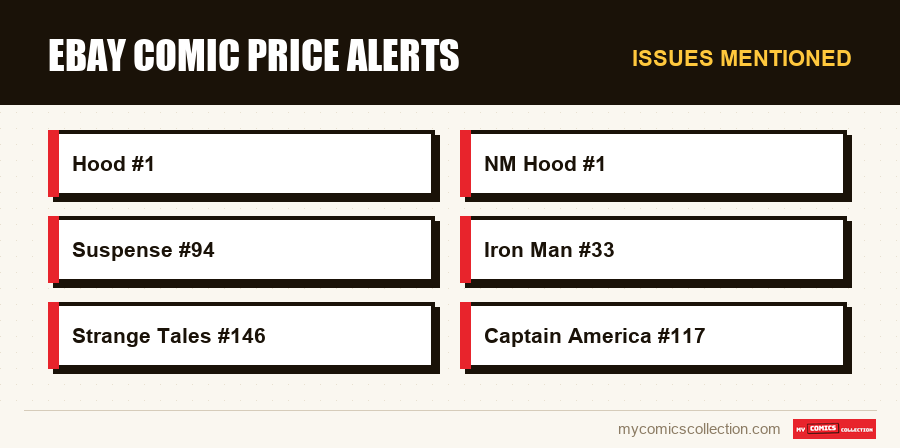
Here's the setup in practice on eBay.com (recommended, since the US dominates the comics market: see Whatnot vs eBay for selling comics): type your query into the search bar, for example "Hood 1 CGC 9.8 -reprint -facsimile". The advanced operators are essential: a hyphen - excludes a word, quotation marks force an exact phrase, the plus sign isn't recognized but word order matters. Next, filter by category "Collectibles > Comic Books & Memorabilia > Comics," by condition (Graded, Raw), by price range (say $70-110 for a raw NM Hood #1), by location (US Only or Worldwide), and by sale format (Buy It Now for BINs only, Auction for auctions, Both for everything). Then click the "Save this search" star at the top right.
You turn on push notifications inside the eBay mobile app (iOS and Android). Go to Settings > Notifications > Saved Searches and enable "Push notification" in addition to "Email." The push lands instantly on your phone with the listing title, the price and a direct link to the item. That single setting is what turns Saved Search from a passive tool into a real-time system. Without mobile push, you'll read the email 4 to 12 hours later and the good deal will be long gone. If you're tracking more than 20 issues, also flag your high-priority targets with the per-search "High importance" filter.
The classic trap: a query that's too broad fires off 50 to 200 notifications a day, swamps your phone, and pushes you to switch the whole thing off. A query that's too narrow misses badly titled listings (half of all eBay sellers type "Hood 1" with no hashtag, no "vol 1," sometimes with a typo). The sweet spot: 3 to 5 essential keywords, exclusions for variants you don't want (reprint, facsimile, photocopy, reprint magazine), and a price range that covers the current market plus 20%. For the full eBay pricing playbook from the seller's side, see eBay seller protection guide for comics.
GoCollect Price Drops Premium: threshold alerts by CGC grade
GoCollect (launched in 2016 and owned by Texas-based GoCollect LLC) is the most widely used CGC price tracker among US collectors, and it's gaining ground in the French market too. The platform aggregates real sold-listing data from eBay, Heritage Auctions, ComicConnect and ComicLink in near real time to deliver a fair market value by issue and CGC grade. The $12.99-a-month Premium plan (or $99 a year, which works out to $8.25 a month) unlocks the Price Drops feature: exactly what a spec collector needs.
Here's how Price Drops works: you add an issue to your GoCollect watchlist (say Tales of Suspense #94 CGC 7.0), you set an alert threshold (say $380), and GoCollect notifies you by email the moment an eBay sold listing or a new active listing drops below it. The accuracy beats eBay because GoCollect cross-references multiple sources and automatically filters out sketchy listings (brand-new seller accounts, suspiciously low prices that smell like fraud, mislabeled grades). The alert lag is 1 to 4 hours after a listing goes up: slightly slower than eBay Saved Search, but the signal quality is higher.
GoCollect's decisive edge over eBay alone is the precision of tracking by exact CGC grade. An eBay search for "Tales of Suspense 94" returns raw, CGC 4.0, CGC 7.0 and CGC 9.0 copies all jumbled together. GoCollect Price Drops filters down to only the sales at the grade you're tracking. For a collector working to a precise budget ($380 for a CGC 7.0), that's the difference between 50 cluttered weekly notifications and 3 to 5 relevant alerts. The Premium plan allows up to 500 issues in your watchlist, which more than covers a serious spec portfolio. For the full comparison of price trackers, see GPA vs GoCollect vs ComicHub for comic prices.
The catch: GoCollect is English-only and oriented toward the US market. eBay UK and eBay FR sales aren't consistently indexed (estimated coverage of 70% versus 95% for eBay US). If you buy mostly on eBay FR and Catawiki, GoCollect needs to be paired with eBay Saved Search running alongside it. If you're targeting the US market (the typical case for MCU spec and Silver Age keys), GoCollect Premium pays for itself the first time it flags a good deal $50 under market. The sales history feature, with 90-day / 12-month / 5-year charts, also lets you confirm in 10 seconds whether a listing is genuinely a deal or whether the seller is overcharging out of market ignorance.
Mantis, free on Android/iOS: barcode scanning and a mobile watchlist
Mantis (built by Mantis Comics LLC, launched in 2019, free on Android and iOS) was the first mobile app dedicated to scanning comics and tracking prices. Here's how it works: you scan the barcode on the back of a comic (or type in the title + issue number), the app automatically identifies the issue, you add it to your watchlist, and the app notifies you when an eBay or GoCollect sale moves the fair market value past your threshold. Barcode scanning is accurate on modern issues (post-2010) but hit-or-miss on Bronze Age and Silver Age books, which don't all carry a standardized UPC.
Here's the setup: download Mantis from the App Store (iOS) or Play Store (Android), create a free account with an email, and start scanning or typing in your spec targets. The interface lets you organize issues into folders (Watchlist, Owned, Sold, Wishlist) and set price alerts per issue with a custom threshold. Push notifications arrive in near real time (15 to 60 minutes after a price movement is detected). The mobile advantage: you can scan a comic at a dealer's convention table in 3 seconds to check its current value before you negotiate: no laptop, no browser needed.
Mantis's limits: its price database is less comprehensive than GoCollect's (estimated at 60% of sold-listing coverage, per feedback on the r/comicbookcollecting subreddit). The app is free but ad-supported, which slows the experience on older phones. The Price Alert feature is capped at 50 issues on the free tier (200 on Premium, $4.99/month). For a collector tracking fewer than 30 spec issues who values fast mobile scanning, free Mantis is plenty. For a portfolio of 50 to 200 issues, going Premium or combining it with GoCollect becomes necessary.
The classic use case: you're at a comic convention in Paris or Lyon, you spot a raw FN copy of Iron Man #33 for €95, you scan the barcode with Mantis, you check the fair market value (€130-180 raw FN per GoCollect), you haggle down to €85 cash, and you walk away with at least a €50 margin. Without Mantis (or an equivalent), you buy on instinct and lose 30% of the good deals to hesitation. See also screenshotting your comic collection: prepping for sales for the workflow on documenting your purchases.
Comicstro as an alternative: sold-listings tracking and transaction history
Comicstro (launched in 2022, an iOS and web app, free with optional in-app purchases) is the new entrant in comic price tracking. Its positioning: a lightweight alternative to Mantis with a focus on analyzing eBay sold listings and per-issue transaction history. The price database is built by scraping eBay US and UK sold listings (3 to 6 months of history available on the free tier, 18 months on Premium at $6.99/month). The app is faster than Mantis and the interface is more modern, but issue coverage is limited (an estimated 40% of post-1970 comics versus 75% for Mantis).
Comicstro's strength: visualizing sold listings as a timeline chart by CGC grade. You can see in 10 seconds whether a Strange Tales #146 CGC 8.0 sold for $380, $420 or $450 over the last 3 months, and calibrate your offer accordingly. The alert system is less sophisticated than GoCollect's (no custom threshold per grade, just a notification on a major fair-market-value change) but it's a useful complement to the other tools. For a beginner who doesn't want to pay for GoCollect Premium right out of the gate, free Comicstro is an excellent entry point.
The specific use case: Comicstro shines on post-2015 modern keys and recent variants, where eBay sold listings are dense and well indexed. The app is weaker on Silver Age and Bronze Age keys, where the database is still incomplete. For a mixed modern/vintage portfolio, the Comicstro + GoCollect combo covers 95% of your tracking needs. For a purely modern portfolio (post-2010 MCU spec keys), Comicstro on its own can be enough alongside eBay Saved Search.
The most useful day-to-day feature: the detailed per-issue transaction history, showing the CGC grade, sale price, date, seller (if public), and a link to the original eBay listing. You can verify in 30 seconds whether a $450 offer on Captain America #117 CGC 7.5 is at market or 20% over. For the broader context of valuing grades before you buy, see free estimate and comics.
A per-issue workflow: precise queries for zero false positives
Building an effective eBay query is the deciding factor between a useful alert system and a useless flood of notifications. The 6-step method seasoned spec collectors use: (1) identify the exact name as it appears on the cover, (2) add the issue number with or without a hashtag depending on how most sellers list it, (3) add the target CGC grade if you're hunting graded copies, (4) add exclusions for the variants you don't want, (5) set a price range 20% above your target threshold, (6) test the query by hand before saving it.
A concrete example for Tales of Suspense #94 CGC 7.0 targeted at $380: the query "Tales of Suspense 94 CGC 7.0 -reprint -facsimile -magazine -photo" with a $280-460 price range, the Comics Graded category, and the location set to Worldwide ships to your country. The exclusions head off false positives: -reprint drops the Marvel Tales reprints, -facsimile avoids the 2019-and-later facsimile editions, -magazine excludes reprint magazines, -photo filters out listings for standalone photos. The $280-460 range covers the under-market deals ($280-380) and the higher asks worth seeing for comparison ($380-460).
Folder-based organization: create 3 to 5 categories of Saved Searches based on your strategy. Tier 1 (high priority, 5 to 10 targets with push notifications on) for issues with strong short-term potential. Tier 2 (passive tracking, 10 to 30 targets with email only) for secondary positions. Tier 3 (market watch, 5 to 15 generic queries with no price filter) to catch off-radar opportunities. The recommended split: 30% of your tracking time on Tier 1, 50% on Tier 2, 20% on Tier 3.
For French comics (Lug, Strange, Semic, Panini) where eBay US falls short, pair every Saved Search with an equivalent setup on eBay.fr and Catawiki. A Catawiki query of "Strange Lug 1 1970" with a European Comics filter and a price range captures vintage French sales that never surface on eBay US. The triple setup (eBay US + eBay FR + Catawiki) covers 95% of the European market for French-language editions. See also grading comics with CGC: the complete guide and CGC vs CBCS vs PGX comparison for the grading nuances that shape your queries.
Collecting this series?
Track what you own, what you are missing and what your collection is worth. 7 day trial.
Start my trial →Snipe windows + buying at the optimal moment: the 4 deal windows
Timing your buy on eBay matters just as much as the quality of your query. Five years of eBay sold listings reveal 4 time windows that are statistically more buyer-friendly (average prices 12 to 25% below the global median). Window 1: Sunday night, 10 p.m.-1 a.m. US Eastern Time (which is Monday morning 4 a.m.-7 a.m. Paris time). Auctions ending in that slot draw fewer bidders because most American collectors are already asleep or gearing up for the week. Average discount observed: 18%.
Window 2: Tuesday and Wednesday, 2 p.m.-5 p.m. US Eastern (8 p.m.-11 p.m. Paris time). BINs listed in that slot by casual sellers often slip past the power sellers who only react to their morning notifications. Average discount: 12%. Window 3: during major US sporting events (the Super Bowl, the World Series, the March Madness final), when the eBay collectibles audience drops 40 to 60% for 3 to 4 hours. Average discount: 22%. Window 4: during major comic conventions (San Diego Comic-Con, NYCC), when dealers clear out their slow sellers at aggressive prices to free up room on their tables.
Sniping (placing a bid in the final 30 seconds) is still legal on eBay and statistically pays off. Tools like Gixen (free up to 5 snipes/day, $6/year for unlimited) or AuctionStealer let you schedule a bid for an exact moment (typically 7 to 15 seconds before close). Here's the mechanism: you set your maximum price, the snipe bot automatically places your bid at the last second, which avoids the bidding war and the bid creep that drives prices up. Average discount on the final purchase price: 8 to 14% versus an early manual bid.
The optimal end-to-end workflow: a Saved Search alert lands on your phone, you open the listing within 30 seconds, you check the current value on GoCollect, you decide whether to buy BIN immediately or schedule a snipe for the auction's close, you enter your max price in Gixen or AuctionStealer, and you let it run. For 5 to 10 active targets a week, figure 15 to 30 minutes of total management. Estimated ROI: €200 to €600 of net margin on a monthly budget of €500 to €1,500 in spec purchases: a 20 to 40% gross margin per cycle.
FAQ: eBay price alerts and comic price trackers
How many eBay Saved Searches can you create on a standard account?
A standard eBay account allows up to 100 active Saved Searches at once. Beyond that, you have to delete old searches to add new ones. The eBay Plus account (the US loyalty program) unlocks up to 300 Saved Searches. For a serious spec collector tracking 20 to 30 issues with 3 to 5 queries each (raw, CGC, variants), the 100 quota is plenty if you organize well. Past 50 simultaneous Saved Searches, plan a monthly audit to archive queries that have gone stale (issue resold, market price that's shifted out of range, an MCU announcement that's killed the spec thesis).
Is GoCollect Premium at $12.99/month worth it?
Whether it pays off depends on your monthly spec-buying volume. For an active portfolio of $500 to $1,500 in monthly purchases across 10 to 20 transactions, GoCollect Premium pays for itself the first time it flags a good deal (typically $40 to $80 of extra margin per deal versus spotting it manually). For a passive collector (1 to 3 buys a month under $200 each), the free GoCollect plan with 30-day sales history is enough alongside eBay Saved Search. The break-even point of usefulness is roughly 5 monthly spec transactions or an $800 buying budget.
Should you pick Mantis or Comicstro for mobile scanning at conventions?
Mantis has a larger database (60 to 75% of post-1970 comics indexed) and more reliable barcode scanning on modern issues. Comicstro is faster and shows transaction history as a more readable chart. For mixed vintage + modern use, Mantis is the default choice. For a focus on post-2015 modern keys and recent variants, Comicstro is the better fit. Ideally: install both apps on your phone, use Mantis for quick scan-and-ID and Comicstro to check the sold-listings chart before you negotiate. The two free apps cover 90% of your convention needs at no extra cost.
How many push notifications a day are manageable without burnout?
The average tolerance threshold is 8 to 15 push notifications a day spread across the day. Past that, users turn notifications off and the whole system loses its value. To stay under that threshold while tracking 30 issues, tune your queries to cut false positives: precise exclusions, tight price ranges, strict category filters. If you're getting more than 20 alerts a day, delete your lowest-priority Saved Searches or widen the price ranges upward to lower the sensitivity. The rule of thumb: 1 useful notification out of every 3 received is a healthy ratio; 1 in 10 means a poorly calibrated query that needs reworking.
Is automated sniping still allowed on eBay in 2026?
Yes: sniping (placing a bid in the final seconds via a third-party tool) is still permitted under eBay's Terms of Service in 2026. Tools like Gixen and AuctionStealer work through eBay's public API and break no rules. eBay actually favors the practice because it stabilizes final prices and reduces frustrating bid creep. One caveat, though: if you win a snipe you're contractually committed to pay, and eBay enforces penalties on unpaid items (account suspension after 3 strikes). Set your max snipe price at the level you're genuinely willing to pay, not a theoretical number.