
In short
In November 1963, The Amazing Spider-Man #6 turned Dr. Curt Connors into the Lizard, courtesy of writer Stan Lee and artist Steve Ditko. He began as a one-armed scientist whose regeneration serum backfired, and he has stayed a tragic figure ever since. The turning points are the 1967 return in #44-45, Todd McFarlane's Torment in Spider-Man #1-5 (1990), and the Shed storyline of 2010, where his son Billy dies and the character changes for good.
The Lizard is a rare Spider-Man villain whose history is also a family history. The beast in the swamp is the smaller half of the story; the larger half is a husband and father who keeps losing ground to his own research. Reading him in order of publication shows how each generation of Marvel writers decided how much of Curt Connors to keep in the monster, and how much of the monster to leave in the man.
Every issue range, cover month and credit in this history was matched against published listings, from the swamp debut to the Morbius pages, the 1990 relaunch and the 2010 storyline. Where an era has no credit we could confirm, we name the issues and leave the creators out. The readings of why each turn matters, and the shelving advice, are our own analysis.
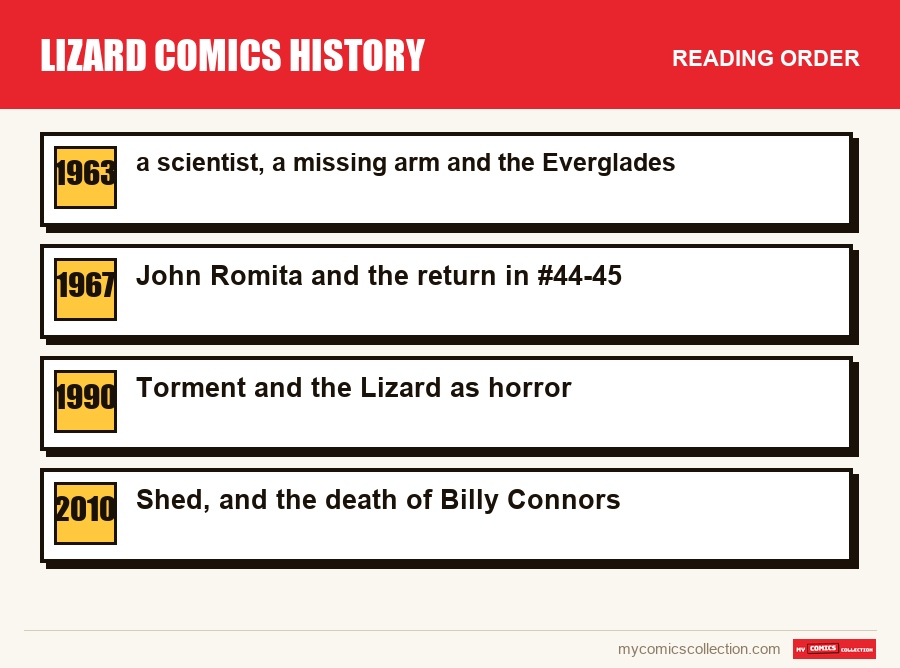
1963: a scientist, a missing arm and the Everglades
Issue #6 goes by "Face-to-Face With...the Lizard!" on the cover month of November 1963. Lee scripted it, and Ditko penciled and inked it. The setting is Florida, and the series leaves its New York rooftops for swamp country. Connors is a scientist who has lost an arm, and he is researching how reptiles regrow limbs.
What matters for the long run is the design of the trap. The serum works, since the arm comes back, and the price arrives with the result. Connors is not chasing money or power. He is trying to repair himself, and the repair produces a creature that wants none of his goals. Later writers keep returning to that inversion, because it lets the same character be a victim in one issue and a threat in the next. Spider-Man also wins with chemistry, using Connors's own notes to make an antidote, which sets the template for later rescues.
Doctor Octopus and the Sandman had arrived earlier in 1963, both villains with a grievance and a gadget. The Lizard adds a man who is the hero's ally by temperament. Our guide to #6 covers the issue itself, and the Steve Ditko hub lists his other work on the title.
1967: John Romita and the return in #44-45
More than three years pass before Connors comes back. The Amazing Spider-Man #44 and #45 appear in 1967, in the John Romita years of the title, right after Connors helps Spider-Man against the Rhino. Lee still scripted the book. The two-parter fixes the pattern that later Lizard stories follow: Connors experiments again, the Lizard emerges, and Peter has to save the person while stopping the animal.
It also changes the visual register. Ditko's Lizard lived in tangled shadow; Romita's is cleaner and closer to the Spider-Man most readers imagine. For a collector building a character run, the two looks are worth shelving side by side.
1971 to 1989: Morbius, guest turns and Inferno
The Amazing Spider-Man #100 to #102 form a three-issue stretch that goes beyond the Lizard. Issue #101 (cover dated October 1971) introduces Morbius, the Living Vampire, created by Roy Thomas and Gil Kane, and it is the first issue of the series not written by Stan Lee. In #101-102, Morbius meets the Lizard, and his blood reverts the creature to Curt Connors. The same sequence ends the storyline in which Spider-Man had grown extra arms, so Connors's laboratory sits at the center of a story that is mostly about someone else.
This is where the Lizard becomes a supporting character in the practical sense: a scientist who can help, and a monster who can complicate. Marvel Team-Up #19-20 pairs him with Ka-Zar and the Black Panther in a Stegron story, and The Amazing Spider-Man #165-166 has Stegron kidnap Billy, an early sign that the son would eventually matter more than the formula.
The same pattern shows in the 1980s. In the Secret Wars miniseries the Lizard refuses to take sides, and The Amazing Spider-Man #313 ties him to the Inferno crossover, where mystical activity revives his bestial nature. These appearances are less about development than about status: a character who can be dropped into a company-wide event, unchanged and instantly legible, has a fixed identity. That sets up the next decade, where writers asked what a Lizard story looks like when the identity is in doubt.
1990: Torment and the Lizard as horror
Todd McFarlane launched a new Spider-Man series in 1990 and both wrote and illustrated its first storyline, Torment, which ran in issues #1-5 from August to December 1990. In it Calypso hypnotizes the Lizard, who goes on a murderous rampage and poisons Spider-Man. Issue #1 sold in the millions, which is why Spider-Man #1 turns up in collections that have little else to do with the Lizard.
McFarlane's version belongs to the horror end of the spectrum. It probably explains why a generation of collectors looks for the Lizard in this run before looking for 1963. The Todd McFarlane hub collects our pieces on that period. The arc was first collected as a paperback in 1992 and has been reprinted several times as Spider-Man: Torment.
The 1990s: cures, a vault and the clone years
With Torment as the high-water mark, the decade explores one question: can Curt Connors be separated from the Lizard? In The Amazing Spider-Man #365 and Annual #27, Connors cures himself for a time and enters the Vault of his own will, and in Web of Spider-Man #109-111 the Lizard falls into quicksand and is believed dead. In The Spectacular Spider-Man #237-239, a Lizard clone grows from a piece of the original's tail, and the real Connors kills it. A cure can be reversed and a double can appear, and the Lizard keeps coming back to the same unresolved argument.
The miniseries Spider-Man: Quality of Life (#1-4) turns to the family, with a cancer story: Martha and Billy fall ill from a laboratory's carcinogens, and Martha dies. Read next to the 1963 debut, it shows how the premise matured: the man is not hunting a prize; he is trying to hold a household together.
2004 to 2008: the mind inside the beast
The Lizard's Tale arc in The Spectacular Spider-Man (2004), written by Paul Jenkins, reveals that Connors had been consciously controlling the Lizard all along, which gives the character the most psychological treatment he had received. In the series that became The Sensational Spider-Man, issues #23-27 turn Billy into an adolescent Lizard of his own. The Lizard also joins the Sinister Twelve in Marvel Knights Spider-Man #7-11, and Civil War #3 includes him in a new Sinister Six.
The effect is cumulative: a villain once defined by a single bad experiment now has an inner life, a hereditary risk and a place on a team roster. Then Brand New Day resets the wider cast, and in The Amazing Spider-Man #553-558 Connors is again a man in a laboratory, experimenting with animal stem cells and helping to defeat the Freak.
Do you collect this series?
Track what you own, what you are missing and what your collection is worth. 7-day trial.
Start my trial →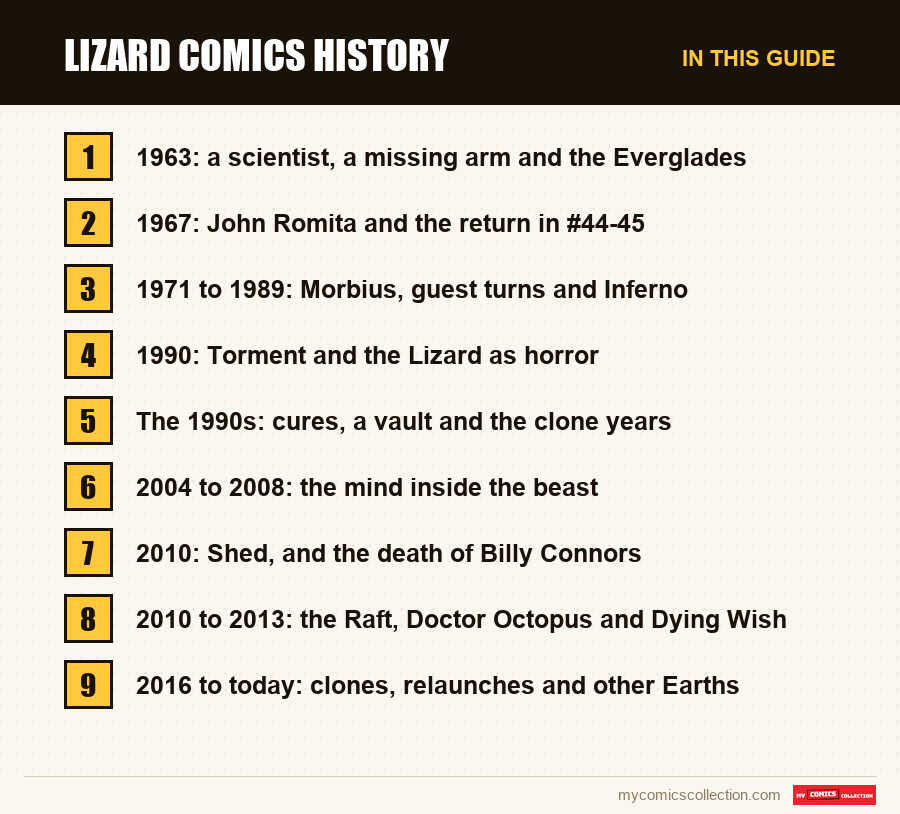
2010: Shed, and the death of Billy Connors
The turning point of the modern era is Shed, which ran in The Amazing Spider-Man #629-633 in 2010 as part of The Gauntlet. Zeb Wells wrote it, with art by Chris Bachalo and Emma Rios, and it was collected as The Gauntlet, Volume 5: Lizard. A prelude ran in Web of Spider-Man #6. The Zeb Wells hub lists more of his work on the title.
In the arc, Connors loses custody of Billy and, denied his suppressant, loses control of the Lizard. In #631, Ana Kravinoff leaves Billy in an alley, and the Lizard kills his own son. The family that had always been the reason for sympathy becomes the cost.
From this point, writers can no longer treat Connors as a man who might be cured and forgiven; any later story has to deal with a death. The issues read as one continuous story, which is why the collected volume is the practical way in.
2010 to 2013: the Raft, Doctor Octopus and Dying Wish
After Shed, the Lizard becomes part of a larger machine. In The Amazing Spider-Man #642 he joins Doctor Octopus's team, and in #645-646 he steals Menace's baby before it is returned. In #679 and #688-691 the Lizard uses Billy's DNA to restore Connors, and by #691 he is held in the Raft. In #699, during Dying Wish, Morbius frees him from the Raft, and The Superior Spider-Man #11-13 has him loose during Alistair Smythe's escape attempts, impaled through the shoulder in #13.
The common thread is institutional. A man once hunted in a swamp is now held in prisons, recruited by organizers and used by other villains. The Dan Slott hub follows the main title in these years. For the body swap around #700, see the Doctor Octopus history.
2016 to today: clones, relaunches and other Earths
In The Clone Conspiracy #1, #4 and #5 and Clone Conspiracy Omega #1, Connors makes a deal that brings back Martha and Billy as clones, then turns them into lizard people to save them from the Carrion virus, which makes grief itself a plot device. The fifth volume of The Amazing Spider-Man brings Connors back to Empire State University in #1-2, uses him in #21-22 of the Hunted arc built around Kraven, and uses #70, tied to Sinister War, for the Isotope Genome Accelerator that separates Connors from the Lizard.
Other Earths treat him differently. In the Ultimate line he appears in Ultimate Spider-Man #16 and #127 and Ultimate Marvel Team-Up #10, and in the Earth-65 setting of Spider-Gwen volume 2 he turns up in #1, #4 and #22. These are separate continuities, so treat them as side branches.
The key issues across his history
- The Amazing Spider-Man #6 (1963): the debut by Stan Lee and Steve Ditko, set in Florida, with the regeneration serum.
- The Amazing Spider-Man #44-45 (1967): the return in the John Romita years, with the pattern of rescue and capture.
- The Amazing Spider-Man #101-102 (1971): Morbius debuts, and his blood turns the Lizard back into Connors.
- Spider-Man #1-5 (1990): Todd McFarlane's Torment, with Calypso controlling the Lizard.
- Spider-Man: Quality of Life #1-4: the Connors family at the center.
- The Amazing Spider-Man #629-633 (2010): Shed, with Billy's death in #631.
- The Amazing Spider-Man #688-691 (2012): Connors's restoration, a cure attempt and the Raft.
- The Clone Conspiracy #1 and #4-5: the clones of Martha and Billy.
How to follow the Lizard in a collection
Decide which character you want. For the Silver Age scientist, work through The Amazing Spider-Man #6 and #44-45 and the Morbius issues. For the horror version, go to Spider-Man #1-5 and check which printing or edition you are buying, since issue #1 was printed in very large numbers. For the family tragedy, the Shed issues and the Quality of Life miniseries belong together, and the paperback of The Gauntlet Volume 5 is the practical shortcut.
Watch the numbering: the main series was renumbered across the 2010s, so match the cover date and not the number alone. Many Lizard stories are guest turns, so a single issue can be listed under another character. Our best Lizard comics guide ranks six entry points, and the blog index lists the neighboring histories.

Frequently asked questions
The Lizard debuts in The Amazing Spider-Man #6, cover dated November 1963. Stan Lee wrote the issue and Steve Ditko penciled and inked it. The story is titled "Face-to-Face With...the Lizard!" and is set in Florida, where Curt Connors has used a reptile-based serum on himself.
Curt Connors is a one-armed scientist who researches limb regeneration and becomes the Lizard when his serum goes wrong. Across his history he is also a friend of Peter Parker, a husband to Martha and a father to Billy, which is why many writers treat him as a tragic figure and not just a villain.
In Shed, which ran in The Amazing Spider-Man #629-633 in 2010, Billy is left in an alley by Ana Kravinoff in issue #631, and the Lizard kills him. The storyline was written by Zeb Wells with art by Chris Bachalo and Emma Rios, and it changes how later writers use the character.
It depends on the tone you want. For the original scientist, read The Amazing Spider-Man #6 and #44-45. For horror, read Todd McFarlane's Spider-Man #1-5 from 1990. For the family tragedy, read Shed in The Amazing Spider-Man #629-633 or the collected Gauntlet Volume 5.
No. The Ultimate line is a separate continuity, with the Lizard appearing in Ultimate Spider-Man #16 and #127 and Ultimate Marvel Team-Up #10. The same applies to the Earth-65 version in Spider-Gwen. Keep these apart from the main series when you sort a Lizard collection.
If you hold a copy of The Amazing Spider-Man #6 or McFarlane's Spider-Man #1, you can have it valued before you decide how to keep it.
Estimate my comic