
In short
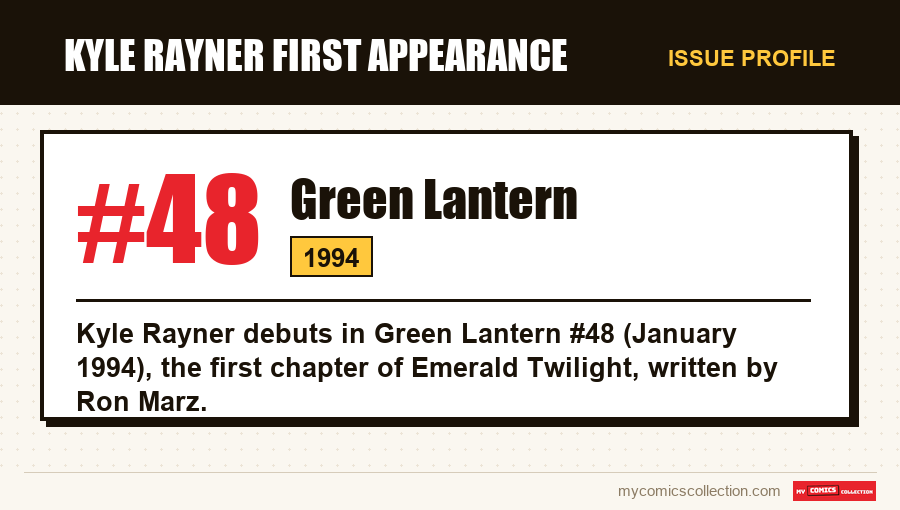
Kyle Rayner first appears in Green Lantern vol. 3 #48, cover-dated January 1994, the opening chapter of the three-issue Emerald Twilight story. Ron Marz wrote it, Bill Willingham pencilled the issue, with inks by Romeo Tanghal and Robert Campanella. Kyle, a freelance comic artist, appears at the end, watching a trail of energy cross the sky. Ron Marz and Darryl Banks are credited as his creators, and he becomes the new Green Lantern in the story that follows.
Few debuts in modern superhero comics were as divisive as this one. Issue #48 is a quiet cameo at the tail of an issue about someone else, and the character it introduces went on to carry the title in the years that followed.
What follows covers the issue itself: its credits, what the cameo shows, how it relates to Emerald Twilight and to Kyle's later turn as the lead, and what to check before buying. Credits, issue numbers and cover dates were checked; the discussion of significance and the buying method are analysis.
The issue: cover date, credits and where it sits in the volume
The comic is Green Lantern volume 3, issue #48, with a cover date of January 1994. Ron Marz took over as writer with #48, after DC set aside the version of the story that Gerard Jones had scripted. The change of writer lands exactly on the issue that introduces Kyle, which is why this number is the natural cut point for the whole period.
The credits on #48 are shared across several hands. Marz wrote it. Bill Willingham pencilled it, and the inks are credited to Romeo Tanghal and Robert Campanella. Albert DeGuzman lettered the issue, Steve Mattsson colored it and Kevin Dooley edited it. Darryl Banks is the artist most people associate with Kyle, but he did not pencil this issue; he pencils the third chapter, #50, and the cover of #51 carries his art. Writing that Banks drew #48 would be a mistake.
Marz and Banks are the names credited as creators of Kyle Rayner. That reflects the character's design and the way he was written in the run that followed, not the pencils on one issue. When you describe or list a copy, the series, volume, number and date are the details to give: Green Lantern (1990 series) #48, January 1994.
What the issue shows: a cameo at the end
Issue #48 is mostly about Hal Jordan. He stands in the ruins of Coast City with the remains of a doll in his hand. He uses his ring to re-create the city, including people who died. When the ring's energy runs out, a Guardian of the Universe contacts him by hologram and criticizes him for using the ring for personal gain. Hal then heads for Oa, the home of the Guardians.
Kyle appears at the very end. He is an illustrator who looks up and sees Hal's energy trail, and he mistakes it for a comet. That is the whole of the appearance in this issue, and it is why the cover and most of the pages belong to another story. The scene is a plant for the reader: a stranger watching the sky, unaware that the event overhead will change his life.
This is useful to know before you buy. A listing that promises a big, character-defining Kyle story in #48 is overstating the case. The key element is a short introduction, and the issue's weight comes from the context around it.
As elsewhere in this guide, the content is described in outline only, with no pages or dialogue reproduced.
Emerald Twilight: how the three chapters fit together
Emerald Twilight is the name given to Green Lantern #48 to #50, cover-dated January to March 1994. Marz wrote all three. The pencilling changes from chapter to chapter: Bill Willingham on #48, Fred Haynes on #49 and Darryl Banks on #50. Romeo Tanghal is credited with inks across the three, with Robert Campanella on #48 and Dennis Cramer on #49 also listed.
The arc follows Hal's collapse. By its end he has become the villain Parallax, and a later story, Green Lantern: Rebirth, revealed that a fear entity bearing that name had been driving his actions. Ganthet, one of the Guardians, then brings the last working power ring to Kyle. The crossover Guy Gardner: Warrior #18 to #21, titled "Emerald Fallout," shows Guy Gardner confronting Hal on Oa.
The distinction that matters for collectors is this. Kyle debuts in #48, in a cameo. Hal's rampage fills #49 and #50. From #51 the stories centered on Kyle continue, in the issues later collected as New Dawn. Some listings treat #48, #49 and #50 as interchangeable "Kyle Rayner" issues; they are not. If the point of a purchase is the character's first appearance, the answer is #48, and the later chapters are important context rather than a substitute.
The original plan for the title was different. Gerard Jones had scripted a story built around two competing sets of Guardians; DC's editors felt the concept would not attract new readers, editors including Paul Levitz and Kevin Dooley reworked the plot, and Marz wrote the story that became Emerald Twilight. That is part of why the arc felt like a hard break, and why the cameo at the end of #48 reads, in hindsight, as the first sign of a new direction.
Who Kyle is, and where the name came from
Kyle Rayner is a freelance comic artist who grew up in North Hollywood, raised by his mother as an only child. His artistic profession is central to the character: it shapes how he handles the ring and what he builds with it. The name comes from a character in James Cameron's film The Terminator.
Kyle designed his own costume, and his girlfriend Alexandra DeWitt encouraged him to do so. That detail makes the design a part of his story rather than a piece of equipment handed down, and it is one reason the look reads as distinct from earlier Green Lanterns.
Alexandra's fate is the other early landmark. She was killed in Green Lantern #54, cover-dated August 1994, in a story now cited as an example of the "Women in Refrigerators" trope. The issue is a significant one in a different sense from #48: it matters for the history of how comics treat supporting characters, and it is a frequent search from readers who come to Kyle's early run.
Do you collect this series?
Track what you own, what you are missing and what your collection is worth. 7-day trial.
Start my trial →
Why the number matters for a collection
The significance of #48 rests on three facts. First, it is the debut of the character who carried Green Lantern after Hal Jordan, served in the JLA and later became Ion, a transformation that took place in issue #145, cover-dated February 2002. Second, it is the opening chapter of a story that remains one of the most discussed turns in DC's modern history. Third, the issue marks the handover from Gerard Jones to Ron Marz, which is a landmark of the title's creative history.
The character kept returning after the 1990s. Green Lantern: Rebirth, published from December 2004 to May 2005, brought Hal Jordan back to the Corps, while Kyle was moved back into a different role. In the New 52 period he is linked to the New Guardians. The best Kyle Rayner comics guide places these in reading order, while this page stays on the debut issue.
It is useful to keep a clear separation between the Green Lantern character and the Green Lantern mantle. Hal Jordan's debut is in Showcase #22 (1959); the guide to that issue covers it. Kyle is a different person who held the same title, and #48 is the issue that records the transition in the character's story.
Collected editions and the numbers that get mixed up with #48
- Green Lantern #49 and #50: the other two chapters of Emerald Twilight. Kyle is in the story, but #48 carries the debut.
- Green Lantern #51: the opening of the early Kyle Rayner stories that follow Emerald Twilight, with a Darryl Banks cover. A key issue for the run, but not the first appearance.
- Green Lantern #54 (August 1994): the issue in which Alexandra DeWitt is killed.
- Collected editions: a trade paperback titled Green Lantern: Emerald Twilight was published in 1994 and reprints #48 to #50. A later volume, Emerald Twilight/New Dawn, appeared in 2003 and collects #48 to #55. A New Dawn collection covers #51 to #55. These contain the story, not the original issue.
- Other series: the 2017 collection Kyle Rayner, Green Lantern, Volume One gathers early volume 3 issues including #0, R.E.B.E.L.S. '94 #1 and The New Titans #116 and #117.
- French editions: publishers in France issued their own series under the Green Lantern name. Those are translated editions with their own numbering and are not the American Green Lantern #48. The Green Lantern collecting guide helps with the differences.
Collected editions are good for reading, but they are separate products and do not stand in for the single issue.
What to check before buying a copy
A 1994 comic is a modern-era book, and the condition questions are different from those for a 1950s title. Many copies were bought and bagged at the time, so what separates one from another is subtle.
- Spine and corners. Look for small stress lines, corner blunting and color breaks. On a dark cover these show up in raking light, so ask for photos at an angle.
- Printing and edition marks. Check the volume, the number and the 1994 date together. A listing for "Green Lantern #48" should be volume 3, 1994, and not a French edition or a later reprint.
- Interior pages. The cameo comes at the end of the story, so check that the closing pages is intact and that the book has not been trimmed.
- Graded copies. A graded copy carries a label with the grade and the certification number. Read the label, confirm the number and compare against other copies at the same grade, not against asking prices.
- Raw copies. A single issue from a long run is often available in several conditions, and the discipline is to compare copies of the same grade rather than assume a bargain from a low listing.
- Lots and runs. If #48 is sold as part of a run, check that the lot includes the volume 3 numbers you need, and look at each issue on its own.
For a wider look at how to weigh a graded copy, the Green Lantern grading guide goes through the labels and the questions to ask. Since #48 is a cameo and #50 and #51 carry more of the story, some collectors buy all four numbers together and treat them as one set.
The apparitions that count after #48
- Green Lantern #49 and #50 (1994): the two remaining chapters of Emerald Twilight, which carry Hal's rampage to its end.
- Green Lantern #51 (1994): the first of the early Kyle Rayner stories collected in New Dawn.
- Green Lantern #54 (August 1994): the death of Alexandra DeWitt.
- Green Lantern #145 (February 2002): Kyle becomes Ion.
- Green Lantern: Rebirth (December 2004 to May 2005): the series that returned Hal Jordan to the Corps.
The Green Lantern story around these numbers continues in the best Green Lantern runs, and another DC event from the same year is covered in the Zero Hour key issues guide.
Frequently asked questions
Green Lantern volume 3 #48, cover-dated January 1994. It is the first chapter of Emerald Twilight, written by Ron Marz. Kyle appears at the end as a freelance artist who sees Hal Jordan's energy trail in the sky, and the stories centered on him continue from issue #51.
Writer Ron Marz and artist Darryl Banks are credited with creating Kyle Rayner. Banks pencilled #50, but Bill Willingham pencilled the debut issue #48, so the artist you associate with Kyle is not the artist on his first appearance.
No. Emerald Twilight is the name of the three-issue story told in Green Lantern #48 to #50. Issue #48 is its opening chapter and Kyle's debut. The other two chapters carry the rest of the story, and collected editions reprint the whole arc.
No. Hal Jordan debuts in Showcase #22 in 1959. Issue #48 is where his story reaches a breaking point after the loss of Coast City, and where Kyle Rayner is introduced. The two debuts are decades apart and belong to different issues and eras.
Confirm it is volume 3 from 1994, not a translated edition or a reprint. Check the spine, corners and final pages, because the cameo comes at the end. With a slabbed copy, the label tells you the grade; set it beside sales of the same grade only.
Do you own Green Lantern #48 or the other chapters of Emerald Twilight? Check where your copy stands before you buy or sell.
Estimate my comic