In short
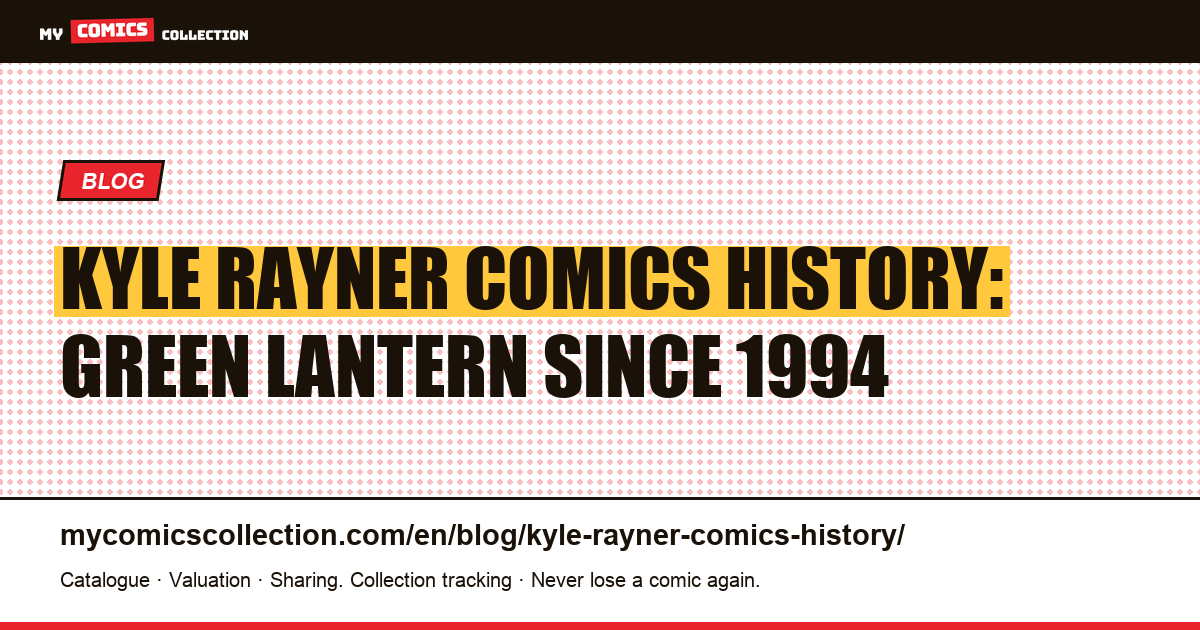
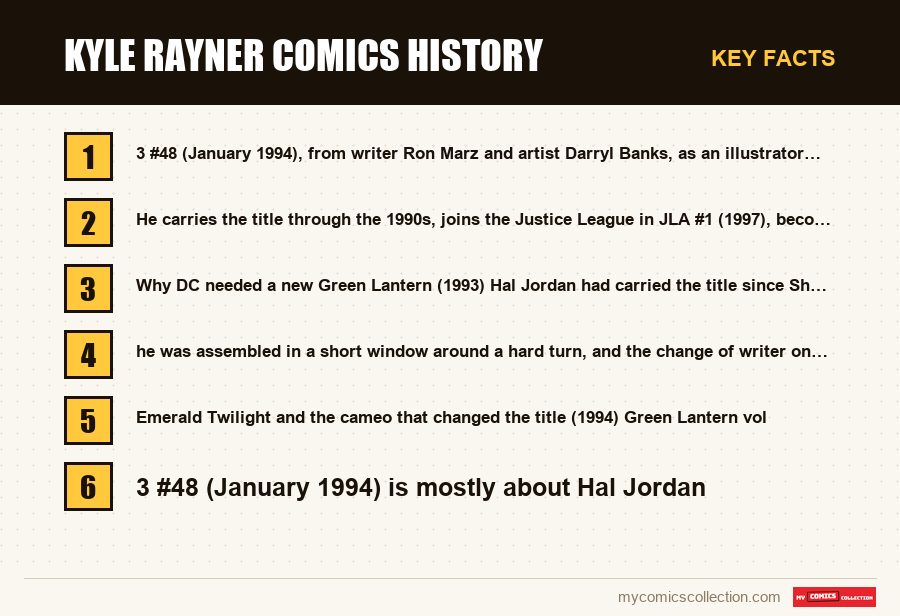
Kyle Rayner debuts in Green Lantern vol. 3 #48 (January 1994), from writer Ron Marz and artist Darryl Banks, as an illustrator who ends up with the last working power ring after Emerald Twilight. He carries the title through the 1990s, joins the Justice League in JLA #1 (1997), becomes Ion in 2002, steps back after Geoff Johns's Green Lantern: Rebirth returns Hal Jordan, and becomes a White Lantern in the New 52 era.
Kyle Rayner is the Green Lantern who was supposed to be a stopgap. He arrived in a story about someone else, held a monthly title for a decade, was transformed into a cosmic entity, and then spent twenty years as the ring bearer who stays after the franchise goes back to its first hero. Reading him in order is a lesson in how a replacement character can outlast the reason he was created.
For this Lantern the creator names and issue numbers were confirmed before publication, while the months shown are only those that could be read. How each period reshapes him is my own reading. What each era means for Kyle is analysis, and no page or dialogue is quoted.
Why DC needed a new Green Lantern (1993)
Hal Jordan had carried the title since Showcase #22 in 1959. The bombing of Hal's hometown, Coast City, by Mongul and the Cyborg Superman gave DC a way to break the character without erasing his history. The first plan for what came next, scripted by Gerard Jones, was built around two competing sets of Guardians. Editorial judged that it would not draw new readers, and Paul Levitz, Mike Carlin, Dennis O'Neil, Archie Goodwin and Kevin Dooley plotted a replacement story, which Ron Marz wrote.
That editorial detail explains the shape of what follows. Kyle was not planned for years; he was assembled in a short window around a hard turn, and the change of writer on #48 is why that number is the cut point for the whole decade.
Emerald Twilight and the cameo that changed the title (1994)
Green Lantern vol. 3 #48 (January 1994) is mostly about Hal Jordan. Kyle shows up at the end of the issue, mistaking Hal's energy trail for a comet. Bill Willingham pencilled that issue, with inks credited to Romeo Tanghal and Robert Campanella. The three-part Emerald Twilight story runs through #49, pencilled by Fred Haynes, and #50, pencilled by Darryl Banks, cover-dated March 1994. In #50 Kyle appears in the role of Green Lantern after the Guardian Ganthet hands him the last working power ring.
Marz and Banks are the credited creators. Banks is the artist most associated with Kyle, but he is not the penciller of the debut, and a listing that credits him with #48 has the wrong issue. The character's manner and the way he is written belong to the run that follows rather than to the cameo.
The page on the debut issue goes through the cover, credits and condition questions for that single book. This history stays with the character's path over time.
A hero with no Corps (1994 to 1996)
From #51 the stories center on Kyle. He is an illustrator with no mentor in the Corps, and that profession shapes how he builds with the ring. The tone of the series from here is that of a young man learning on the job in a universe where former colleagues distrust the replacement.
The turning point of the early run is Green Lantern vol. 3 #54 (August 1994), where Alexandra DeWitt is killed by Major Force. Major Force leaves her body in a refrigerator, the image behind the "Women in Refrigerators" label, and the issue is as much a landmark in the history of comics criticism as in Kyle's story. A tie-in, Guy Gardner: Warrior #18 to #21 ("Emerald Fallout"), puts Guy opposite Hal on Oa. The three Emerald Twilight issues and the next stretch were later gathered in collected editions, which are the easiest way to read this period.
The Final Night, the Justice League and Circle of Fire (1990s to 2000)
The Final Night event drags the Green Lantern book into a universe-wide story. It matters for the long arc because it is the story in which Kyle absorbs the energy Hal Jordan left in Earth's Sun, a moment that sets up his next transformation.
In January 1997 JLA #1 begins, and Kyle is the Green Lantern of the new Justice League. For a character who spent three years proving himself as a stand-alone lead, being the Lantern of the League is the moment he is accepted by the wider universe.
The 2000 event Green Lantern: Circle of Fire sets Kyle against the entity Oblivion, collected in 2002. Oblivion returns in Green Lantern Annual vol. 5 #2 (December 2013), where Kyle creates it from his own doubts and then defeats it with his allies, which is part of why readers who prefer his psychology to his powers keep coming back to him.
Ion and the weight of the ring (2001 to 2002)
The energy taken in during the Final Night is what leads Kyle to become Ion, the power shown on the cover of Green Lantern vol. 3 #145 (February 2002). In #150 (July 2002) he gives up that omnipotence to keep his humanity, recharging the Central Power Battery on Oa. Ion later returns as a separate story thread: in Rann-Thanagar War: Infinite Crisis Special (April 2006) the death of Jade transfers her power to Kyle and makes him Ion again, and a twelve-issue series, Ion: Guardian of the Universe, was collected in two volumes in 2007.
For a collector, Ion is the point at which Kyle becomes a mix of two characters: a young artist and an ambiguous power. The numbers to remember are the two in 2002, because the story is easy to confuse with the other renamed and cosmic Lanterns of the decade.
Rebirth and the Torchbearer years (2004 to 2007)
The third Green Lantern series ends with #181 (November 2004). Green Lantern: Rebirth, a six-issue miniseries written by Geoff Johns and pencilled by Ethan Van Sciver and published in 2004 and 2005, returns Hal Jordan to the role of Green Lantern. Kyle arrives with Hal's body, learns that Parallax is an alien fear entity, and helps Jordan, Stewart, Gardner and Kilowog free Ganthet from it. Afterwards the Guardians name him the Torchbearer, the Lantern who carried the legacy through the Corps' darkest period. The five-issue follow-up Green Lantern Corps: Recharge (2005), co-written by Johns and Dave Gibbons, shows Kyle, Guy Gardner and Kilowog helping the Guardians bring in 7,200 new recruits.
The new Green Lantern Corps series, vol. 2 #1 (August 2006), builds on that Torchbearer role. The shift is consequential: a hero who held the whole franchise alone is now one of many, and the writers have to find a purpose for him that does not depend on being the only one.
Do you collect this series?
Track what you own, what you are missing and what your collection is worth. 7-day trial.
Start my trial →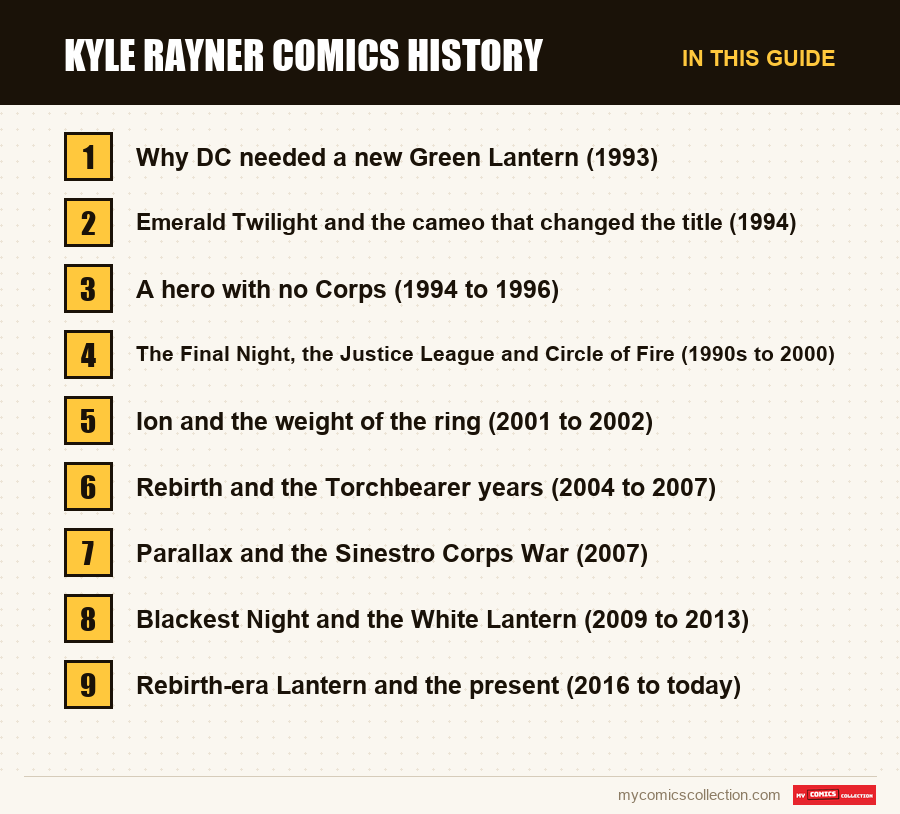
Parallax and the Sinestro Corps War (2007)
The Sinestro Corps War runs through Green Lantern vol. 4 #21 to #25 (July to December 2007), with the Green Lantern: Sinestro Corps one-shot in August 2007 and the tie-in specials Tales of the Sinestro Corps Presents: Parallax (September 2007) and Presents: Ion (December 2007). In #21 Sinestro abducts Kyle, reveals that he infected Kyle's mother with a virus, and Parallax possesses him. In the Parallax special Kyle is trapped inside his mother's house and escapes through her painting, which he hangs in his Oan apartment in Green Lantern Corps vol. 2 #20 (February 2008).
The story ties back to his origin as an illustrator, since the method of his victory is a piece of art.
Blackest Night and the White Lantern (2009 to 2013)
Blackest Night (2009 to 2010) puts Kyle in the middle of a Green Lantern Corps crisis. Blackest Night #1 is dated July 2009 and #8 March 2010, while the Green Lantern Corps vol. 2 tie-in issues #36 to #46 run from May 2009 to March 2010. Kyle sacrifices himself at the Central Power Battery in #42 (October 2009) and is resurrected by Miri Riam in #43 (December 2009).
In the New 52, Green Lantern: New Guardians #1 (September 2011) to #20 (May 2013) follows Kyle after he is turned into a "ring magnet" by Sayd. After mastering every part of the emotional spectrum he becomes a White Lantern, and the rings later break into seven White Lantern rings. Green Lantern Annual #3 (2011), with art by Ethan Van Sciver, shows him in that role. For collectors it is a clean run of twenty issues, easy to complete.
Rebirth-era Lantern and the present (2016 to today)
The 2016 relaunch places him in the ensemble book Hal Jordan and the Green Lantern Corps, a series that starts with a Rebirth special (July 2016) and features him in #9, #10, #17 and #21 (2016 to 2017). In Dark Crisis (2022) he escapes an alien prison with a new ring from Hal Jordan and Sojourner Mullein, and DC All In (2024) gives him back his White Lantern abilities. Collections have kept pace: the 2017 Kyle Rayner, Green Lantern Volume One includes Green Lantern #0, #56 and #57, R.E.B.E.L.S. '94 #1 and The New Titans #116 and #117, Volume 2 followed in May 2018, and a Rising Compendium appeared in 2023.
The key issues across his history
- Green Lantern vol. 3 #48 (January 1994): first appearance, a cameo at the end, by Ron Marz.
- Green Lantern vol. 3 #50 (March 1994): the end of Emerald Twilight and Kyle as Green Lantern, with Darryl Banks on pencils.
- Green Lantern vol. 3 #54 (August 1994): the death of Alexandra DeWitt.
- JLA #1 (January 1997): Kyle joins the Justice League as its Green Lantern.
- Green Lantern vol. 3 #145 (February 2002): the Ion cover.
- Green Lantern: Rebirth (2004 to 2005): six issues by Geoff Johns and Ethan Van Sciver that bring Hal Jordan back.
- Green Lantern vol. 4 #21 to #25 (July to December 2007): the Sinestro Corps War and Parallax.
- Green Lantern: New Guardians #1 (September 2011): Sayd turns Kyle into a ring magnet, the road to the White Lantern.
How to follow Kyle Rayner in a collection
Begin with the volume that carries his debut. The title is Green Lantern vol. 3, the 1990 series, and the number to check is #48; a later series that shares the name starts its own count, so always confirm the volume and the year. The early run is easiest to read in the 2003 collection Emerald Twilight/New Dawn (#48 to #55) or in the 2017 Kyle Rayner volume, and the single issues are worth buying when the goal is the key books rather than the whole run.
After the 1990s the reading divides by series: JLA for his years in the League, the fourth Green Lantern volume for the Sinestro Corps War, and New Guardians for the White Lantern years. French editions carry their own numbering and are not the American issues. The best Kyle Rayner comics ranks these stories, and the best Green Lantern runs shows where his years sit against the rest of the franchise.
Frequently asked questions
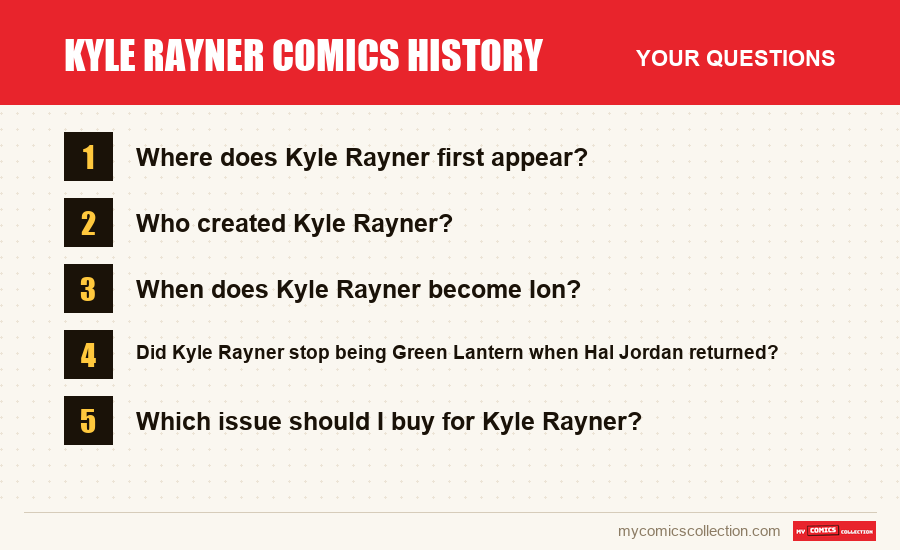
Kyle first appears in Green Lantern vol. 3 #48, cover-dated January 1994, as a cameo at the very end of the issue. Ron Marz and Darryl Banks are the credited creators, although Bill Willingham pencilled #48 and Banks pencilled #50.
The creator credit goes to Ron Marz as writer and Darryl Banks as artist. Marz became the writer of Green Lantern with #48 after DC reworked an earlier plot scripted by Gerard Jones. Banks is the penciller most associated with Kyle, drawing the third chapter of Emerald Twilight in #50.
The energy Hal Jordan left in Earth's Sun, absorbed during the Final Night, leads Kyle to become Ion, and the Ion cover is Green Lantern vol. 3 #145, cover-dated February 2002. He gives up the power to keep his humanity in #150, cover-dated July 2002. Jade's death in a 2006 special makes him Ion again.
No. The Johns and Van Sciver miniseries Green Lantern: Rebirth (2004 to 2005) restores Hal Jordan, yet Kyle keeps his ring. The Guardians name him the Torchbearer, and Green Lantern Corps vol. 2 #1 (August 2006) builds on that role.
For the character's debut, buy Green Lantern vol. 3 #48 (1994) in the right volume. For the story that defines him, add #50 and #54. Collected editions such as the 2017 Kyle Rayner Volume 1 are better for reading than for standing in for the single issue.
Holding a Green Lantern issue from the Kyle Rayner years and unsure of its grade or worth?
Estimate my comic