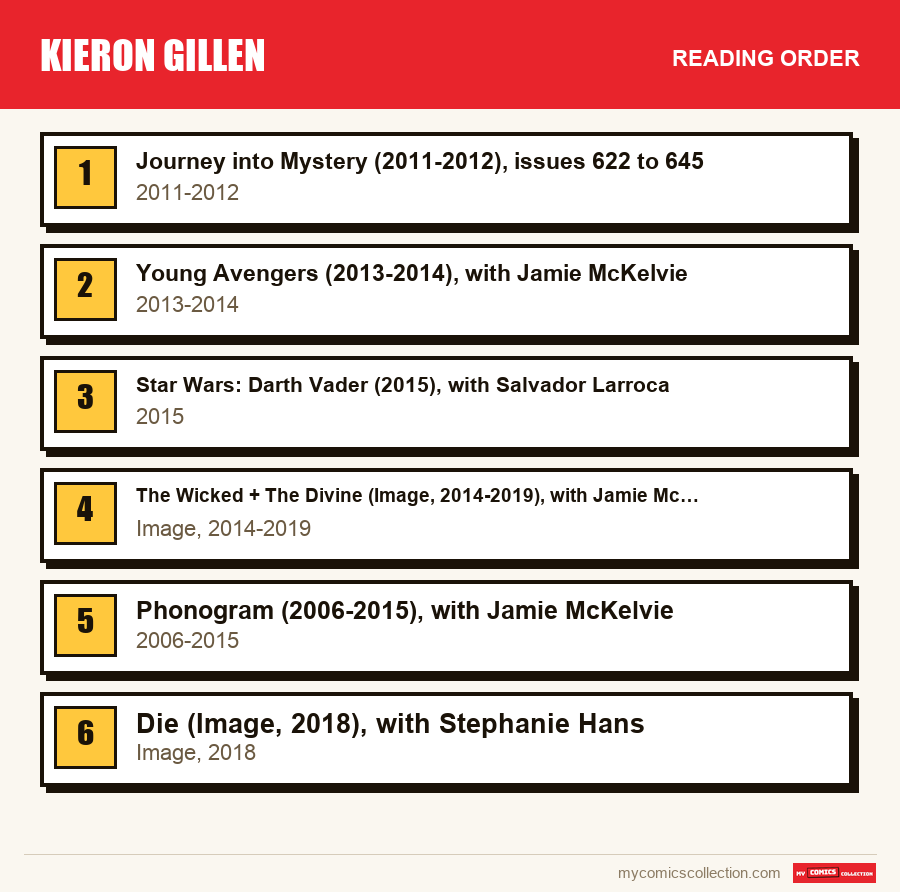
To read Kieron Gillen, open Journey into Mystery (Marvel, 2011-2012, issues 622 to 645), where Loki returns as a child. Follow it with Young Avengers (2013, with Jamie McKelvie), then Star Wars: Darth Vader (2015, with Salvador Larroca). Move on to The Wicked + The Divine (Image, from 2014), then the more erudite Phonogram, and finish with Die (2018, with Stephanie Hans).
Kieron Gillen has built a body of work around a single subject approached by very different roads: what stories, songs and games do to the people who love them. At Marvel, that theme runs through a Norse god or a team of teenagers; at Image, it yields series of musical or gaming fantasy. This path goes from the most welcoming to the most demanding.
As always on this guide, only verified facts (creators, issues, dates) are stated as fact; the analysis is our own, with no reproduction of protected art or dialogue.
How this path is ordered
Gillen has written for Marvel, for Image, for BOOM! Studios and for other publishers, often with the same artists. Rather than follow the dates, we ranked by the distance to cover: a series that stands on its own comes before one that assumes you know Marvel mythology, and that one comes before the projects that call for musical knowledge or a taste for experiment. Each step says what you should know before opening it.
Gillen does not have a biographical page on this guide yet. In the meantime, our ranking of the best Loki runs serves as a landmark, with Journey into Mystery on top. What you will find here is a reading itinerary, not a career story.
Step 1: Journey into Mystery (2011-2012), issues 622 to 645
After Loki's apparent death in Siege, the god of mischief is reborn as a child. Gillen takes up the old title that had seen Thor and Loki born in 1962 and turns it into a dark, tender comedy, in which the hero has to prove he is no longer what people expect. The arcs follow one another with different artists, including Doug Braithwaite and Richard Elson, without the voice of the story getting lost.
The start of the run takes place during the Fear Itself event, which gives issue 622 some background context, but the plot stays readable without it. Why begin here? Because the character is introduced from scratch, the series ends cleanly at issue 645, and it already holds the writer's obsessions: storytelling as power, and a destiny one refuses to inherit. The Loki reading guide places it within the god's full path.
A note for collectors: the Loki hub gathers the character's dossiers, including the one on key issues, useful if you want to understand what this run weighs against the older milestones.
Step 2: Young Avengers (2013-2014), with Jamie McKelvie
Gillen and artist Jamie McKelvie relaunch Young Avengers in 2013 with a team where Kate Bishop, Wiccan, Hulkling and a teenage Loki carried over from the previous run all cross paths. The series lasts fifteen issues, breaks free of the routine of superhero teams and favors the relationships between the characters, in a very pop visual style. The whole thing reads better when you take into account what Journey into Mystery set up for Loki.
This step shows how Gillen opens a universe to readers who were not entering through the big events. It also matters to Kate Bishop fans: our ranking of the best Hawkeye runs places it fourth, as a useful follow-up to the 2012 series. To place the team, the Avengers hub remains the best foundation.
The series has a collecting quirk: McKelvie's art, on covers and interiors alike, has a crisp rendering that holds up well in collected reprints. Single issues are common and no market value has settled on these numbers, which leaves the choice of format to reading comfort.
Step 3: Star Wars: Darth Vader (2015), with Salvador Larroca
After Disney acquired the Star Wars license, Marvel relaunched its series set in the galaxy far, far away, and Gillen wrote Darth Vader across twenty-five issues with Salvador Larroca. The action sits between the first two films of the original trilogy: Vader, humiliated after the destruction of the Death Star, tries to win back his place at the Emperor's side. The angle is that of a villain who is handed a point of view, with a dryness that suits the black armor.
The series is also the first appearance of Doctor Aphra, an unscrupulous archaeologist created by Gillen in issue 3. The character then got her own series, written from late 2016 with Kev Walker on art. If the Star Wars universe appeals to you, you can extend your reading with this spin-off, which detaches itself enough to be read alone.
It is the easiest step to approach after Journey into Mystery: no knowledge of comics is required, the films are enough. The guide to collecting Star Wars at Marvel explains how to find your way among the series of the same period.
Step 4: The Wicked + The Divine (Image, 2014-2019), with Jamie McKelvie
The premise of The Wicked + The Divine fits in one sentence: every ninety years, twelve gods are reincarnated in teenagers, and they die two years later. The era chosen is our own, and the deities have become stars of the music scene. Gillen writes the series with McKelvie, who draws the characters as fashion icons, and colorist Matthew Wilson gives the whole a vivid palette. The series runs forty-five issues, with specials on top.
This title is more demanding than the previous ones on two counts. First, the tone slides quickly from fantasy toward grief, which can come as a surprise. Second, the story uses mystery as its engine, so the opening pages reward a reread after the ending. It is for the reader who likes form to be part of the point, and for anyone who knows or enjoys recent pop culture.
It is also the best showcase of the Gillen and McKelvie pairing, and an example of a creator-driven series that found its audience in bookstores as much as in comic shops. To understand the editorial context of this kind of project, the Image collecting guide maps out the publisher's landscape.
Do you collect this series?
Track what you own, what you're missing and what your collection is worth. 7-day trial.
Start my trial →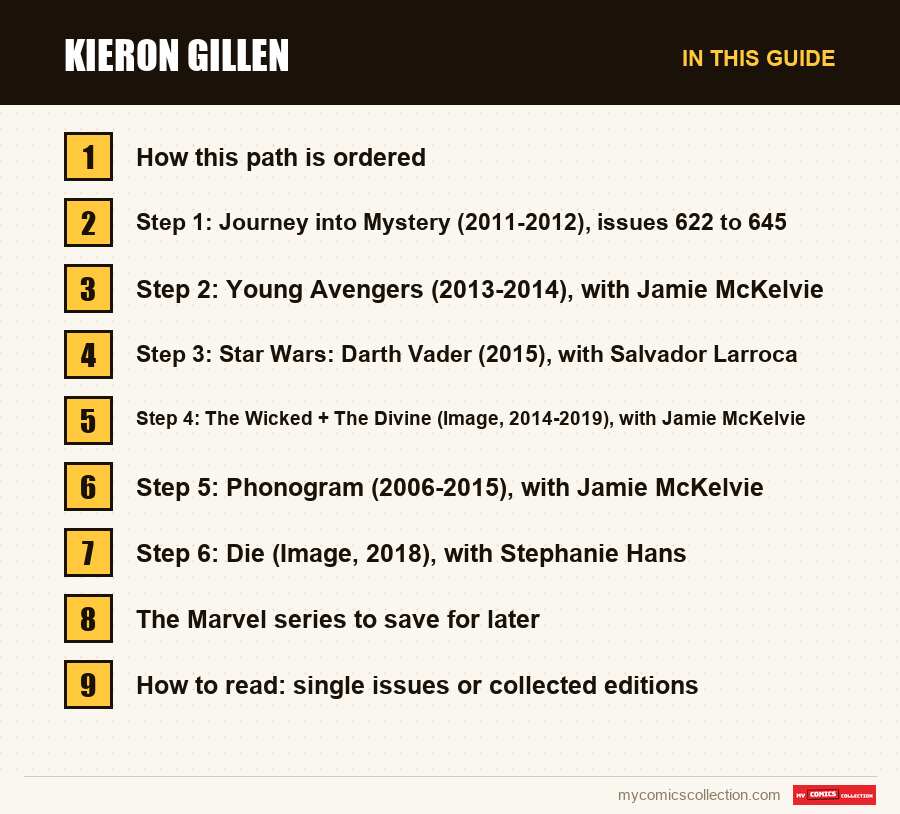
Step 5: Phonogram (2006-2015), with Jamie McKelvie
Phonogram is the founding project of the collaboration with McKelvie. The first cycle, Rue Britannia, came out in 2006 at Image and follows a character able to use music as magic, in a London marked by the British pop of the 1990s. The second cycle, The Singles Club, changes the setup, and the third, The Immaterial Girl, appeared in 2015. The whole reads in three volumes.
Why place it fifth? Because the enjoyment depends on the reader's musical knowledge. The references point to specific bands and songs; without them, you grasp the idea but lose some of the finesse. The volumes are not scarce, and the reading choice comes down mostly to your relationship with music. It is also the title where you best gauge how Gillen works: a simple idea, developed into structure.
The series prepares the ground for The Wicked + The Divine, which it foreshadows with its taste for icons and rituals. Read after it, it looks like a manifesto; read before, it serves as training for the form.
Step 6: Die (Image, 2018), with Stephanie Hans
Die is a fantasy inspired by role-playing games: a group of teenagers vanishes during a game session, then reappears a few decades later, grown up and traumatized. Gillen develops a game world in which each character class reflects a psychological trait, and Stephanie Hans paints it with a rich palette, far from McKelvie's clean line. The series runs twenty issues.
It closes this path because it demands both a sensitivity to role-playing games and a tolerance for darkness. Die is the most recent of the six steps, and the market has not yet set a reference point for it. Neither an adaptation nor a cover ratio is worth invoking here, for lack of reliable information.
If Die suits you, the same writer also wrote Once & Future (BOOM! Studios, 2019, with Dan Mora), a rewrite of the Arthurian myth, and Three (Image, 2013, with Ryan Kelly), about the helots of Sparta. We leave them outside the main order, but they extend this territory naturally.
The Marvel series to save for later
Gillen also wrote Iron Man (2012), Uncanny X-Men (2011), Eternals (2021) and Immortal X-Men (2022), but these titles mostly suit the reader who knows continuity well. For Sabretooth, Gillen wrote a one-shot in 2009 with Dan Panosian, X-Men Origins: Sabretooth, which our ranking of Sabretooth runs treats as a good short portrait of the character. Read it separately, unconnected to the rest of this path.
How to read: single issues or collected editions
For older Marvel series like Journey into Mystery, the original single issues remain easy to find, and the collected editions follow the sequence without a hitch. Issue 622, which opens the run, is the one collectors request most often as a standalone. For Young Avengers, the fifteen issues are easy to assemble; one collected edition is enough for anyone who just wants to read.
For Darth Vader, one point of caution: the series sits within a set of Star Wars titles published at the same time, and the collected editions do not all mix the same issues. For The Wicked + The Divine, collected editions have the advantage of grouping the special issues in the right place. Phonogram and Die are easy to buy in volumes.
Series from 2018 to 2024 have no established market value. To assess them, watch the length of the series, the reprints of the first issue and the fate of the variant covers, cited only if you have verified them. Cross-check several completed sales before drawing a conclusion, rather than relying on a live listing.
Recap: the recommended order
- Step 1: Journey into Mystery (2011-2012), issues 622 to 645, the Marvel way in.
- Step 2: Young Avengers (2013-2014), with Jamie McKelvie, the team of young heroes.
- Step 3: Star Wars: Darth Vader (2015), with Salvador Larroca, the license.
- Step 4: The Wicked + The Divine (Image, 2014-2019), the best-known creator-driven series.
- Step 5: Phonogram (2006-2015), the most erudite.
- Step 6: Die (Image, 2018), with Stephanie Hans, the darkest and the most recent.
For a reader in a hurry, three titles are enough: Journey into Mystery, The Wicked + The Divine and Die, which cover the writer's three registers. To keep exploring, the blog offers other paths of the same kind.
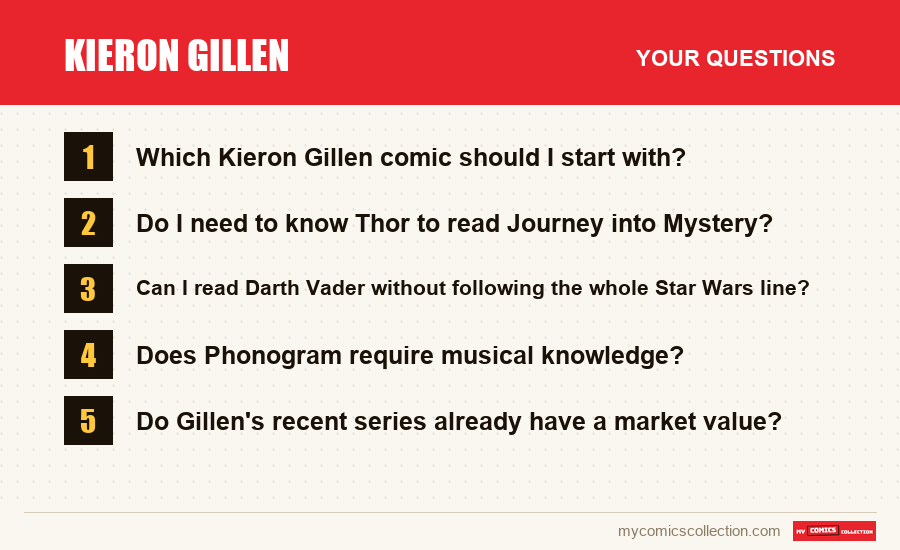
Frequently asked questions
Start with Journey into Mystery, issues 622 to 645 (2011-2012). The story introduces Loki from scratch, ends cleanly and already holds the writer's themes. If you prefer a series outside Marvel, The Wicked + The Divine, at Image, is the best choice.
No. The run centers on Loki as a child and does not call for prior reading of Thor stories. The beginning coincides with Fear Itself, of which a general idea is enough. The ranking of Loki runs confirms that this title is the most welcoming way in.
Yes. The twenty-five issues by Gillen and Larroca read on their own and lean on the films rather than on the license's other comics. Doctor Aphra, who debuted in issue 3, then got her own series, which you can read separately.
It helps a lot. The references to specific bands and songs feed the story, and without them you lose some of its finesse. It is not a blocker, but that is why the series sits fifth in the path rather than first.
Not yet for the most recent, like Die (2018). Over time, demand will follow the scale of the series, the reprints of the first issue and the variant covers. Cross-check several completed sales before buying, and do not rely on a single listing.
A Journey into Mystery 622 or a first issue of The Wicked + The Divine in your boxes? Get the copy appraised before choosing what to keep.
Estimate my comic