
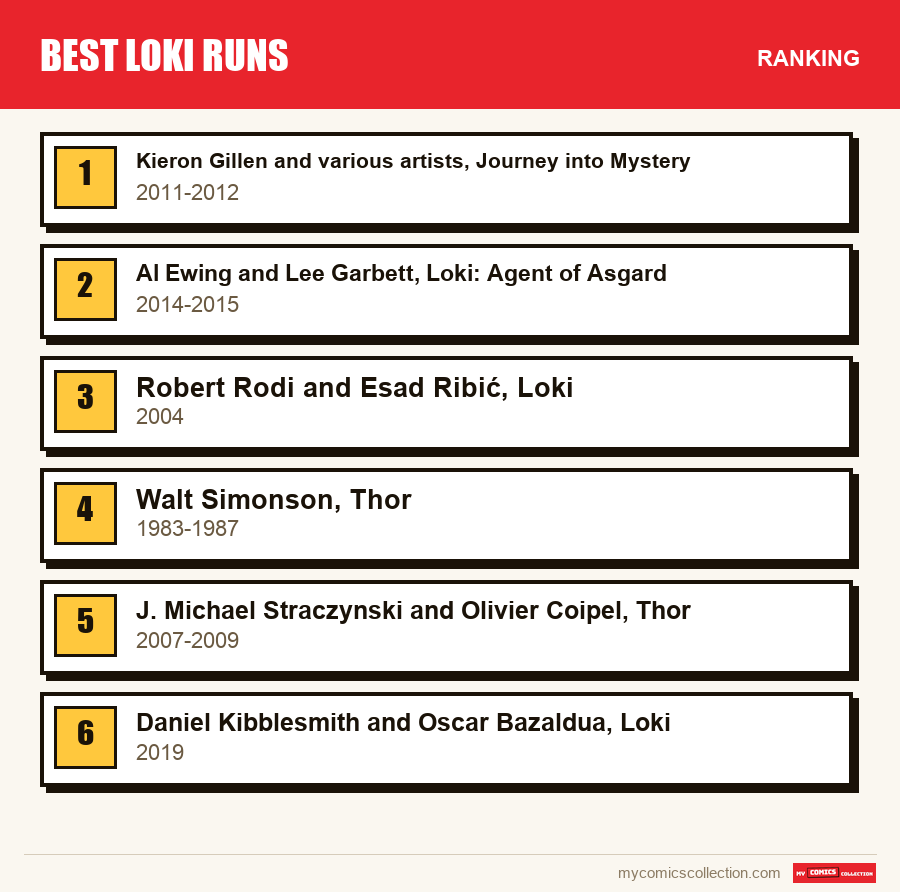
The best Loki run is Kieron Gillen's Journey into Mystery (2011-2012), where the god of mischief returns as a child. Behind it come Loki: Agent of Asgard (2014-2015), by Al Ewing and Lee Garbett, and the 2004 Loki miniseries by Robert Rodi and Esad Ribić. Six stories make up this ranking, each with the format we recommend, whether you want to read it or collect it.
For a long time Loki was more of a guest star than a headliner: Thor's adversary for four decades, he only got a space of his own in the twenty-first century. Ranking his best runs therefore means mixing ongoing series, closed miniseries and two stretches of his adoptive brother's title. The six entries follow, with each position explained.
As always in this guide, we state only verified facts (creators, issue numbers, dates); the analysis is our own, with no reproduction of protected artwork or dialogue.
How we ranked these runs
We started from a single test: does the story stand up if you take Thor off the page? Loki is a character defined by a relationship, and many of his appearances are only worth reading for his brother's shadow. So we went looking for the runs where he carries the plot, even if that meant placing a Silver Age story behind far more recent series. Two further criteria round out the test: how easy the story is for a reader arriving with no background, and the mark it left on the writers who followed.
The order here measures how good the story is, not what the issues sell for. The most sought-after issues in Loki's bibliography belong to other stories, and the final section keeps the two questions apart.
No. 1: Kieron Gillen and various artists, Journey into Mystery (2011-2012)
After Loki's apparent death during Siege, Marvel brings the character back as a young boy, haunted by the memory of a past he did not live the way everyone else did. In Journey into Mystery, the historic title that had introduced Thor and then Loki in 1962, Kieron Gillen writes a dark yet tender comedy: a child trying to earn forgiveness for a crime nobody really holds against him anymore, and which everyone expects him to repeat. Doug Braithwaite and Richard Elson are among the artists on a series that changes hands from arc to arc without losing its coherence.
It matters for the character because it flips the question every Loki story asks: can anyone step out of a role written in advance? The writers who followed, Al Ewing foremost, inherit that shift. The run covers issues 622 to 645, roughly two years of monthly publication, which makes it a substantial body of work that is still easy to track down. Any reader can dive in, even without knowing Thor; the first issues take place during Fear Itself, and a vague idea of that event helps a little.
To collect it, the simplest route is the trade paperbacks covering the whole run. The original issues are easy to find and inexpensive compared with Silver Age books; do keep an eye out for issue 622, which opens the run and which buyers often ask for on its own.
No. 2: Al Ewing and Lee Garbett, Loki: Agent of Asgard (2014-2015)
A solo series of seventeen issues, it carries Gillen's child forward into a young adult working for Asgard, handed shady missions in exchange for having his misdeeds wiped away. The plot pits Loki against his own future self, who has become a tyrant. Al Ewing builds a mythological spy thriller, and Lee Garbett gives it a clean, elegant line that supports the irony. The setting is a world where every promise is a contract, which suits a character who has always been defined by what he hides.
It matters because it turns Loki into a lead who can sustain a full series, where his earlier solo titles ran four or five issues. It also puts forward the idea of a god of stories rather than lies, which has fed how the character is portrayed ever since. It is for the reader who wants a complete tale from start to finish without wading through twenty years of continuity. You are better off reading Gillen first, since the series takes him for granted, but it is not required.
As a collection, the ideal format is the single-issue run, 1 through 17, entirely completable. Paperback collections gather it into three or four volumes, depending on the edition. Of everything in this ranking, it is the easiest run to own in full.
No. 3: Robert Rodi and Esad Ribić, Loki (2004)
Four painted issues, published in 2004. Robert Rodi imagines a Loki who has won: master of Asgard after toppling the throne, he finds that triumph does not make him any more secure. The story rests on the inner monologue of a character who speaks to his reader more than to his enemies. Esad Ribić, who would return to Thor years later, paints sculpted faces and cold architecture with an almost austere restraint.
It matters because it is one of the first miniseries devoted to Loki alone, and it made everything that followed thinkable: a reader can feel attached to the character without him ever ceasing to be dangerous. It suits anyone who prefers a closed, literary story to an ongoing series, and it demands no prior knowledge. It sits in third place because of its brevity: you can finish it in an evening.
For collectors, it is four issues that fill in quickly, plus a single collected edition. The collections do justice to the painting; the originals have the advantage of the period paper, but the difference is mostly a matter of reading comfort.
No. 4: Walt Simonson, Thor (1983-1987)
Walt Simonson writes and draws Thor from issue 337 through 382, and his stretch is regarded as one of the character's great periods. Loki is not the hero there, but he remains an engine of the story: his schemes tangle with Asgard's big conflicts and feed the tension in the realm. With Simonson, the god of mischief is still a villain, cruel and far more dangerous than in the nuanced version that would come later.
The run matters because it is the finest expression of the classic Loki, the one the twenty-first century then reinvented. To grasp what Gillen and Ewing are challenging, you need to have read the original. It is for the reader already attached to Thor, since Loki shares the stage with a large cast and the pace is that of a saga unfolding over forty-six issues.
The original format is the monthly series, a long block that is nonetheless very accessible in 1980s single issues. Omnibus and similar collected editions gather the period in a few volumes. Our detailed ranking of the best Thor runs places this stretch within the thunder god's career.
Do you collect this series?
Track what you own, what you're missing and what your collection is worth. 7-day trial.
Start my trial →
No. 5: J. Michael Straczynski and Olivier Coipel, Thor (2007-2009)
Asgard's return to Earth, after Ragnarök, comes through a new volume of Thor. J. Michael Straczynski writes the rebuilding, and Olivier Coipel draws wide, luminous pages. Loki reappears in this setting in an unexpected form, housed in the body of another Asgardian figure, which opens the door to the shifts of identity and gender the character would explore afterward. It is a turning point more than a story centered on him.
It matters because the Loki of the following decade, more fluid and less monolithic, finds his starting point here. It speaks to Thor readers more than Loki readers: a transitional run, useful for understanding where Gillen and Ewing come from, less so on its own merits. It is deliberately placed in the middle of the table.
The series relaunched in 2007 is easy to collect in single issues, and the start of that volume remains one of the landmarks of the modern era. Collected editions in a few volumes reprint the sequence. We point you to our key Loki issues guide for the specific issues collectors chase in this period.
No. 6: Daniel Kibblesmith and Oscar Bazaldua, Loki (2019)
A five-issue miniseries from 2019 that brings Loki back to a lighter tone. Daniel Kibblesmith writes a comedy of power, and Oscar Bazaldua draws it with a supple, very readable line. The aim is more modest than Gillen's or Ewing's: the story is happy to let the character be funny, vain and sometimes ridiculous, without turning him into a cosmic stake.
It earns its place through the variety it adds: after the two great rewrites, it shows that Loki can also serve a short, amusing tale. It is for the reader who already knows the character and wants a light read, rather than for the newcomer. It takes last place without apology: well executed, but less foundational than the others.
For collecting, this is a recent book: its market value has not settled, and what moves it will depend on the character's future place at the publisher and on how scarce any alternate printings turn out to be, which we do not document here. A single collected edition gathers all five issues.
And outside the ranking
The Silver Age deserves a mention of its own. Journey into Mystery 85 (1962) gives birth to the Marvel version of Loki: Stan Lee and Larry Lieber on the text, Jack Kirby on pencils. The character also brings about, in spite of himself, the formation of the Avengers in Avengers 1. These issues are left out of the ranking for lack of a standalone run, but they remain the bedrock. Another notable absence is Young Avengers by Gillen and Jamie McKelvie (2013), where a teenage Loki joins a team, which we read as an extension of Journey into Mystery rather than a run about the character.
Which one to start with, depending on your profile
If you are discovering Loki, open Gillen's Journey into Mystery: it is the most welcoming story and it holds most of what the character has become. If you prefer a closed format, the Rodi and Ribić miniseries takes just four issues. If you enjoy spy fiction, jump straight to Agent of Asgard, then go back. For Thor readers, Simonson and Straczynski are required stops, read as much for Thor as for Loki. Finally, for a light read between two sagas, the 2019 miniseries fits. Our Loki reading guide arranges these runs in chronological order.
What these runs are worth as a collection
One point to settle first: the best run is never the most expensive. Among single issues, the releases from 2011 to 2015 are complete series with big print runs, where an average copy and an exceptional copy sell at similar levels. Their appeal lies in completion: owning 1 to 17 of Agent of Asgard, or 622 to 645 of Journey into Mystery, in matching condition. By contrast, the issues that carry real weight are the early Silver Age ones, outside this ranking.
The method is to treat two purchases separately. On one side, the collected editions, which serve reading and lose little; on the other, the single issues, which you choose for their condition and their place in the series. To pin down a given copy, note several active listings, discard the extreme values, then check them against the sales actually completed on that issue, provided it is the same condition. The opening issues of a run, such as 622 of Journey into Mystery or 1 of Agent of Asgard, stand out slightly from the middle issues. For 2019 and after, the market is still to be built, and how long the character stays with the publisher will be the first factor.
Frequently asked questions
Kieron Gillen's Journey into Mystery, issues 622 to 645 (2011-2012), tops our ranking. It reinvents Loki as a child eager to break with his past, reads without major prerequisites and influenced every writer after him, notably Al Ewing in Agent of Asgard.
It is preferable, though not mandatory. Agent of Asgard continues the youth of Loki imagined by Gillen and takes up his themes, but Al Ewing sums up the essentials as the story goes. A reader in a hurry can start with Ewing, then go back to Gillen, who sheds light after the fact on some of the character's choices.
Not a long one of this kind before the Robert Rodi and Esad Ribić miniseries in 2004, which is one of the first devoted to him. Before that, Loki appears mostly as an adversary in Thor and in the Avengers. His first real story centered on him can therefore be read in four issues, which explains this miniseries' special status.
It is not essential, but it shows the classic Loki, villainous and dangerous, whom recent writers challenge. Simonson writes and draws Thor from issue 337 to 382 (1983-1987). Reading it after Gillen and Ewing gives a real measure of how far the character has come.
It depends on your goal. For reading, the collected editions are enough and take up less space. For collecting, the 2010s single issues are easy to complete and keep the appeal of an entire series, while Simonson calls for more care over the condition of the original paper.
Do you own an issue of Journey into Mystery or Agent of Asgard? Estimate it from current listings.
Estimate my comic