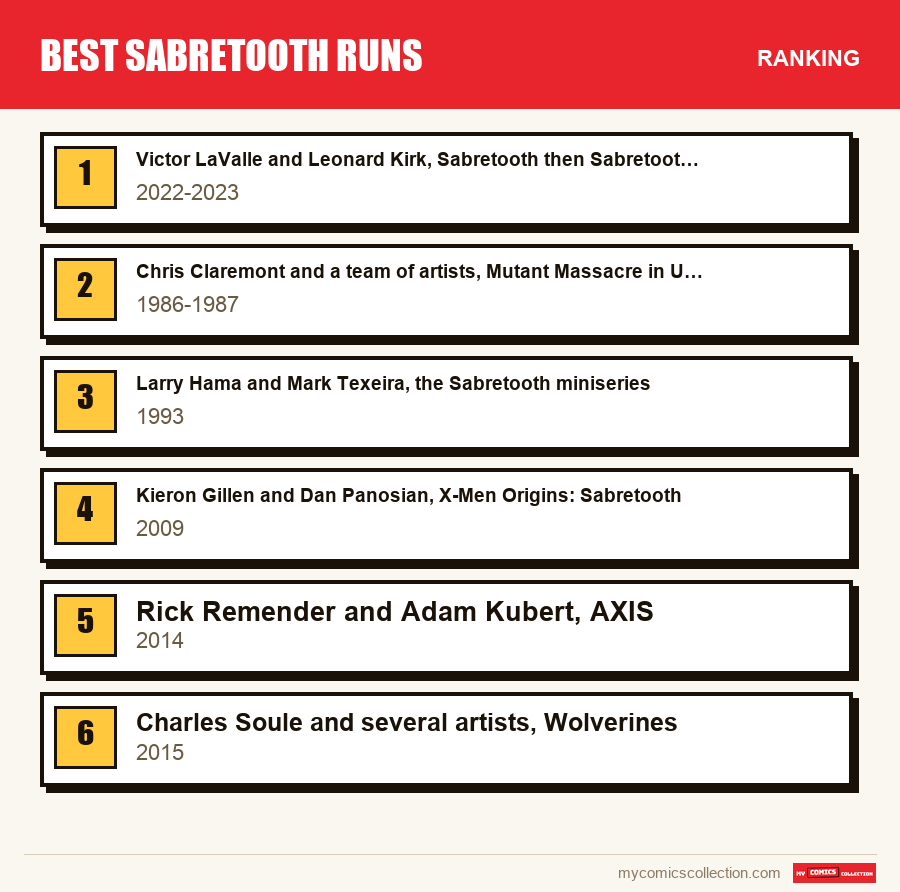
The best run devoted to Sabretooth is the Sabretooth series by Victor LaValle and Leonard Kirk (2022-2023), followed by the 1986 Mutant Massacre crossover and the 1993 miniseries by Larry Hama and Mark Texeira. We kept six reading periods, from the Morlock massacre under Chris Claremont to the Krakoan prison, and for each one we note the background you need and the format we recommend.
Victor Creed is a rare case: an antagonist who has lasted four decades without Marvel giving him an ongoing series of his own before 2022. His best material is therefore scattered across Wolverine's books, team events and a handful of miniseries. Our reading guide offers a chronological path; here we sort by quality, and we accept leaving out some periods that are important all the same.
As always in this guide, we only state verified information (creators, issues, dates); the analysis is our own, with no reproduction of protected pages or dialogue.
Our method for ranking scattered runs
Ranking Sabretooth runs is like looking for a needle in thirty years of Wolverine. No writer stayed with him long enough for us to talk about "his" run the way we talk about Walt Simonson on Thor. So we set four requirements for every candidate: Victor Creed has to drive the story, not be a luxury extra; the story has to read without having swallowed all of mutant continuity; it has to teach us something new about him; and finally, its influence should show in what other writers borrowed from it.
Our order rewards the pleasure of reading and sets market value aside. The issue every collector hunts for, Iron Fist #14 from 1977 with Chris Claremont and John Byrne at the creation, is not here: it is a first appearance in someone else's series, not a run. The six entries below are reading periods; the piece on the first appearance covers that key object separately.
Top 1: Victor LaValle and Leonard Kirk, Sabretooth then Sabretooth & the Exiles (2022-2023)
This is the first time Creed carries a solo title with a real narrative thread, in two five-issue cycles. Victor LaValle, a novelist who comes from social horror, starts from a situation that follows from the Krakoa era: the predator has been convicted of killing humans and locked up in the exile prison the mutant nation invented for its own criminals. The first cycle takes place largely inside the convict's head, between memories, hallucinations and encounters with other inmates. Leonard Kirk draws these slippages with a clean line that lets the dread come from the story and not from the effect.
The second cycle extends this material by putting the exiles in the foreground, which widens the scope: what is a prison for when its rules were written by the people living in it? That political question sets the run apart from the purely physical clashes of the Claremont era.
It matters because it turns a monster of convenience into a character you read for his own sake, with no Wolverine to light him. It suits readers who enjoy psychological stories and know the broad strokes of Krakoa; the continuity level is medium. On the collecting side, these ten issues are recent and easy to assemble, so the choice comes down to the cover and the pleasure of rereading more than to scarcity. A collected edition saves you from having to bridge the two cycles.
Top 2: Chris Claremont and a team of artists, Mutant Massacre in Uncanny X-Men #210 to #213 (1986-1987)
This is where Creed goes from hired killer to force of nature. In the tunnels that shelter the Morlocks, a team of hunters, the Marauders, methodically slaughters a community of outcast mutants, and Sabretooth is its most bestial executioner. Chris Claremont writes the event in Uncanny X-Men, while X-Factor, New Mutants and other series relay the same drama in their pages, which forces a choice between the tight reading and the complete one.
The confrontation with Wolverine, in the central issues of the series, sets the mechanism that will serve for forty years: two fighters with similar gifts, one of whom kept a moral compass. The duel works here as a revealing moment and not as one more brawl.
The run earns second place rather than first for a simple reason: it reads better with some background, since it assumes you know the team, the Morlocks and the tone of the period. Yet no other period explains better why the character is frightening. For the collection, these mid-1980s issues had a large print run but are not rare; the issues of the duel attract Wolverine buyers, and a collected edition of the crossover spares you the hunt for scattered tie-ins. Our piece on the Wolverine vs. Sabretooth duel details which issues to target.
Top 3: Larry Hama and Mark Texeira, the Sabretooth miniseries (1993)
Four issues, one story, a closed-room thriller: this is one of the rare chances to read Creed as a protagonist before 2022. Larry Hama, who knew the character from years on Wolverine's books, sets up a thriller in which the killer's captivity becomes the heart of the plot. Mark Texeira, whose heavy, dark line suits the look of the era, gives the reluctant hero an almost sculptural build.
The interest is twofold. First, the miniseries gives Victor Creed a psychology outside the hunt: we read about a man who does not know what he wants without prey. Second, it plants an idea that LaValle will pick up thirty years later, that of a predator whose cage is also internal.
It will please anyone looking for a short story, wrapped up in four issues, with nothing to catch up on beforehand. The flip side is a dated style, very much marked by the 1990s. For the collection, the miniseries turns up in period issues with a decent print run, but collected editions are scarcer than for recent runs: if you want to read it before collecting it, go through a digital edition or a library, then hunt down the four issues.
Top 4: Kieron Gillen and Dan Panosian, X-Men Origins: Sabretooth (2009)
The shortest of our selection and the most self-contained. This one-shot condenses into a single issue what others took years to say: Creed's relationship with Mystique, his bond with family and with the passing of time, and the way his cruelty could have been built up by accumulation. Kieron Gillen, a British writer then rising fast at Marvel, makes it a tight portrait, and Dan Panosian gives the scenes a leathery roughness that suits the character.
The issue makes no claim to epic scale. Its strength comes from working as a synthesis: you can read it first to learn who Creed is, or last to glue the pieces back together. It is the cheapest entry point in both time and continuity.
We place it behind Hama's miniseries because it is more a portrait than a story, but for a reader in a hurry it can come first. For the collection, a single issue is enough; the hardest part is finding it in the bins, because a one-shot is often filed apart from the series. It also exists in collected editions about mutant origins, which spares you buying it alone if you are after several portraits at once. Fans of the writer can follow up with the Kieron Gillen hub.
Do you collect this series?
Track what you own, what you're missing and what your collection is worth. 7-day trial.
Start my trial →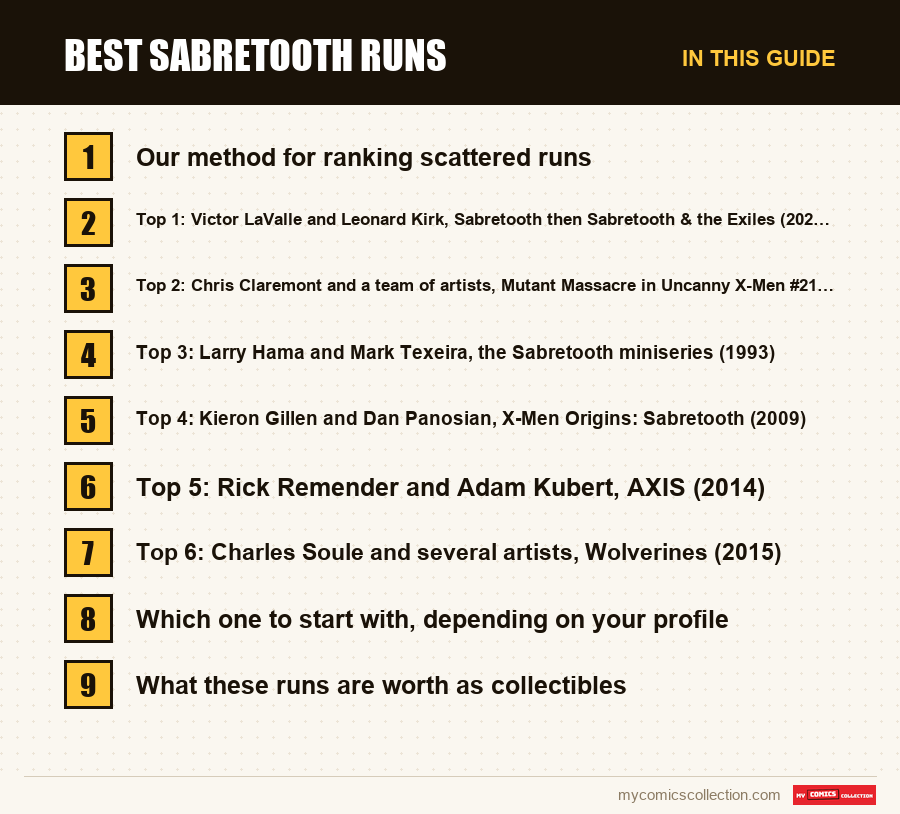
Top 5: Rick Remender and Adam Kubert, AXIS (2014)
A moral inversion spell hits the Earth: heroes turn cruel, villains turn good. For Creed the effect is paradoxical, since he leaves brutality behind for a form of conscience and so begins, inside the main continuity, a long road to redemption that other writers will build on. Rick Remender writes the event on the scale of the Avengers and the X-Men, and Adam Kubert draws it.
AXIS ranks fifth for a structural reason: Sabretooth is not its subject but its pivot. You read a single chapter of his trajectory, useful mostly because it explains the series that follow. The story requires knowing the teams involved and assumes a partial reading of the associated miniseries, which makes it a pick for an established reader.
It matters for the character because it makes possible the antihero of the following years, right up to the shift to Krakoa. For the collection, the event exists in recent single issues and in a collected edition, with variant covers whose nature is worth checking before you buy. Fans of the writer can explore the Rick Remender hub.
Top 6: Charles Soule and several artists, Wolverines (2015)
The weekly series Wolverines follows a group of Weapon X program alumni after Logan's disappearance, with Creed in the role of a survivor rather than a hunter. Charles Soule builds a group investigation in which each issue is a piece of a puzzle, a change from the two-man duel that defines most of the character's stories. Several artists take turns, which makes for a series that is uneven visually.
It closes our ranking because it serves the mythology more than it renews it: you find Creed in a team setting, without the tension that makes him strong elsewhere. But it matters for understanding how the writers of the decade used this character once Wolverine was gone, and so it is for readers who have already worked through the first four entries.
For the collection, the weekly series produced around twenty issues that are easy to find in the bins, and a collected edition keeps you from losing the thread. It is the cheapest in search effort of the whole list.
Which one to start with, depending on your profile
If you want a modern, self-contained story of rare coherence, start with LaValle and Kirk: the series runs ten issues and reads without knowing thirty years of continuity. If you want to understand why the character has been frightening since 1986, start from Mutant Massacre, reading the four Uncanny X-Men issues first before venturing into the tie-ins.
The reader in a hurry will pick the Gillen and Panosian one-shot, which offers a complete portrait in a single issue. Whoever likes the 1990s will take the Hama and Texeira miniseries, with its pages so marked by the era. The reader who follows current X-Men news will keep AXIS and Wolverines to understand the character's recent evolution.
Finally, if you are just discovering Logan's world, our ranking of the best Wolverine runs will give you the context that is missing here, because Creed only comes into full relief as a mirror.
What these runs are worth as collectibles
The value of a run is measured by the ratio between how scarce the issues are and how hungry buyers are, never by a raw figure. For Sabretooth the hierarchy is clear: period issues of Mutant Massacre sell at prices close to those of the series they sit in, while the 2022-2023 series sells at the price of a modern issue and benefits from no scarcity. The issues that move are the ones carrying a lead role, a first meeting or a memorable duel.
The method we recommend: for each entry, spot the pivotal issue, compare three completed sales in equivalent condition, then do not pay more for a variant cover without knowing its original ratio. Collected editions are judged on their contents: a volume gathering the four issues of an arc is better than four separate purchases if you read, and worse if you are after condition. To gauge what each issue weighs, lean on our guide to the value of Sabretooth comics.
One last marker: demand follows mutant news. An announcement of an adaptation, a crossover or a relaunch moves the issues tied to the character, sometimes without warning; patient buyers build up a stock of arc issues before the announcement, not after.

Frequently asked questions
For reading quality, the Sabretooth series by Victor LaValle and Leonard Kirk (2022-2023) tops our ranking, because Victor Creed is finally the subject of a sustained story there. Mutant Massacre, in Uncanny X-Men, remains the stretch that explains why the character is frightening.
Yes, several. The 1993 miniseries by Larry Hama and Mark Texeira, four issues, is his first major solo story. Victor LaValle's 2022 series, continued by Sabretooth & the Exiles, is the most accomplished. The rest of his career is scattered across the titles devoted to Logan and to mutant teams.
It is not essential for the short stories, such as Kieron Gillen's one-shot or the 2022 series. However, Mutant Massacre and the underlying rivalry are better read after a few Wolverine stories, because Creed is Logan's mirror and gains relief by contrast.
Collected editions work if you want to read without chasing every issue, especially for Mutant Massacre and its scattered tie-ins. Single issues make sense for the period issues and for recent series, which are easy to find. For condition and original cover, only the single issue counts.
Both, depending on the era. For twenty years he is a pure antagonist of Wolverine; the alternate reality of Age of Apocalypse shows him on the heroes' side, and AXIS opens in main continuity a period of antihero status that leads up to the Krakoa era.
Got a 1986 X-Men issue or a Sabretooth miniseries? Check its value before you put it away.
Estimate my comic