
In short
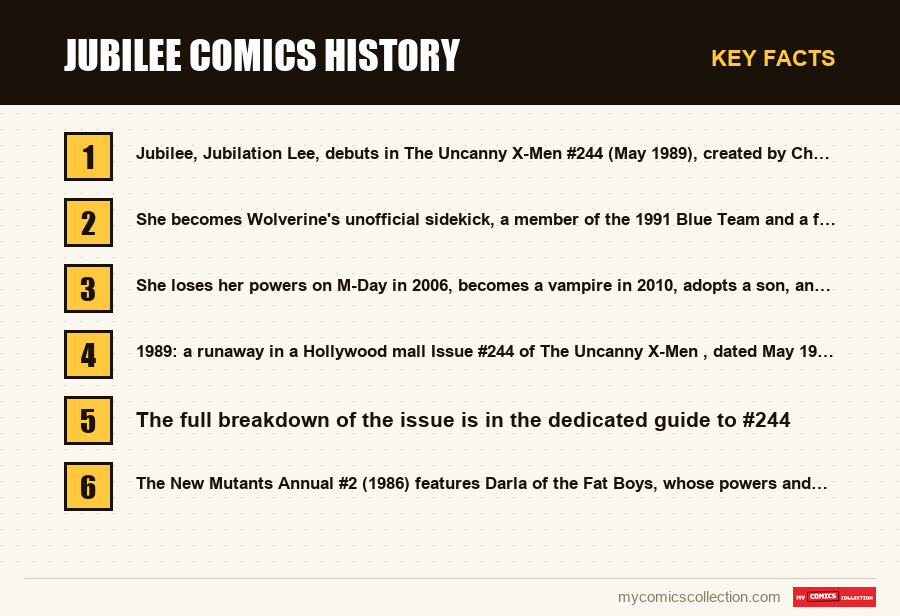
Jubilee, Jubilation Lee, debuts in The Uncanny X-Men #244 (May 1989), created by Chris Claremont and Marc Silvestri. She becomes Wolverine's unofficial sidekick, a member of the 1991 Blue Team and a founding student of Generation X (1994-2001). She loses her powers on M-Day in 2006, becomes a vampire in 2010, adopts a son, and has her powers restored in the 2017 Generation X series.
Jubilee is a late-1980s X-Men creation who has stayed in the franchise for more than three decades. Her publication history is a sequence of reinventions: runaway, sidekick, student, mentor, powerless ex-mutant, vampire and parent. Each one corresponds to a particular creative moment, and following them in order explains why her books are scattered across so many series.
Names, issue ranges and years in this timeline were matched to the character's printed record up to the Krakoan period, whereas the reading of each reinvention is ours, and nothing from the pages is quoted.
1989: a runaway in a Hollywood mall
Issue #244 of The Uncanny X-Men, dated May 1989, brings Jubilee in; she is created by writer Chris Claremont and artist Marc Silvestri. Jubilation Lee is a teenager born in Beverly Hills to Chinese immigrant parents, who are murdered by the hitmen Reno and Molokai. She ends up hiding in the Hollywood Mall, where she discovers her powers while fleeing security.
The M-Squad comes after her, and Dazzler, Psylocke, Rogue and Storm rescue her from it; she then follows them through a portal to the Outback hideout the team uses at that time. The detail that deserves a collector's attention is the setting: the debut is staged in the team's Outback years, not in the school-based books that precede and follow them. The full breakdown of the issue is in the dedicated guide to #244.
A similar character had appeared three years earlier. The New Mutants Annual #2 (1986) features Darla of the Fat Boys, whose powers and self-introduction echo Jubilee's. The story never links the two, so treat the annual as a curiosity rather than an earlier debut.
The power she arrives with is the one that defines her visual identity: pyrotechnic energy plasmoids she calls fireworks, which obey her mental control and which she can absorb back without harm. She is also immune to telepathy, which keeps her hidden from telepaths. The first editorial decision about Jubilee was to make her young, funny and out of place among veteran heroes, and almost every later chapter builds on that contrast.
1989 to 1991: the youngest member and Wolverine's shadow
From the Outback she finds Wolverine, a captive of the Reavers, and nurses him back to health until the Reavers hunt them both down. That sequence establishes the bond that organizes the next several years, with Jubilee as the young partner at his side. The wider Wolverine collection is organized on the Wolverine hub.
Her regular slot in The Uncanny X-Men lasts until #280 (September 1991). Meanwhile the 1991 relaunch of X-Men puts her on the Blue Team; #4-5 (January and February 1992) document that membership. She is also Wolverine's sidekick in Wolverine vol. 2 #40-75, published between 1991 and 1993, and that stretch closes with #75 (November 1993).
Taken together, these books show the editorial use of the character: a young viewpoint who asks the questions an outsider would ask, in two flagship franchises at once. For a collector, this period explains why her appearances from 1989 to 1993 cut across The Uncanny X-Men, X-Men and Wolverine, rather than sitting inside one title. The same era frames the careers of Storm and Psylocke, who were on the page at her debut.
1994 to 2001: the Phalanx Covenant and Generation X
The next change is structural. After the Phalanx Covenant storyline, which runs through X-Men #16-17 and The Uncanny X-Men #316-317, Jubilee is transferred to a trainee squad. That team, Generation X, is introduced in The Uncanny X-Men #318 (November 1994) and is created by writer Scott Lobdell and artist Chris Bachalo.
Generation X gets its own monthly series: issues #1-75, running from 1994 to 2001. The founding cast in the first issues includes Chamber, Husk, Jubilee, M, Skin and Synch, with Banshee and Emma Frost as the mentors. Jubilee is a founding member and appears across the whole run, from #1 to #75. The mentor who shapes the book is covered in the Emma Frost comics history.
This is the period when the character acquires a past with stakes. In the series she tracks down Hunter Brawn, her parents' killer, blows up his warehouse and leaves him to be arrested instead of killing him. The decision answers the question left open by the debut: the orphan from #244 does not become a vigilante. It also marks the point where she stops being only the youngest person in the room and begins to carry a story of her own.
For collectors, 1994 to 2001 is the most orderly part of her history. One series, seventy-five numbered issues, a stable team and a clear entry through #318 make this the easiest block of Jubilee comics to assemble. The difficulty is only that the opening issues sit across two titles, so the Phalanx Covenant chapters are worth reading alongside the first Generation X issues.
2002 to 2005: back on the X-Men roster, and a first solo series
After the end of Generation X, Jubilee returns to the main team's books. She joins X-Corporation in The Uncanny X-Men #403-406 (2002), and she is a team member in issues #423-437 (2003-2004). It is a quieter phase, with the character now an adult-adjacent presence among larger rosters.
In 2004 she receives a six-issue self-titled limited series written by Robert Kirkman, whose own page on this site is at Robert Kirkman. A limited series is a different commercial proposition from a monthly book: it signals that the publisher considers the character strong enough to carry a short run, though not a permanent one.
This stretch matters mostly as a bridge. The years from 2002 to 2005 do not alter what Jubilee is, but they keep her in print and prepare the ground for the biggest change to her powers that the franchise would make.
2006: M-Day and the years as Wondra
Her powers vanish with most of the mutant population when the Scarlet Witch rewrites reality, and the issue that shows it, House of M: The Day After #1, is dated January 2006. The consequence for the character is stark: the one thing that made her unusual is gone, and a hero defined by spectacle has none.
She adopts the alias Wondra and joins the reconstituted New Warriors, in volume 4, issues #1-20 (2007-2009). The role shifts her from the X-Men's world of mutant identity to a team of young heroes, and the time in a different franchise is a notable part of her record.
This phase is easy to overlook when you list her key issues, since it is not tied to one famous book. But it is the earliest sign of a pattern in Jubilee's later history: when the franchise needs a character who has lost something and has to reinvent her place, she is the one it uses.
Do you collect this series?
Track what you own, what you are missing and what your collection is worth. 7-day trial.
Start my trial →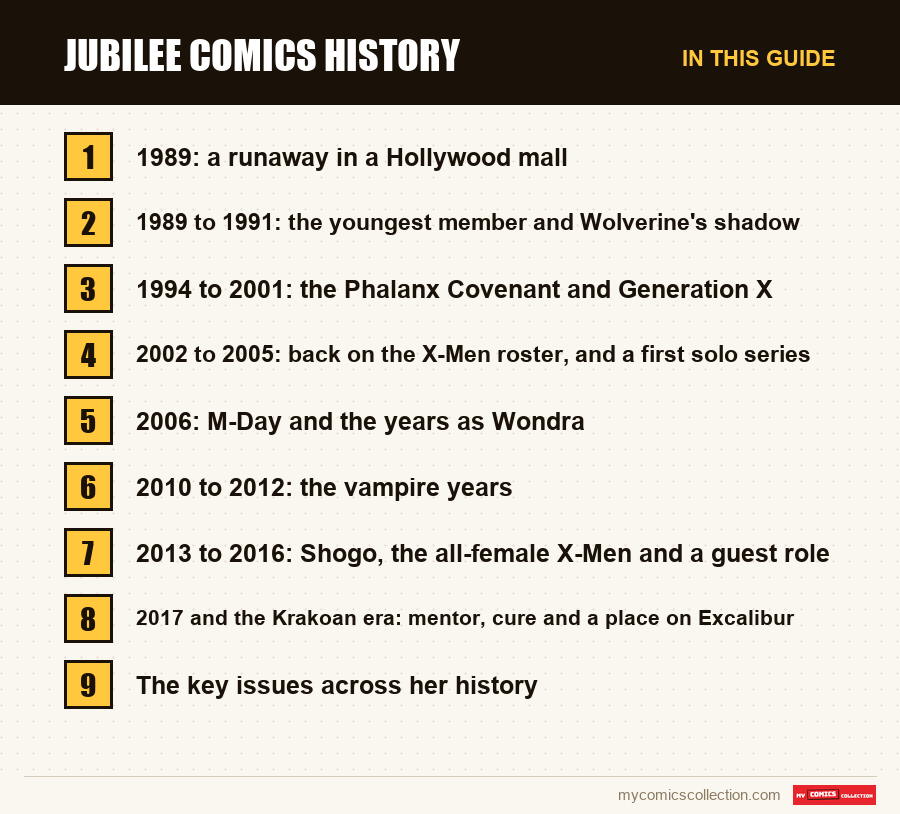
2010 to 2012: the vampire years
The next transformation comes through the "Curse of the Mutants" storyline. A bio-engineered virus spread by a vampire suicide bomber turns Jubilee into a vampire, and the change is told in X-Men vol. 3 #1 (2010). She stays a sporadic presence in that series through #27 (2012) and is a supporting character in X-23 vol. 3 (2010-2011).
Her own spotlight in the period is Wolverine and Jubilee, a four-issue limited series from 2011 written by Kathryn Immonen and drawn by Phil Noto. The title restores the old pairing in a new setting, and it is the one book in this stretch whose name alone tells you the content.
Vampirism is the most unusual identity in her record, and it is also the one that most clearly depends on the event cycle of the time. Collectors who want the whole arc should follow it through the crossover and the series, because the single issues rarely make sense on their own. The result for Jubilee is a long period in which she is a character in the middle of a story, not the person the story is about.
2013 to 2016: Shogo, the all-female X-Men and a guest role
With the Marvel NOW! relaunch, Jubilee returns as a regular in the all-female X-Men vol. 4, issues #1-25 (2013-2015). In #1 (July 2013) she takes in an orphaned baby, Shogo, who is infected with Arkea. During Battle of the Atom (September and October 2013), Sentinel X is revealed to be a grown Shogo, and in #7 (January 2014) Storm confirms the adoption.
This is a distinct change of role. For twenty-five years Jubilee had been the youngest person in the story, and in 2013 she becomes a parent. The change gives the character a lasting stake that does not depend on powers or on any one team, and it is the clearest piece of continuity in her recent history. She then supports Patsy Walker, a.k.a. Hellcat! in 2016.
2017 and the Krakoan era: mentor, cure and a place on Excalibur
Jubilee returns to Generation X in the 2017-2018 volume 2 as the adult mentor to a new group of teens, in #1-9 and #85-87, an inversion of her place as a student in the first series. Quentin Quire had already cured her vampirism with a shard of the Phoenix Force at the Xavier Institute, and this run leaves her cured with her mutant powers restored.
Once Krakoa becomes the mutant homeland, she joins a new Excalibur beside Betsy Braddock, Captain Britain, Rogue, Gambit and Apocalypse, a team that investigates the link between Otherworld and the island. The overall shape is a circle: the student of 1994 becomes the teacher of 2017, and the character who lost her powers has them back.
The key issues across her history
- The Uncanny X-Men #244 (May 1989): the debut, by Chris Claremont and Marc Silvestri.
- The Uncanny X-Men #280 (September 1991): the end of her regular run as a team member in the original series.
- X-Men #4-5 (January and February 1992): the Blue Team years.
- Wolverine vol. 2 #75 (November 1993): the end of her time as his sidekick.
- The Uncanny X-Men #318 (November 1994): Generation X is introduced, by Scott Lobdell and Chris Bachalo.
- Generation X #1 (1994): the first issue of the seventy-five-issue run.
- House of M: The Day After #1 (2006): the powerless Jubilee who will soon call herself Wondra.
- X-Men vol. 4 #1 (July 2013): she takes in the baby Shogo.
How to follow Jubilee in a collection
Start with the debut, then choose a path by role. For the Wolverine pairing, follow Wolverine vol. 2 from #40 to #75. For the team years, follow X-Men from 1991 and then Generation X from #1. For recent history, Generation X vol. 2 and the Krakoan books are the entry points. The reading order for a first purchase is set out in the best Jubilee comics guide.
Numbering is the main trap. Because The Uncanny X-Men, X-Men and Wolverine were each renumbered over the years, and X-Men vol. 3 (2010) and vol. 4 (2013) are different books, confirm volume and year before you pay. Treat the vampire years as a block that is best collected with its crossover, and treat the Kirkman and Immonen miniseries as short, complete purchases. Where you only want to read the story, collected editions of the main runs are a lower-risk route than single issues.
Frequently asked questions
The writer is Chris Claremont, the artist Marc Silvestri, and the book is The Uncanny X-Men #244 from May 1989. She is introduced as a teenage runaway living in a Hollywood mall, rescued from the M-Squad by four X-Men and brought through a portal to their Australian Outback base.
Jubilee was a founding member of Generation X, introduced in The Uncanny X-Men #318 (November 1994). She starred in the whole of the first series, issues #1-75, which ran from 1994 to 2001. She returned in the 2017-2018 volume 2, this time as the adult mentor.
She lost her mutant powers on M-Day, the event in which the Scarlet Witch's reality-altering act stripped most mutants of their abilities. The powers return only in the 2017-2018 volume of Generation X.
A bio-engineered virus spread by a vampire suicide bomber during the "Curse of the Mutants" storyline turned her into a vampire, and the change appears in X-Men vol. 3 #1 (2010). Quentin Quire later cured her with a shard of the Phoenix Force.
Shogo is an orphaned baby, infected with Arkea, whom Jubilee takes in during X-Men vol. 4 #1 (July 2013). During Battle of the Atom in 2013, Sentinel X is revealed to be a grown Shogo, and Storm confirms the adoption in #7 (January 2014).
If you own Jubilee books from The Uncanny X-Men #244 to Generation X, a free valuation shows where your copies stand.
Estimate my comic