
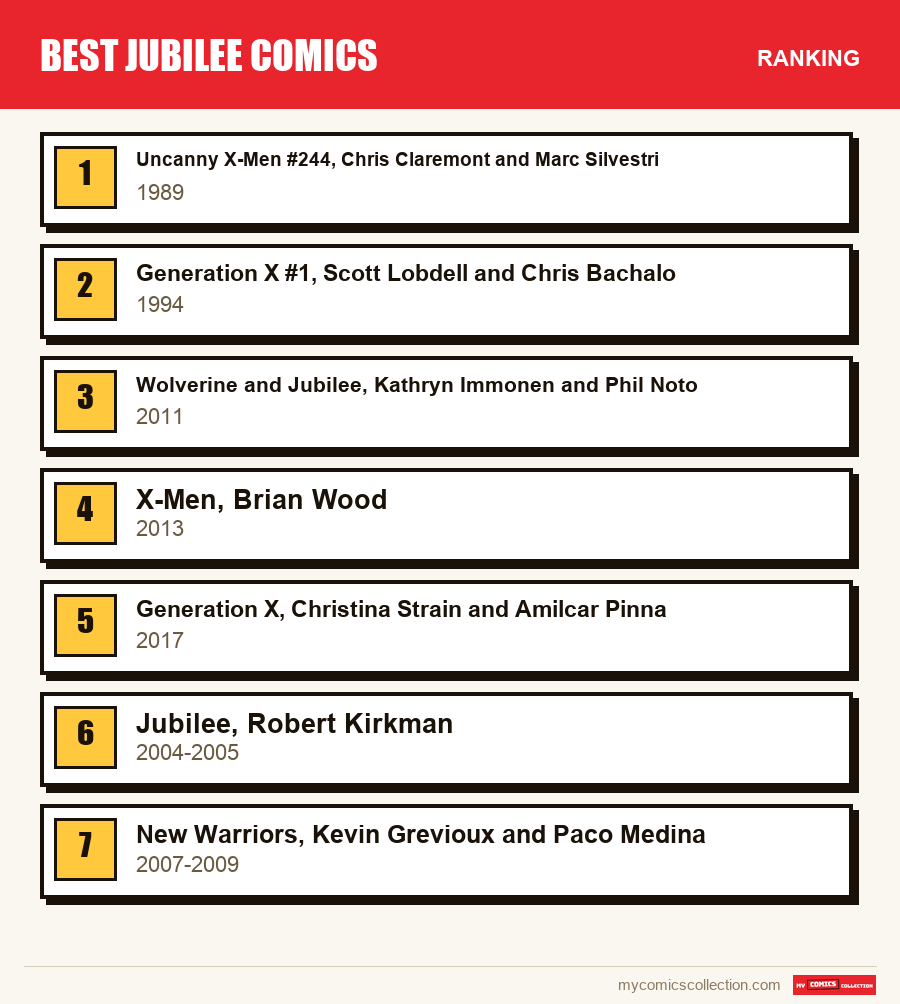
To find the best Jubilee comics and where to start, open The Uncanny X-Men #244 (May 1989) by Chris Claremont and Marc Silvestri, her first appearance. Continue with Generation X #1 (November 1994) by Scott Lobdell and Chris Bachalo, then Wolverine and Jubilee (2011) for the vampire period. Recent readers can finish with Generation X (2017), where she leads a class of mutants.
A Chinese-American teenager from Beverly Hills, a mall regular able to project bursts of colored energy, Jubilee has moved through three decades of X-Men stories under several statuses: recruit, Wolverine's sidekick, student, depowered, vampire, then teacher. This guide ranks seven reads to help you follow these stages without reading the bibliography out of order.
As always in this guide, we only state verified information (creators, issue numbers, dates); the analysis is our own, with no reproduction of protected art or dialogue.
Her first appearance
Jubilee was born in The Uncanny X-Men #244, dated May 1989. Claremont wrote the text, Silvestri the pages. The issue arrives right after the end of the big Inferno crossover: rather than extending the battle, Claremont and Silvestri make it an atmospheric epilogue, a breather that shifts the tone before the rest of the series.
For the collector, this issue is the character's entry piece, and it remains a regular-series issue, with no complication from a British printing or a special. It has also been reprinted in several collections devoted to Jubilee: you find it at the front of the Primer volume of the 2013 X-Men series as well as in the hardcover devoted to Wolverine and Jubilee. Reading the original or the collection therefore comes to the same thing, story-wise.
Jubilee remains a full member of the X-Men in Uncanny X-Men up to issue 280, then she follows Wolverine, before moving to the Generation X team. The entries below follow this trajectory, from apprentice to adult.
1: Uncanny X-Men #244, Chris Claremont and Marc Silvestri (1989)
This is the essential entry: an issue dated May 1989 that introduces Jubilation Lee, her explosive powers, and her character as an ordinary bystander dragged into the mutant war. Claremont sets the character's voice in a few pages, and Silvestri fixes her look, which explains why the character sticks from the first read.
Who is it for? Any reader curious about Jubilee, with no prerequisites, including someone who has read no Uncanny X-Men at all. How to read it? On its own, like a short story, or in the 2013 Primer collection, which places it before the first issues of the series led by Brian Wood. To place the issue within the parent series, see our selection of the key issues of Uncanny X-Men.
2: Generation X #1, Scott Lobdell and Chris Bachalo (1994)
Issue 1 of Generation X is dated November 1994. The team debuted the same month in Uncanny X-Men #318, during the Phalanx Covenant arc, and the regular series settles its students at Xavier's mansion in a chapter titled "Third Genesis." Scott Lobdell writes, Chris Bachalo draws, Mark Buckingham inks, and the cover goes to Bachalo and Buckingham.
Jubilee is one of the students there, alongside White Queen, Banshee, Husk, Synch, M, Skin, Chamber, and Penance. The series runs 75 issues, from 1994 to 2001, plus a run of annual specials: it is the character's longest showcase, and the one where she becomes a heroine in her own right rather than a young recruit. There you will see Jubilee learn to control her powers in a school setting, far from the big teams of the parent series.
The reader of this installment will also find Emma Frost in her teacher role, a useful counterpoint if you have read our page on Emma Frost. Start with issue 1 and read a few issues in a row before deciding whether to continue with the whole series.
3: Wolverine and Jubilee, Kathryn Immonen and Phil Noto (2011)
Kathryn Immonen writes and Phil Noto draws this four-issue miniseries, released in 2011. It follows Curse of the Mutants, the event launched in 2010 by X-Men #1, written by Victor Gischler and drawn by Paco Medina, in which Jubilee is infected with vampire blood after an attack in San Francisco.
This story is for the reader who wants to see how Jubilee copes with her new condition, facing Wolverine, with whom she shared many episodes. Between 1991 and 1993, she was already his sidekick in the Wolverine series, issues 40 to 75: the bond goes back a long way, and the miniseries plays on it. The whole is published in hardcover under the title Curse of the Mutants, which also collects issue 244 of Uncanny X-Men.
Read it in a collected edition: four issues read in one sitting. Having skimmed the start of the 2010 event helps, but the miniseries can be followed around its central duo.
4: X-Men, Brian Wood (2013)
In 2013, Marvel relaunches X-Men with an all-female team, written by Brian Wood. Issue 1, drawn by Olivier Coipel, brings together Storm, Jubilee, Rogue, Kitty Pryde, Rachel Grey, and Psylocke. Jubilee is on the team for all 25 issues of the series, from 2013 to 2015.
The series suits anyone who wants to find Jubilee in a group of adult characters, with figures who each have their own page in our ranking: think of Kitty Pryde and Psylocke. The first collected edition, Primer, collects issues 1 to 4 and adds Uncanny X-Men #244, which lets you read Jubilee's debut and the 2013 series in one volume.
Watch the numbering: this is the fourth X-Men series, not to be confused with those of 1991 or 2010. A collector who orders without checking risks receiving a different volume.
5: Generation X, Christina Strain and Amilcar Pinna (2017)
The new Generation X arrives in 2017 as part of the ResurrXion event. Issue 1 is written by Christina Strain and drawn by Amilcar Pinna, with a cover by Terry Dodson. The Xavier Institute reopens its doors to a class of young mutants, and Jubilee, back from a stint with Patsy "Hellcat" Walker, becomes its cornerstone as a teacher.
This installment extends the 1994 series: we follow an adult who passes on what she has learned, in a school for outcasts. It is also in this series that Jubilee is cured of vampirism and regains her powers. The series runs nine issues before returning to the numbering of the Marvel Legacy era (issues 85 to 87), twelve issues in all.
It is for today's reader who wants a readable team story without knowing the whole history. Read it after entry 2 to measure the distance traveled, or on its own if you have never opened the 1994 series.
Do you collect this series?
Track what you own, what you are missing and what your collection is worth. 7-day trial.
Start my trial →
6: Jubilee, Robert Kirkman (2004-2005)
Jubilee also gets her own six-issue series, written by Robert Kirkman and published from November 2004 to April 2005. It is a short series, collected in one volume, that puts the character at the center without requiring knowledge of the X-Men news of the moment. To place the writer, see the page devoted to Robert Kirkman.
Who should you recommend it to? The reader who likes standalone miniseries and wants a headlining Jubilee. How to read it? After Generation X and before the loss of her powers: its date, 2004-2005, puts it before House of M, when Jubilee still has her abilities. Reading in publication order avoids misreadings.
7: New Warriors, Kevin Grevioux and Paco Medina (2007-2009)
In House of M: The Day After #1 (January 2006), Jubilee loses her mutant powers. She reappears in the fourth New Warriors series, launched in 2007, under the name Wondra, in a team of characters stripped of their powers. The series runs twenty issues, until 2009; Kevin Grevioux writes, Paco Medina draws the first issues, and Reilly Brown takes over from issue 14.
This entry interests the reader who wants to fill in the period when Jubilee is no longer a mutant. It is not the most accessible entry point, but it is the link that explains how she goes from the end of the Kirkman period to the 2010 vampire storyline. Read it last, once you have gone through the previous entries.
Where to start based on your profile
The reader in a hurry starts with Uncanny X-Men #244, in the Primer collection if you prefer a bound volume to the single issue. The one who likes the atmosphere of the 1990s opens Generation X #1 and reads the first twelve issues. The reader drawn to the character's dark side goes straight to Wolverine and Jubilee, having skimmed X-Men #1 from 2010 to understand the San Francisco attack.
If you read current series instead, the 2017 Generation X is the most direct. The collector who wants a coherent library will choose one landmark per period: an issue from 1989, one from 1994, one from 2011, one from 2013, one from 2017. This method avoids buying a whole series for a character who, at times, only plays a supporting role in it.
The key issues to know
To start, remember The Uncanny X-Men #244 (May 1989), where Jubilee makes her entrance. The second landmark is Wolverine (second series) #40, the start of the period when she accompanies Wolverine, from 1991 to 1993. The third landmark is The Uncanny X-Men #318 (November 1994), where the Generation X team debuts, followed by Generation X #1, dated the same month.
Then come two turning points: House of M: The Day After #1 (January 2006), which takes her powers away, and X-Men #1 from 2010, which infects her. On the recent side, Generation X #1 from 2017 puts her back in the teacher's seat. For each issue, ask yourself one question: does it fix a state of the character or open a period? A starting landmark is hunted for its position in the bibliography, a transition landmark for the story it tells.
Before buying, identify the exact edition of your copy: the same issue can exist as a newsstand printing or a direct market printing, and some series carry the same title under different numberings. Once your list is set, compare copies of the same grade, and not only the listing's claims.
How to read in collections or single issues
Jubilee's stories lend themselves well to collections. Primer covers her debut and the 2013 return, the Wolverine and Jubilee hardcover groups the 2011 miniseries with the 1989 issue, and the 1994 series reads in blocks. Single issues are for those who want a precise landmark in their boxes, rather than a complete run.
For a long series like Generation X, it is better to choose a block of twelve issues than to aim for the whole. For the short series, the 2004 miniseries and the 2011 one, the complete collection fits in a single box and stays easy to complete.

Frequently asked questions
Jubilee appears in The Uncanny X-Men #244, dated May 1989. She was created by Chris Claremont on script and Marc Silvestri on art. This issue is a quiet epilogue after the Inferno crossover, and it has been reprinted in several collections devoted to the character.
Start with The Uncanny X-Men #244, then move to Generation X #1, by Scott Lobdell and Chris Bachalo (November 1994). If you prefer a recent, easy-to-access series, open the 2017 Generation X, written by Christina Strain. Neither series requires reading the whole X-Men history first.
The shift happens during the Curse of the Mutants event, launched in 2010 in X-Men #1, written by Victor Gischler and drawn by Paco Medina. The miniseries Wolverine and Jubilee (2011), by Kathryn Immonen and Phil Noto, explores the aftermath. She is later cured in the 2017 Generation X series.
Yes. She loses her mutant powers in House of M: The Day After #1, dated January 2006. She then joins the New Warriors under the name Wondra, in a twenty-issue series published from 2007 to 2009. Her powers return later, in the 2017 Generation X.
The main series runs 75 issues, from issue 1 in November 1994 to June 2001, plus a -1 issue from 1997 and several annuals and specials. The initial cast, led from Xavier's mansion, includes Jubilee, Husk, Synch, M, Skin, Chamber, and Penance, with Banshee and Emma Frost among the school's adults.
An Uncanny X-Men from the Claremont and Silvestri era sitting in your boxes? Get a first reference point before deciding what to keep.
Estimate my comic