The Emma Frost comics history begins in X-Men #129 (January 1980), where Claremont writes and Byrne draws the debut of Emma Frost, White Queen of the Hellfire Club. An X-Men adversary, she switches sides, runs the school of Generation X in the 1990s, finds her diamond form and a co-leader's place under Grant Morrison and Joss Whedon, then sits on the Krakoa Council. It is one of the longest character turns in the mutant catalog.
Few characters have changed sides as gently as Emma Frost. She debuts as a telepathic businesswoman in the service of a secret club, and three decades later she shares the leadership of the X-Men. That path does not hinge on a plot twist or a single series: it is written in layers, by writers with different priorities.
As always in this guide, only verified facts (creators, issues, dates) are stated; the analysis is our own, with no reproduction of protected pages or dialogue.
Her first appearance
Issue 129 of X-Men, from January 1980, sees the debut of Emma Frost; Claremont writes it, Byrne draws it. The issue is part of the Dark Phoenix Saga; it also introduces Kitty Pryde, as detailed in our entry on this issue. She holds the rank of White Queen in a secret circle where money, influence and high-society receptions meet.
Her initial role is that of an elegant adversary. Paired with Sebastian Shaw, she takes part in running the club's Inner Circle, and her telepathic gifts make her a threat who needs no physical strength. The choice of white sets the character's aesthetic: cold, composed, aristocratic.
What is interesting today is that nothing in this first appearance foreshadows the turn to come. Emma is written as an obstacle, not as a potential ally. The major shifts will come from later writers, who take the material left by Claremont and Byrne and turn it around. For context, see also the page devoted to the key issues of the Dark Phoenix Saga.
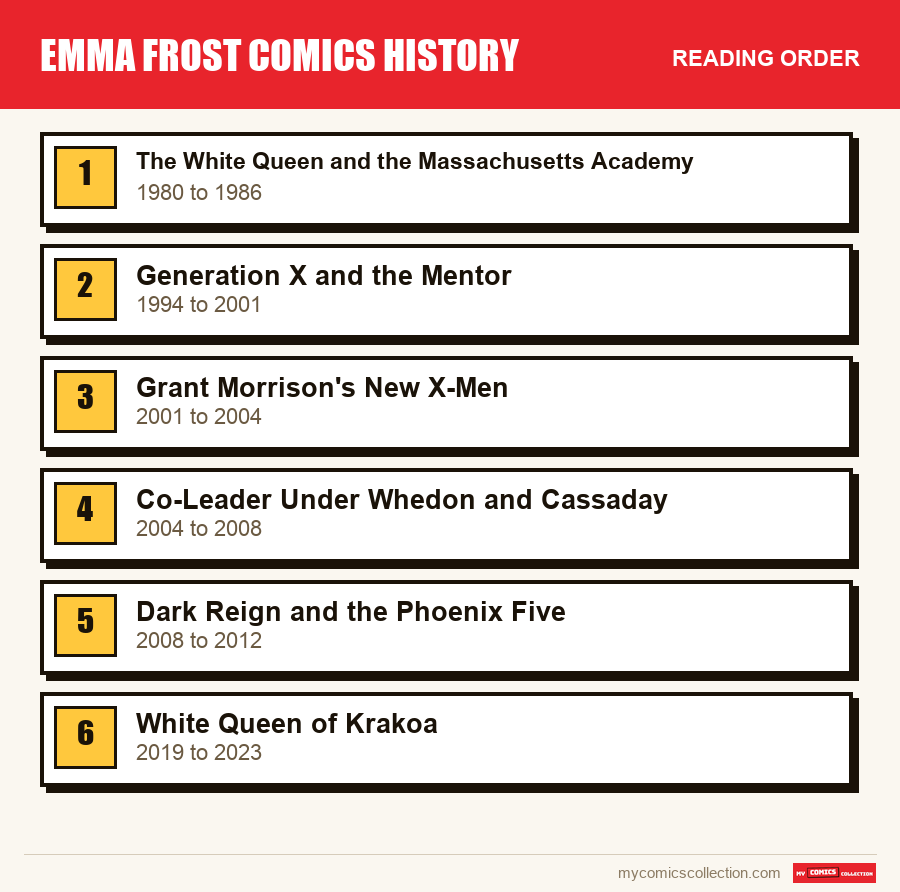
Era 1: The White Queen and the Massachusetts Academy (1980 to 1986)
Through the 1980s, Emma Frost remains anchored on the adversary side. The character is headmistress of the Massachusetts Academy and runs the company Frost International, two attributes that place her in a register of institutional power rather than that of the classic supervillain. She appears notably in the 1983 New Mutants series, where the school becomes the setting for clashes with young mutants.
The 1986 miniseries Firestar, written by Tom DeFalco and Mary Wilshire, with Steve Leialoha, also features her. For a collector, this period is made of one-off encounters more than a continuous thread: you follow Emma through series that people do not always read for her, and there is no reference run to aim for.
Yet this phase lays down the character's raw material. A reader arriving later finds the figure of the school head unsurprising: this is where she is built, before other writers turn the teaching mission into a redemption arc.
Era 2: Generation X and the Mentor (1994 to 2001)
The first real shift happens in 1994, during the Phalanx Covenant event. Scott Lobdell and Chris Bachalo create Generation X, a team of young mutants based not at Xavier's mansion but in a school in western Massachusetts. Emma Frost, now the former White Queen, shares the leadership with Banshee. The team's first appearance is in Uncanny X-Men #318, from November 1994.
The Generation X series runs from November 1994 to June 2001, from #1 to #75, with a #-1 issue in July 1997. The original members are Chamber, Husk, Jubilee, M, Penance, Skin and Synch. For Emma, the editorial stake is simple: the former adversary becomes a demanding teacher, and the reader learns to see her differently. The contrast with the 1980s is deliberately sharp.
For the collection, Generation X is completist territory: a seventy-five-issue series plus a #-1 issue, whose appeal depends on your taste for the period. The opening issues are spotted by the event they come from, and a copy of Uncanny X-Men #318 reads as a bridge issue more than a mass-market buy.
Era 3: Grant Morrison's New X-Men (2001 to 2004)
In 2001, Grant Morrison takes over the parent series, rebranded New X-Men. This is where Emma's diamond form appears, a secondary mutation that manifests during the destruction of Genosha. In this form, she gains strength and near-invulnerability, but she shuts off her telepathic powers for as long as she keeps it up. Frank Quitely's art accompanies part of this run, whose landmarks you will find in Grant Morrison: where to start.
Warning, spoiler: the series makes Emma a central figure of the team. She begins a relationship with Cyclops, at first psychic, while he is married to Jean Grey; Jean, on discovering it, humiliates Emma through telepathy. After Jean's death, the relationship between Scott and Emma becomes real, and the two become co-headmasters of the school. This shift has lasting consequences: Emma is no longer an ally of convenience, but the partner of a team leader.
Morrison's run also introduces the Stepford Cuckoos. Seen from Emma's history, it makes the character a junction point between the former mentor of Generation X and the team leader who is to follow. It is, by far, the era that did the most for her current reputation.
For a collector, Morrison's complete run is a more coherent goal than buying isolated issues: the story reads better in one sitting, and the series is dense enough to justify a continuous read before buying copies.
Era 4: Co-Leader Under Whedon and Cassaday (2004 to 2008)
Joss Whedon and John Cassaday launch a new volume of Astonishing X-Men in 2004, running until 2008, across issues 1 to 24 and a Giant-Size. Emma is co-leader there with Cyclops. The couple, established in the previous series, becomes a leadership duo here, with its tensions and its reconciliations.
Warning, spoiler: in the Torn arc, Emma, manipulated by Cassandra Nova, creates the psychic projections of a new Hellfire Club launched against the X-Men. The former White Queen is then caught in the trap of her own history, a reminder that the character's past is never quite closed.
This period has the advantage of being short and easy to read. For a collection centered on Emma, it is one of the most accessible entry points: one creative team, a clean beginning and end, and a story focused on leadership and its conflicts.
Do you collect this series?
Track what you own, what you are missing and what your collection is worth. 7-day trial.
Start my trial →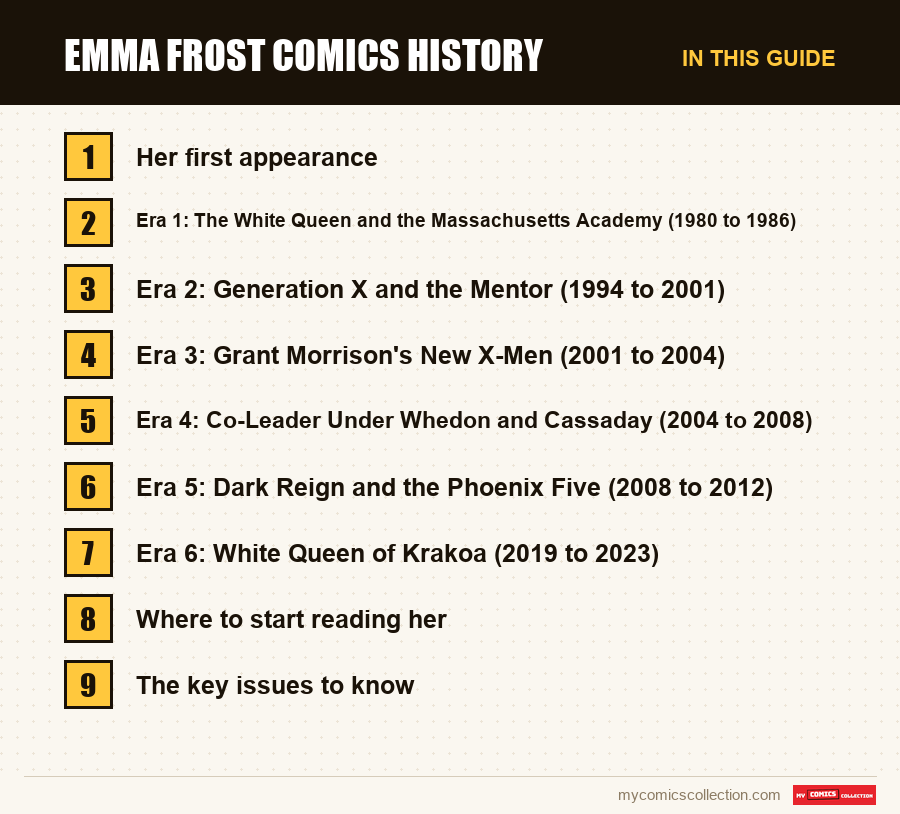
Era 5: Dark Reign and the Phoenix Five (2008 to 2012)
In 2008 and 2009, during Dark Reign, Emma joins Norman Osborn's Cabal and leads the Dark X-Men, while working as a double agent against him. The character thus returns to the ground of power and cunning that was hers originally, but this time in the service of a goal she chooses.
In 2012, Avengers vs. X-Men counts her among the five X-Men who each receive a share of the Phoenix Force. Under the Phoenix's influence, Emma kills a man guilty of a hit-and-run and reveals to Cyclops a past psychic affair with Namor. At the end of the clash, Cyclops takes back his share of the Phoenix Force. We refer you to our page on the Avengers vs. X-Men reading order for the details of the issues.
These two events show a character who is both leader and suspect, ready to cross lines that other X-Men refuse to. For the collector, these are event pieces: their interest lies in reading them alongside other titles more than in their value on their own.
Era 6: White Queen of Krakoa (2019 to 2023)
In 2019, Jonathan Hickman's twin series, House of X and Powers of X, give Emma back a place at the top of the mutant nation. The setting of this reversal is laid out in our analysis of Hickman's return. Krakoa is founded there, Emma becomes White Queen of the Hellfire Trading Company and sits on the Quiet Council, the body that governs the island. She creates the Marauders, led by Kate Pryde, to handle the black market in mutant medicines.
The loop is striking: the Hellfire Club, once a lair of adversaries, becomes a political and economic instrument of a mutant nation. Emma keeps her style, her taste for power and her coldness, but she puts them in the service of a collective project she helps to found.
For the collection, you will read this period as one continuous run, starting from the two opening series.
Where to start reading her
Her first solo series, Emma Frost, dates from 2003 and carries Karl Bollers's byline. Here are four entry points depending on your profile.
- The classics reader: X-Men #129 and the Dark Phoenix Saga, to see how Claremont and Byrne introduce her.
- The reader who likes young teams: the first issues of Generation X, by Lobdell and Bachalo.
- The reader who wants the character's turning point: Grant Morrison's New X-Men, read in one go.
- The modern reader: the twenty-four issues of Astonishing X-Men by Whedon and Cassaday, then Krakoa.
For curated reading, our selection of her best comics fits the bill; this page, for its part, unrolls her trajectory.
The key issues to know
For a collector, method matters more than the list: rank the first appearance first, then the turning points, and document every copy. The markers, with no prices:
- X-Men #129 (January 1980): debut of Emma Frost, alongside Kitty Pryde.
- Uncanny X-Men #318 (November 1994): the issue that introduces Generation X.
- Generation X #1 (November 1994): the start of the series led by Emma and Banshee.
- Morrison's New X-Men (2001 to 2004): the run that establishes the diamond form and the relationship with Cyclops.
- Astonishing X-Men #1 (2004): the start of the Whedon and Cassaday run.
- House of X (2019): the opening issue of Krakoa, with Emma at the head of the Hellfire Trading Company.
As for method, a copy should be compared with its peers by grade and printing, never by the luck of a listing. For X-Men #129, scrutinize the edge, corners and spine under raking light: quiet restoration can hide there. For 1990s series, which run to many issues, it is better to complete the series before upgrading copies one by one.
Frequently asked questions
In X-Men #129, in January 1980, by Claremont and Byrne. She appears as the White Queen of the Hellfire Club, facing the X-Men, during the Dark Phoenix Saga. Kitty Pryde debuts in the same issue, which doubles its appeal.
The turn runs through Generation X, launched in 1994 by Scott Lobdell and Chris Bachalo, where she runs a school with Banshee. Morrison then puts her at the center of New X-Men, before Whedon and Cassaday give her co-leadership of the team in Astonishing X-Men.
It is a secondary mutation that manifests during the destruction of Genosha, in Grant Morrison's run. It gives Emma strength and near-invulnerability, but it shuts off her telepathic powers while it is active. Morrison conceived it to replace Colossus's physical strength on the team.
In 2012, she is among the five X-Men who each receive a share of the Phoenix Force. In that story, under the Phoenix's influence, she kills a man guilty of a hit-and-run and reveals a past psychic affair with Namor. Cyclops takes back his share of the Phoenix in the final clash.
In the island state created by Hickman, she rules the Hellfire Trading Company and sits on the Krakoa Council. She also creates the Marauders, led by Kate Pryde, to manage the black market in mutant medicines.
Do you own an X-Men #129 or an issue of Generation X? Get its condition appraised before you sell it or insure it.
Appraise my comic