In short
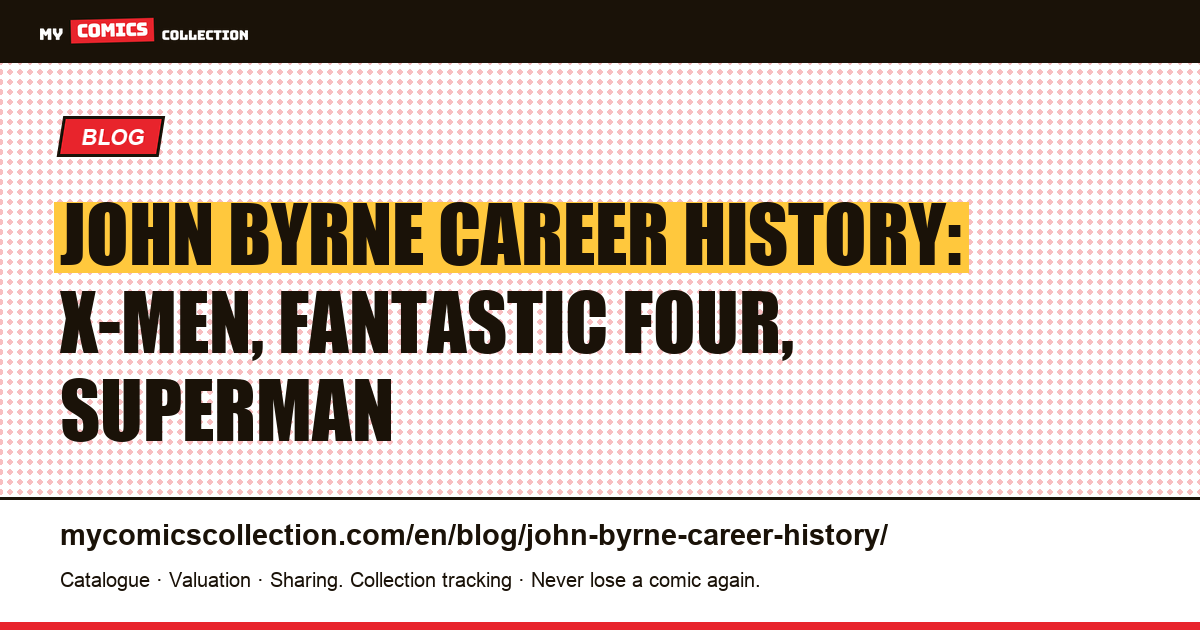
John Byrne broke in with small jobs for Skywald and Charlton in 1974 and 1975, then drew Marvel's Iron Fist before joining Chris Claremont on X-Men #108 in 1977. Byrne wrote and drew Fantastic Four from #232 in 1981, launched Alpha Flight in 1983, and relaunched Superman in The Man of Steel in 1986. After She-Hulk, Namor and the creator-owned Next Men at Dark Horse, Byrne wrote and drew Wonder Woman from 1995, then worked for IDW.
Few careers in superhero comics trace as many turns as this one: a Canadian art student who sold pages to small publishers, became the penciler Marvel leaned on for its biggest team books, then crossed to DC to rebuild its flagship hero, and later set up shop on terms set by the creator. This guide follows that path in order, period by period, so you can see why each run looks the way it does.
Every Byrne credit and issue number in this timeline was cross-checked, and a date is either a cover date or a bare year. The reading of what changed in each period is analysis, and the page deliberately skips sales figures and market talk.
From an Alberta art college to Charlton
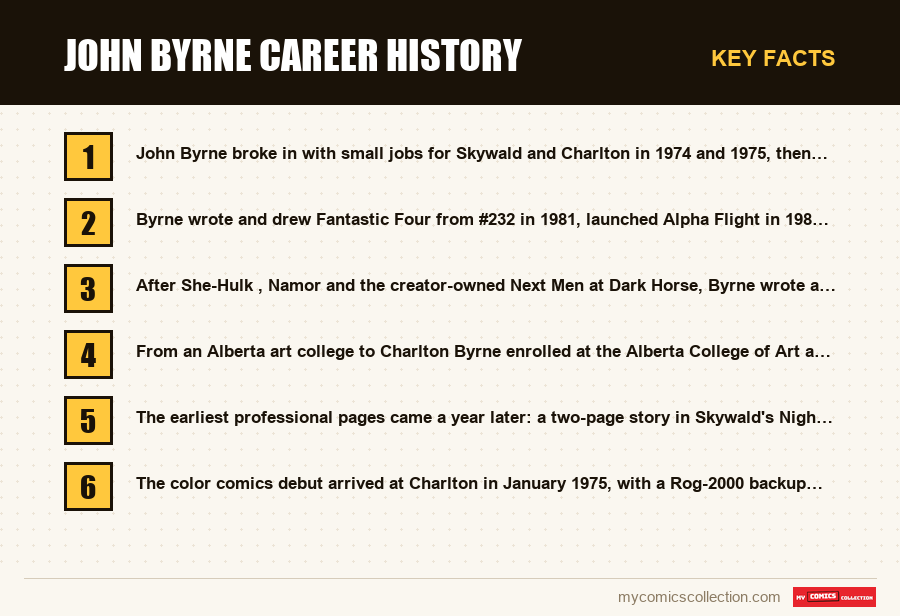
Byrne enrolled at the Alberta College of Art and Design in 1970 and left in 1973 without graduating. The earliest professional pages came a year later: a two-page story in Skywald's Nightmare #20, dated August 1974, and a fan art piece in Marvel's house magazine FOOM earlier that year. Those credits are small, but they show a young artist testing several doors at once rather than aiming at one publisher.
The color comics debut arrived at Charlton in January 1975, with a Rog-2000 backup story titled "That Was No Lady" in E-Man #6. Charlton was a modest publisher with a reputation for letting newcomers draw whole stories, and Byrne used it as a workshop. Over 1975 and 1976 the artist penciled Doomsday + 1 #1 to #6 and Space: 1999 #3 to #6 there. Byrne co-created Doomsday + 1 with writer Joe Gill, a post-apocalyptic science-fiction series where the clean, fine line is already forming.
Marvel followed in June 1975, when "Dark Asylum" ran as filler in Giant-Size Dracula #5, Byrne's first professional sale to the company. That sale matters because everything after it, in 1975 and beyond, happens in parallel: Charlton work continues while Marvel assignments grow.
Iron Fist and the Marvel Team-Up years
The assignment that moved Byrne from fill-in artist to regular penciler was Iron Fist. Byrne penciled issues #1 to #15 between 1975 and 1977, after Pat Broderick missed a deadline on the feature in Marvel Premiere and the book was offered to Byrne, who turned the first script around in time. Chris Claremont, the writer Byrne would later be paired with most famously, had pushed for Byrne to draw one of the Claremont scripts. The martial arts hero gave the artist room for dynamic choreography, and the pages were notable for tight panel storytelling.
In parallel, Byrne drew Marvel Team-Up on and off from 1977 to 1980, covering issues such as #53 to #55, #59 to #70, #75, #79, and the second half of #100. Issue #53 is also where Byrne drew the X-Men for the first time. Reading this stretch in sequence, you can watch the penciler adapt to a different guest star every month, a training ground for the ensemble work that followed.
X-Men with Chris Claremont
In December 1977, Byrne joined Claremont on X-Men #108. The title was renamed The Uncanny X-Men with #114, and from that issue on Byrne also co-plotted, not just penciled, with Terry Austin as inker. That credit change is the key to understanding the period: the stories bend toward Byrne's strengths, the tight team scenes and the dramatic confrontations, because the artist had a hand in the structure.
Byrne created Alpha Flight, Proteus, and Kitty Pryde (Shadowcat) during this stretch. The "Dark Phoenix Saga" was published in 1980. "Days of Future Past" ran in #141 and #142, dated January and February 1981, and Byrne left the title with #143 in March 1981. In other words, the run covers roughly three years and a handful of the best-known X-Men stories ever printed.
During the same years the artist kept working elsewhere at Marvel. Byrne penciled The Avengers #164 to #166 and #181 to #191, the stretch where Byrne and writer David Michelinie co-created Scott Lang in #181 (March 1979), and drew Captain America #247 to #255 from July 1980 to March 1981. In early 1980, Byrne also penciled the first issue of the DC miniseries The Untold Legend of the Batman, inked by Jim Aparo, a brief early sign of the later move across town.
Fantastic Four as writer and artist
The next step, and the biggest change of method, came in 1981. Byrne became writer and artist of Fantastic Four from #232, a run that lasted until #295, with cover dates from July 1981 to October 1986. Doing both jobs removed the plot conference that defined the X-Men years: one person now set the pace, chose the splash pages and decided which long-dormant threads to resume.
Because the run is long and unbroken, it suits a collector who wants to read one author's pages as a single block. The series keeps its own internal rhythm, with story arcs of a few issues, then change-of-pace standalone installments. Byrne's tenure is also where many readers meet the Fantastic Four as a family drama first and a science adventure second, a balance the writer-artist set deliberately by drawing the team's home life as carefully as its battles.
Alpha Flight, Hulk and the move to DC
With the Fantastic Four running, Byrne launched Alpha Flight in 1983, a title built on the Canadian team created in the X-Men years. The artist wrote and drew issues #1 to #28 through 1985, then moved on. The series shows the writer-artist model applied to a brand new cast: no inherited continuity, a new set of heroes, and the freedom to invent. Also in 1983 came The Further Adventures of Indiana Jones #1 and #2, co-written and penciled by Byrne, and Byrne also wrote and drew The Incredible Hulk #314 to #319.
The big change arrived in 1986. As the Fantastic Four run came to its end, Byrne moved to DC to reintroduce Superman in the six-issue miniseries The Man of Steel, published in 1986. In January 1987, Byrne began the new Superman volume 2 as writer and artist, then took on Action Comics from #584 and wrote Adventures of Superman #436 to #442 and #444. The artist also produced three four-issue miniseries, The World of Krypton, The World of Metropolis and The World of Smallville. That is a whole redefinition of a character, executed through the same single-author method as Fantastic Four.
Do you collect this series?
Track what you own, what you are missing and what your collection is worth. 7-day trial.
Start my trial →
Back at Marvel: She-Hulk, Namor, Iron Man
Even before leaving Superman, Byrne took over Marvel's Star Brand, revamped in 1987, with #11, a title that was canceled eight issues later. The full return to Marvel came in 1989. The more lasting work began in 1989 with The Sensational She-Hulk, where Byrne wrote and drew the first eight issues and returned for #31 to #46 and #48 to #50, through 1993. The series is notable because it broke the fourth wall and played the lead for comedy, a very different tone from the Superman books.
In 1989 and 1990 the artist also wrote and drew West Coast Avengers #42 to #57, retitled Avengers West Coast, a run that introduced the Great Lakes Avengers. In April 1990, Namor, the Sub-Mariner launched with Byrne writing and drawing #1 to #25, then writing #26 to #32. From July 1990 to February 1992, Byrne wrote Iron Man #258 to #277. By this point the pattern is clear: Marvel handed over a character, and Byrne rebuilt the cast and the setting in a few years.
Legend, Dark Horse and creator-owned work
The next change was about ownership rather than publisher. In 1992 Byrne launched John Byrne's Next Men at Dark Horse, with a #0 issue and then #1 to #30 through 1994, and was one of the creators who banded together to form the Legend imprint at Dark Horse. The series follows young people with powers produced by a secret program, and it is the clearest place where Byrne's own plotting meets no editorial brief.
1994 brought Danger Unlimited and Babe, and Byrne scripted the four-issue Hellboy: Seed of Destruction for Mike Mignola that year. The Legend years are the shortest chapter of the career, but they matter for collectors because they show the artist testing a self-directed model at a company other than Marvel or DC.
Wonder Woman, Fourth World and the later years
The return to DC came in 1995. Byrne wrote and drew Wonder Woman volume 2 from #101 to #136, finishing in 1998, and created Cassie Sandsmark, the second Wonder Girl, in the run. The same period brought the Marvel/DC crossover Darkseid vs. Galactus: The Hunger, issues #12 to #15 of New Gods volume 4 from the end of 1996, and then Jack Kirby's Fourth World #1 to #20 from 1997 to 1998. Between 1999 and 2004, the three Superman & Batman: Generations series stretched the heroes across decades.
Marvel work in the late 1990s ran alongside: Spider-Man: Chapter One from December 1998, The Amazing Spider-Man volume 2 #1 to #18 in 1999 and 2000, Hulk #1 to #7 in 1999 with Ron Garney on art, and X-Men: The Hidden Years, written and drawn by Byrne for 22 issues until its cancellation. In 2004, Byrne co-wrote and drew JLA #94 to #99, the "Tenth Circle" arc, then wrote and drew Doom Patrol volume 4 #1 to #18. From 2005 to 2006, the artist returned to Action Comics #827 to #835, written by Gail Simone.
From 2008 onward the center of gravity shifted to IDW: FX #1 to #6 from March 2008, Star Trek titles from 2008 through 2018, and a revival of Next Men in 2010. From 2019 to 2022 came X-Men Elsewhen #1 to #32, a webcomic that imagines how the X-Men story would have continued. The career thus closes in the way it began, with Byrne controlling the pages and publishing in the channels that suit the work.
The key issues across the career
- Iron Fist #1 (1975): the series where Byrne becomes a regular Marvel penciler, after Pat Broderick missed a deadline.
- X-Men #108 (December 1977): Byrne joins Claremont on the title.
- The Avengers #181 (March 1979): Scott Lang, co-created with David Michelinie, appears.
- The Uncanny X-Men #141 (January 1981): the start of "Days of Future Past," concluded in #142.
- Fantastic Four #232 (July 1981): Byrne begins as writer and artist.
- Alpha Flight #1 (1983): the writer-artist launch of the Canadian team.
- The Man of Steel #1 (1986): the DC relaunch of Superman.
- Wonder Woman volume 2 #101 (1995): Byrne begins writing and drawing the title.
How to collect John Byrne
Start from the method, not the checklist. Pick the three jobs that define the career, the Claremont X-Men stretch, the Fantastic Four block from #232, and The Man of Steel with the Superman volume 2 launch, and decide whether you want original issues or reprints. Original runs from the late 1970s are older and scarcer than the 1986 miniseries, so a staged approach works: take the later, more available books first, then work backward.
Watch the numbering. X-Men became The Uncanny X-Men at #114, West Coast Avengers became Avengers West Coast, and Wonder Woman, Amazing Spider-Man and Hulk all have more than one volume in the period. Always note the volume and the cover date when you log an issue, and compare it with your starting guide to decide the order. For the Superman launch in particular, the Man of Steel guide explains how to tell issues apart.
Frequently asked questions
Byrne sold "Dark Asylum" to Marvel in June 1975, where it ran in Giant-Size Dracula #5. The first regular assignment was Iron Fist, penciled for issues #1 to #15 between 1975 and 1977, after a missed deadline by Pat Broderick opened the door.
Byrne joined Chris Claremont on X-Men #108 in December 1977 and left with #143 in March 1981. From #114 the book was called The Uncanny X-Men and Byrne shared the plotting. Terry Austin was the inker of the partnership, and the two-part "Days of Future Past" (#141 and #142) came just before the exit.
Byrne took over as writer and artist with Fantastic Four #232 in 1981 and stayed until #295 in 1986. The run came between the X-Men years and the move to DC, and it set the template for the long single-author runs that define the later career.
Byrne reintroduced Superman in the six-issue The Man of Steel in 1986, then wrote and drew Superman volume 2 from January 1987 and Action Comics from #584. Later DC work includes Wonder Woman #101 to #136, Generations and Doom Patrol.
John Byrne's Next Men is a creator-owned series published by Dark Horse, with a #0 issue and then #1 to #30 from 1992 to 1994. Byrne was a founder of the Legend imprint, and the series was revived at IDW in 2010.
Found a Byrne X-Men or Fantastic Four issue in your boxes? Get a quick read on it before you decide what to do.
Estimate my comic