In short
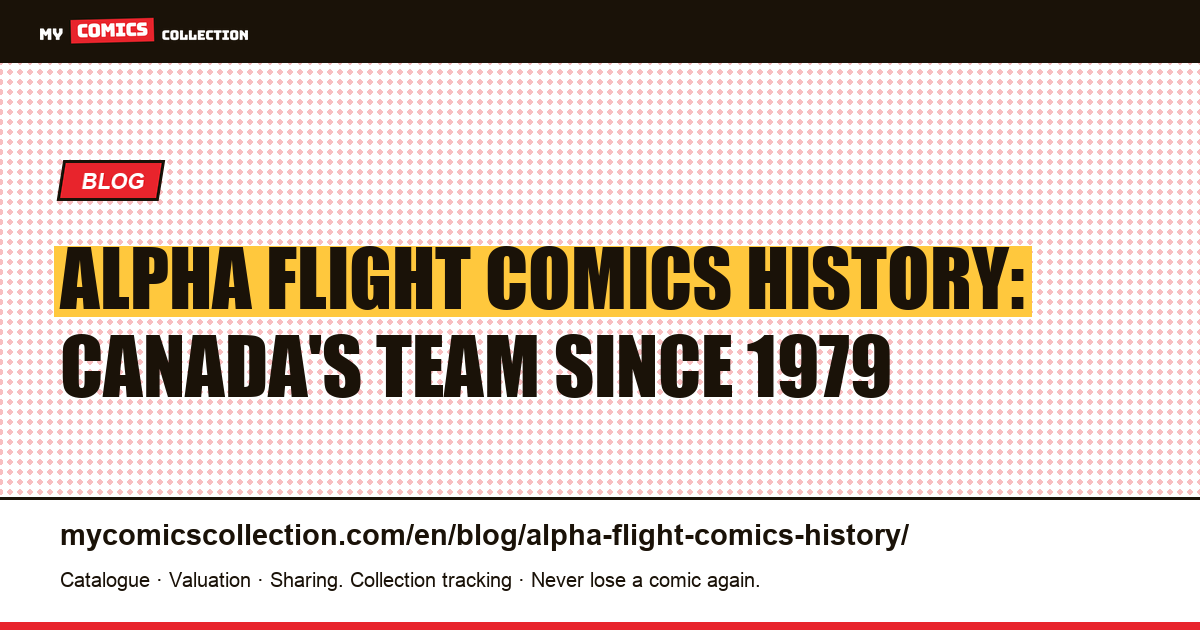
Alpha Flight, Marvel's Canadian super team, appears in The Uncanny X-Men #120 and #121 (1979) from Chris Claremont and John Byrne. Byrne then wrote and drew the first 28 issues of the 1983 series, which ran 130 issues. The turning points are the apparent death of Guardian in #12, Northstar saying "I am gay" in #106 (1992), the 2007 massacre and Omega Flight, and the revivals that followed.
Alpha Flight has one of the stranger publishing histories among Marvel's teams: a group invented as an obstacle for the X-Men, promoted to a monthly series by the same artist who drew them, and then rebooted so often that its collectors have to track five separate volumes and a handful of miniseries.
Rosters, issue numbers and years here were confirmed against published listings; what each Canadian era meant for the team is our own reading, and no page art or speech is reproduced.
Weapon Alpha and the first sighting in the X-Men
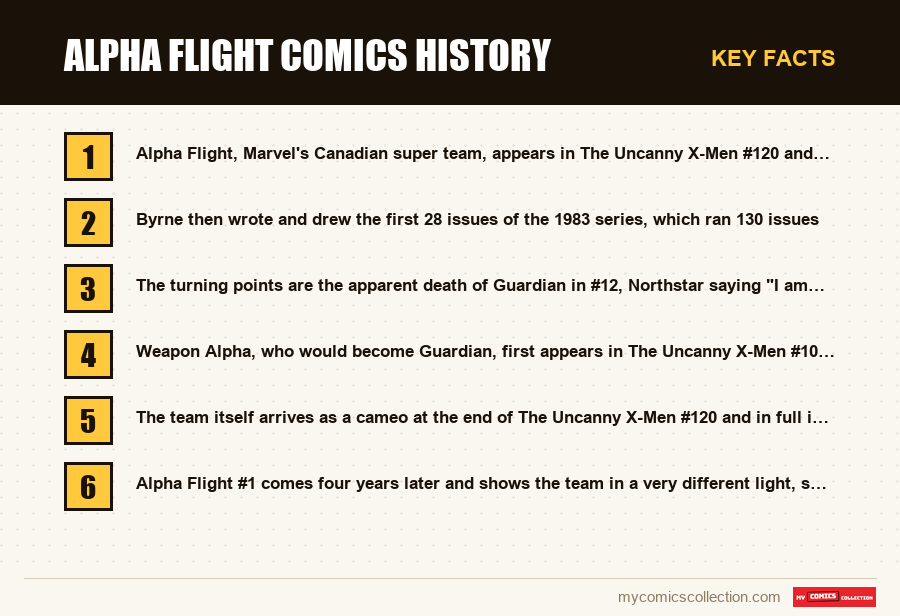
The earliest piece of the story is a character rather than a team. Weapon Alpha, who would become Guardian, first appears in The Uncanny X-Men #109, before the group around him. John Byrne is credited as the creator of Alpha Flight, and Byrne built the group merely to survive a fight with the X-Men in a single story. That purpose explains the design: a squad of government-backed professionals, organized and uniformed, set against a team of outcasts who answered to nobody.
The team itself arrives as a cameo at the end of The Uncanny X-Men #120 and in full in #121, both from 1979 and both written by Chris Claremont with Byrne on the art. The founding roster is Guardian (James Hudson), Northstar, Aurora, Sasquatch, Shaman and Snowbird. The team is sent to follow up on Vindicator's earlier mission to retrieve Wolverine from the X-Men, so the first meeting between the two teams is built around a retrieval, not around a villain of the week.
For a collector this two-issue sequence is the real first appearance of the team as a group. Alpha Flight #1 comes four years later and shows the team in a very different light, so the 1979 issues and the 1983 issue answer different questions. The distinction matters for individual members too: Northstar debuts in #120, while Puck and Marrina only reach the main roster with the series.
The 1983 series: Byrne alone for twenty-eight issues
The monthly Alpha Flight series launches in 1983 with Byrne writing and penciling. Byrne holds both jobs for the first 28 issues. Over the run, two members of the junior roster, Puck and Marrina, are promoted from Beta Flight into the main lineup, and their arrival gives the series its own cast instead of a simple continuation of the 1979 group.
The publishing logic is worth stating clearly. A group designed for one fight became a franchise when Marvel asked Byrne to give it its own series, and a monthly title built around these characters gave Byrne room that a team shared with other writers never could. The result is a book with a strongly Canadian identity, with a government agency in the background and a cast whose personal conflicts matter as much as the villains.
The cast widens quickly. Talisman, Madison Jeffries, Box, Diamond Lil, Wild Child, Persuasion and Witchfire are among the characters introduced in the series, which gives later writers plenty of material to recycle.
Issue #12 and the apparent death of Guardian
The first major structural change is in Alpha Flight #12, where Guardian apparently dies. The wording matters: the character is not gone for good, and his return becomes a recurring device across the following decades. What changes in the short term is the leadership. Heather Hudson takes over as team leader, and she later takes up the Vindicator and Guardian identities herself.
That succession is the reason the codenames are confusing for new readers. Vindicator is the name James Hudson carries in the X-Men appearances; Heather later uses it, and then Guardian too. A collector building a checklist should treat the names as roles that move between characters, not as fixed labels attached to one person.
After Byrne: a series that outlasts its creator
Byrne leaves after issue #28, and the series continues under other creators for another hundred issues, ending at #130 in 1994. This is the part of the run that rewards patient collectors rather than speculators. The book survives its founder, which is not a given for creator-driven titles of the period, and its longevity is the clearest sign that readers had attached themselves to the characters as much as to the artist.
The same period produces X-Men and Alpha Flight (1985), a limited series written by Chris Claremont. Paul Smith pencils it, because Byrne was unable to take the assignment, and Bob Wiacek inks. It is the moment where the writer who placed the team in the X-Men returns to it, and where the two franchises meet on equal terms.
1992: Northstar and the issue everyone remembers
The most discussed single issue in the team's history is Alpha Flight #106, from 1992. Writer Scott Lobdell was given permission to have Northstar say "I am gay." Northstar had been a charter member since 1983 and had debuted in the 1979 X-Men issues, so the moment recasts years of earlier appearances.
Northstar's career continues outside Canada. He joins the X-Men in The Uncanny X-Men #414 (December 2002), and in Astonishing X-Men #51 (June 2012) he marries Kyle Jinadu. Both belong in a Northstar checklist, yet neither carries the Alpha Flight title.
The Flight and the rebuilt hierarchy
In 1992 the team also gets an origin of sorts. Alpha Flight Special vol. 2 #1, written by Scott Lobdell and Simon Furman, introduces The Flight, the group that came before Alpha Flight. The story includes the sacrifice of St. Elmo and sets out the tiered structure of Alpha, Beta and Gamma Flight that explains why some characters sit on the junior roster before moving up.
The 1997 relaunch and the end of the original lineup
Marvel relaunches the series in 1997 with a new set of members, among them Flex, Manbot, Murmur and Radius, plus General Clarke, the sinister head of Department H. Puck is back on the 1997 roster, alongside a younger Guardian later exposed as a 19-year-old clone of James Hudson. The central plot involves the hidden agenda of Department H, including the brainwashing of Madison Jeffries as Gemini and the kidnapping of Diamond Lil.
The series ends with issue #20, and its main plotlines resolve in Wolverine vol. 2 #142 and #143. The ending sits in a Wolverine book, so a checklist of the 1997 volume is incomplete without those two issues.
Do you collect this series?
Track what you own, what you are missing and what your collection is worth. 7-day trial.
Start my trial →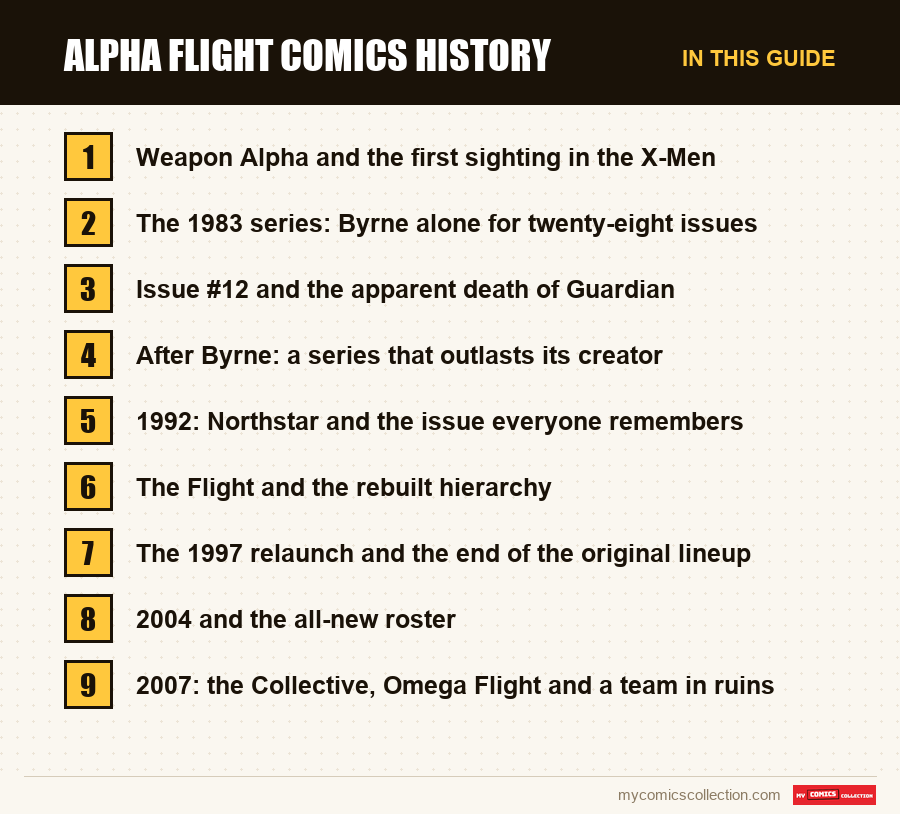
2004 and the all-new roster
The third volume, from 2004, is marketed as "All-New, All-Different." Sasquatch recruits a roster that includes Centennial, Major Mapleleaf, Nemesis, Puck (now Zuzha Yu) and Yukon Jack. The second six-issue arc, "Waxing Poetic," brings back original members Guardian, Vindicator, Puck and Shaman, so the series mixes new characters with veterans in a single run.
2007: the Collective, Omega Flight and a team in ruins
In New Avengers #16, the Collective, inhabiting Michael Pointer, kills Sasquatch, Guardian, Vindicator, Shaman, Major Mapleleaf and Puck. The event happens outside the team's own title. The limited series Omega Flight, five issues from Michael Avon Oeming and Scott Kolins in 2007, follows with a roster that includes Beta Ray Bill, U.S. Agent, Arachne, Talisman and Pointer himself. The team then disbands.
A team defined by its own series is removed in someone else's book, and the successor miniseries is a pickup squad of other Marvel characters. The 2004 volume, the New Avengers issue and Omega Flight read as one closed arc.
Chaos War, the 2011 series and a Canadian reboot
Chaos War (2010) returns Guardian, Vindicator, Shaman and Marrina from the dead, and Puck joins in a Fear Itself tie-in. An eight-issue limited series follows in 2011 and 2012, with Fred Van Lente and Greg Pak named as its writers. The team handles rescue efforts after a tsunami unleashed by Nerkodd, is betrayed by Gary Cody and his newly elected Unity Party, and the story also involves Master of the World. The story was collected in 2012.
Marvel's All-New, All-Different era then offers a version of the team operating from a low-orbit space station, with Captain Marvel, Abigail Brand, Aurora, Puck and Sasquatch. Alpha Flight: True North returns the original lineup (Guardian, Aurora, Northstar, Snowbird, Sasquatch, Puck and Marrina) as the country's top team.
The Fall of X era and the current volume
The fifth volume belongs to the Fall of X period. Department H orders Guardian, Snowbird, Shaman and Puck to hunt mutants after Orchis manipulates the Canadian government. Northstar, Aurora, Fang and the new Nemesis, revealed as Heather Hudson, quietly smuggle mutants to Shi'ar space. Department H deploys Box Sentinels, and the remaining members are arrested for treason across issues #1, #2 and #5.
The premise returns to the irony of 1979, when a government team is sent to bring back a mutant of its own.
The key issues across the team's history
- The Uncanny X-Men #120 and #121 (1979): the cameo and the full first appearance, Claremont and Byrne, with Guardian, Northstar, Aurora, Sasquatch, Shaman and Snowbird.
- Alpha Flight #1 (1983): the launch of the series, with Byrne writing and drawing.
- Alpha Flight #12: Guardian apparently dies and Heather Hudson takes over as leader.
- Alpha Flight #28: the last issue of Byrne's run as writer and penciler.
- X-Men and Alpha Flight (1985): the limited series written by Claremont, penciled by Paul Smith and inked by Bob Wiacek.
- Alpha Flight #106 (1992): Northstar says "I am gay," from Scott Lobdell.
- Alpha Flight Special vol. 2 #1 (1992): The Flight, from Lobdell and Simon Furman.
- New Avengers #16 and Omega Flight (2007): the Collective's massacre and its miniseries aftermath.
How to follow Alpha Flight in a collection
Start with the cast, not the series. The two 1979 X-Men issues give the original lineup, and the 1983 launch gives the version that most readers mean when they say Alpha Flight. Treat these three issues as a set and decide from there whether the goal is the complete first volume or a handful of landmarks.
The numbering is straightforward within each volume, but the five volumes overlap in character names, so a checklist needs the volume number and the year, not just the issue. The 1997 volume ends at #20 and resolves in a Wolverine crossover, which means the story is incomplete without those two issues. The 2007 event does the opposite: the death sits in New Avengers, not in an Alpha Flight title.
Reprints can fill gaps. The Alpha Flight Classic collections cover the early years in three volumes, a John Byrne Omnibus followed in 2017, and the 2011 limited series was collected in 2012 under the names of Greg Pak and Fred Van Lente. For a deeper look at the launch issue, the dedicated guide to Alpha Flight #1 covers the single-issue questions, and the Giant-Size X-Men #1 guide shows how the X-Men side of the story began.
Anyone collecting through the Wolverine connection should also read the Weapon X key numbers guide, which covers the other thread that ties Canada to Marvel's mutant books.
Frequently asked questions
The team appears in The Uncanny X-Men #120 (1979) as a cameo and in full in #121, both by Chris Claremont and John Byrne. The character who would become Guardian had already shown up as Weapon Alpha in The Uncanny X-Men #109. The team's own series starts in 1983.
John Byrne is credited as the creator, and Chris Claremont wrote the 1979 X-Men issues where the team debuts. Byrne first designed the team merely to survive a fight with the X-Men, before Marvel asked for a series. Byrne then wrote and penciled the first 28 issues of the 1983 Alpha Flight series.
It is Alpha Flight #106, from 1992. Writer Scott Lobdell was given permission to have Northstar say "I am gay." Northstar later marries Kyle Jinadu in Astonishing X-Men #51 (2012).
The first volume ran 130 issues, from 1983 to 1994, plus annuals and miniseries. Byrne wrote and penciled the first 28 issues, and other creators carried the remaining run. Later volumes started in 1997, 2004, 2011 and again during the Fall of X period.
In New Avengers #16, the Collective, inhabiting Michael Pointer, kills Sasquatch, Guardian, Vindicator, Shaman, Major Mapleleaf and Puck. The five-issue miniseries Omega Flight, by Michael Avon Oeming and Scott Kolins, follows with a roster of other Marvel characters. The team then disbands.
Found an old Alpha Flight issue in a longbox, from the 1983 launch to the 1992 Northstar issue? Get an estimate before you decide how to store or sell it.
Estimate my comic