Jeff Lemire's work is published in French by several different publishers, with divisions that never correspond to those of the American collections. This is the main source of error for a French-speaking collector: a French volume can cover five issues where the equivalent American collection covers seven. The only reliable reference is the range of numbers indicated on the cover pages, never the volume number on the edge.
Several publishers, divisions that do not coincide, and no official correspondence between the two markets. This is the concrete problem posed by Lemire's collection in French.
This is not a publishing fault but a normal consequence of the market: French-speaking publishers adapt the pagination to their formats and their selling prices. This article explains where the pitfalls lie, how to avoid them, and how to maintain a coherent collection when mixing the two languages.
Why do the cuts differ?
An American collection generally brings together the narrative arc as the screenwriter constructed it: five, six or seven issues depending on the case. The selling price is based on a standard format for the North American market.
A French publisher works under other constraints: a different book format, a higher public price, a readership accustomed to thicker volumes. It therefore groups differently, sometimes by merging two American collections, sometimes by cutting differently to balance the pagination.
Neither approach is wrong. The problem only arises when a reader switches from one to the other believing that “volume 2” means the same thing on both sides.
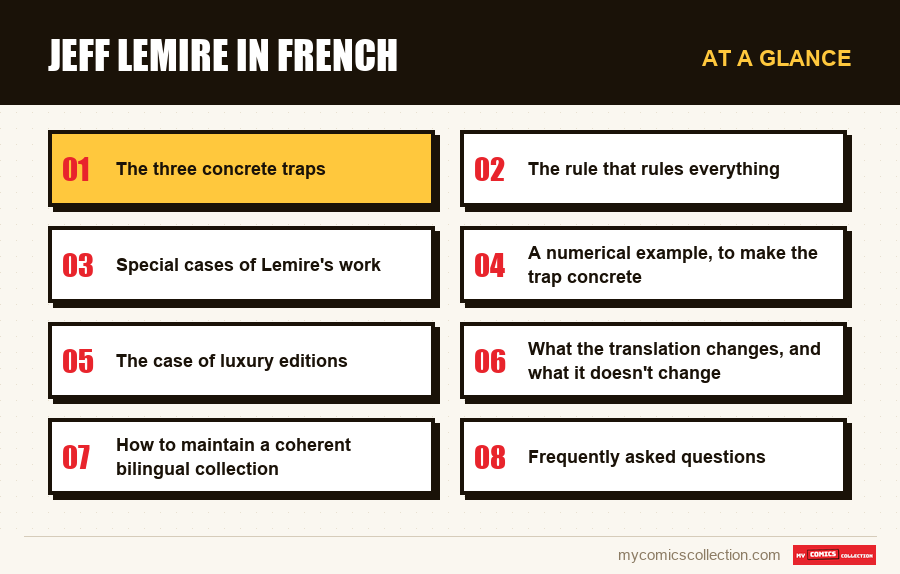
The three concrete traps
1. Le recouvrement partiel
You own American collections 1 and 2, i.e. numbers 1 to 12. You purchase French volume 2, which covers numbers 8 to 16. You have just purchased five issues.
This is the most common case, and the most expensive, because nothing on the cover indicates this.
2. Le trou invisible
The opposite case. Your French volumes stop at number 14, the following American collection starts at 18. Four numbers are missing, and nothing indicates it: the numbering of the volumes follows without any apparent break.
3. The incomplete series in French
Some series have only been partially translated, or their publication has been interrupted. A reader who only follows the French edition can wait indefinitely for a sequel that will not come in that language.
The rule that rules everything
It can be summed up in one sentence: save the original issues, never the volumes.
A catalog which contains “Descender, volume 3” does not allow any verification. The same catalog containing “Descender #13 to #18” immediately answers, in any language and for any edition, the only question that matters in stores: does this volume bring me anything?
This information systematically appears on the cover pages, generally at the back of the title page, under a notice such as “contains numbers X to Y”. This is an obligation of use among all serious publishers, and it is the only data that never lies.
The reflex to take in store: open the volume to the endpapers before purchasing, and compare the number range to what you already have. Thirty seconds which avoid a duplicate for twenty euros.
On used editions sold online, ask for a photo of this page if the ad does not provide it. A serious seller will provide it; a salesman who refuses teaches you something.
Special cases of Lemire's work
Series that change names
Descender becomes Ascend, Royal City becomes Sonic Youth. In French, these changes have sometimes been treated differently: merged under a single title, or published at distinct paces.
Les univers étendus
Black Hammer has around ten derivative series. Not all of them have been translated, and those that have been have not followed the American order of publication.
Several French publishers
His work is distributed between different houses according to series and periods. None has the complete catalog, and none references the titles published by others.
Calendar shifts
A series can be published in French several years after its American publication, or in parallel. The offset varies depending on the title and does not obey any predictable rule.
A numerical example, to make the trap concrete
Consider a series of 32 numbers: the order of magnitude of Descender. On the American side, it appears in six collections of five to six issues. On the French side, the publisher chose thicker volumes and published it in four volumes of eight issues.
A reader starts in French and buys volumes 1 and 2: he owns numbers 1 to 16. Two years later, he finds second-hand the American collection 4, which covers numbers 16 to 21. He believes he will extend his collection. In reality, he repurchased issue #16 and left a hole nowhere, but if he had purchased collection 3, covering issues 11 through 15, he would have repurchased five out of eight issues.
The calculation is simple to do when you have it in front of you. It is impossible to make up your mind in a store, two years later, in front of a volume whose cover only displays a Roman numeral.
It is exactly for this type of situation that the number range is the only valid data. “Volume 2” means nothing outside of its edition; “Numbers 9 to 16” means the same thing everywhere, in all languages and in all markets.
Should we mix languages?
The honest answer depends on your goal.
If you read to read, mix and match without qualms. Take what's available, in the language you prefer, just checking the continuity of the numbers. Reading loses nothing.
Si vous collectionnez, decide at the start of a series and stick to it. A mixed collection is difficult to resell, visually inconsistent on the shelf, and above all much more exposed to holes and duplicates.
If you are looking for availability, the original version almost always wins in the long run. American print runs are larger, the second-hand market deeper, and the series are fully available there where translations sometimes stop en route.
Collecting this series?
Track what you own, what you are missing and what your collection is worth. 7 day trial.
Start my trial →The case of luxury editions
One point deserves attention because it concerns Lemire specifically: several of his series are based on graphic work that the format actually serves or undermines.
Descender is entirely painted in watercolor: the reproduction size and quality of the paper change what the eye perceives. Gideon Falls relies on page layouts that lose their effect in small format. Trillium includes plates designed to be read by turning the booklet over, which certain bound editions had to linearize.
On these three titles, the choice of edition is not cosmetic. Check the format and pagination before purchasing, and note them in your catalog-this is one of the rare cases where two editions of the same story do not provide the same reading.
What the translation changes, and what it doesn't change
A word about the text itself, since the question often comes up among hesitant readers.
Lemire's writing poses few translation problems, for a simple reason: it relies massively on silence. Its strongest pages: the ice rink Essex County, the dives of The Underwater Welder, the farm scenes of Black Hammer: feature little or no dialogue. What is lost from one language to another in a talkative author is very little lost in him.
Two reservations however. The first concerns games on language registers: in Royal City, the characters from 1993 speak like teenagers from 1993, and this dated anchoring resists the transition into French. The second concerns Trillium, part of which is based on the fact that the two protagonists do not understand each other: the graphic treatment of this incomprehension varies depending on the edition.
For the rest, reading Lemire in French does not cause you to lose anything essential. The choice of language can therefore be made on practical criteria (availability, price, coherence of the collection) without ulterior motives regarding the quality of the text.
How to maintain a coherent bilingual collection
Three pieces of information are enough, and they must be noted at the time of purchase because they cannot be reconstituted after the fact.
The original number range. This is the base. It makes all editions comparable to each other, regardless of language or format.
The language and the publisher. Useful for resale, and essential for spotting series that you follow in two languages without realizing it.
The format. Soft issues, collection, library edition. On titles where layout matters:Trillium, Gideon Falls, Descender: this information does not relate to bibliographic detail: it changes the nature of the object and what you see when opening it.
With these three pieces of data, the question “do I already have it?” » can be adjusted in one second in front of a beam. Without them, she means going home and clearing out a shelf: which no one does, hence the duplicates.
Frequently asked questions
Almost never, and this should not be seen as an editing fault. French-speaking publishers adapt the pagination to their book formats and their public prices, which mechanically produces different divisions. A French volume may merge two American collections, or cut in the middle of an arc to balance the thickness of the volume. Only the range of numbers indicated on the cover pages allows the two markets to be compared. to their formats and their prices, which produces different cuts. A French volume can merge two American collections, or cut in the middle of an arc. Only the range of numbers indicated on the cover pages allows comparison.
By comparing the last issue covered by the French edition to the total number of issues published in the original version. Some translations are interrupted without announcement, and the continuous numbering of the volumes does not indicate this. This is the most frustrating trap in long series.
For a collection intended to be complete, yes: the print runs are larger, the second-hand market deeper, and no series stops partway through lack of translation. To read, the question does not arise: take the language that suits you.
On the cover pages, generally on the back of the title page, under a notice such as “contains numbers X to Y”. All serious publishers include it. If a volume does not indicate this anywhere, this is in itself a signal of the care taken in the edition.
To read, yes, provided you check the continuity of the numbers. For collecting, it is not recommended: a variegated series is more difficult to resell, visually inconsistent, and above all much more exposed to holes and overlaps that no one notices for months.
Save issues, not volumes
It is the only data comparable between editions, between languages and between formats, and the one which responds in one second in front of a shelf.